System planners and grid operators are treating extreme heat as an assumed operating condition given new pressures, including drought, demand growth, and fuel concerns. Will it be enough?
For decades, the U.S. power system treated extreme heat as a tail risk, managed through seasonal readiness—something for which to prepare. But hotter conditions are now arriving earlier and lasting longer, prompting system planners and grid operators to treat extreme heat as a design baseline—an assumed operating condition.
The U.S. Energy Information Administration’s (EIA’s) May 2026 Short-Term Energy Outlook, for example, projects roughly 1,610 cooling degree days (CDDs) nationwide this year—the standard industry measure of air-conditioning demand—4% above 2025, with the third quarter alone running 8% above the same period last year and 5% above the ten-year average. The North American Electric Reliability Corporation (NERC), the bulk power system’s designated reliability entity, has begun flagging the overlap of early-summer heat with spring maintenance outages as a recurring concern, alongside wide-area heat events that NERC names as a primary reliability risk for summer 2026, on par with generator outages and fuel supply.
Yet every concern about extreme weather appears rooted in the grid’s overall health—particularly its physical fabric: whether existing wires, transformers, and substations can withstand hotter conditions on top of the soaring load growth and aging infrastructure already straining the system.
Among several adaptive measures of note, utilities are now rating their transmission lines hour by hour against ambient temperature rather than against the once-a-season nameplate values they used for decades. High temperatures, meanwhile, threaten to accelerate wear on distribution and substation transformers, aging assets already in short supply and difficult to replace. On a larger systems level, operators are bracing for peaks that now arrive later in the evening, after solar output diminishes. Utilities are also tracking insulator faults hundreds of miles downwind of any fire line, where wildfire smoke deposits conductive particulates on high-voltage equipment, which raises fault risk on otherwise clear days.
Summer 2026: A Better Position, but Not a Solved Problem
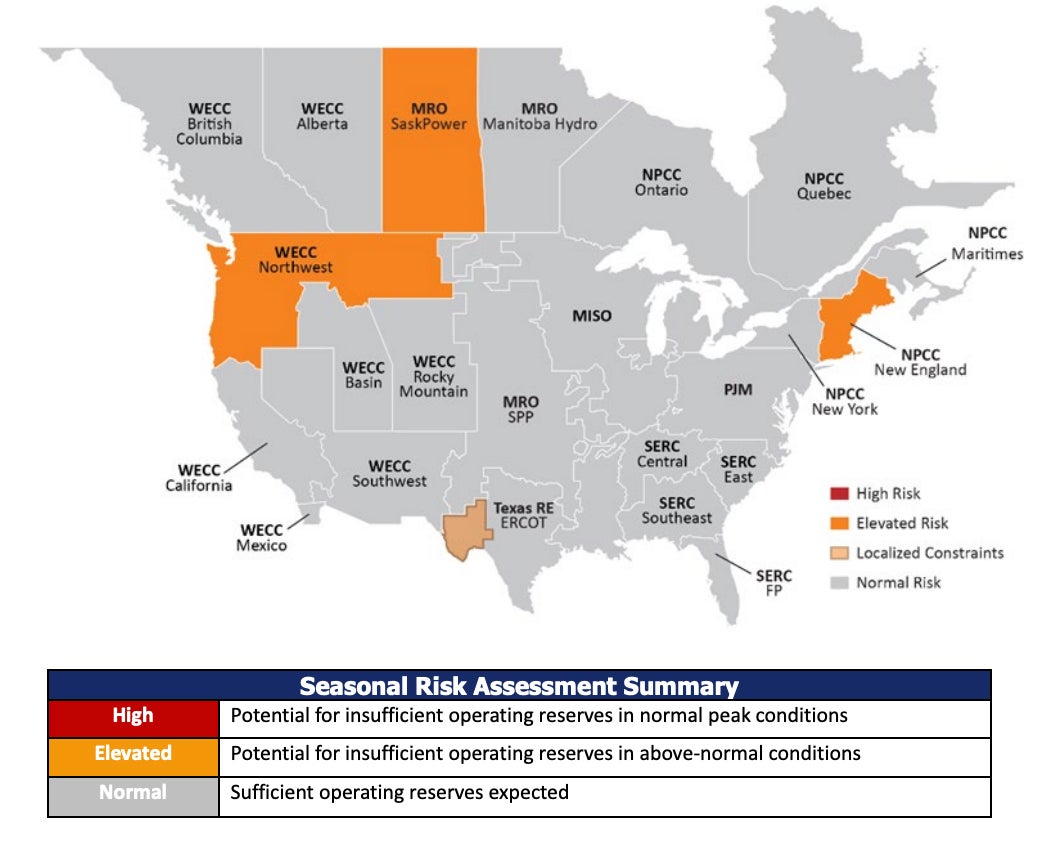
The 2026 season, at least, will begin in a somewhat stronger position than last summer. According to NERC’s 2026 Summer Reliability Assessment, released on May 19, net internal demand—total demand minus controllable demand response available at the peak hour—is expected to rise 1.3%, or 10 GW, from 780 GW in summer 2025 to 790 GW in summer 2026, with peak demand growing in 19 of 23 assessment areas. The bulk power system will enter summer with more than 58 GW of new on-peak capacity, including 16.4 GW of solar, 14.7 GW of batteries, 6.7 GW of natural gas, and 1.6 GW of wind, alongside 19 GW from other resource additions and accounting changes. NERC, however, flags three subregions for elevated risk under above-normal or extreme conditions—Northeast Power Coordinating Council (NPCC)–New England, Midwest Reliability Organization (MRO)–SaskPower, and Western Electricity Coordinating Council (WECC)–Northwest—and identifies western ERCOT (Electric Reliability Council of Texas) as a localized constraint where transmission limits in the Permian Basin could bind under high demand, even though the broader ERCOT system has the largest reserve margin in North America (Figure 1).
Meanwhile, the Federal Energy Regulatory Commission’s (FERC’s) 2026 Summer Energy Market and Electric Reliability Assessment, released on May 21, projects national wholesale electricity prices to average $46.81/MWh this summer, down 5% from 2025, though ERCOT, PJM Interconnection, and SERC Reliability Corporation will see increases of 11%, 5%, and 5%.
Still, both reports identify above-normal summer temperatures as the dominant operational concern, citing a National Oceanic and Atmospheric Administration (NOAA) forecast with a 61% chance of El Niño conditions and a one-in-four chance of a strong El Niño later this year. “Geographically widespread, high temperatures can intensify stress on the electric grid by reducing the ability of neighboring systems to exchange supply while they are simultaneously facing high demand,” the FERC report says, adding that high temperatures also “increase transmission line losses and cause conductors to reach operating limits sooner under the combination of high load and high heat conditions, all of which increase the risk of outages.”
Drought, Demand, and Federal Intervention
The other dominant variable is drought. “Drought conditions impact 62% of the continental U.S. and are expected to expand this summer,” FERC said, noting that Lake Powell is forecast to receive only 13% of average inflow—the lowest since Glen Canyon Dam began operating in 1964 (Figure 2). If conditions persist, FERC said, up to 4,500 MW of Colorado River hydropower could be affected as soon as August 2026, including the 2,000-MW Hoover Dam. NERC added that snowpack in the Pacific Northwest peaked at low elevations and melted early this year, which poses a problem for the region, whose generation mix is 55% hydropower. Canadian hydropower exports to the U.S. fell 28% in 2025 to 35.64 TWh, the lowest annual total since 2004, which threatens to reduce the flexibility available to the New York Independent System Operator (NYISO), ISO New England (ISO-NE), and the Midcontinent Independent System Operator (MISO).
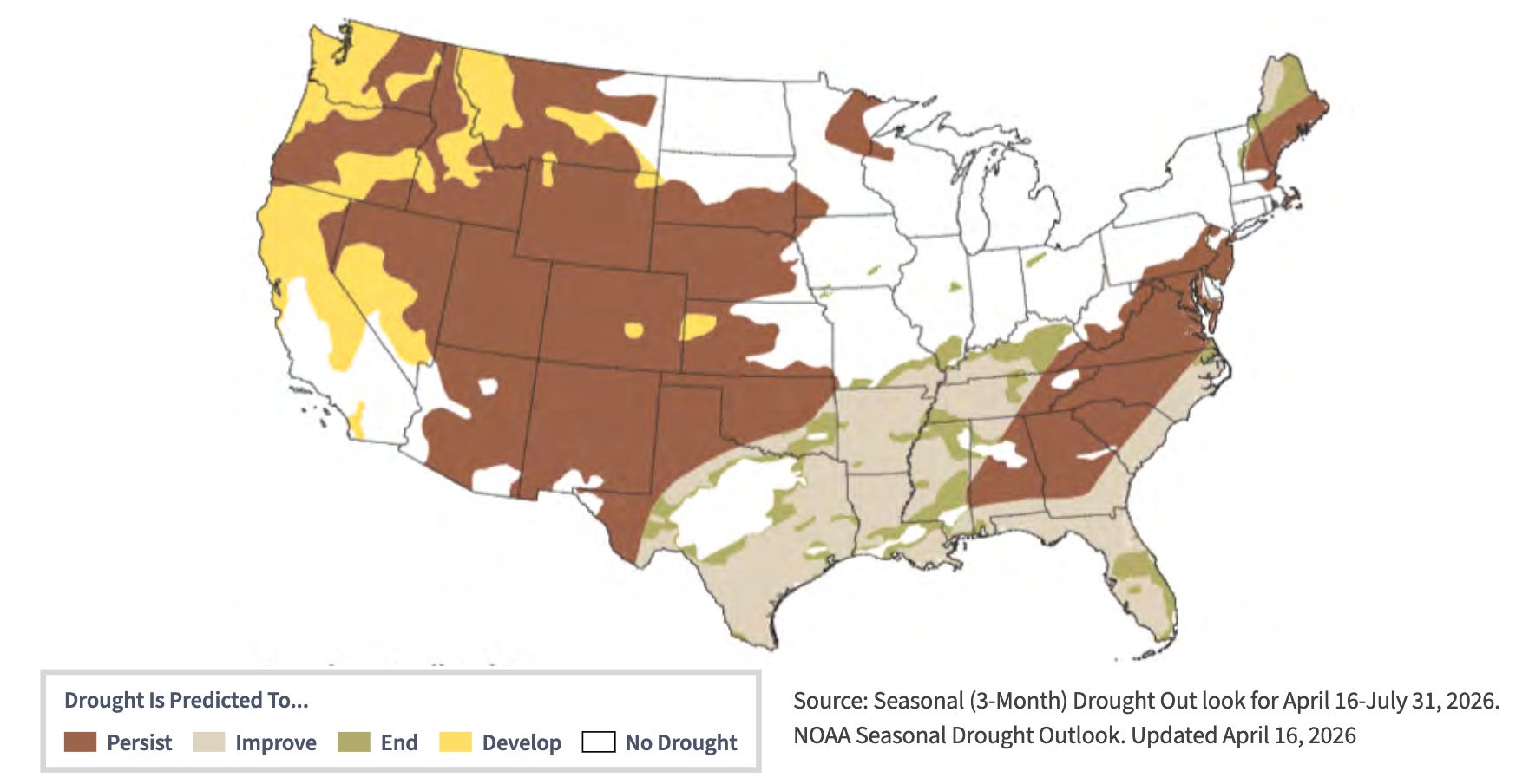
And beyond hydropower generation, “low water volumes in summer 2026 in the greater Missouri and Mississippi River basins, following multiple consecutive years of low water flows, increase the risk of disrupted navigation, including for barges carrying coal to power plants,” FERC noted. “Low water levels, the risk of saltwater intrusion, and increased water temperatures could prompt derating or forced outages of generators with once-through-cooling equipment on the affected rivers.”
Finally, as both NERC and FERC flag, this summer’s challenges may be compounded by a rapidly morphing demand curve—of load as well as fuel. NERC reported that aggregated peak demand across all assessment areas has increased by more than 11 GW since its 2025 summer assessment, exceeding the 10-GW year-on-year increase that preceded summer 2025. FERC, citing EIA data, projects total summer 2026 electricity consumption will reach 1,587 TWh, up 3% from summer 2025—the strongest year-over-year summer growth since 2022.
On the fuel side, FERC expects total U.S. natural gas demand to average 101.3 billion cubic feet per day (Bcf/d) this summer, with power burn remaining the largest demand sector. Power burn is forecast to average 44 Bcf/d for the full summer and 47.9 Bcf/d across July and August, while gross liquefied natural gas exports rise 10% to 15.8 Bcf/d. As POWER has reported, the Natural Gas Supply Association forecasts gas-fired power burn reaching 11 Bcf/d above the 2015 baseline this summer, driven by 7.9 Bcf/d of structural growth—much of it attributable to data center load, projected to grow 25% from 44 GW in 2025 to 55 GW in 2026—and 3.1 Bcf/d of economic dispatch.
But for hot-weather operations, the timing—not just size—of the peak also substantially matters. In Texas, the greatest-risk hour has been creeping closer to 9 p.m.—the late-evening ramp after solar output drops off, even as cooling and data center load remain. Compounding that stress, NERC said, large data centers and industrial facilities “pose risks of sudden load loss, which can trigger frequency disturbances, voltage instability, and cascading outages.” While ERCOT has proposed ride-through requirements for large electronic loads (Nodal Operating Guide Revision Request [NOGRR] 282), those rules will not be in place for this summer, NERC said.
Weather-related reliability concerns, notably, have been the basis for a flurry of Department of Energy (DOE) Section 202(c) emergency orders, which use emergency authority under the Federal Power Act to keep an estimated 4,400 MW of coal and gas capacity online past planned retirement dates. As POWER has tracked, the affected capacity is concentrated in regions with the heaviest summer cooling loads and the largest hydropower flexibility losses.
As of May, the DOE, for example, has extended its orders for the 1,560-MW J.H. Campbell coal plant in Michigan through Aug. 16 and the 760-MW Eddystone Units 3 and 4 in Pennsylvania through Aug. 22 to cover peak demand in MISO and PJM. It also added a new order for Wagner Unit 4 in Maryland through Aug. 19, and left earlier orders covering the Centralia plant in Washington—in NERC’s elevated-risk WECC–Northwest subregion. The current emergency orders suite also covers Schahfer and F.B. Culley, both in Indiana, and Craig Station Unit 1 in Craig, Colorado, in place through staggered dates in June.
Rating Transmission for Heat
Physical stress to the grid is perhaps most worrisome during extreme heat to the transmission system. High-voltage lines tolerate the heat generated by their current by dissipating it to the surrounding air, but when ambient temperatures rise and the wind drops, lines have less capacity to dissipate that heat. Overheated conductors can sag toward objects on the ground and short out, or “anneal”—meaning they permanently lose the tensile strength needed to stay taut between towers. For decades, operators have managed that risk by setting conservative once-a-season nameplate ratings and redispatching generation when lines approached those ratings, but it has resulted in chronic underutilization of the existing transmission fleet on most days of the year.
FERC’s Order 881, a 2021-finalized rule that took effect in July 2025, requires transmission providers to use ambient-adjusted ratings (AARs)—line ratings that update hourly based on actual and forecast temperatures, with hourly forecasts required out to ten days, separate ratings for day and night, and updates triggered by every five-degree-Fahrenheit change in temperature. In March, PJM became the first regional transmission organization (RTO) to implement AAR after a multi-year effort. Its ratings now adjust hourly across 47 regional weather-forecast zones inside the RTO’s footprint.
“This was an enterprise-wide effort, involving a comprehensive stakeholder process, and Operations, Markets, and IT [Information Technology] working with three vendors on the design, deployment, and go-live event on March 4,” noted Darlene Phillips, executive director of Operations Engineering Support. “PJM pushed the boundaries of technology and support that other RTOs will be able to follow, and our real-time monitoring and studies of the grid are now enhanced by ratings adjusted for ambient temperatures and the best available forecasts.”
For now, the Southwest Power Pool also expects to implement AAR on Sept. 1, while MISO expects full compliance by the second quarter of 2028. Several utilities are also looking to run AAR this summer, including Tampa Electric, Duke Energy Florida, Southern Company, Dominion Energy South Carolina, Louisville Gas and Electric, Kentucky Utilities, Avista, Idaho Power, Public Service Company of New Mexico, and Portland General Electric.
Dynamic line ratings (DLR), which use sensors to measure line temperature and ampacity in real time rather than relying on ambient forecasts, are moving from pilot projects toward corridor-scale deployment. Advanced composite-core conductor reconductoring offers another route, replacing existing conductors rather than building new lines. CTC Global told POWER the key appeal of advanced reconductoring lies in its ability to use existing rights-of-way and, in many cases, existing structures to increase transfer capacity faster than a rebuild.
Interregional transfer capability (ITC), which has been much called for, given the system’s ability to move power reliably from one planning region to another, remains another potential solution. FERC’s February 2026 report to Congress on NERC’s Interregional Transfer Capability Study transmitted NERC’s recommendation for 35,000 MW of technically prudent additions across 10 regions projected to have resource deficiencies in 2033. Several of the modeled deficiencies were tied to heat-wave weather years, including MISO-East, New York, California North, and New England. However, the report cautiously refrained from recommending specific projects and notes that it does not include an economic or cost-benefit analysis.
Order 1920’s long-term regional planning framework provides a procedural vehicle for evaluating some of those needs. Whether cost allocation moves fast enough to turn reliability findings into funded projects remains unresolved. Capacity accreditation rules are also still being worked out. PJM’s proposed Effective Load Carrying Capability (ELCC) accreditation reform at FERC Docket ER24-99, currently pending, will determine how solar, storage, and demand response receive capacity credit through the 2030s. The House High-Capacity Grid Act (H.R. 6633), introduced Dec. 11, 2025, notably, would direct FERC to establish a best-available-conductor standard for FERC-jurisdictional projects, but the bill remains in the House Energy and Commerce Committee.
Local Thermal Stress and Flexible Load
On distributed grids, meanwhile, heat exacts a slow toll on substation and distribution equipment that ultimately delivers power to the load. Insulation life in oil-filled transformers roughly halves for every 10C above rated winding temperature, and the IEEE C57.12.96 standard derates self-cooled distribution transformers 0.4% per degree when the 24-hour average ambient exceeds 30C. The DOE Large Power Transformer Resilience Report from July 2024 notes that large power transformers can be overloaded 10% to 20% above rated power, but that doing so accelerates insulation aging. The same report notes that transformer cooling capacity depends on both the operating load and ambient temperature, and that additional cooling—from larger tanks, radiators, fans, or alternating fans—can be designed into units for long-duration, high-temperature events.
Meanwhile, replacement timelines remain stretched. Wood Mackenzie’s 2025 modeling concluded that announced North American manufacturing expansions—roughly $1.8 billion as of late 2025—should ease the large-power-transformer shortage by 2028, but distribution-transformer broker lead times remained 80–120 weeks through early 2026, with prices well above pre-2022 levels.
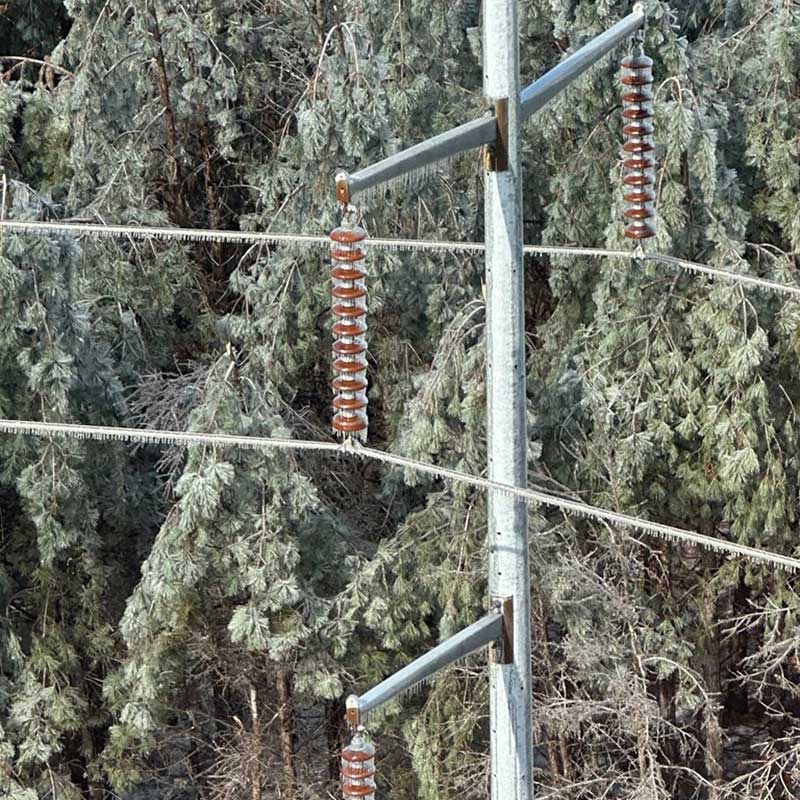
Wildfire smoke introduces another distinct distribution-system hazard that became more prominent during the 2024 and 2025 western fire seasons. Conductive particulates deposit on insulators along transmission corridors hundreds of miles downwind of any fire line, lowering flashover voltage and producing faults on otherwise clear days. A March 2026 review in Frontiers in Energy Research documented insulator flashover events linked to smoke deposition at distances well beyond traditional fire-impact zones.
On the ignition side, Pacific Gas and Electric’s (PG&E’s) 2026–2028 Wildfire Mitigation Plan, filed with California’s Office of Energy Infrastructure Safety in April 2025, reported that its Enhanced Powerline Safety Settings (EPSS) program—which trips circuits at lower fault thresholds during high-risk conditions—contributed to a more than 72% reduction in California Public Utilities Commission (CPUC)–reportable ignitions on EPSS-enabled primary distribution lines in 2024, compared to the 2018–2020 average. EPSS now protects 1.8 million PG&E customers, and more than half of those customers experienced no outage while EPSS was enabled in 2024.
Generator-Side Preparedness
While generators don’t have a hot-weather equivalent to NERC’s cold-weather EOP-012-3 reliability standard, effective Oct. 1, 2025, the entity cautions in its latest summer reliability outlook that forced outage risk can rise during hot-weather operations because of plant age, operating patterns, and limited pre-seasonal maintenance availability. Its 2026 summer assessment further warns that early heat overlapping with spring maintenance can lower operating reserves, especially when hydro overhauls, contractor constraints, or major work at older generating sites delay return-to-service.
For now, state and market-level rules are filling some of the gap. ERCOT’s weatherization inspection program is now a quantified enforcement record. As of October 2025, ERCOT had completed 4,079 cumulative inspections across four winter and three summer seasons, comprising 1,433 Resource Entity inspections and 2,646 Transmission Service Provider inspections. Summer-only cumulative totals climbed from 1,660 after summer 2023 to 2,902 after summer 2024 to 4,079 after summer 2025. ERCOT evaluates individual facility outages during peak demand periods and opens follow-up investigations to confirm preparation measures are in place. The agency assessed that the program has had “a significant positive impact on the reliability of the bulk electric system during winter and summer.”
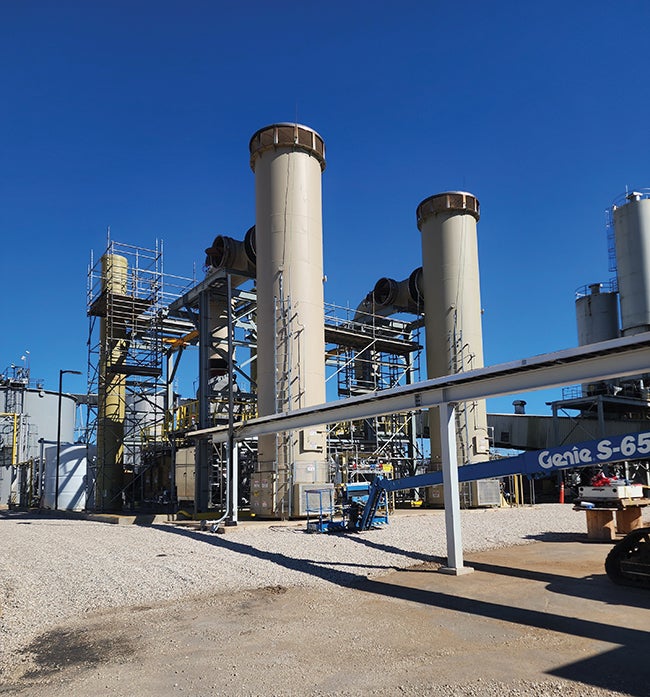
Efficiency measures are also continuing, including, for example, inlet air cooling (IAC) retrofits. For every 4-degree-F drop in inlet temperature, gas turbine output rises by about 1%, and above 90F ambient, utilities can see roughly 10% performance loss without mitigation, according to a July 2025 Burns & McDonnell engineering analysis. IAC retrofits can recover roughly 10% of the capacity loss imposed by high ambient temperatures on unmitigated combustion turbines, it suggests. Long interconnection queues, multi-year turbine lead times, and import tariffs on heavy equipment are pushing utilities to treat IAC as a near-term capacity play rather than an optional efficiency upgrade, it notes.
And as significantly, generator capability rules are also becoming more seasonal. PJM revised its Capacity Verification Testing rules effective June 1, 2025, requiring separate summer and winter tests, and ending the practice of correcting a summer verification test to winter conditions. Summer capability is now tied to generator-site ambient conditions coincident with the last 15 years of PJM summer peaks, while winter capability is tied to the corresponding winter peaks. ERCOT’s summer weatherization rule is more prescriptive: under 16 TAC §25.55, generation entities must prepare for sustained operation up to the greater of the facility’s prior maximum operating temperature or the 95th-percentile 72-hour temperature for its weather zone, document hot-weather critical components, and complete summer inspections by June 1 each year.
Still, plant-level capability filings suggest that, in some cases, extreme heat remains subject to licensing margins and operational constraints. Constellation in March 2025 sought a temporary Nuclear Regulatory Commission (NRC) license amendment for its Braidwood Station in Illinois to raise the nuclear plant’s Ultimate Heat Sink (UHS) Technical Specification limit from 102F to 102.8F through Sept. 30, 2025. The filing cited historical summer conditions—including elevated air temperatures, high humidity, low wind speed, and the July 4–9, 2020, hot-weather and drought period—that had repeatedly challenged the existing limit. It also pointed to a Dec. 20, 2024, request for a permanent amendment to adopt a diurnal UHS temperature curve, reflecting that the cooling pond’s thermal margin depends on peak water temperature, time of day, and recovery profile. Constellation said its analyses showed safety-related equipment would maintain its design function at the higher UHS temperature.
Digital Operations and Flexible Load
Solutions also extend into distribution-system operations and customer-side resources. Advanced Distribution Management Systems (ADMS) and Distributed Energy Resource Management Systems (DERMS) are the operational platforms connecting bulk-system conditions to local grid response, and utilities are deploying integrated versions of both at scale, including Southern California Edison’s (SCE’s) integrated Grid Management System and PG&E’s ongoing three-release ADMS rollout through 2026. Those platforms increasingly anchor utility-managed electric vehicle (EV) charging programs like PG&E’s WeaveGrid-operated EV Charge Manager, SCE’s CPUC-approved ORCHARD program, and Con Edison’s SmartCharge New York.
Finally, virtual power plants (VPPs) are the best-documented new category of demand-side flexibility heading into summer. The DOE’s Pathways to Commercial Liftoff: Virtual Power Plants report estimates the U.S. installed base at 30 GW to 60 GW, with a 2030 target of 80 GW to 160 GW. A Rocky Mountain Institute analysis published May 14, 2026, described several program dispatches during summer 2025, including Sunrun’s more than 340-MW residential battery dispatch on June 24, EnergyHub’s 900 MW of peak load shed and 3.5 GWh shifted to off-peak hours, Uplight’s 350 MW of flexible load managed, and a July 29 California Independent System Operator (CAISO) Demand Side Grid Support test that delivered more than 500 MW of demand relief during the late-afternoon net-load peak.
Demand response (DR) remains a crucial tool for extreme heat operations. PJM, for example, cleared its June 2025 heat wave—which drove a peak of 162,401 MW on June 24, the third-highest in PJM history—by deploying DR that reduced load by more than 4,000 MW at the most extreme peaks, with no firm load shed. ERCOT is taking a similar approach as summer load growth raises operating risk. In a December 2025 Grid Insights brief, ERCOT said its DR programs—Emergency Response Service (ERS), Load Resource Participation, and Voluntary Load Response—are designed to reduce load during periods of scarcity, including extreme weather events or unexpected generation or transmission outages. ERS participants must provide agreed-upon megawatts within 10 to 30 minutes when called. ERCOT also said it is reviewing existing DR tools and piloting Aggregate Distributed Energy Resources (ADERs), which aggregate distribution-connected sites that can respond to ERCOT dispatch instructions.
—Sonal Patel is a POWER senior editor (@sonalcpatel, @POWERmagazine).