
Research and Development
-
 Research and Development
NRC Finalizes Rule Allowing Reactor Applicants to Use DOE, DOW Demonstration Data
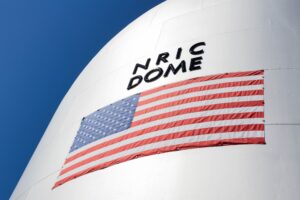
The Nuclear Regulatory Commission (NRC) on Oct. 22 finalized a rule that allows commercial nuclear reactor applicants to use analyses, test data, and other technical evidence from reactor demonstrations previously authorized by the Department of Energy (DOE) or Department of War (DOW) to support license applications. The measure establishes a more direct means of incorporating […]
-
 T&D
T&DKeeping the Lights on When Power Demand Fluctuates
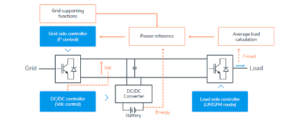
Data centers do what any industry would to continue operations during a power outage: Quickly pivot to their own emergency energy. As reported in several media outlets, a 10-minute grid outage in late July of this year on the East Coast caused data centers to hop off the main grid and switch over to their […]
-
 Nuclear
Austrian Start-Up Pitches Container-Sized Thorium Reactor, With Storage Coming First
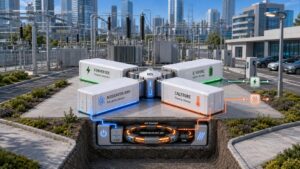
Emerald Horizon plans to sell a hybrid battery and molten-salt storage system now and add an accelerator-driven thorium generator later. The generator remains at an early stage of development. Austria decided against nuclear power in the late 1970s and has not revisited the question since, according to Mario Müller, vice president of research and development […]
-
 Nuclear
Westinghouse, Poland Begin Long-Lead Item Procurement for Country’s First Nuclear Power Plant
Polskie Elektrownie Jądrowe (PEJ) has commissioned Westinghouse Electric Co. to begin procuring long-lead items (LLIs) for the first AP1000 unit of the Lubiatowo-Kopalino nuclear power plant project. This is one of the most important stages in preparing for the start of construction and ensuring that the project is completed on schedule. “This is an extremely […]
-
 Commentary
Zinc Batteries: Making a Power Breakthrough in Data Centers
Data centers increasingly serve a pivotal role in the global economy, driving artificial intelligence (AI) systems, cloud transactions, and e-purchases. Historically lead‑acid, and more recently, lithium‑ion batteries have supplied backup power, but safety, sustainability, longevity, and high-power performance progressively place zinc batteries as the preferred solution for uninterruptible power supply. With the recent announcement that […]
-
 Technology
Asset Information Lifecycle Management: The Digital Backbone of Trusted Operations, Compliance, & AI
This eBook explains how organizations in the Power & Utilities industry can evolve from scattered, uncontrolled engineering information to a governed, connected, and AI-ready digital foundation. It introduces Asset Information Lifecycle Management (AILM) as the extension of engineering document control across the full asset lifecycle—keeping engineering records aligned with the physical plant as assets […]
-
 Management
Executive Leadership Award Finalist: Westinghouse CTO Dr. Lou Martinez Sancho
At the inaugural Pennsylvania Energy and Innovation Summit, hosted by Sen. Dave McCormick at Carnegie Mellon University on July 15, 2025, Westinghouse Electric Co. put a live proof of concept on display: an artificial intelligence (AI) system aimed at reducing the cost and schedule risk of building new AP1000 reactors. According to Westinghouse, the demonstration […]
-
 O&M
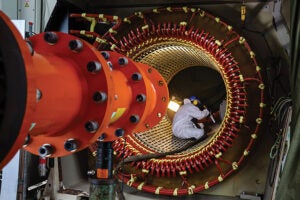
O&MOld Data, Still-Valid Lessons: What Two EPRI Studies Confirm About Generator Maintenance
A shorted rotor winding doesn’t care what year it is. Neither does a cracked retaining ring or a degraded stator insulation system. The physical mechanisms that take generators offline—fatigue
-
 Data Centers
The Rise of Low-Power Instrument Transformers in Data Center and Industrial Applications
Traditional magnetic induction-based instrument transformers have served the power industry reliably for decades, but a new generation of low-power alternatives is gaining ground — particularly in data centers and industrial facilities where accuracy, size, and integration with digital secondary systems matter. This paper reports on LPIT history, standardization, and some of the applications in […]
-
Data Centers
On-Demand Podcast – The Data Center Challenge: Build Faster, Be Efficient, and Keep the Data Flowing
Data centers face big challenges, from processing trillions of search queries, storing billions of emails and photos and serving countless hours of video every day while at the same time developing ways of decreasing their energy and carbon footprints and increasing data security. In this episode, Angad Sandhu, CTO of Giga Energy (director of […]
-
 solid state transformers
Major Leap for Solid-State Transformers: Megawatt-Class Unit Demonstrated on Live Feeder
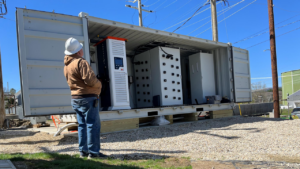
North Carolina State University, the New York Power Authority (NYPA), and EPRI have demonstrated a megawatt-class solid-state transformer (SST) on a live 13.2-kV utility distribution feeder, marking what the partners describe as the first independent validation of a megawatt-class SST under real-world distribution conditions. The NC State-built prototype was connected at EPRI’s power delivery laboratory […]
-
 Nuclear
Three Questions Every Utility Should Ask About Advanced Reactors
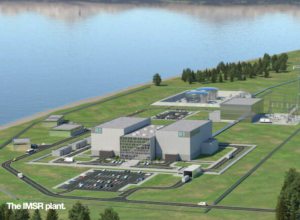
The U.S. power grid is entering a period unlike any it has experienced in decades. Rapid electrification, domestic manufacturing, and the exponential growth of artificial intelligence are reshaping electricity demand. A recent report from Lawrence Berkeley National Laboratory, supported by the U.S. Department of Energy, projects that data centers alone could account for between 9.5% […]
-
 Nuclear
The Janus Five: 20+ Commercial Nuclear Microreactors, Starting in 2028
Five advanced nuclear companies will build, own, and operate more than 20 commercial nuclear microreactors across five U.S. Army installations under the Janus Program, a milestone-based effort designed to place the first project into useful service by September 2028 and establish repeatable commercial products. In exclusive interviews, the selected companies told POWER they intend to use the […]
-
advanced nuclear
NRIC Adds 13 Projects to Nuclear Energy Launch Pad, Expanding Advanced Reactor and Fuel-Cycle Pipeline
The Department of Energy’s (DOE’s) National Reactor Innovation Center (NRIC) has selected 13 new projects across 12 companies for its Nuclear Energy Launch Pad initiative in a significant expansion of the DOE-authorization pathway that channels advanced reactor and fuel-cycle developers toward demonstration on federal and non-federal sites. The selections—spanning microreactor developers, enrichment startups, fuel fabrication […]
-
 Commentary
Alarm Bells Are Sounding for the Grid: Answering Them Takes More Than Megawatts
When federal emergency powers become routine operating procedure, the system is not holding up. It is operating at its ceiling. And the customers who kept their lights on paid triple for the privilege, which means the event that operations survived is one that affordability did not.
-
 Nuclear
Curio, NuScale, Framatome Join to Support Fuel Solution for Advanced Reactors
Three companies at the forefront of nuclear energy technology have signed a memorandum of understanding (MOU) to evaluate fuel technologies to support advancement of next-generation nuclear power.
-
 Nuclear
DOE Approves Safety Design of Deep Fission’s Underground SMR
California-based Deep Fission said the DOE signed off on the Nuclear Safety Design Agreement (NSDA) for its Gravity Nuclear Reactor. The group called it a major regulatory milestone that confirms Deep Fission’s reactor design warrants advancement under the DOE Reactor Pilot Program.
-
 Smart Grid
Resilience and Digital Transformation Spearhead the Energy Infrastructure Transition
The transition to sustainable energy infrastructure has been experiencing steady progress in recent years across the globe, while simultaneously undergoing constant fluctuation. Actual progress is influenced by a wide variety of factors, such as the drivers behind participants’ motivations and the technologies enabling the transition, as well as the status of supply chains and geopolitical […]
-
 Fusion
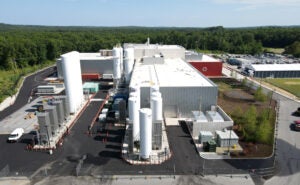
Commonwealth Fusion Systems Raises Another $1 Billion as Work on Commercial Power Plant Continues
A varied group of investors has provided Commonwealth Fusion Systems (CFS) with another $1 billion in equity financing, with the company on July 30 saying the funding supports the group’s continuing work toward operating a commercial fusion energy power plant.
-
 Nuclear
Microsoft’s $60 Million Genesis Mission Commitment Puts Nuclear AI at the Center
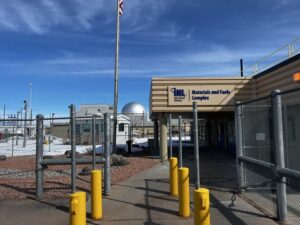
Last week, Microsoft announced a $60 million, multiyear commitment to the Department of Energy’s (DOE’s) Genesis Mission, the national initiative to embed artificial intelligence (AI) across the country’s 17 national laboratories. The company’s stated goal, echoing DOE’s own framing, is to help “double the productivity and impact of American research and innovation within a decade.” […]
-
 Solar
SolarCaelux Signs Partnership Deals With Leading India Solar Module Makers
A California-based solar power equipment group said it has signed two separate five-year, 5-GW commercialization partnerships with a pair of India’s leading solar module manufacturers.
-
 Commentary
Your Customers Are Asking AI About You. Do You Know What It’s Saying?
Why Generative Engine Optimization Is the Next Reputation Management Secret Weapon for Energy Brands Energy has become a kitchen-table issue. Bills are climbing. Data centers are being built at a breakneck pace, and new technologies are being launched faster than ever before, often facing NIMBY concerns. As customers and stakeholders look for answers, they may […]
-
 Research and Development
AI Is Usually Cast as a Grid Burden. The Genesis Mission Is Betting It’s a Grid Tool.
The explosion of artificial intelligence (AI) computing is, for most utilities, a problem to be absorbed: gigawatts of new data-center demand arriving faster than transmission can be planned or built. The U.S. Department of Energy’s (DOE’s) Genesis Mission does not dispute that framing. But buried in the national research portfolio it unveiled July 22 is […]
-
 Technology
Quantum Computing Is Emerging as a Tool for Tomorrow’s Electrical Grids
Artificial intelligence and high-performance computing have helped electrical utilities modernize how they model, forecast, and manage grid operations. These tools already play a central role in maintaining reliability, balancing supply and demand, and planning new infrastructure. But as electrical grids become more distributed, data-intensive, and renewable-heavy, some of the most complex decision-making problems are becoming […]
-
 O&M
O&MSevere Service Control Valves for Power Plants: Reducing Cavitation, Noise, and Maintenance Costs
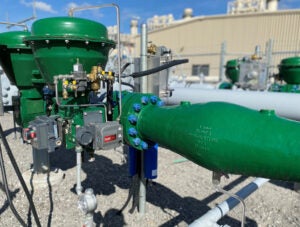
Power industry severe service applications can be difficult, but new advanced trim designs and external noise reduction devices have created higher-performing and more cost-effective alternatives. Power industry applications practically define the phrase “severe service.” Elevated temperatures and pressures, cavitation, erosive solids, and high noise all conspire to push control valve technology to its very limits. […]
-
 Commentary
America Needs a Fifth Nuclear Executive Order
President Trump’s four nuclear executive orders issued on May 23, 2025, represented a historic liftoff for American nuclear energy. COMMENTARY As electricity demand surges, geopolitical energy competition intensifies, and America’s power infrastructure faces mounting strain, the administration acted decisively. It recognized that American energy dominance—and leadership in the digital age—requires a resurgence of nuclear reactor […]
-
 Data Centers
White paper: Measuring and monitoring emissions at data centers. A practical guide to compliance and performance
Sponsored by:Thermo Fisher ScientificAs data centers expand to meet growing AI, cloud computing, and digital infrastructure demands, many facilities are incorporating onsite power generation to support reliability and accelerate deployment. This shift creates new emissions monitoring, reporting, and compliance responsibilities. Download this white paper for a practical overview of emissions monitoring strategies for data centers with onsite […]
-
 Fusion
Pacific Fusion Says Pulsed-Power Prototype Hits Milestone at National Lab
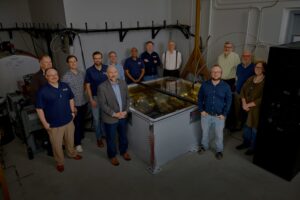
California-headquartered Pacific Fusion announced that a pulsed-power prototype designed and built at Lawrence Livermore National Laboratory (LLNL) has surpassed 3,000 shots under a Cooperative Research and Development Agreement with the company. Pacific Fusion on July 16 said this marks a key milestone in the development of high-gain fusion, and provides a practical example of government-industry […]
-
 Commentary
Power Demand as Catalyst for Change
What was the biggest engineering achievement of the 20th century? The automobile? Space flight? The internet? According to the National Academy of Engineering, it was in fact the electric power grid—the one thing underpinning nearly all of them. Centralized electricity has literally powered the growth of the U.S. economy and quality of life for decades. […]
-
 Commentary
The New Large-Load Compact
Why AI Data Centers Can No Longer Be Treated as Passive Customers For decades, even very large electric customers fit inside a familiar planning model. A factory, refinery, industrial campus, hospital complex, hospital system, or manufacturing facility requested service. The utility studied the load, identified required facilities, assigned costs, and folded the demand into its […]