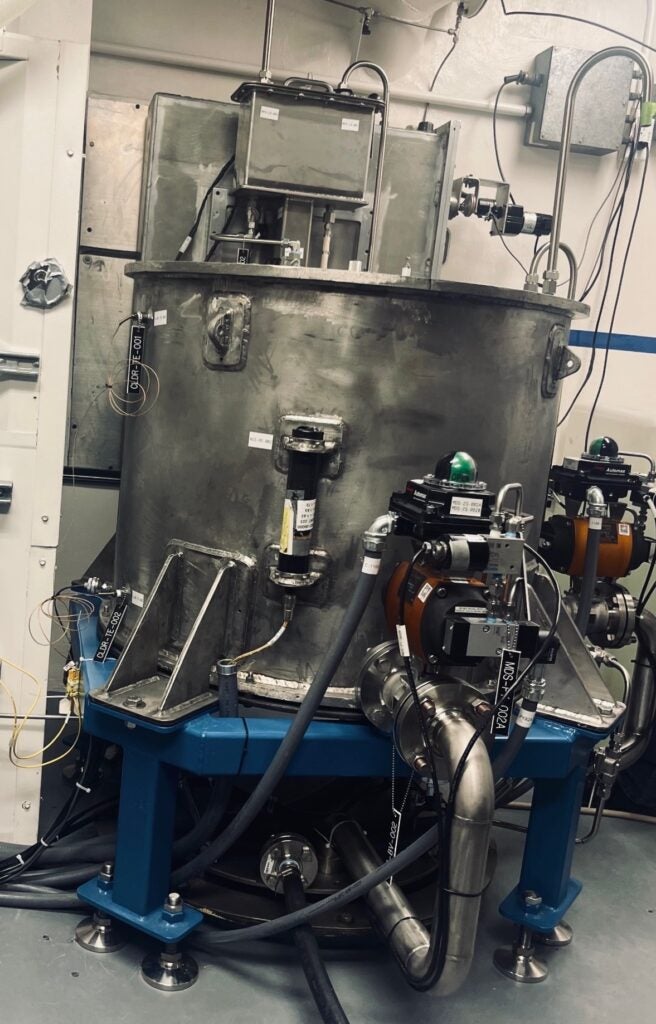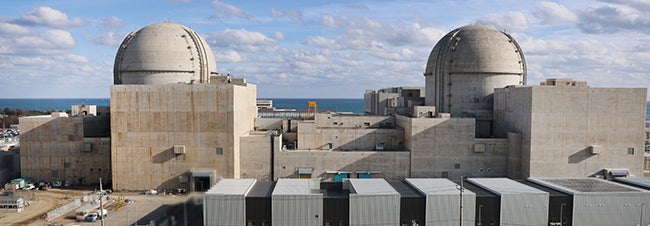
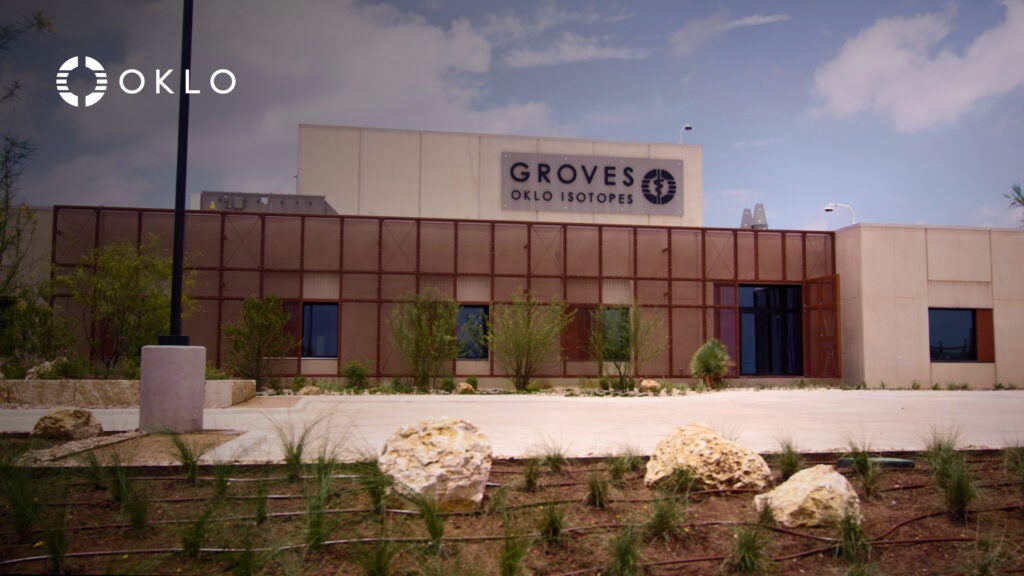
Oklo’s Groves Isotope Test Reactor in Lockhart, Texas, has become the fifth reactor to achieve criticality under the U.S. Department of Energy’s Reactor Pilot Program (RPP), and the first under the program to do so on private land. The low-power test reactor reached criticality at 9:19 p.m. ET Aug. 5, achieving a controlled, self-sustaining nuclear chain reaction less than a year after groundbreaking, Oklo said Aug. 6.
The milestone supports Groves’ role as a technical and operational foundation for future commercial isotope production. Groves was designed and authorized to reach up to 100 We as part of the RPP, though it will not be run at that level. Startup testing will continue after initial criticality, including additional measurements and verification of reactor behavior, Bonita Chester, Oklo’s head of communications and media, told POWER.
But the milestone also extends a rapid sequence of DOE-authorized advanced reactor criticalities this summer. Antares Nuclear’s Mark-0 reactor reached zero-power criticality at Idaho National Laboratory (INL) on June 4, becoming the first advanced reactor to achieve the milestone under the Reactor Pilot Program. Valar Atomics’ Ward 250 reactor reached criticality at the Utah San Rafael Energy Lab on June 18, becoming the second RPP reactor and the first DOE-authorized reactor built and operated outside the national laboratory system. Deployable Energy’s Unity reactor reached zero-power criticality at INL on June 30 through DOE’s Nuclear Energy Launch Pad initiative, while Aalo Atomics’ Critical Test Reactor reached criticality at INL on July 4.
Groves adds a distinct case, given that it is a privately financed isotope test reactor sited on private land in Texas, rather than a power-reactor demonstration or a reactor hosted inside existing national laboratory infrastructure. A low-power reactor intended to demonstrate reactor design, construction, startup, and operations for future isotope production facilities, Groves is the first reactor at Oklo’s Groves site and a demonstration project for Oklo Isotopes, the business formed from Oklo’s 2024 acquisition of radioisotope specialty firm Atomic Alchemy.
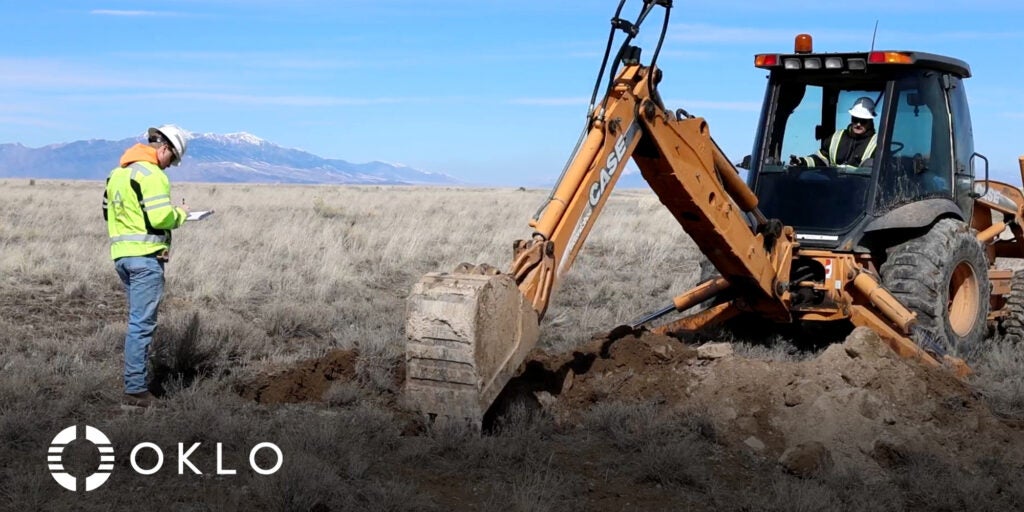
“Reaching criticality in less than a year is an incredible milestone for our team,” said Oklo co-founder and CEO Jacob DeWitte. “Oklo developed Groves from a greenfield site on private land, completed full-scale civil excavation and construction, manufactured or commercially procured all components, including fuel, and developed its operating programs in-house. Taken together, we believe these accomplishments establish a new benchmark for the Reactor Pilot Program and set the stage for the future of advanced nuclear deployment at scale.”
What Groves Is Designed to Prove
Groves is tied to Oklo’s isotope business, which grew out of the company’s 2024 acquisition of Atomic Alchemy. As POWER reported in November 2024, Oklo acquired the U.S. radioisotope specialist in a $25 million all-stock transaction and has since rebranded the business as Oklo Isotopes. Groves is part of that effort to build domestic isotope production capabilities for healthcare, industry, research, space, and national security applications.
Atomic Alchemy’s core concept was its Versatile Isotope Production Reactor, or VIPR, a non-power reactor platform the company said could produce more than 40 economically valuable isotopes. Targets Oklo identified when the deal was announced ranged from actinium-225 for targeted cancer therapies and ytterbium-176, a precursor to lutetium-177, to cobalt-60 for sterilization and radiography, strontium-90 and plutonium-238 for space power systems, and tritium for defense and fusion research. Oklo also highlighted neutron transmutation doping of silicon, a reactor-based process used to produce highly uniform dopant distribution in semiconductor material.
Oklo’s isotope platform now includes Oklo Isotopes’ Nuclear Regulatory Commission (NRC)-licensed Idaho Radiochemistry Laboratory and a planned multi-reactor isotope foundry. In March, Oklo announced that the NRC had issued a materials license allowing the Idaho Falls laboratory to receive, store, process, refine, and distribute isotope materials, including activities involving up to 2 curies of radium-226. The radioactive isotope is used as a feedstock for medical-isotope supply chains, including targeted alpha therapy. Oklo has said operating experience from the laboratory is expected to inform processes, procedures, and systems for a planned foundry that could include up to four non-power VIPR systems, each around 15 MWth.
Groves’ crucial role in that strategy will be to serve as a test platform. While the Lockhart facility is not a commercial power plant and is not intended to produce saleable isotopes, its purpose is to test the reactor physics, equipment, operating procedures, safety programs, and workforce capabilities Oklo expects to need for future isotope-production facilities, Chester said.
“Groves is designed to establish the technical and operational foundation for producing medical and industrial isotopes,” she explained to POWER. “In isotope production, target materials are placed in or near a reactor core and exposed to neutrons. Those neutrons transform some of the atoms in the targets into specific isotopes, which can be separated, processed, and supplied for uses such as cancer treatment, medical diagnostics, industry, and research.”
“Groves is the test platform for Oklo’s planned isotope production campus, which will be a larger-scale facility with multiple reactors designed for sustained isotope production,” Chester added. “The work at Groves supports research and development, trains personnel, and builds operating experience while allowing Oklo to demonstrate reactor behavior, instrumentation and controls, shutdown performance, operating procedures, and organizational readiness.”
“First criticality at Groves is an early operational milestone,” she stressed.
That mission also separates Groves from Aurora-INL, Oklo’s first planned commercial powerhouse, which is under construction at INL. “The Aurora powerhouse, the first of which is currently under construction at INL, has a different primary mission,” Chester said. “The Aurora-INL is an advanced fast reactor designed to generate electricity and usable heat for customers. While Groves is a low-power, water-cooled test reactor focused on isotope-production development, Aurora-INL is a sodium-cooled power reactor intended for commercial energy production.”
Future isotope-production facilities would be separate projects requiring their own designs, production and processing systems, commercial arrangements, and regulatory approvals, Chester noted. Any NRC licensing would require a separate application and review, she said, and is not an automatic next step for Groves.
While Oklo has described Groves as full-scale and commercially oriented, Chester said those terms refer to the way the facility was executed, not to its power level or isotope output. “‘Full-scale’ for Groves refers to the execution of a complete operating reactor facility, not to its power level or isotope production capacity,” she said. “Groves involved full civil construction and uses actual reactor systems, components and fuel, rather than reduced-scale models or laboratory test equipment.”
“‘Commercial-scale’ refers to the project’s commercially oriented delivery model: private financing, construction on private land, commercial procurement of fuel and major equipment, and the establishment of personnel, procedures and safety programs required to commission and operate a reactor,” she said. “The project provides real-world cost, schedule, and operating experience that can inform future deployments.”
“Neither term means Groves is a commercial isotope-production reactor,” she said. “Groves is a low-power test reactor and will not produce isotopes.”
Startup Testing Continues Under DOE Authorization
Beyond the reactor-physics milestone, Groves represents an important test of private-sector nuclear project execution, including to assess whether a developer can move from greenfield construction to fuel loading, startup testing, and criticality through a DOE authorization pathway on a compressed schedule.
Oklo had pointed to that execution case before first criticality. In May, the company said it had built the Groves test reactor facility in 229 days and was targeting criticality by July 4. On the May 12 earnings call, DeWitte said Groves showed that “with the right design, scope, supply chain authorization pathway and commercial mindset, nuclear assets can move much faster than people may expect.” Lessons from Groves around procurement, construction, installation, regulatory sequencing, and commissioning would inform future nuclear asset deployments across Oklo’s platform, he said.
Authorization progress made rapid headway in July. On July 1, the DOE approved the documented safety analysis (DSA) for Groves, moving the project from the documentation phase into final pre-startup review. Oklo described the DSA as the facility’s final safety basis, grounded in detailed technical analysis of potential hazards, safety controls, and operating requirements needed to support safe startup. The DSA followed DOE approval of the preliminary documented safety analysis (PDSA), which established the facility’s preliminary safety basis during design and construction.
By July 23, DOE startup authorization had cleared the way for fuel loading, startup testing, and first criticality. Oklo highlighted it progressed from groundbreaking to startup authorization in just over 10 months, during which it built the reactor facility, established the operating organization, qualified personnel, implemented nuclear programs and procedures, procured fuel and major equipment from commercial suppliers, and completed DOE’s authorization process.
Oklo’s regulatory dashboard now lists Groves as having completed all five DOE authorization steps: the Other Transaction Agreement, Nuclear Safety Design Agreement, preliminary documented safety analysis, documented safety analysis, and readiness review and startup approval. The company noted the RPP created a pathway that allowed construction and organizational readiness activities to proceed while DOE conducted its reviews.
The startup authorization followed DOE’s readiness review, the final step in the department’s pre-startup process. Among the myriad steps toward achieving criticality, Oklo said a multidisciplinary DOE team evaluated whether facility procedures and personnel training were adequate and whether facility and equipment conditions conformed to the approved design. It also assessed whether safety equipment functioned properly and whether required safety management programs had been implemented. Notably, Oklo said it developed those safety management programs in-house rather than relying on an existing operating framework at an established facility such as a national laboratory.
First criticality now ushers Groves into the remaining startup-test phase. “First criticality is one milestone in Groves’ broader startup program,” Chester noted. “Oklo will now complete the remaining testing under DOE’s authorization, confirming reactor behavior, control performance, systems, procedures, and organizational readiness. The purpose of Groves is to build experience and capabilities that can inform future isotope-production facilities.”
“Oklo’s broader commercialization effort will apply the lessons from Groves to purpose-built facilities capable of reliable isotope production at commercial scale,” she said.
Groves Was Oklo’s Fastest Criticality Candidate
Oklo’s broader business spans fast fission power plants, fuel recycling, and isotope production. Its power business includes Aurora-INL, the company’s first planned commercial powerhouse at INL where POWER has reported on-site characterization, DOE authorization work, and early deployment planning, as well as Siemens Energy’s pioneering turbine-generator package for the project’s conventional island. Oklo is also advancing a potential 1.2-GW Aurora campus in Ohio backed by Meta and an Aurora-derived project at Eielson Air Force Base in Alaska designed to provide both electricity and heat under a long-term power purchase agreement.
Its fuel work includes the Aurora-INL Fuel Fabrication Facility (A3F), which is intended to fabricate metallic HALEU fuel for Aurora-INL using material sourced from the former Experimental Breeder Reactor-II, and the Tennessee Advanced Fuel Center, which underlies Oklo’s longer-term recycling strategy. As POWER reported in September 2025, the privately funded used-fuel recycling facility in Oak Ridge is poised to become the first commercial-scale U.S. deployment of electrochemical recycling technology and a future fuel source for fast reactors such as Aurora.
The isotope side now includes Groves, the NRC-licensed Idaho Radiochemistry Laboratory, and Oklo Isotope’s planned multi-reactor isotope foundry. Oklo’s regulatory dashboard lists the foundry as one step into a five-step NRC application review and license-issuance process, with a licensing project plan completed, pre-application engagement underway, and a readiness assessment, license application, and license issuance still ahead. Groves, notably, has now completed all five DOE authorization steps under the RPP.
While Groves was not Oklo’s only RPP project, DeWitte told POWER in a June interview at INL that the Texas isotope reactor was the project best matched to DOE’s July 4 criticality target. Aurora-INL is proceeding on its own construction and DOE authorization schedule. The third Oklo project is “Pluto,” a plutonium-fueled powerhouse tied to advanced reactor and fuel-system design work, including artificial intelligence-enabled engineering workflows through INL’s Prometheus AI platform.
Pluto, notably, will give Oklo a separate RPP pathway to test plutonium-bearing fast-reactor fuel and design methods. Associated with Oklo’s effort to qualify surplus plutonium as bridge fuel for fast reactors, in December 2025, Oklo said it had conducted a multi-day plutonium fast-reactor critical test suite with Los Alamos National Laboratory at DOE’s National Criticality Experiments Research Center, using the Flattop fast-spectrum critical assembly to generate benchmark measurements of reactivity feedback and power response. Oklo said those data provide an early contribution to Pluto’s design and safety basis and help establish technical foundations for using fuel fabricated from surplus plutonium in future Aurora powerhouses. In April, the company also announced work with NVIDIA and LANL focused on physics- and chemistry-based AI models, trained inference models, materials science, and fabrication R&D to support fuel validation for plutonium-bearing fuels.
Aurora was not a realistic candidate for the July 4 target, DeWitte said. Oklo considered whether an Aurora-related critical assembly could accelerate that program, but concluded that a separate criticality exercise risked pulling focus from construction of the plant itself. Groves, by contrast, offered a more direct execution test.
Oklo’s objective was to make Groves “indicative of what it’s actually going to look like for a full commercial deployment,” DeWitte said. “In other words, it was a one-reactor unit of what our full isotope production facility is, which is a multi-reactor unit, but we needed the practice in building, designing, building, and standing up the facility, and that’s what it’s for.”
The RPP “has been massively successful,” he said. “It’s helped us build faster, helped us move into build mode. We, as an organization, if you interviewed me a year ago and asked me, what’s your product? I’d tell you, I’d say power reactors and isotopes. You know what we were actually doing? We were optimizing to submit licensing documentation. That’s what the main product we were shipping. Now we’re actually building.”
DeWitte pointed to Groves’ private-land setting, civil-construction scope, and commercial procurement as crucial RPP differentiators. “It’s important to note, we’re the only company that did it on private land,” he said. Oklo, he added, “did full civil construction. We didn’t just pour a flat slab and put a steel [tent] up.” Groves also relied on commercial sourcing. “Everything sourced commercially,” he said. “We didn’t use government fuel like others.”
He added: “We’ve learned a ton because it’s allowed us to move faster through the regulatory and the design. I mean, it’s an unbelievably valuable program.”
A Private-Land Test of Nuclear Project Delivery
Groves also established engineering practices, operating procedures, training programs, commissioning experience, and organizational capabilities that Oklo said will reduce uncertainty across future isotope, powerhouse, and fuel-cycle deployments.
Caroline DeWitte, Oklo co-founder and chief operating officer, made that point in the company’s July 23 startup authorization announcement.
“Executing on Groves has meant much more than just a construction project; it has been a valuable part of building and exercising key operational muscle across the Oklo enterprise,” she said. “Startup of a private facility means honing and implementing operating procedures, training programs, security programs, environment, health and safety programs, quality assurance programs and procedures, and much more. Oklo’s centers of excellence on all of these operational aspects now have this experience to bring to all our projects currently in progress and to build on for the future.”
Assistant Secretary for Nuclear Energy Ted Garrish has described the milestone as part of the federal push to accelerate advanced reactor deployment, calling the Isotope Test Reactor a “part of the revival of America’s nuclear energy industry.”
Texas Gov. Greg Abbott, meanwhile, connected Groves to the state’s advanced nuclear development efforts. “Texas is leading America’s nuclear renaissance by advancing the technologies that will power innovation and strengthen our nation’s future,” Abbott said. “From expanding our nuclear workforce to rebuilding critical domestic supply chains, Texas is creating the foundation for the next generation of advanced nuclear development. Congratulations to Oklo on reaching this important milestone, which will help expand isotope production for critical medical therapies and reinforce Texas’ leadership in nuclear innovation.”
—Sonal Patel is a POWER senior editor (@sonalcpatel, @POWERmagazine).
Editor’s note: This is a developing story and will be updated as additional details are confirmed.