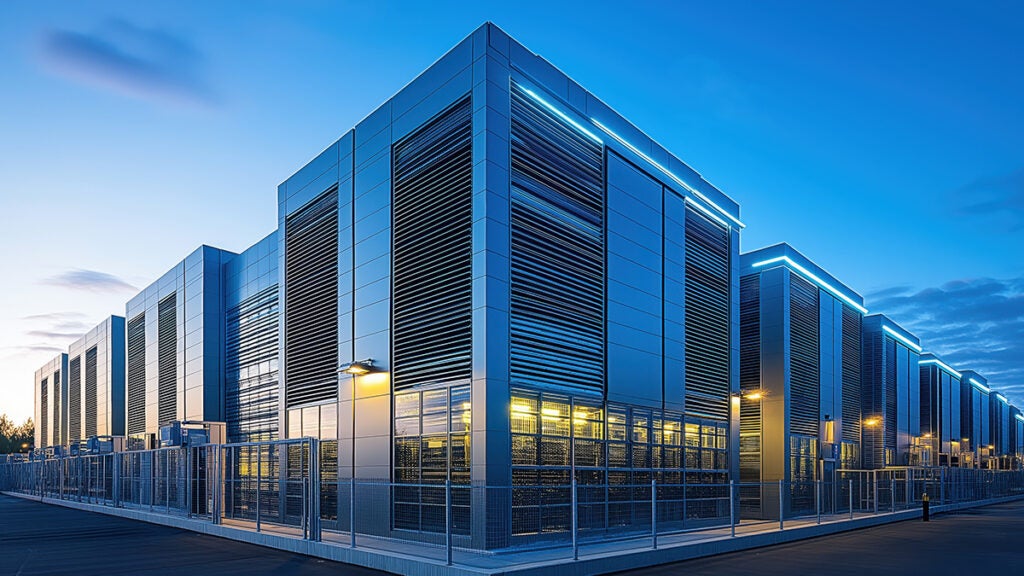
Artificial intelligence (AI) has overturned the long-stable trajectory of U.S. electricity demand. After decades of flat growth, planners and regulators now face a surge driven by hyperscale data centers—massive campuses demanding hundreds of megawatts. This demand shock is accelerating pressure for new generation and grid infrastructure.
This surge is colliding with an electric system built for slow, incremental expansion. Generator interconnection queues now stretch for years—up to seven in Virginia’s “Data Center Alley.” Transmission projects face lengthy permitting and construction timelines, while capacity market designs require predictable demand growth to produce prices that are reliable for suppliers and reasonable for customers.
COMMENTARY
Electricity demand is now outpacing supply and deliverability at a speed the grid has never experienced. Utilities pay more to procure and move power, and those costs ultimately reach customers. Policymakers face a difficult tradeoff: rapid AI infrastructure expansion is framed as a strategic imperative, yet rising electricity prices are a political liability fueling consumer frustration and calls for data center moratoria.
Two broad frameworks have emerged to navigate these tensions: co‑location, often described as “bring your own generation” (BYOG), and supplemental or “backstop” capacity procurement.
Who Pays for Growth?
Regulators and market participants face two core risks regarding the current investment cycle.

In This Issue
Full issueThe first is overbuilding versus underbuilding. Electric assets take years to plan and construct, making it difficult to align supply with fast‑shifting demand. Overbuilding occurs when infrastructure is built for data centers that fail to materialize, driving up system costs. Underbuilding occurs when upgrades lag demand growth, threatening reliability and limiting access to power.
DPX is the only event programming the actual decision points between the power and data center industries — where contracts, interconnection, and self-supply choices being made now will determine which AI-scale projects come online, and when.
View Conference Program
The second risk is cost allocation. Because grid costs have historically been shared across customer classes, non-data-center customers may end up paying for infrastructure built primarily to serve hyperscale load—even if that load ultimately materializes. These equity concerns are long‑standing, but newly urgent given the size and speed of AI‑driven demand growth.
Framework 1: Co‑Location/Bring Your Own Generation
Traditional grid planning assumes centralized generation serving dispersed load. Co‑location reverses this model by siting data centers adjacent to new or existing generation, reducing reliance on constrained transmission systems.
In BYOG arrangements, data centers typically finance generation through long‑term bilateral contracts but retain grid interconnections for backup power, maintenance outages, and restart services. As a result, the Federal Energy Regulatory Commission (FERC) has emphasized that co‑located loads must continue to pay for the transmission, distribution, and reliability services they use.
BYOG carries material risks. If co‑located generation underperforms, data centers may pivot abruptly to grid supply, stressing reliability. Generators face counterparty risk if data centers exit and alternative transmission access is unavailable. Cost‑shifting concerns also arise if co‑located loads underpay for shared services.
At the same time, BYOG offers clear advantages. Data centers gain faster access to firm power and greater control over their resource mix. Other customers may avoid near‑term capacity price increases when large loads self‑supply. Generators benefit from stable, long‑term revenues outside annual capacity auctions.
Framework 2: Supplemental/Backstop Procurement
Backstop procurement occurs when regional operators or utilities acquire capacity outside standard market mechanisms to address near‑term reliability risks. Because major transmission upgrades are often unavoidable, long lead times and unresolved cost‑allocation questions are central challenges. While FERC regulates wholesale markets, it lacks authority over retail rate recovery, leaving states to decide how costs are distributed across customer classes.
Backstop procurement carries substantial risks. If AI‑driven load proves ephemeral, accelerated procurement may result in overbuilding. Long‑term contracts can shift costs onto remaining customers if data centers exit service territories. Existing generators may also face price suppression if supplemental resources later enter capacity auctions, potentially discouraging future investment.
Nonetheless, backstop approaches offer system‑wide benefits. Integrated planning can reduce the risk of stranded generation and support reliability. Utilities benefit from expanded transmission investment, and storage and distributed resources can provide congestion relief and operational flexibility.
No Silver Bullet
Debates over who pays for grid expansion are not new. Principles such as cost causation and beneficiary‑pays continue to anchor regulatory decision‑making. While regulators may soften the impact of rising electricity prices for some customers by reallocating costs, their jurisdiction over electricity markets cannot counter broader inflationary pressures.
The average installed cost of gas turbines continues to soar. All-in levelized generation costs have doubled, with turbine costs accounting for about 28% of the increase, according to calculations based on data from several groups.
Meeting AI‑driven demand will therefore require multiple strategies pursued in parallel, including expanded use of storage and distributed resources. Even after the immediate surge subsides, the political and technical debate over grid expansion—and who should pay for it—will endure.
—Chris Goncalves is managing director and chair, and Hans Leonard, PhD is director of BRG’s Energy and Climate practice.