
The Federal Energy Regulatory Commission (FERC) has voted unanimously to issue tailored show-cause orders under Section 206 of the Federal Power Act to each of the six regional transmission organizations (RTOs) and independent system operators (ISOs) under its jurisdiction, directing them to either defend or reform tariff rules governing how data centers, manufacturing facilities, and other large energy users access the transmission system.
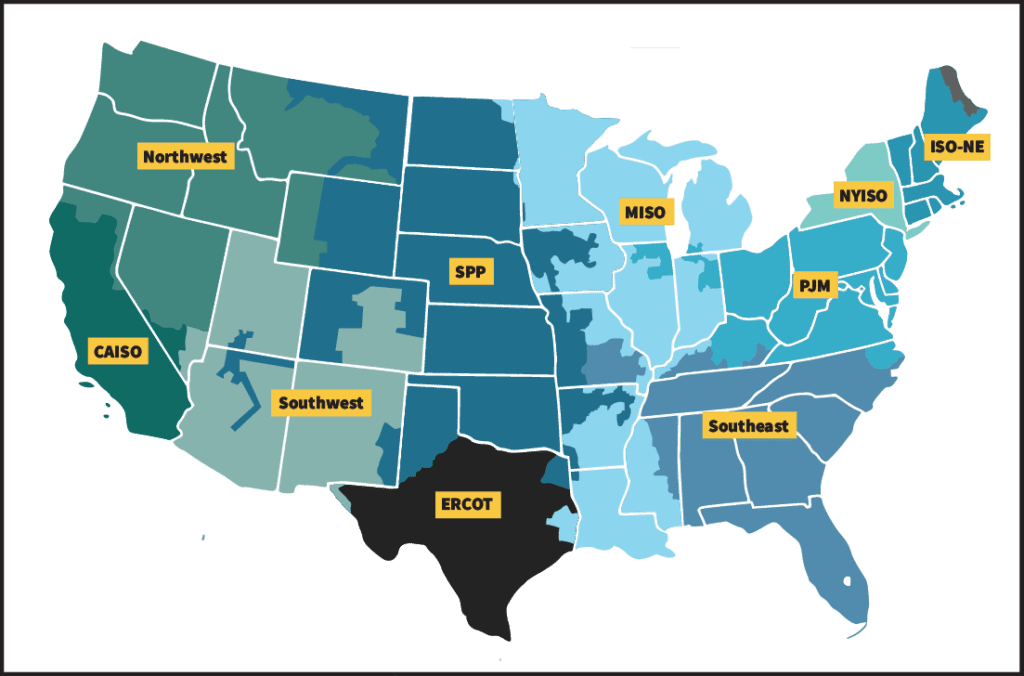
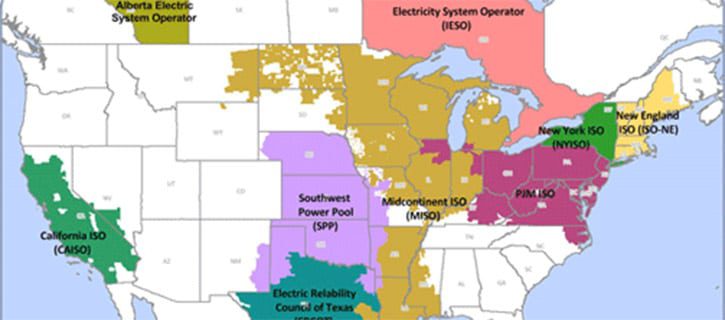
The orders, issued on June 18, apply to PJM Interconnection, the Midcontinent Independent System Operator (MISO), Southwest Power Pool (SPP), the California Independent System Operator (CAISO), ISO New England (ISO-NE), and the New York Independent System Operator (NYISO), along with their transmission owners.
FERC staff said the orders address “the pressing need in the RTO/ISO regions” and will affect 200 million Americans in more than 30 states and the District of Columbia, covering nearly two-thirds of electricity load served under commission-jurisdictional rates.
The federal regulator said the U.S. is experiencing “unprecedented demand for electricity, due in large part to the rapid growth of data centers,” and that RTOs and ISOs have “in some cases struggled” to make reforms that would ensure data centers can “quickly and efficiently access the transmission system” and that associated costs are fairly allocated.
“We are setting the stage for a resilient, reliable, and forward-thinking grid that empowers communities and safeguards consumers by transforming the way large energy users access the grid,” said FERC Chairman Laura V. Swett. “It also is critical that FERC provide certainty for investors by directing the markets to protect existing deals and unlock opportunities for technological advancement and economic expansion. We can facilitate both, which is exactly what we did today.”
In its staff presentation, FERC said the orders are informed by more than 3,500 pages of comments submitted in the Department of Energy’s (DOE) October 2025 advance notice of proposed rulemaking (ANOPR), which proposed reforms to ensure the “timely and orderly interconnection of large loads.” FERC’s June 18 action is the commission’s promised response to that proceeding. As POWER reported in April, FERC had said it intended to act to address the problems raised in the ANOPR “in a manner that is quick, efficient, and legally durable.”
On Thursday, the commission said the six markets’ existing tariffs “appear to be unjust and unreasonable” because they do not adequately address the challenges associated with integrating large and co-located loads onto the transmission system. More specifically, FERC staff said the tariffs “appear to lack provisions addressing five categories of reform.”
Those five categories are transmission service application and study processes, including consideration of alternative transmission technologies; prevention of cost shifting and increased cost transparency; treatment of co-location arrangements and behind-the-meter generation; new transmission services for flexible large loads; and study processes for generating facilities serving electrically proximate large loads and large co-located loads.
How FERC Defines a “Large Load”
Across all six orders, FERC set out—for the first time—a preliminary, common definition for a “large load” that each RTO and ISO will now be required to test against its own tariff. As described in the orders, the “reasonable definition” of large load is a new commercial or industrial customer, located at a single site behind one or more points of interconnection, with a peak load of 50 MW or greater, that interconnects to the transmission system at a voltage level greater than 69 kV, and is not part of a co-location arrangement.
The commission also introduced the concept of an “electrically proximate large load,” which is defined as a large load that is “sufficiently electrically close” to the interconnection customer’s requested point of interconnection that the combined impact on the transmission system of the generating facility and the load—setting aside the transmission facilities between the two—would be effectively the same as if they were located at the same substation. FERC offered a working benchmark of no more than two substations apart to align with SPP’s High Impact Large Load Generation Assessment (HILLGA) design.
The orders also introduce the concept of a “flexible large load,” a subset of large loads that are willing and able to limit their withdrawals from the transmission system under specified conditions. That operating profile could potentially reduce or defer the need for network upgrades if properly reflected in tariffs and study processes, FERC suggested.
The Five Categories of Reform, in More Detail
1. Study and application processes, and alternative transmission technologies. FERC preliminarily found that the tariffs appear unjust and unreasonable because they lack clear provisions governing the application, study, and ongoing operational requirements for eligible customers seeking transmission service on behalf of large loads.
Generally, each RTO/ISO must also explain why its tariff remains just and reasonable without provisions requiring the evaluation of alternative transmission technologies—including static synchronous compensators, static VAR (volt-ampere reactive) compensators, advanced power flow control devices, transmission switching, synchronous condensers, voltage source converters, advanced conductors, tower lifting, and dynamic line ratings—as potential solutions to accommodate large-load service requests.
Where alternative transmission technologies are considered and rejected in favor of traditional network upgrades, the commission directs that the study report include a “sufficiently clear demonstration” of why the alternative technologies were infeasible or would not yield lower costs or a faster timeline. FERC emphasized that it is not mandating the use of these technologies but is requiring their transparent evaluation.
2. Cost-shifting prevention and cost transparency. The commission preliminarily found that the tariffs lack adequate mechanisms to mitigate the risk of cost shifting among transmission customers, citing an apparent lack of transparency around the assignment and cost of network upgrades needed to serve large loads, and the absence of a pro forma cost recovery agreement between the RTO/ISO, the relevant transmission owner, and the eligible customer taking service on behalf of the large load.
Each RTO/ISO must now explain whether its tariff remains just and reasonable without robust, systematic disclosure of network upgrade cost data “in a single location, and in an easily accessible format that is searchable and allows users to filter the data,” and without a pro forma cost recovery agreement designed to ensure that eligible customers—not other transmission customers—ultimately bear the costs incurred to provide their service. Payments made under such agreements must be credited toward transmission owners’ revenue requirements consistent with FERC’s cost-of-service regulations.
FERC, however, was explicit about the limits of its jurisdiction, noting that “states have authority over how the wholesale costs of providing electricity, including transmission of such electricity, to those retail customers are recovered through retail rates.” The commission said the enhanced cost transparency it is directing is intended to give state public utility commissions “the information necessary to allow them to understand which transmission costs are caused by which transmission customers, so that they can sub-allocate these costs to the appropriate retail customers.”
3. Co-location and behind-the-meter generation. Each order except PJM’s directs the RTO/ISO to address the rates, terms, and conditions of service that apply to co-located loads and to loads served in whole or in part by behind-the-meter generation. PJM’s co-located load issues are being addressed in a separate, ongoing Section 206 proceeding, and the June 18 PJM order is therefore limited to non-co-located large loads. The commission noted that PJM “has not yet proposed tariff revisions to address the challenges associated with the integration of large loads,” even as it has moved on co-location efforts.
4. New transmission services for flexible large loads. FERC preliminarily found that the tariffs lack provisions recognizing the unique operational characteristics of large loads, which can limit their withdrawals under certain conditions—flexibility that, if properly studied and reflected in tariffs, could reduce the need for network upgrades. The commission suggested that additional informational and study requirements, including Electromagnetic Transient (EMT) studies, may be necessary to accurately model these dynamic loads while maintaining reliability.
5. Study processes for generation serving electrically proximate or co-located large loads. Each RTO/ISO must address the rates, terms, and conditions of service applicable to interconnection customers serving electrically proximate large load or co-located load. FERC pointed to SPP’s HILLGA process, which studies a generating facility and the large load it serves jointly when the two are located no more than two substations apart, as a benchmark for this category of reform.
Regional Differences Recognized
FERC’s six orders, notably, acknowledged that each market is at a different stage.
SPP has already moved further than any other RTO/ISO, having secured FERC approval of its High Impact Large Load (HILL) study process and Conditional High Impact Large Load Service (CHILLS), along with the HILLGA framework for studying generation serving proximate large loads. Even so, FERC preliminarily found SPP’s tariff appears unjust and unreasonable because it lacks provisions requiring evaluation of alternative transmission technologies and pro forma provisions in transmission service agreements memorializing ongoing operational requirements for HILL customers.
CAISO is also structurally distinct. Unlike other regions, CAISO does not offer traditional Order No. 888 network and point-to-point transmission services, offers no firm, long-term transmission reservations of capacity, and does not provide a formal application process for transmission service. Instead, its Participating Transmission Owners perform wholesale load interconnection studies. The order recognizes that Participating Transmission Owners may need to augment their existing study processes to respond to FERC’s concerns.
PJM, meanwhile, is separately subject to the commission’s co-location proceedings, and Thursday’s PJM order is confined to the integration of large loads that are not co-located with generation. While ISO-NE, MISO, and NYISO each have distinct existing processes, network service constructs, and stakeholder proceedings, the commission said it took these into account when tailoring the individual orders.
60 Days to Respond, Orders Not Intended to Disrupt Existing Agreements
The orders give RTOs, ISOs, and transmission owners 60 days to respond to the orders, including briefing questions, and 30 days to file informational reports on resource adequacy. RTOs, ISOs, and transmission owners may request abeyance within 45 days, and interested parties may respond to RTO/ISO and transmission owner filings within 30 days. FERC, notably, said it “will not grant such abeyances reflexively,” and that any abeyance would be conditioned on demonstrated progress toward a Section 205 filing addressing the issues raised in the order.
The 30-day informational reports on resource adequacy must describe any proposals under consideration in the RTO/ISO stakeholder process to address resource adequacy for new large loads, a detailed schedule of key milestones, including expected FERC filing dates, and any ongoing stakeholder processes that seek to accelerate the addition of generating capacity in the region.
As notably, FERC said the orders “are not intended to disrupt existing agreements that large loads have negotiated, or are in the process of negotiating, for the provision of transmission service,” and that the RTOs and ISOs “should allow a reasonable amount of time to finalize agreements that are nearing completion when any tariff revisions are filed with the Commission.” All the orders direct each RTO/ISO to include a reasonable implementation period and a reasonable effective date in any proposed tariff revisions to minimize disruption to those existing commercial arrangements.
At the June 18 press conference following the open meeting, Swett said her biggest takeaways from hyperscalers were “that the rules aren’t clear and the markets aren’t going fast enough,” and that a third concern — proactive bilateral deal-making already underway — shaped the grandfathering provisions in the orders. “A lot of these hyperscalers and utilities have been very proactive. They have engaged in bilateral commercial negotiations and some of those are worth billions of dollars, and the orders specifically provide that the markets should not disturb those agreements and that we are going to grandfather anything that is underway or finalized by the time the tariff reforms are filed,” the FERC chairman said.
While the June 18 orders do not finalize a single national rule, FERC said the orders seek to provide regional flexibility “instead of a one-size-fits-all solution,” recognize progress made in SPP and PJM since October 2025, and acknowledge ongoing stakeholder efforts by other RTOs and ISOs. The commission also encouraged RTOs and ISOs to work with transmission owners and regional stakeholders on Section 205 filings that could address FERC’s concerns.
Finally, FERC also left the DOE ANOPR docket open for further potential action. In its presentation, the commission encouraged public utilities in other regions to file Section 205 proposals addressing the concerns raised in the orders and the ANOPR.
—Sonal Patel is senior editor at POWER magazine (@sonalcpatel, @POWERmagazine).