Shadow a utility work crew for a day and you would be amazed at how many obstacles, inefficiencies, and headaches they face from the mobile applications they use. These teams are productive despite those applications, not because of them. It is an unfortunate irony that the mobile apps that promised to replace paper-based processes, put critical information at the team’s fingertips, and bring greater efficiency to their workflows, instead do the opposite.
How did we get here? It started with good intentions. Utilities deployed third-party point solutions to bridge a gap in the new enterprise software systems they implemented organization-wide over the past couple of decades. Those enterprise resource planning (ERP), warehouse management system (WMS), and enterprise asset management (EAM) systems lacked functionality when it came to supporting work crews in the field. These third-party apps filled those gaps, bringing much-needed data and workflow support out into the field. That was a major step forward at first, but the downside of this mobile information technology (IT) strategy surfaced as these third-party apps proliferated.
The proliferation of these applications forced crews to wrestle with a dozen or more apps that were never designed to work together, never designed to work seamlessly with the enterprise systems, and never designed to share data with effective data governance. The result is a mess for work crews to wrangle, as they struggle with a tangled web of applications that add confusion and complexity, introduce significant inefficiencies to their workflows, and make reporting even harder.
And because the functionality of these apps doesn’t meet their needs, crews still use paper-based processes to fill the gaps. To add insult to injury, work crews know that the apps are degrading data quality for the organization daily because of the apps’ deficiencies when it comes to accessing and sharing data.
Solving a Pain Point
This is suboptimal for many reasons, but it’s crucial to know it does not need to be this way. This is not an unavoidable headache inherent to mobile apps, where users must take the bad with the good of having tablets in the field (Figure 1). These inefficiencies are not a prerequisite for all mobile field apps. These are the specific results of relying on poorly connected point solutions that were never designed to work together.
 |
|
1. Utility crews working in the field know that having connected devices can provide them with real-time visibility into asset and grid operations, enabling faster response times and improved reliability. However, crew members often struggle with the proliferation of mobile field apps that were never designed to work with one another. Courtesy: TRC Companies  In This IssueFull issue |
To solve this pain point, utilities need to replace this piecemeal approach to mobile apps with a more unified strategy focusing on technology that meets the core needs of both field workers and the larger organization. A solid solution includes the following:
■ A single platform that universally supports mobile use cases and eliminates the complexity coming from separate apps for each use case.
■ Seamless interoperability with enterprise systems that solves the inefficiencies and roadblocks that impact not only work crews but also operational teams, geographic information system (GIS) teams, and IT teams.
■ Native support for digital maps and location-based data, which eliminates obstacles that work crews experience when accessing and updating critical asset information before, during, and after they perform work on-site.
■ Protection of data quality that ensures that data accuracy, richness, and timeliness is not degraded as teams access, update, and share it.
Unlock the Potential of Work Crews
This strategy for mobile applications would not only solve the headaches and inefficiencies discussed above. It would also unlock the potential of what work crews can accomplish each time a truck rolls. Here are a few examples.
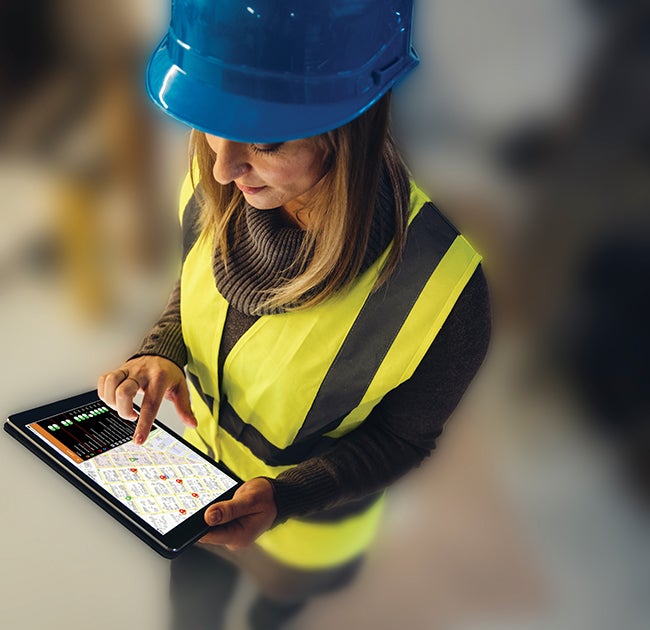
Enhanced, Accelerated Asset Inspections. By moving beyond point solutions, utilities would empower work crews with far more information than what is available today. Through full integration with work and asset management systems, field teams could immediately see all available asset data, work order history, and geospatial layers simultaneously—a depth of information that has never been at their fingertips (Figure 2). They could share on-site data with managers and collaborate in record time on work order changes based on the reality of the situation on site. Rather than requiring multiple truck rolls and slow decision-making, work crews could track inspections and submit work requests in the field based on regulation-driven requirements. And all new information would be instantly captured with high accuracy, building the richness of the utility’s digital model of its infrastructure.
 |
|
2. A worker in the field uses the Lemur mobile mapping solution. Field teams are able to immediately see all available asset data, work order history, and geospatial layers simultaneously. Courtesy: TRC Companies |
Construction Tracking and Traceability. Construction processes would be far more efficient if utilities moved beyond point solutions. By using a technology strategy based on the checklist above, work crews could start the day by receiving proposed construction plans in an interactive map view using GIS layers. As work progresses, crews could confirm plan accuracy or update it directly in the field. Redlining tools enable the digital markup of map revisions, while photo attachments and notes provide additional context. Workers could even propose asset location updates with GPS-level accuracy. Barcoding would ensure new equipment installations are logged quickly and accurately. Because all construction and asset data are stored digitally in one platform, tracking and traceability would become seamless—making it easy to produce reports, verify work completed, post final as-built data, and maintain system of record updates.
Vegetation Management and Fuels Reduction. Maintaining clear rights-of-way is another use case that can be transformed with never-before-possible offline capabilities, particularly for crews working in remote or rugged environments. Even when connectivity is weak or not available, mobile crews continue to access critical digital maps, work orders, and more information. They could continue recording vegetation information, such as species and growth rates, visualize all existing vegetation records, and create new entries in the field. From this data, they could also generate specific work requests, such as tree trimmings tied to individual vegetation hazards, improving follow-up clarity and operational efficiency.
Damage Collection and Outage Restoration. The value of an enterprise field solution strategy for mobile apps gains further clarity in emergency scenarios. In the aftermath of a storm or other emergency, rapid collection and transmission of asset condition data is critical, something point solutions struggle with. With a more integrated approach to mobile field apps, work crews would gather on-the-ground intelligence—even without connectivity—and quickly generate updated spatial data for damaged assets. Field workers could quickly update asset statuses, capture asset location changes, add notes, redline issues, and share findings as soon as a signal is available. This would dramatically accelerate repair scheduling, shorten outage durations, and facilitate faster notifications to customers about when service can be restored.
Maintenance and Repair. Maintenance and repair work is another high-impact area where a new approach to mobile field apps would excel. By moving beyond the limitations of point solutions, crews could prioritize tasks based on inspection grades or severity, view the triggering inspection, and review the asset’s work history on the spot. Workers could also receive recommendations for repairs, log exactly what was done, and scan barcodes for replacement components to keep inventory records accurate. This would create a complete lifecycle record of the asset, reducing repeated issues, improving service reliability, and meeting compliance demands. And since updates would occur in near real time, managers would receive fast information on the repairs and any new assets that require tracking.
Integrated Solutions Are Available Today
These are just a few of the ways that a more integrated strategy for mobile field apps would not only remove significant inefficiencies and headaches for work crews but also empower them to deliver greater value to the organization when they are on-site.
It is key to understand this is not a discussion of futuristic examples that might someday be available. This technology exists today and is proven in the field. The obstacle to removing these inefficiencies and headaches is not technological. As an industry, utilities may have been stuck with the frustrating tradeoffs of those point solutions for a time. But companies can support mobile work crews in a much smarter way today, and the benefits will be significant across a utility’s operations.
—Jen Campbell is vice president, focused on product management for the Lemur mobile mapping solution at TRC Companies, a global professional services firm providing integrated strategy, consulting, engineering, and applied technologies in support of the energy transition.