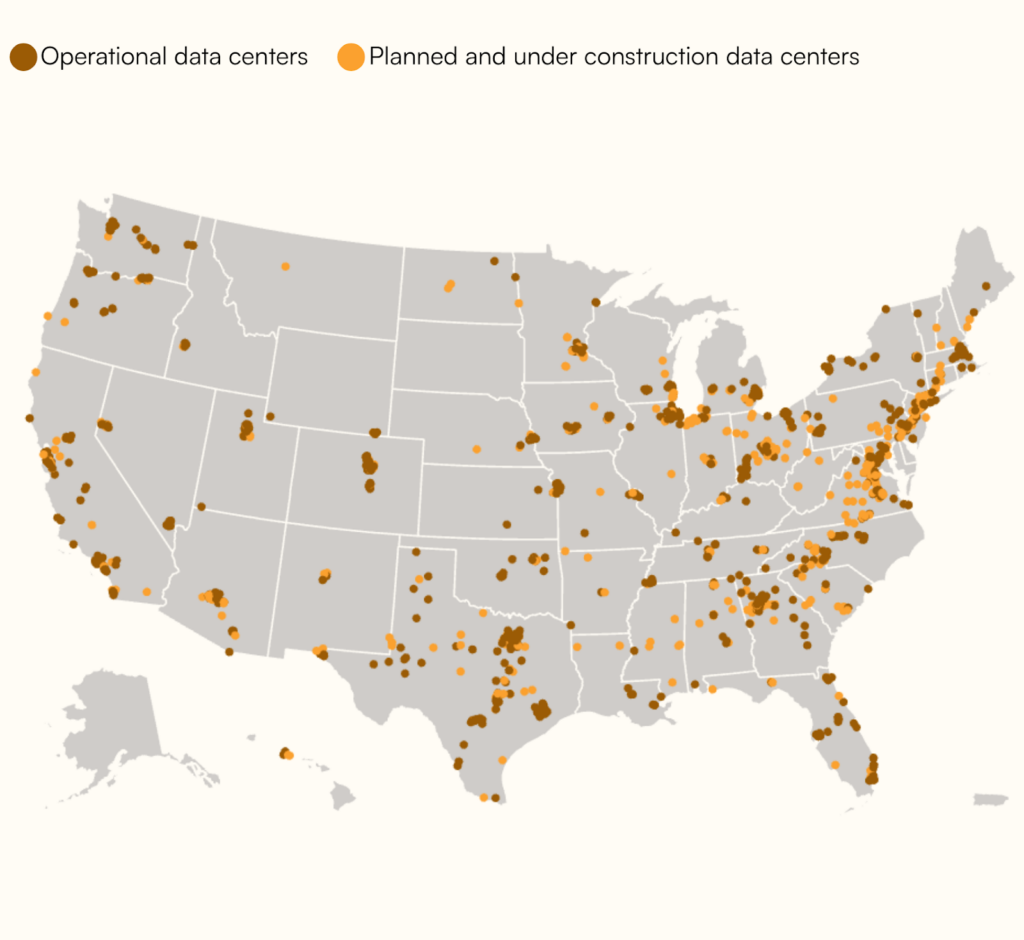

Texas Governor Greg Abbott has directed the Public Utility Commission of Texas (PUCT) and the Electric Reliability Council of Texas (ERCOT) to conduct a comprehensive audit of every data center advancing through the state’s interconnection queue, warning that projects that fail to disclose ownership, financial, water, and community-impact information could be denied grid access.
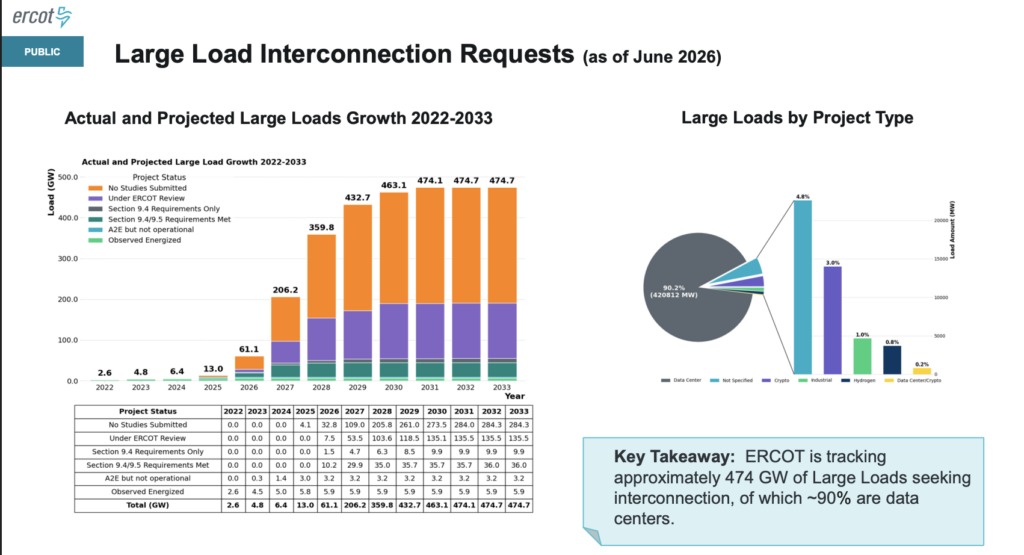
The directive, issued in an Aug. 3 letter to PUCT Chairman Thomas Gleeson and ERCOT President and CEO Pablo Vegas, arrives as the ERCOT large-load interconnection queue has surged to 474 GW—of which approximately 90% is data centers, according to testimony ERCOT delivered on July 29 to the Texas Senate.
“That is more than five times Texas’ record peak electricity demand for ERCOT,” Abbott wrote in his letter, referencing an all-time hourly peak of 91,089 MW that ERCOT set on July 22, 2026. “That unprecedented load growth could endanger the reliability and stability of the Texas electric grid.”
The audit is tied directly to non-compliance with existing state law, Abbott wrote. “The failure of some data centers to comply with the PUC’s survey measuring water and power usage under the General Appropriations Act makes this necessary,” he wrote. “Failure to fully comply with that law hinders your ability to make fully informed decisions.”
“Our top priority is to protect Texans’ safety and quality of life,” Abbott said. “Any project that fails to comply with the requirements set forth by the PUCT and ERCOT, and by state law, must be denied connection to the Texas grid. Simply put, Texans must come first.”
Second Intervention Amid SB 6 Rulemaking
Abbott’s directive arrives as the second intervention in less than two months, even as the PUCT is developing rulemaking to implement Senate Bill 6 (SB 6)—the statute Gov. Abbott signed in June 2025 that overhauls how large-load customers of 75 MW or more interconnect to the ERCOT grid.
Essentially, SB 6 amends the Public Utility Regulatory Act (PURA) to direct the PUCT to establish interconnection standards for large loads at a 75 MW threshold, requires each applicant to disclose whether it is pursuing substantially similar interconnection requests elsewhere in Texas and to disclose any on-site backup generation capable of serving at least 50% of the facility’s demand, and requires financial commitments and site control before ERCOT will study a project.
The statute also authorizes ERCOT, once the PUCT defines emergency criteria, to instruct qualifying large loads with dedicated behind-the-meter backup generation to curtail net consumption during grid emergencies after ERCOT has exhausted market services other than frequency response. Separately, SB 6 amends PURA to require transmission service providers to curtail non-critical new large loads energized after Dec. 31, 2025 during firm load-shed events, and to govern net-metering arrangements between new large loads and generation resources that were registered with ERCOT before Sept. 1, 2025. Finally, the law directs the PUCT to reexamine wholesale transmission cost allocation and to require new large loads to contribute to interconnection cost recovery. SB 6 took effect immediately on June 20, 2025, and requires PUCT implementation by Dec. 31, 2026.
The PUCT is executing SB 6 across five dedicated rulemakings, two of which are already complete. In February 2026, the commission adopted 16 TAC §25.370, which sets minimum standards for the information a utility must submit before ERCOT will include a proposed large load in its forecast. And in March 2026, the commission adopted 16 TAC §25.205, which requires PUCT approval before a new large load can be net-metered with any generation resource that was already registered with ERCOT before Sept. 1, 2025.
Then on June 10, 2026, Abbott issued his first intervention. In a letter to Gleeson and Vegas, the governor issued three directives to the two agencies: to ensure that data-center interconnections result in reduced residential electric bills, to require data centers to pay for all of their electric infrastructure costs so that no residential ratepayer is burdened by them, and to review existing PUCT and ERCOT authority to identify further consumer safeguards.
Abbott set two deadlines. The two agencies had to submit a joint memorandum by July 17 summarizing actions already taken, identifying statutory limitations, and recommending legislation for the 2027 session. In addition, the PUCT had to initiate action to reduce residential ratepayer transmission costs by July 31.
Abbott also pledged to pursue six items with the legislature next session: codifying that data centers pay their own infrastructure costs, requiring that data centers add to Texas’ electric capacity rather than only to its demand, mandating water-efficient technologies such as closed-loop cooling systems for new builds, requiring large data centers to annually report electricity and water usage to the PUCT, repealing sales-tax exemptions and other incentives for data centers, and requiring data centers to reduce impacts on neighbors through setbacks, noise-reduction technology, and similar measures. The directive, effectively, asked the PUCT to sharpen the rulemakings still in progress.
Eight days after Abbott’s letter, on June 18, the PUCT approved ERCOT’s Batch Study framework, built through Nodal Protocol Revision Request NPRR1325 and Planning Guide Revision Request PGRR145. The framework groups qualified large-load projects of 75 MW and above into a single interconnection study, and requires each applicant to post financial security of $50,000/MW by July 10, 2026, to remain eligible.
Testifying at a July 29 Texas Senate hearing, ERCOT’s Vegas said the framework is designed to deliver three outputs to each qualified project: an annual megawatt allocation from 2028 through 2032, transparency on interconnection and upgrade costs, and a coordinated transmission plan identifying the upgrades required to serve additional load. Approximately 205 GW of large-load requests are eligible for inclusion in Batch Zero based on existing studies, according to a preliminary ERCOT overview—65 GW as base load, 114 GW as allocated load, and 25 GW awaiting a final base-or-allocated determination.
For now, ERCOT plans to issue classifications by Aug. 7, complete the ensuing dispute, security-reconciliation, and data-correction process by Sept. 1, and begin the Batch Zero interconnection study no later than Sept. 2. Study results are scheduled for April 9, 2027, followed by interconnection agreements and final confirmation of capacity allocations by June 8, 2027. Projects excluded from Batch Zero—because they cannot post financial security or otherwise meet eligibility criteria—will be considered in a subsequent round that ERCOT and stakeholders have referred to as Batch One, though its start date and criteria are still being developed.
On July 17, Gleeson sent Abbott a written response developed in consultation with ERCOT, filed at the PUCT Interchange under Project 58317. The letter documents four actions the two agencies have already taken—the two adopted rules, the May 2026 transmission-cost evaluation, and the June 18 approval of PGRR 145—and identifies three rulemakings in progress: interconnection standards in Project 58481, a demand-management reliability service in Project 58482, and a follow-on transmission-cost recovery rulemaking in Project 58000. Gleeson told Abbott the commission will consider a final Project 58481 rule “later this summer.”
On July 24, Abbott released Gleeson’s letter along with three legislative recommendations for the 2027 session: expand the Lone Star Infrastructure Protection Act to cover large computational loads, require data centers to register with both the PUCT and ERCOT, and clarify the PUCT’s authority to impose reliability requirements—including direct ERCOT-to-load curtailment instructions—on large computational customers. On July 30, 2026, the PUCT advanced Project 58482 to Proposal for Publication, with a Sept. 4 comment deadline. The commission’s SB 6-mandated evaluation of transmission cost recovery had already produced a staff draft on May 4, 2026, before the June 10 directive; the follow-on Project 58000 rulemaking must be completed by the December 2026 statutory deadline.
The core interconnection-standards rulemaking in Project 58481—the rule that will set financial security, study fees, and site-control requirements for every large load requesting interconnection—remains in scoping.
Abbott’s Audit Goes Beyond Batch Zero Screening
Batch Zero, notably, already imposes several commercial-readiness gates. Applicants must submit qualifying studies, technical and dynamic models, commissioning plans, attestations, and financial security. ERCOT will also verify supporting evidence from a sample of applicants, including purchase orders for long-lead equipment, real-estate and land-use agreements, end-user agreements, and construction contracts. Projects that cannot demonstrate eligibility will be disqualified.
But Abbott’s Aug. 3 directive appears to extend that scrutiny by ordering a review of every large-load request and seeking disclosures covering ownership, water use, infrastructure needs, and community effects. Whereas Batch Zero is principally designed to determine whether projects are sufficiently advanced and technically prepared to enter the interconnection study, the new directive adds a broader examination of who is behind the projects and how they could affect surrounding communities.
During the July 29 Texas Senate Committee on Business and Commerce hearing, data center representatives generally supported stronger qualification and cost-recovery requirements, though they differed over whether Batch Zero’s existing screens would work as intended.
Chris Matos, who leads Google’s energy market development in Texas, said the hyperscaler had urged ERCOT and the PUCT to develop an interconnection process that is “both rigorous and fair,” including financial commitments calibrated to “hold existing ratepayers harmless for stranded costs.” He cautioned regulators, however, to “avoid retroactive financial penalties that could inadvertently stall mature and already advanced development.”
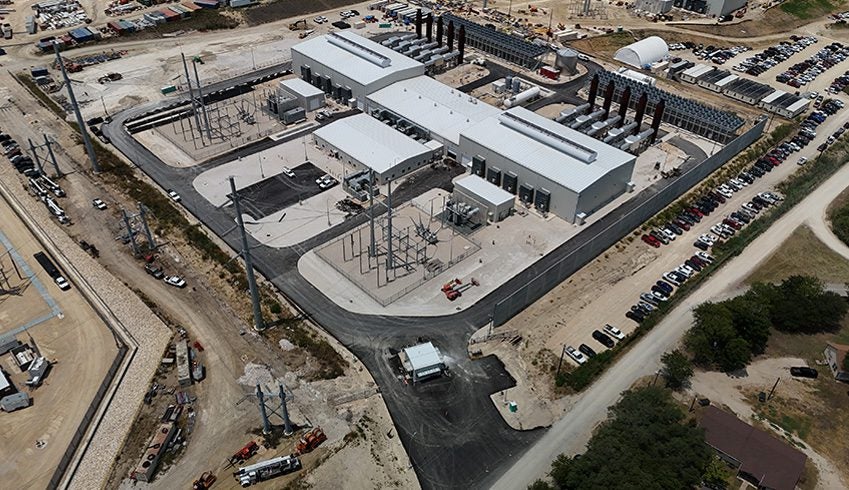
Matos noted Google had contracted for more than 7.8 GW of new grid-connected generation and capacity in ERCOT ahead of its energy needs. Matos said Google had committed “$30 million in energy impact funding to scale and accelerate energy efficiency initiatives.” Google operates established data center campuses in Midlothian and Red Oak and in November 2025 announced a $40 billion Texas investment program through 2027. As POWER reported in June, that buildout now includes the Meitner Energy Center in Gray and Roberts counties, a more-than-1-GW complex that will pair a Google data center with new wind, solar, battery storage, and on-site gas-fired generation. The facility will use air cooling instead of evaporative cooling, eliminating the cooling-tower water withdrawals typically associated with large data centers and limiting water use to domestic purposes.
Amazon Web Services (AWS) likewise endorsed requirements intended to keep large-load costs from shifting to other customers. Ray Fakhoury, an AWS energy policy manager, said the company wanted to ensure that the cost of developing its infrastructure “is not passed on to others” and committed to paying its “full cost of service.” AWS, which does not yet operate data centers in Texas but is evaluating investments in the state, also supported collateral that could be drawn when projects drop out after infrastructure has been planned or built. Fakhoury, notably, called for a broader package that includes capacity reallocation, exit fees, defined contract terms, and load-ramp requirements.
However, Compass Data Centers offered a sharper critique of the process. Cliff Pompe, the company’s vice president of power and emissions, said the queue was “being distorted from both directions,” with “ghost and transom loads being given allocation while real projects are kept out.” He also suggested “a lack of requisite criteria and inadequate prerequisite criteria” was allowing speculators to create false demand.
Compass operates a campus in Red Oak where it has invested more than $100 million in grid infrastructure, Pompe noted. In the weeks before the July 10 Batch Zero security deadline, Pompe said Compass was personally pitched more than 14 sites totaling over 15 GW by speculators who needed the company to front roughly $790 million in security deposits, which they could not post themselves. Some proposals claimed power densities two to four times the roughly 1.5 MW per acre that Pompe said legitimate hyperscale facilities rarely exceed. They were “basically impossible to construct,” he told state senators, because the available real estate could not physically accommodate the requested capacity.
Compass’s own second Red Oak project, filed with its transmission provider in May 2024, was excluded from Batch Zero. Pompe said the provider did not submit the project to ERCOT until March 2026, “nearly two years later,” even though Compass had engaged directly with ERCOT and participated in the stakeholder process throughout, supplying additional evidence of project maturity, including enhanced site-control documentation, site surveys, and $6.5 million in deposits. “We were told these requests were to demonstrate the seriousness of our project, which we were happy to do,” Pompe said. “We understood the rules proposed by ERCOT for Batch Zero were to ensure legitimate and mature projects were provided allocation. Unfortunately, as we sit today, that is not what ended up happening.”
Pompe said Compass learned the week before the July 29 hearing that the project had been excluded. Its transmission provider also told the company it was stopping work on the required dynamic-stability study while awaiting further ERCOT guidance for Batch One. ERCOT created a good-cause exemption that same day for projects that had substantially met Batch Zero’s requirements, but eligibility for the exemption required a completed transmission study. “That makes a lot of sense,” Pompe said. “But because our project had not had that study completed, we could not apply for this exemption.”
The problem, he stressed, was not the study requirement itself, but the absence of a firm deadline for the transmission provider to complete it. “The fact that our study isn’t complete does not make sense,” Pompe said. Without a firm completion date, Compass faces “real risk of this project finding itself in the same position next year during Batch One—excluded, having done everything we can and everything we were asked to do.”
Queue Scrutiny Carries Wider Power-Market Consequences
Determining which large-load projects are real is also central to decisions confronting the rest of the Texas power sector. The load that survives ERCOT’s screening will shape reliability assessments, scarcity pricing, transmission development, power-purchase negotiations, and decisions to build or retain generation. At the July 29 hearing, power-market participants warned that errors in either direction could prove costly.
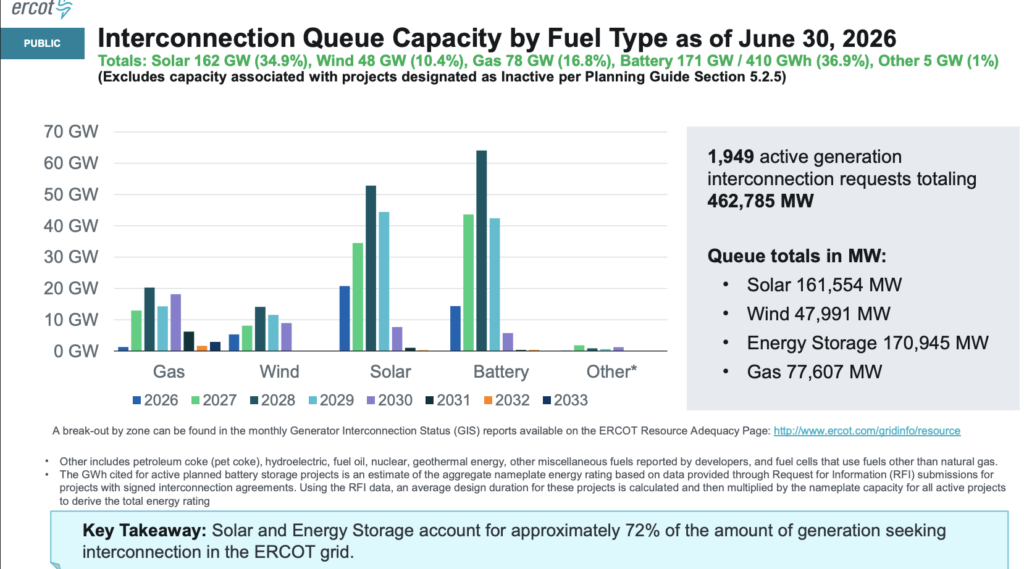
As Jeff McDonald, director of the ERCOT Independent Market Monitor and vice president at Potomac Economics, cautioned, even ERCOT’s revised midterm load forecast remains uncertain. McDonald credited ERCOT and the PUCT with bringing the forecast into “a much more reasonable range” by incorporating additional real-world constraints into the modeling. But some of its largest variables remain difficult to model.
“The AI business model and the AI revenue model in particular is still sort of in its infancy compared to other industries,” he told senators. He pointed to rising prices from major AI providers, public reports that some large users have directed employees to scale back AI use, local resistance to data-center development, and normal business cycles as factors that could suppress actual construction. ERCOT’s projection, he said, “could be considered an upper bound,” while the capacity ultimately installed and placed into commercial operation “might be considerably lower than that.”
Julia Harvey, representing Texas Electric Cooperatives, warned that even partial realization could alter ERCOT’s supply balance and wholesale prices. “Those dynamics could change quite significantly if even a fraction of the load currently forecast materializes,” she said. ERCOT could face a supply deficit in both its reliability assessments and actual operations, leaving the system dependent on large-load curtailments to preserve reliability.
While Senate Bill 6 provides mechanisms for those curtailments, Harvey warned that the associated price adjustments could produce high prices “with some frequency” if ERCOT adds more load than it can serve. She also cautioned against interpreting a modeled reliability deficiency as requiring enough new capacity to serve all projected large-load demand without curtailment. Large incremental additions “don’t fit as well in the conventional one-event-in-10-years framework,” she said, because “by design, the curtailments will happen more frequently than that.” Applying the conventional standard without accounting for those operating characteristics could impose unnecessary resource-adequacy costs on cooperative customers, she said.
The uncertainty also affects investment decisions. Walt Baum, representing Powering Texans and Texas Competitive Power Advocates, said greater clarity from Batch Zero would give generators more confidence that prospective customers are genuine. “When we get Batch Zero out there and know who it’s going to be, that is going to help spur new development because we’re going to know that these projects are real,” he said. That clarity, Baum added, could support new long-term power purchase agreements and new generation construction.
Bill Barnes, senior director of regulatory affairs at NRG Energy, said Batch Zero had already shown that financial security by itself was not enough to distinguish credible projects. The initial assumption, Barnes said, was that the queue contained applicants seeking a free option and that imposing financial requirements would clear them out. “And that is not what has happened,” he said. Instead, the process revealed a secondary market in interconnection positions and rewarded access to capital, Barnes said.
“The people with the most money are the ones that won,” he said, including applicants that partnered with other entities to secure a position. “There are going to have to be additional indicia of maturity besides just money going forward,” Barnes concluded, because money “did not have the culling effect that we thought it was going to.”
NRG also urged ERCOT to use the batch process to favor projects that improve system conditions. Barnes said transmission capacity should prioritize large loads that bring new generation or can operate flexibly as controllable resources.
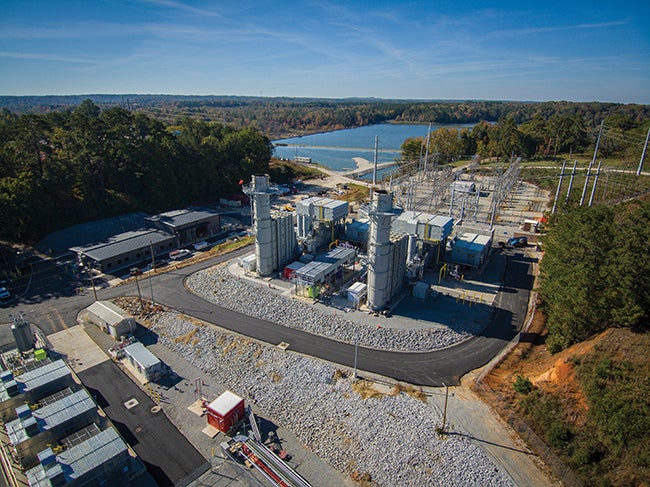
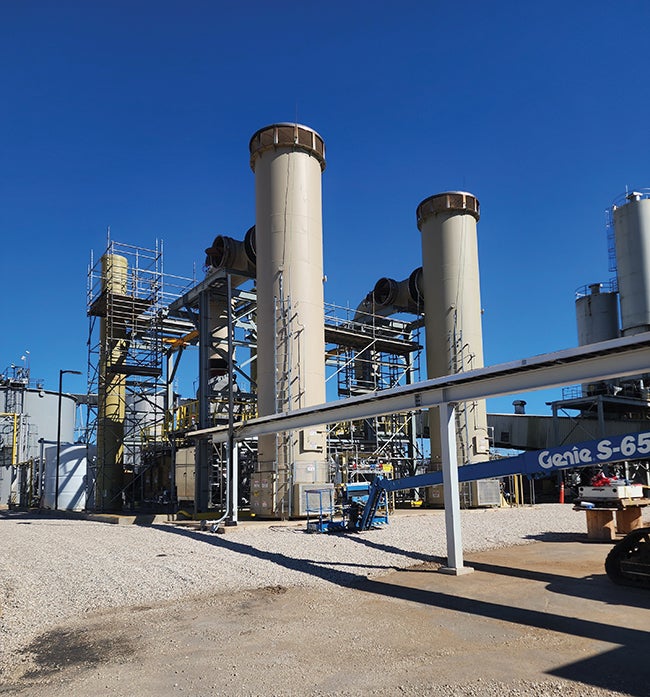
Texas is already using public incentives to expand dispatchable supply through the Texas Energy Fund. Launched in 2024, the fund provides grants and low-interest loans for the construction, maintenance, and modernization of electric facilities. Its In-ERCOT Generation Loan Program offers 20-year loans at a fixed 3% interest rate for projects adding at least 100 MW of new dispatchable capacity, with financing capped at 60% of project costs. As of June 24, 2026, the program had committed $3.65 billion to eight projects totaling 4,994 MW, including three NRG plants and projects sponsored by Constellation, Competitive Power Ventures, Vistra, Rayburn Country Electric Cooperative, and the Kerrville Public Utility Board. Completion-bonus grants had brought total ERCOT-supported capacity to 5,516 MW.
Barnes said NRG is developing three gas-fired plants totaling 1,500 MW through the fund, including two combustion-turbine projects and one combined-cycle plant. The first of those projects, a peaker, was commissioned earlier this summer at NRG’s T.H. Wharton site in northwest Houston. Cedar Bayou and Greens Bayou are targeted for 2028. Barnes argued that the interconnection process could similarly reward large loads designed to support the grid.
“We have this opportunity here where we can provide a carrot, not a mandate, but a carrot and incentive,” he said. “If you want to build a large load in Texas, if you’re going to design your site in a way that is more reliable for the consumers of Texas, then you should have an incentive. That means maybe you get access to the transmission capacity before everyone else.”
—Sonal C. Patel is a POWER senior editor (@sonalcpatel, @POWERmagazine).