 |
Vietnam’s growing economy and need for more electricity is being served by the country’s first power plant to be powered by liquefied natural gas (LNG). The Nhon Trach 3 and 4 expansion project is a finalist for a POWER Top Plant award for gas-fired generation.
Vietnam’s energy landscape is evolving, with the country experiencing robust economic growth and increasing demand for electricity. The Southeast Asia nation is seeing substantial foreign direct investment, in part due to an expansion of manufacturing across several industrial sectors.
The country is seeing more urbanization, as the population moves from rural areas to cities. Government data shows Vietnam’s population at just more than 102 million people as of June 2026, up from just more than 77 million at the turn of the century. A denser population in urban areas is driving the need for more power generation, both for commercial and residential use. The government also is focused on growing high-tech industries, including data centers and smart power infrastructure.
The International Trade Association (ITA), part of the U.S. Department of Commerce, in a report earlier this year said that according to BMI Research, Vietnam’s electricity demand will grow at an annual average rate of 7.2% through 2034. Officials have said the country needs to not only increase power generation capacity, but to also modernize transmission and distribution infrastructure. The ITA in its report said the country’s latest energy plan “estimates that approximately $62 billion will be needed for transmission investment through 2050, with around $18 billion targeted for the 2026–2030 period alone. The plan also supports the adoption of advanced grid technologies, including digital monitoring, smart grids, and high-voltage transmission solutions, to improve grid efficiency and flexibility.”
There are plans for nuclear power, but any new plants are years away, with timelines calling for nuclear power in the 2030 to 2035 time period. The country wants to increase its renewable energy output, and lessen its reliance on coal, but also recognizes the need for accelerating new utility-scale generation resources. That’s why a large part of the government’s plan is to bring more natural gas–fired generation capacity online.
 |
|
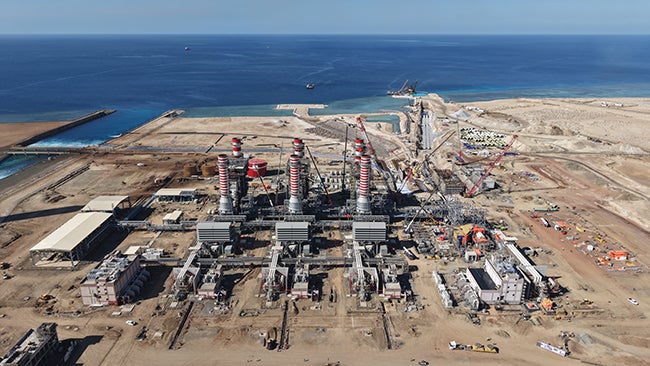
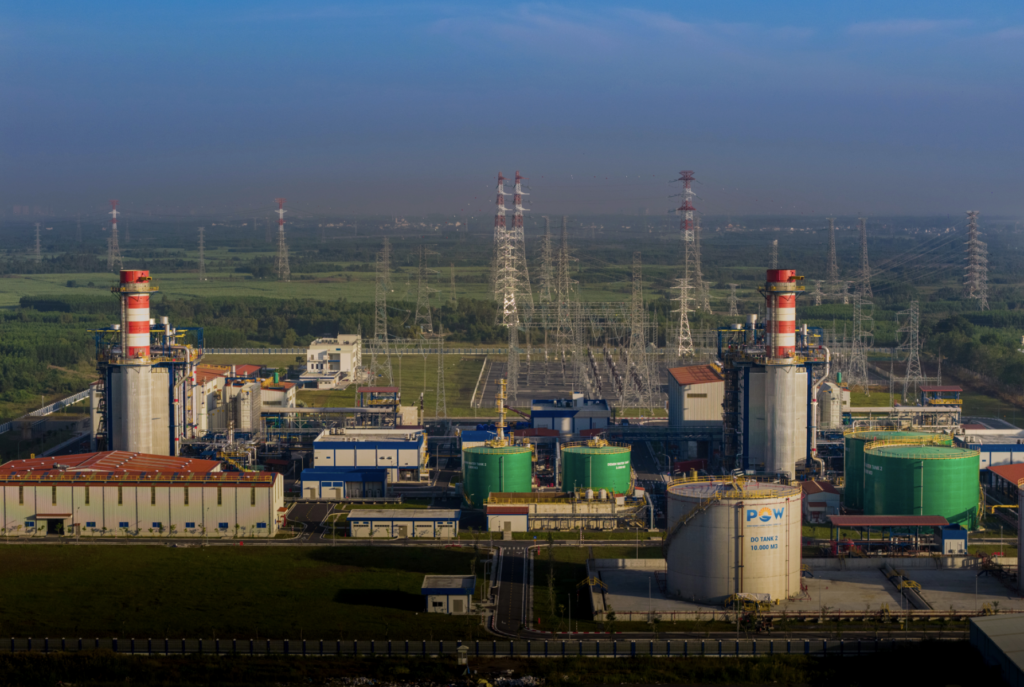
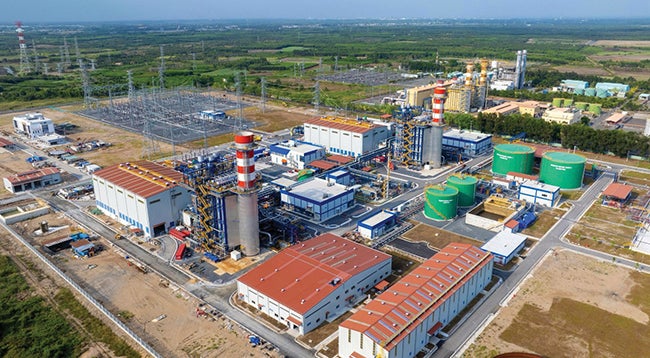
1. Unit 3 is part of a two-unit, 1.6-GW expansion of the Nhon Trach plant in Vietnam. The facility, powered by liquefied natural gas, entered commercial operation in December 2025. Courtesy: PV Power  In This IssueFull issue |
Vietnamese officials highlight the importance of projects such as two new units (Figure 1) with 1.6 GW of generation capacity at the Nhon Trach plant, owned and operated by PetroVietnam Power Corp. (PV Power). The power station is located in the Ong Keo Industrial Park in the Dai Phuoc commune, about 70 kilometers southeast of Ho Chi Minh City. PV Power said the two new units—Nhon Trach 3 and 4—at the power station are part of its Nhon Trach expansion, a series of major ongoing infrastructure and industrial projects in Dong Nai Province. The company said the new units, which entered commercial operation in December 2025, are the most prominent developments among several regional transport and manufacturing upgrades. The new units are a finalist for a POWER Top Plant Award for natural gas–fired power generation.
Landmark Achievement, Defining Milestone
GE Vernova, the original equipment manufacturer for the facility, said the new units are a landmark achievement for Vietnam’s power sector, and a defining milestone for GE Vernova’s H-class technology in Southeast Asia. Ramesh Singaram, president and CEO of GE Vernova’s Gas Power business in Asia-Pacific, told POWER, “This project is a true first for Vietnam, as the country’s first HA-powered plant and its first LNG-fired facility. For Vietnam, it marks an important step in the evolution of the national energy mix, demonstrating the role that highly efficient gas power can play in supporting grid reliability, enabling renewable energy integration, and accelerating the transition away from coal.
“For GE Vernova, it is a defining milestone for H-class technology in Southeast Asia—a strong proof point that world-class efficiency and advanced gas power solutions can be successfully deployed in Vietnam and supported through local capabilities,” said Singaram. “The project also reflects GE Vernova’s deep commitment to Vietnam through strong local partnerships, in-country manufacturing and service capabilities, and a shared vision with PV Power to deliver secure, sustainable, and future-ready energy for decades to come. GE Vernova’s repair and manufacturing footprint in Vietnam includes its Phu My repair facility and Dung Quat HRSG [heat recovery steam generator] manufacturing plant, where the Pressure Part Modules for this project were manufactured locally.”
GE Vernova in nominating the project for a POWER Top Plant Award wrote that the units establish “a new benchmark for advanced gas power generation, positioning Vietnam at the forefront of modern, high-efficiency power infrastructure in the region. The project delivers 1.6 GW of dependable baseload and flexible generation capacity to Vietnam’s southern region, directly supporting the rapidly growing electricity needs of Ho Chi Minh City and Dong Nai province. In alignment with Vietnam’s Adjusted Power Development Plan VIII, the facility plays a critical role in reinforcing grid reliability and operational stability as renewable energy capacity expands. Its combined cycle configuration enables fast response and operational flexibility, supporting higher levels of intermittent renewable integration while ensuring system resilience.”
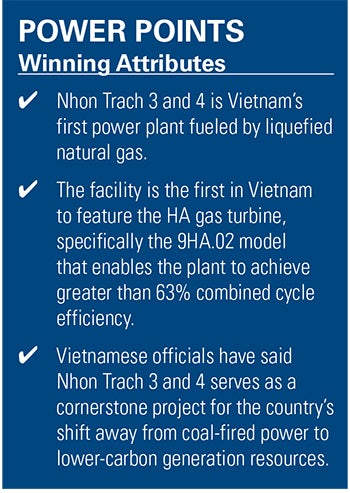
Singaram in commenting on the project said, “By utilizing the 9HA.02 turbine, the plant achieves over 63% combined cycle efficiency, placing it among the most efficient facilities globally. It sets a benchmark by balancing the ‘energy trilemma’—capacity, efficiency, and sustainability—within a single project. By providing 1.6 GW of reliable, low-carbon power, it creates a stable baseload foundation that enables the further integration of intermittent renewable energy sources into the Vietnamese grid.”
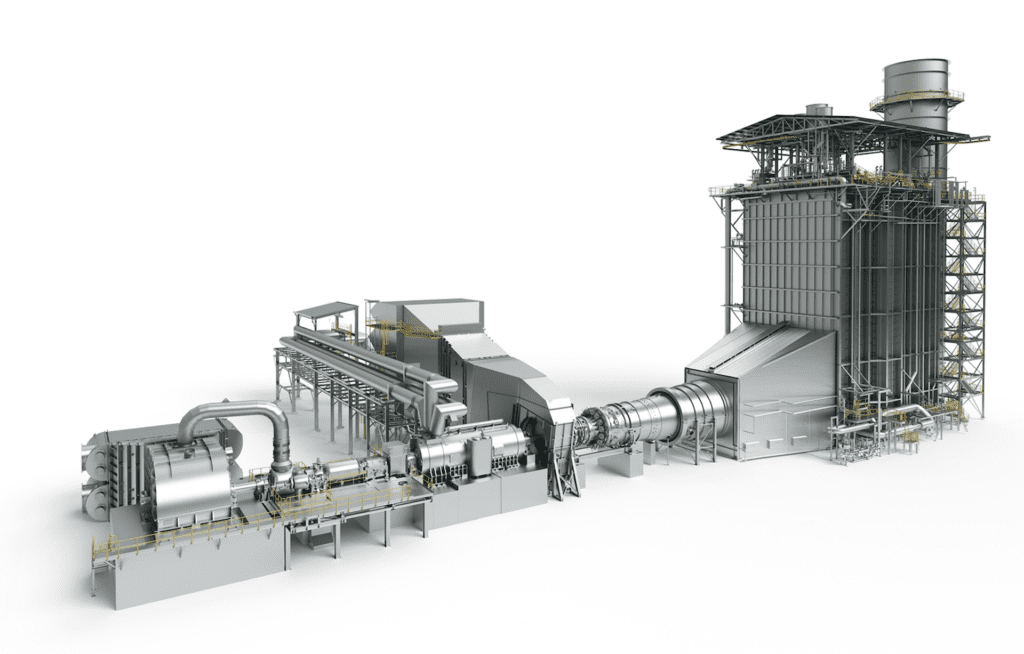
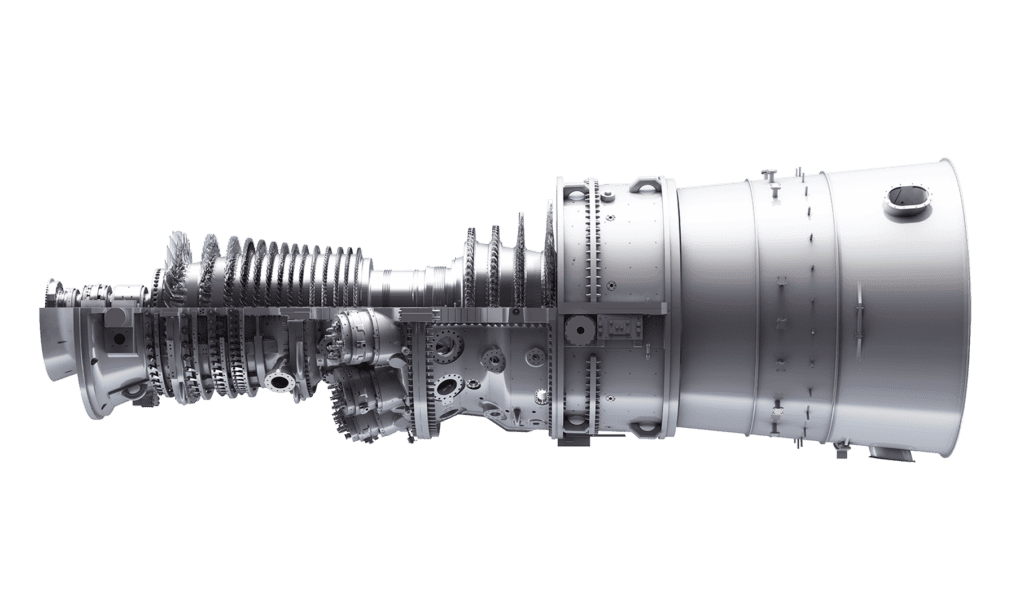
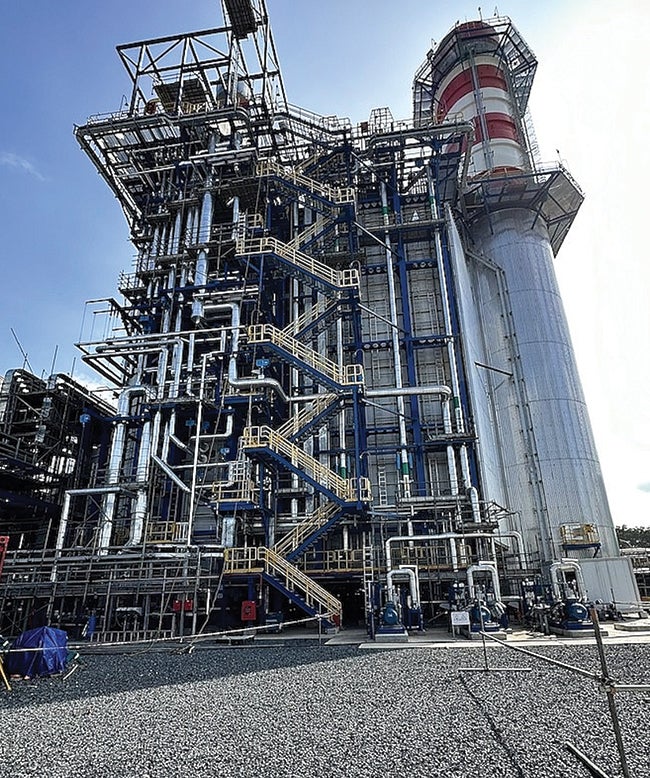
GE Vernova said the core of the plant features the company’s advanced H-class combined cycle technology, supplied as two power blocks of more than 800 MW each. GE Vernova’s scope of work on the project included the 9HA.02 gas turbines, the company’s most efficient 50-Hz gas turbine platform, paired with STF-D650 steam turbines. It also included W88 generators, and once-through HRSGs that are a key enabler in advanced water-steam cycles delivering more than 63% combined cycle efficiency, placing the Nhon Trach units among the world’s most efficient power plants.
GE Vernova said the company’s Mark VIe distributed control system provides enhanced digital visibility, high availability, and optimized plant performance, while helping reduce long-term operations and maintenance costs. The group also noted that from a sustainability and energy-transition perspective, the Nhon Trach units are a cornerstone project for Vietnam’s shift from coal-fired power generation to lower-carbon generation, aligning with Vietnam’s net-zero objectives. The company also said that beyond the technical and environmental impact, the project “reflects GE Vernova’s deep commitment to Vietnam through strong local partnerships, in-country manufacturing and service capabilities, and a shared vision with PV Power to deliver secure, sustainable, and future-ready energy for decades to come.”
Efficiency Gains
 Vu Van Loi, director for the Investment Construction Division of PV Power, said the Nhon Trach units’ efficiency are even more striking when compared to the region’s coal-fired power plants with similar generation capacity. Loi told POWER, “Yes, the Nhon Trach 3 and Nhon Trach 4 Power Plant generates approximately 61% fewer carbon emissions compared to thermal plants of equivalent output powered by coal.”
Like many of today’s new natural gas–fired power plants, including those like Nhon Trach that utilize LNG, the turbines are designed to also burn hydrogen. The units today operate on LNG, but can support up to 50% hydrogen co-firing.
Singaram noted that “the 9HA.02 turbines are currently operating on LNG,” and said “the DLN2.6e [dry low NO x ] combustion system is 50% hydrogen capable, with a future pathway toward 100% hydrogen.”
Said Loi, “For PV Power, this project is central to their commitment to modern energy standards and helps the company align with Vietnam’s national net-zero goals. Currently, PV Power is prioritizing the development of other LNG-to-power projects, such as LNG Quynh Lap and LNG Vung Ang 3, alongside renewable energy and green transition projects, as well as hydrogen and ammonia co-firing initiatives.”
Loi said Nhon Trach 3 and 4’s “1.6 GW of electricity serves the growing demand in the southern region of Vietnam, specifically targeting large industrial areas in Ho Chi Minh City and the surrounding Dong Nai province.” He also noted that “the project utilized local personnel during the construction phase, who are now employed within the plant’s operations team.” Loi said the project was built by the engineering, procurement, and construction (EPC) companies Samsung C&T and Lilama.
It’s expected that Vietnam will build more power plants based on the Nhon Trach model. According to the ITA, “[Vietnam’s] Revised 8th Power Development Plan [PDP8R], issued on April 15, 2025, indicated the important role LNG will play in ensuring Vietnam’s energy security. PDP8R set the goal for LNG thermal power capacity in 2030 at 22,524 MW, accounting for 9.5–12.3% of the country’s energy mix. In 2050, this figure is projected to rise as high as nearly 50,000 MW. It is projected that Vietnam’s demand for gas and LNG will rise by an average of 12% per year and could experience a threefold increase by the mid-2030s. While LNG demand is limited by infrastructure constraints, demand is expected to increase due to the aforementioned developments and the Government of Vietnam’s ambition to rely on natural gas as a source of reliable power.”
—Darrell Proctor is a senior editor for POWER.