Developers and contractors at a recent event described how the generation buildout is forcing earlier engineering, procurement, and construction contractor involvement; deeper supply-chain tracking; repeatable designs; more deliberate risk allocation; and tighter coordination across plant construction, fuel supply, and grid access.
At the Energy Projects Conference & Expo in Houston in June, speaker after speaker—representing the full gamut of stakeholders in the current power buildout, from developers and utilities to EPC contractors, hyperscale data-center buyers, and grid operators—described similar stakes from different vantages. While each is cognizant of the volume of announced generation, each is confronting the uncertain scale of large load guided by distinctive concerns. The seeming common thread, perhaps, is the schedule. Each is being pushed to commit earlier than conventional project development would ordinarily require.
The timing pressure, however, is multifaceted. Developers are reserving combustion-turbine production slots years in advance, but even a secured turbine position now fixes only one line on the schedule, given that transformers, switchgear, breakers, and other long-lead electrical equipment follow separate, sometimes longer, delivery curves.
At the EPC Show, contractors said owners are asking them to commit engineering resources and plan for scarce craft labor before designs are complete and risks are fully allocated. Utilities and grid planners, meanwhile, are weighing commitments against broader systemic risks, such as aging thermal fleets, constrained transmission systems, and hundreds of gigawatts of large-load requests from data centers. Increasingly, the schedule is being set less by an owner’s preferred sequence than by equipment availability, physical infrastructure, and the pace of permitting and interconnection reviews.
Earlier Decisions, Earlier Commitments
For EPCs, the crunch appears to be erasing the traditional handoff where owners developed sites and firm designs, before they then bid work. Contractors now say they are being pulled into projects at the site-selection stage, even as fundamentals—such as labor availability, water, interconnection pathways, and heavy-haul access—are still unsettled. Clients who engage early with a contractor—”which is what we love,” as Kyle Harris, business line manager at Kiewit, noted—stand to gain EPC expertise that could pre-load and test for constructability questions, such as a project’s labor supply, equipment logistics, and interconnection. “When you get a client that understands those risks and is engaging all the parties early, that’s when you have these most successful outcomes,” he said.
The same discipline has cost implications, he said. For now, turbine prices are forecast to keep rising through 2027, Harris said, and field-side constraints—including labor, sub-suppliers, and non-turbine equipment—face similar capacity limits. “In order to get cost certainty, you have to move your decision-making to the left on the timeline,” he said. “Every day that you don’t make a decision is really something that is going to drive costs up in your project or your opportunity.” That could mean locking in suppliers early—”that piece of pipe or all of that cable or that component”—before another round of demand narrows availability or raises the price, he advised.
Today, however, even an early commitment may not secure delivery, said Jeff Gulach of National Grid Ventures, who spent 36 years in EPC before moving into origination. “The supply chain is still broken. That’s the bad news. And it has been going on for six, seven years now,” he said. Gulach cited a four-year lead time on his most recent 345-kV breaker purchase and said original equipment manufacturers and distributors have retreated from delivery guarantees once backed by liquidated damages. “I hear constantly, ‘My switches were supposed to be here eight and a half months ago, and they’re not here.’ You took your eyeball probably off of the production slot, and your [purchase order] allowed the distributor or the OEM to sell your production slot.” Many projects, he added, still lack the procurement staff needed to track those positions through delivery. “I still see 300-person engineering teams and 1,200 craft heading to a major project, and then I’ll see a three-person procurement team still boarding all the stuff to keep all those people busy. Those days are over.”
A four-year breaker lead time, Gulach added, is not itself the barrier so many developers treat it as. Projects that phase construction, co-locate with existing infrastructure, and stay flexible on generation technology can absorb it. The projects that cannot, he said, are the ones that carry a rigid single-technology assumption and a fixed in-service date through years of development, only to discover late that the equipment underpinning both is not available on the schedule the contract requires.
Standardization Meets Uncertainty
Another shift in EPC work is the pull from two very different customer strategies. While utilities are seeking repeatable designs to reduce execution risk, hyperscalers are asking developers and contractors to commit to loads that remain difficult to define years in advance.
Entergy Louisiana is pursuing the first approach. CEO Phillip May said the utility has roughly 26 turbines available to meet projected growth and plans to deploy them through a repeatable combined-cycle design. “We’re stamping out these things, we’re building the same CCCT [combined-cycle gas turbine] over and over again,” May said. A crucial benefit of that approach is that it could give skilled craft “five, seven, 10 years of job certainty” across a fleet concentrated in one region, he said.
For hyperscalers, meanwhile, the schedule is fixed far earlier than the eventual load profile. Jason Altobelli, director of energy and infrastructure partnerships at Google, said the company is building data centers “two to three times, in some cases even more than that, than what we built even a couple of years ago,” under infrastructure commitments extending 20 to 30 years. “Our central problem is that we effectively designed 20- to 30-year agreements for facilities that are hosting products that don’t exist yet,” Altobelli said. “So demand forecasting for those products is hard. The cone of uncertainty widens pretty dramatically five-plus years out. We don’t know what the utilization is going to be, we don’t know to what extent the chips will be optimized.”
Google’s approach is a “bifurcated energy strategy,” Altobelli explained. High-confidence load goes into regulated utility markets, while more flexible or expansion load goes into deregulated markets, such as in the Electric Reliability Council of Texas (ERCOT), where Google can accept lower take-or-pay commitments, add onsite generation and self-supply, and resell any underutilization on the wholesale market. “We’re going to preserve our optionality there,” he said.
Some hyperscale buyers, meanwhile, are going even further, moving to absorb procurement and prefabrication, a scope that has historically belonged to EPC contractors or utilities. Travis Wright, vice president of energy and sustainability at QTS Data Centers, said his company keeps roughly “$18 billion in materials ready for deployment to any one of our data centers.” QTS builds “the same 3-MW chunk over and over and over again,” Wright said, and stocks “utility-scale transformers, breakers, switches, things that we can actually supply to our utilities to get us online faster,” alongside turbines. The company’s quick-build strategy also relies heavily on modularization, including entire electrical rooms fabricated off-site and trucked in for installation. That’s part of a program that lets QTS put up 7 million square feet of data center in 18 months, he noted.
Wright notably also pointed to a design change now beginning to emerge in the hyperscaler community as a direct result of grid physics. Some U.S. data centers had been designed to shift the entire site to on-site battery power for a couple of minutes on small grid disturbances before rolling to diesel generators, then reconnecting once the grid stabilized. The problem, Wright said, is that when many sites executed that transfer at the same instant, “suddenly 2 GW of power dropped off of the grid instantly, all at the same time, because there’s a whole bunch of data centers that did that.” In July, the Federal Energy Regulatory Commission directed the North American Electric Reliability Corporation (NERC) to develop mandatory reliability standards requiring large computational loads to ride through voltage and frequency disturbances rather than tripping off. “You’re going to need to ride through those things.” The implication, Wright noted, is that batteries and other ride-through capability will have to be engineered into the data center itself, which may change how QTS and its peers design new sites and how their EPCs sequence electrical work.
Large-Load Queue Tests Project Timelines
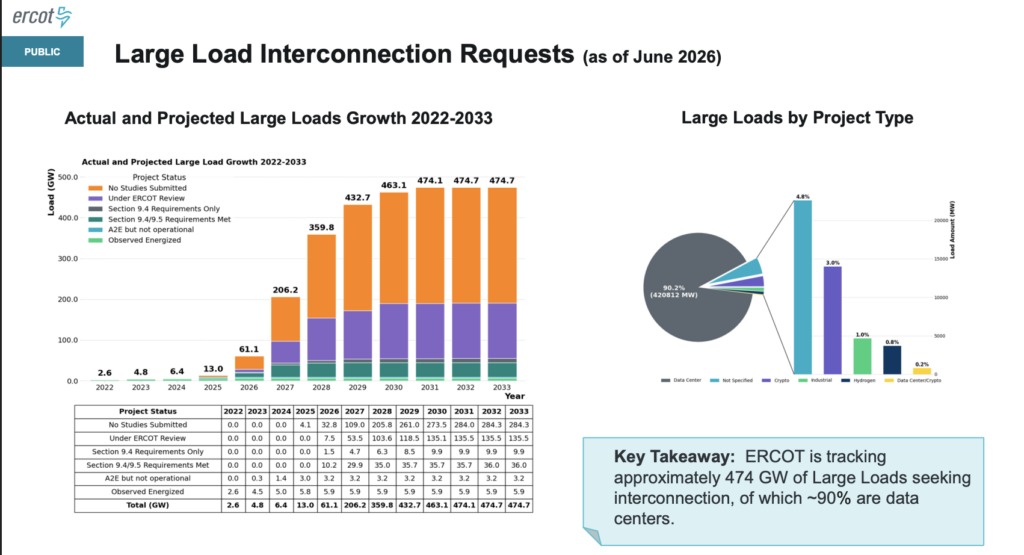
Meanwhile, as several speakers noted over the course of the event, even a well-executed owner–EPC package still has to connect to a grid on terms that align with transmission access, interconnection timing, and the project’s commercial schedule. That commercial risk is perhaps most visible in Texas, where peak demand hovers near 91 GW (Texas set a new record on July 22, 2026). At the EPC Show, ERCOT Chief Operating Officer Woody Rickerson pointed to a large-load queue of roughly 438 GW as of June, of which almost 90% is data center load. That queue has since grown to approximately 474 GW. Only about 7 MW of that large-load queue has actually energized, Rickerson said.
At the same time, roughly 40% of ERCOT’s thermal fleet is more than 30 years old, Rickerson said. Effective load-carrying capability (ELCC)—the share of nameplate capacity a resource can be counted on to deliver at peak—also varies sharply by resource: about 94% for nuclear, 76% for solar in winter, and 22% for wind. Gas capacity in ERCOT’s models, meanwhile, has climbed from around 65,000 MW at the time of the conference to roughly 78,000 MW by late July, according to testimony from ERCOT CEO Pablo Vegas delivered to the Texas Senate Committee on Business and Commerce on July 29.
ERCOT, notably, has moved to sort large-load projects by which ones can actually be energized. On June 18, the Public Utility Commission of Texas (PUCT) approved ERCOT’s Batch Study framework, built through revisions NPRR1325 and PGRR145, which groups qualified large projects of 75 MW and above into a single study. Vegas in July said the framework is designed to deliver three outputs to each qualified project: a year-by-year megawatt allocation between 2028 and 2032, transparency on the interconnection and upgrade costs, and an actionable transmission plan identifying where new lines have to be built to serve loads that cannot be accommodated on the existing system. Roughly 205 GW of large-load requests are currently eligible for inclusion in Batch Zero, Vegas told the committee—65 GW classified as “baseload” projects with a clear five-year energization pathway, 114 GW as “allocated” projects requiring new transmission, and 25 GW awaiting final classification. ERCOT plans to issue Batch Zero classifications no later than Aug. 7, 2026, and the interconnection study itself begins no later than Sept. 2. PUCT Chairman Thomas Gleeson, testifying alongside Vegas, said the batch approach was designed to end what he called a “doom loop of restudy,” in which project-by-project reviews had made effective interconnection impossible.
Still, another structural fix remains: transmission. ERCOT’s board has approved a set of 765-kV lines across the Permian Basin—the operator’s first extra-high-voltage build—with a target in-service date as early as 2029. The alternative, Rickerson noted, would have been three or four parallel 345-kV corridors. Beginning in 2027, ERCOT will fold its Regional Transmission Plan, its Regional Planning Group process, and its new large-load interconnection process into a single Comprehensive Transmission Plan. Cost of service in Texas has risen every year since 2015, Rickerson said, but cost per megawatt-hour has stayed roughly flat.
Planning projects against this dynamic backdrop has been cumbersome. As Alice Jackson, a former president of Xcel Energy – Colorado and later chief planning officer of Xcel Energy, now vice president of Grid Modeling at Bill Gates-backed Breakthrough Energy, stressed at the EPC Show, “every single model that is run is wrong. I’ll say that again, every single model that you run is wrong. It’s a matter of to what degree.” Capacity-expansion models typically resolve down to only two representative hours per month, which makes it structurally hard for long-duration storage or nuanced flexibility to show up in the results utilities and regulators rely on. Breakthrough Energy is trying to seed what Jackson described as an open-source planning ecosystem—a Linux-to-Microsoft alternative to the proprietary tools that dominate transmission and resource planning today.
The Labor Long Pole
Even the best planning tools, however, cannot substitute for skilled labor. Some QTS campuses may require 5,000 workers for five years, Wright noted. At Cedar Rapids, where QTS is developing a $10 billion, seven-building campus—the largest economic development in Iowa’s history—the project workforce has reached 14,000, filling nearby hotels and short-term rentals.
In the power sector, which has long anticipated a demographic squeeze in the skilled trades, labor has now evolved into the ultimate interruption, as Matt Pistner, president of NRG Wholesale, noted. “If you go back 12 months ago, all anyone wanted to talk about was, if you don’t have a turbine, you don’t have a power plant, and that’s true,” he said. NRG is building three plants in the Houston area—two peakers and a combined-cycle unit—backed by the Texas Energy Fund. Transformers and high-voltage switchgear have since emerged as additional constraints, Pistner said, but equipment alone does not produce a plant. “If you don’t have the labor to put the steel in the ground, it’s going to be a really expensive way,” he said. “You can just have an expensive inventory sitting there waiting for someone to show up.”
 |
| 1. NRG’s T.H. Wharton peaker plant expansion in Houston, Texas, came online at the end of May 2026, the merchant generator’s first new plant in a decade. Courtesy: NRG Energy |
The trouble is, as Pistner explained, 20% to 30% of workers in NRG’s critical craft roles—including welders, electricians, and other skilled trades—will be eligible to retire within five years. Nationally, he estimated, roughly 450,000 high school graduates would need to enter the trades each year simply to offset attrition, before accounting for the current buildout. Turnover is also affecting quality. “The ability to keep a high standard on quality is getting tougher and tougher, and so we’re seeing a lot of rework, a lot of missed connections,” he said. “This knowledge transfer, what it takes to someone that’s kind of 30 to 35 years of experience and seeing it all, and now we have this new class of employees coming in, and how do we get that transfer down? It’s going to be a critical solution. We’ve got to figure out. We’re going to miss a material opportunity here.”
Talha Faiz, cofounder of Candid Intelligence, a Seattle-based AI firm focused on compressing pre-construction engineering, argued that the labor crunch is as much a workflow problem as a headcount problem. Owners and EPCs, he said, need to preserve senior engineers’ judgment while also giving younger engineers a way to reach that level of performance without waiting 20 or 30 years. “There has to be a mechanism for us to not just understand and capture the value from previous projects, but make sure that we deliver this to the next stage as well,” Faiz said. By structuring and automating the most repetitive design work, he suggested, artificial intelligence could carry that project knowledge forward in a usable form. Otherwise, he warned, the squeeze will cascade down the value chain into procurement, engineering, and construction.
From Bid to Partnership
Finally, in a trend that has taken on a more solid shape over the past few years, the combined pressure of compressed schedules, unresolved supply-chain constraints, and uncertain load profiles is reshaping EPC contracts. The big new change is that owners are buying more of the plant directly than was historically typical, said Zachry Group Senior Vice President and Power Market Executive Mike Kotara, who leads business development for power, nuclear, and data centers.
“In the past, they typically would buy the combustion turbines, maybe the steam turbine, typically leave the [heat] recovery steam generators, other equipment, balance of plant equipment for the EPCs. Now, what they’re having to do is go out and buy extended scope packages,” Kotara said on the Energy Project Development Panel. Items still left to the contractor—power distribution centers, air-cooled condensers—require enough engineering to specify that procurement runs ahead of the EPC contract itself. “You’re doing that under maybe a limited notice to proceed that allows you to buy equipment at risk, at the owner’s risk. Obviously, the EPC can’t take on that risk, so you have two things that are working against each other that have really turned the entire development process kind of on its ear,” he said.
NRG, like several other developers, meanwhile, is moving in a different direction. NRG last year announced a 5.4-GW partnership with Kiewit built around GE Vernova turbines and a standardized EPC design intended for repeated use across projects. “I think we’ve moved from kind of transactional-based to partnership-based across almost the entire platform of what it takes to go from concept to electron,” Pistner said. “Doing it kind of one-off, transactional is going to be an incremental slowdown to your ability to get moved quickly.”
Chevron is also dividing work differently, though not to dilute accountability. The company has begun breaking single EPC scopes into multiple contracts, said Manish Misra, general manager of capital projects at Chevron. While that can make individual packages more manageable, it leaves the owner responsible for coordinating the interfaces among them.
Misra linked that reallocation to the industry’s baseline safety record. The Bureau of Labor Statistics data still puts the significant-injury rate at roughly one in every 150 workers each year, he noted. Roughly half of those injuries, he said, fall into OSHA’s “focus four”: falls, struck-by, caught-between, and electrical incidents. Chevron’s answer has been to standardize aggressively, including cultivating identical “trains” of equipment repeated across projects, a documented “minimum functional case” that forces every added enhancement to justify itself, and enough repetition that field crews reach expert proficiency by the seventh train. That discipline, he argued, is what allows the company to break EPC scopes into smaller pieces without losing control of the interfaces between them.
“How can you take the risks out of the system and not just look for a supply chain partner or a business partner to trust those risks and try to get through that?” Misra said. Owners and contractors still need to answer for the work they control, he said, including safety, execution quality, and cost. “Safety, reliability, quality, and cost rise and fall together,” he said. “I’ve never been to a job site that is safe but not good, or vice versa.”
—Sonal C. Patel is a POWER senior editor (@sonalcpatel, @POWERmagazine).