
Texas Gov. Greg Abbott’s Aug. 3 order pausing all new data center connections to the Electric Reliability Council of Texas (ERCOT) grid until a comprehensive audit is complete could delay 49.8 GW of new data center electricity demand from advancing on the ERCOT system—nearly 20% of the U.S. development pipeline—BloombergNEF (BNEF) said in an Aug. 5 report.
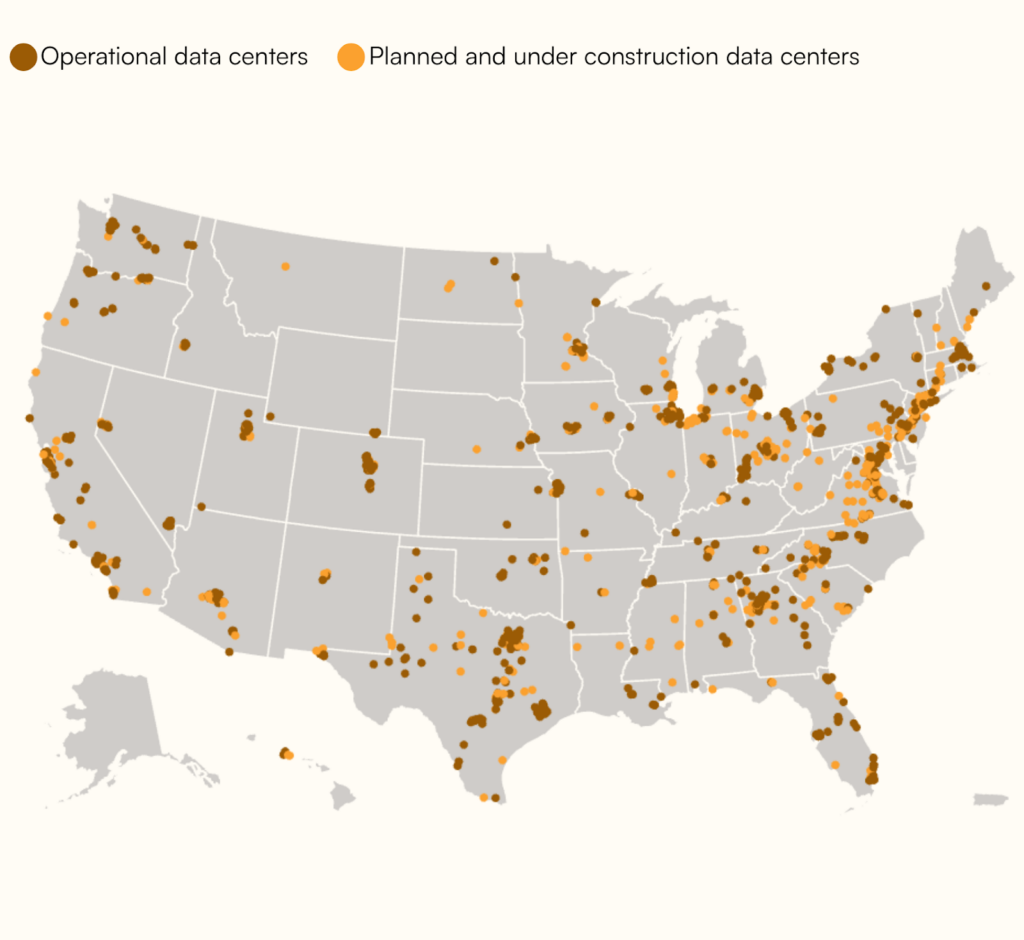
The exposed capacity equals “almost 20% of the U.S.’s 253-GW data center pipeline,” according to the New York–based research firm’s report, authored by senior policy associate Derrick Flakoll, senior associate Nathalie Limandibhratha, and Head of Technology and Innovation Mark Daly, with editor Kamala Schelling. BNEF forecasts 1.2 GW of total ERCOT data center capacity additions between 2Q 2026 and 1Q 2027. Its scenario models a three-month-long delay across the 3Q 2026 through 1Q 2027 subset of those additions, which are assumed to slip to 2Q 2027. Under those assumptions, delays could cost projects “just over $8 billion cumulatively by 1Q 2027 if a supermajority of 60% of delayed capacity is AI-related,” rising to roughly $15 billion in a full-delay case under a 100% AI-compute mix.
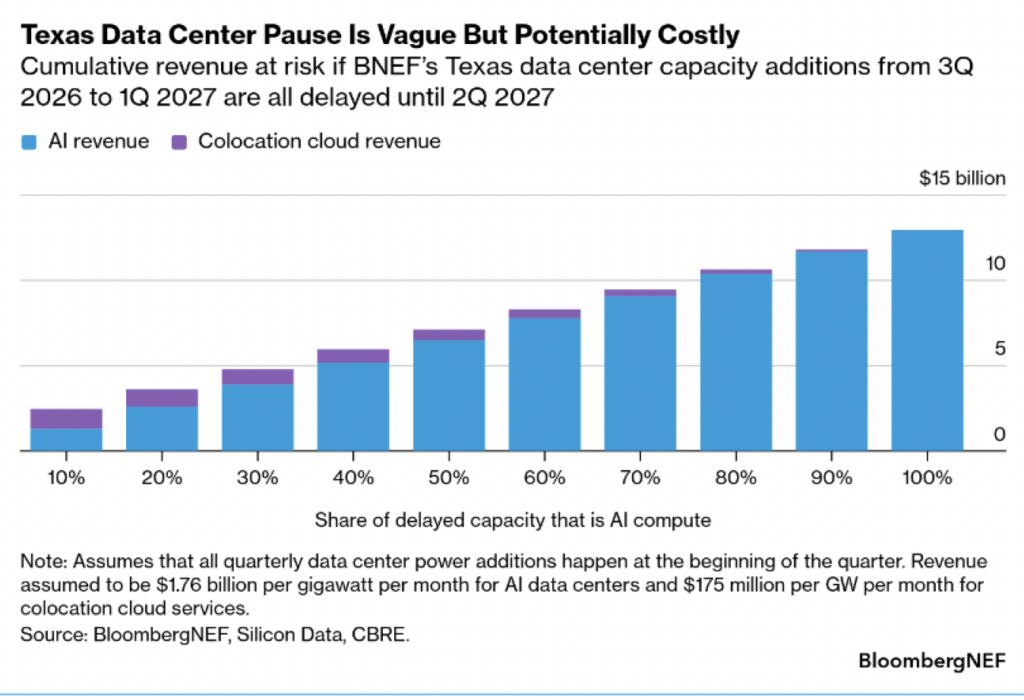
Cumulative revenue at risk climbs with AI-compute share, from about $2 billion at a 10% AI mix to nearly $15 billion at a 100% mix, assuming Texas data center capacity additions forecast for 3Q 2026 through 1Q 2027 slip to 2Q 2027. Source: BloombergNEF, Silicon Data, CBRE. Courtesy: BloombergNEF.
A Political Action?
Abbott’s directive, first reported by POWER on Aug. 4, ordered the Public Utility Commission of Texas (PUCT) and ERCOT to verify and audit every data center project in the interconnection queue—roughly 474 GW of pending large-load requests, about 90% of them data centers—before any additional projects advance. Within hours, ERCOT issued Market Notice M-A080326-01 suspending the first scheduled deliverable of its new Batch Zero large-load interconnection process.
“Based on the directive in the Governor’s letter, ERCOT will not notify each Interconnecting Distribution Service Provider and Transmission Service Provider of how any Large Load is classified in the Batch Zero Interconnection Study by August 7, 2026,” the notice states. ERCOT said it will file “a request for a good cause exception related to the timelines and process for Batch Zero set forth in ERCOT Planning Guide Sections 5 and 9” in advance of the PUCT’s Aug. 20 open meeting.
Abbott cast the audit as a reliability action. ERCOT’s 474-GW queue is “more than five times Texas’ record peak electricity demand,” and “that unprecedented load growth could endanger the reliability and stability of the Texas electric grid,” the governor wrote in his Aug. 3 letter to PUCT Chairman Thomas Gleeson and ERCOT President and CEO Pablo Vegas. He also cited a compliance failure already on the record: “The failure of some data centers to comply with the PUC’s survey measuring water and power usage under the General Appropriations Act makes this necessary. Failure to fully comply with that law hinders your ability to make fully informed decisions.” Abbott further pointed to “recent legislative hearings and public meetings” that “raised important questions regarding the impact of data centers on the grid and on the local communities in which they operate or seek to operate.”
However, BNEF suggests the audit is politically tilted. “Abbott is facing reelection in November this year, and the pause is likely intended to take the controversial data center issue off the table until after the voters have their say,” the report states.
The governor’s letter followed “a weeklong lobbying push against data centers in the state, including a contentious 15-hour public hearing and a call from Abbott’s lieutenant governor, a fellow Republican, to pause $33 billion in planned power grid spending that would boost transmission capacity to western Texas data centers as well as Permian oil and gas production,” the BNEF report says.
Abbott, it notes, had recently called Texas “the epicenter of AI development” after Google’s $40 billion investment announcement. “Community opposition is becoming a material constraint on data center development, even in markets that have actively courted the industry,” BNEF adds.
Abbott’s action extends a pattern of gubernatorial data center restrictions in 2026. New York Gov. Kathy Hochul on July 14 signed Executive Order 62, the nation’s first statewide moratorium on new hyperscale data centers of 50 MW or more, directing the New York Department of Environmental Conservation to hold pending permits in abeyance while the Department of Public Service prepares a Generic Environmental Impact Statement. Illinois Gov. JB Pritzker on June 5 directed the state’s Department of Commerce and Economic Opportunity to pause processing of Data Center Investment Program agreements starting July 1, after the Illinois General Assembly failed to advance legislation on data center energy and water disclosure and cost allocation.
In May, Florida Gov. Ron DeSantis signed Senate Bill 484, which became effective on July 1, that defines large-scale data centers as facilities with anticipated monthly peak load of 50 MW or more, prohibits utilities from shifting their service costs to residential and small-business ratepayers, requires public disclosure of development deals, bars ownership by “foreign countries of concern,” and preserves local zoning authority to deny projects outright.
While none of the three state actions carry implications for interconnection queue capacity comparable to ERCOT’s 474 GW, Abbott’s Aug. 3 action is also an audit/verification precondition, not a moratorium.
Batch Zero Could Bear the Direct Impact
However, BNEF is blunt about the audit’s design deficit. “While it is not entirely clear what the audit would entail, it could include collecting and reviewing info related to power and water use, on-site generation, cooling technologies, ownership, state and local financial incentives, and community impacts.”
Most data centers are “already required by Texas’ Senate Bill 6 or other laws and regulations to submit most of the information the governor requested,” the report notes. However, the audit could add fresh disclosure obligations on top of SB 6’s existing site-control documentation, $50,000/MW financial security, disclosure of duplicative interconnection requests at other sites, and on-site backup generation reporting—requirements the PUCT is still writing into 16 TAC § 25.194, with adoption anticipated in September 2026. BNEF expects a slow process. “The context around the announcement suggests that scrutiny could be strict and the pause could last months,” the report states.
A prolonged audit could collide with the next legislative session, BNEF warns. “The longer that audit and verification take, the greater the risk that legal changes could derail Texas’s data center boom. If the process is particularly onerous, it could continue into the state legislature’s new session in 2027, and potentially as late as April,” BNEF writes. That window “would create additional opportunities for the Texas legislature to change the existing SB6 framework to further restrict data center build-out.”
The BNEF report suggests the audit’s real target may be Batch Zero. SB 6 rulemaking remains on target for the PUCT’s separate December 31, 2026 statutory deadline. BNEF describes Batch Zero as “a new large-load interconnection process, approved in June, that allows the operator to assess projects in batches rather than individually,” and notes that ERCOT’s system could “serve as a model for grid operators” facing rapidly expanding data center queues.
“The point of Batch Zero is to allocate reliable capacity and transmission more efficiently—or in other words to speed up the connection process. The latest publicly available estimates show 204 GW of load eligible for study under the Batch Zero process, with another 294 GW applying for interconnection but not eligible for Batch Zero. Some 90% of this 474 GW large load pipeline comes from data centers,” BNEF writes. For scale: “the total peak demand in ERCOT is 91.3GW, meaning that the interconnection queue is five times the size of peak demand,” it stresses.
The implications could extend both ways on ERCOT’s demand outlook, it suggests. “BNEF’s 2030 ERCOT forecast could be revised significantly higher if Batch Zero proceeds as planned. The current methodology assumes historical development timelines, while Batch Zero could shorten interconnection, one of the longest and most consequential stages in the development process. Conversely, the new audit could delay projects and weigh on the forecast by introducing an additional pause in development.”
Behind-the-Meter Hedging, but Not for This Cycle
The revenue-at-risk range BNEF reports—just over $8 billion cumulatively by 1Q 2027 in the 60% AI-supermajority case, and roughly $15 billion under a full 100% AI-compute mix—rests on two rental benchmarks the firm sources to industry data. “Even a colocation-powered shell for traditional cloud racks in Dallas can earn up to $175 million per gigawatt of capacity per month to rent, according to CBRE data,” the report states. “BNEF analysis—based on graphics processing unit (GPU) rental costs from Silicon Data—estimates that AI compute capacity could earn around $1.76 billion per GW of capacity per month.”
The scenario chart assumes “all quarterly data center power additions happen at the beginning of the quarter” and that ERCOT capacity additions from 3Q 2026 through 1Q 2027 are pushed to 2Q 2027. Revenue exposure scales with the AI share of delayed capacity, running from under $2 billion at a 10% AI mix to roughly $15 billion at 100%.
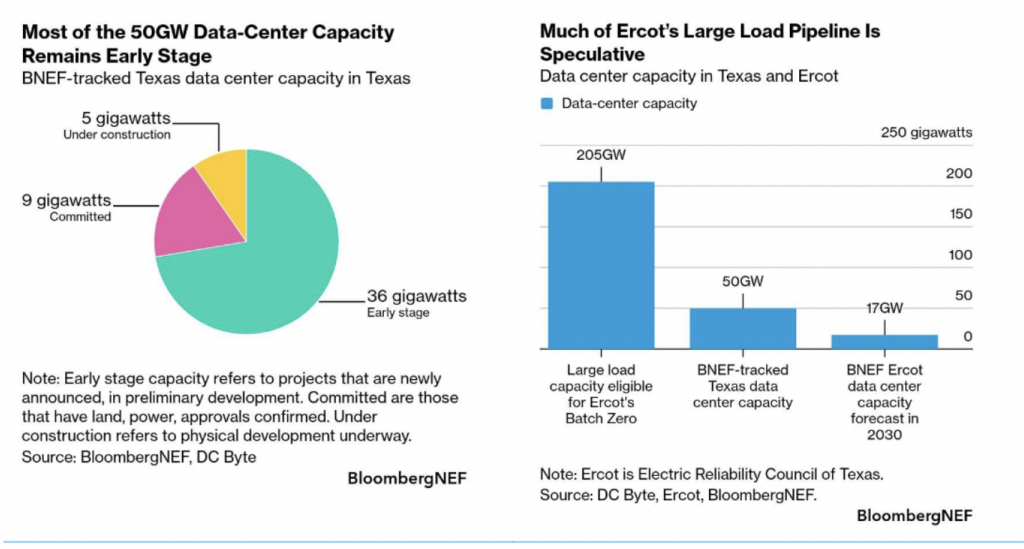
BNEF also flags an important modeling limitation: “Load cannot be neatly separated between traditional cloud services, cryptocurrency mining, and artificial intelligence.” It notes that the operational forecast is a small fraction of the pipeline it counts. The firm estimates “that an additional 8.25 GW of data center capacity will come online in ERCOT through 2030, bringing the total to 17.2 GW.” Its tracked Texas project pipeline totals 50 GW, but “72% of the capacity is still at an early stage, and Fermi America’s 10 GW data center is in Texas but not in ERCOT.”
A companion chart, sourced to BNEF and DC Byte, disaggregates the 50 GW into 36 GW early stage, 9 GW committed, and 5 GW under construction. The gap between BNEF’s 17.2-GW installed forecast for 2030 and the 204 GW of large-load capacity eligible for Batch Zero is the analytical core of what BNEF calls a queue that “is speculative and doesn’t have much project transparency.”
For now, the audit is unlikely to trigger a near-term shift to on-site generation among developers already in the queue. “A delay until April or May 2027 is not long enough for data centers to buy and build behind-the-meter generation on-site as a hedge against delayed grid interconnection,” BNEF writes.
“Any new legislation next year would also impact the 294 GW of large load interconnection requests that were not eligible to participate in Batch Zero, and could encourage those later data centers to build more on-site generation and storage as a hedge against the interconnection process.”
Industry and Legal Reactions
Following the directive this week, several stakeholders put out reactions. POWER’s Aug. 4 coverage tracks initial industry, regulatory, and legal responses.
QTS Data Centers, a Blackstone portfolio company and one of the largest U.S. hyperscale operators, endorsed the audit in an Aug. 6 statement. “Texas has become a global leader in technology and innovation, and now, Texas is leading the national path forward for how to meet growing demand for digital infrastructure while protecting residents, businesses and ratepayers from rising power costs,” said Co-CEOs Tag Greason and David Robey in a joint statement. “We welcome Governor Abbott’s leadership and look forward to working with him to establish clear guardrails for the industry and help ensure all providers operate with a commitment to transparency, accountability and responsible growth.”
QTS’s statement listed operating commitments the company said pre-date the audit—including that data center energy costs are billed separately from residential ratepayers, a 2019 pledge to build data centers that “consume no water once operational,” and community investment programs. It argued the audit’s disclosure categories should be readily satisfied by operators already meeting those standards.
Troutman Pepper Locke’s energy team, in an Aug. 4 client alert by John K. Arnold, Brandon Lobb, and Rachael Beavers, directed clients to review contract exposure. “Real estate investors and developers with land under contract, option agreements, or purchase commitments tied to data center development schedules should review those agreements carefully, with particular attention to change in law, force majeure provisions, milestone extension rights, and termination triggers,” the firm wrote. “Whether a regulatory moratorium of this nature qualifies as a change in law or force majeure event will depend on the specific language of each agreement.”
The firm also flagged the January 2027 convening of the 90th Texas Legislature as the next opportunity for statutory changes to data center regulation, noting that “the PUCT has indicated it will seek expanded statutory authority to regulate the data center industry, and the governor’s sustained engagement with this issue over recent months suggests strong support for that effort.”
—Sonal C. Patel is a POWER senior editor (@sonalcpatel, @POWERmagazine).