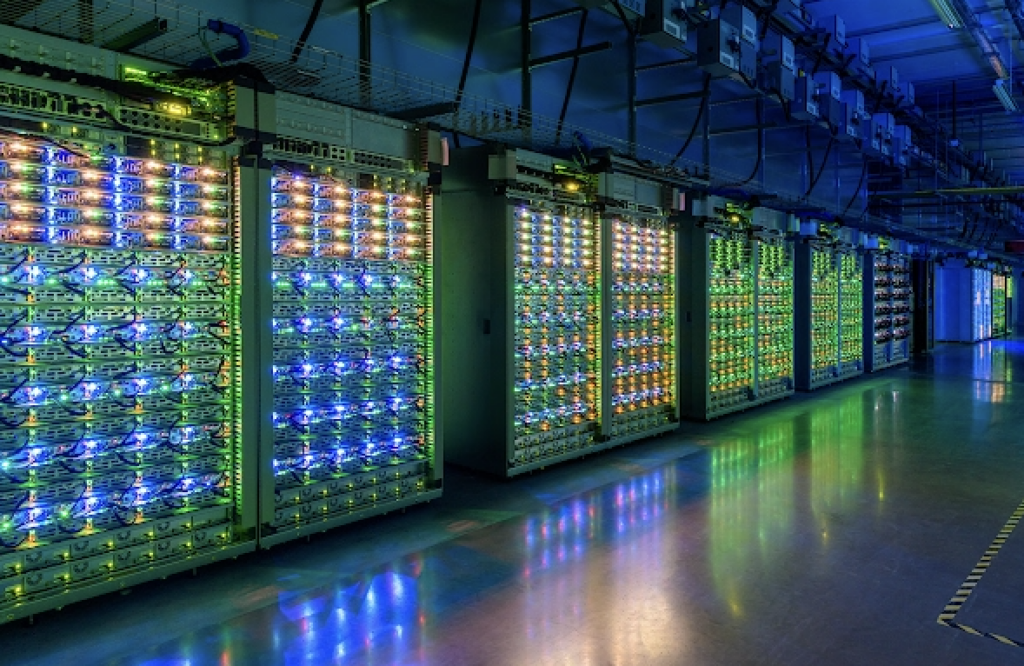

The explosion of artificial intelligence (AI) computing is, for most utilities, a problem to be absorbed: gigawatts of new data-center demand arriving faster than transmission can be planned or built. The U.S. Department of Energy’s (DOE’s) Genesis Mission does not dispute that framing. But buried in the national research portfolio it unveiled July 22 is a bet that the same technology straining the grid can also help operators run it—turning AI from a load the system must serve into an instrument for managing the system itself.
Of the 278 projects DOE announced at the Genesis Mission Summit in Washington, D.C., several take direct aim at grid operations. They sit beneath one of the federal challenges the White House laid out—“Scaling the Grid to Power the American Economy,” which calls for using AI and digital twins to sharpen load and generation planning, and lower the cost of reliable power—and within a broader initiative that the administration says now carries more than $5 billion in commitments across more than 15 agencies. For an industry accustomed to hearing AI discussed only as a driver of demand, the grid awards mark a shift in how Washington is framing the technology’s role.
The intellectual core of that shift came from Hendrik Hamann, chief AI scientist for Innovation, Science, and Security at Brookhaven National Laboratory, who used a summit keynote to lay out why the grid is such a punishing computational problem. The system, he noted, is among the largest and most complex humanity has ever assembled—by his count roughly 200 million access points, 50 million transformers, and 7 million miles of wire, all interacting at nearly the speed of light. Keeping electricity flowing means balancing that network not only in the moment but hours, days, and years ahead, against a future in which demand, generation, and weather are all uncertain.
The number of plausible scenarios that uncertainty generates, Hamann said, can run into the billions—yet operators today evaluate only a handful. “Today, we only analyze a few, which is crazy, considering that we are in the midst of a massive and unprecedented expansion of our grid,” he told the audience. His teams have built what he called grid foundation models—trained not on text but on “the language of the grid,” meaning voltages, power, and frequency across a wide range of conditions—that learn the relationship between grid topology, demand, and consumption directly, rather than solving each scenario from scratch with slower physics-based methods.
The payoff he described is speed at a scale that bears directly on the interconnection queues now choking new load. Data-center interconnection studies that take months or years, Hamann said, can be run “literally in minutes,” with speedups of up to a thousandfold. His framing was a deliberate inversion of the prevailing narrative. “AI is often considered to be a burden on the grid,” he said, “but with Genesis, the opposite can actually be true. It is actually a huge opportunity to build the most secure, affordable, and reliable grid for the American people.”
Hamann’s work is not a solitary demonstration. On DOE’s award list, grid and power-system projects form one of the larger clusters, which is what distinguishes the effort from a one-off. Pacific Northwest National Laboratory drew funding for physics-informed AI aimed at electromagnetic transient analysis under rapid load growth—the fast, hard-to-model dynamics that large new loads impose. A University of Utah project titled “Dispatchable Data Centers: AI-Driven Workload Flexibility for Grid-Aware Load Shaping” approaches the same demand crunch from the other side, treating the data center as a flexible resource the grid can lean on rather than a fixed burden it must accommodate. The Electric Power Research Institute (EPRI) won an award for a “Scalable Agentic Grid Engine” that carries the idea into distribution systems, and a string of university teams—at the University of Kentucky, Arizona State University, the University of Arkansas, and Oklahoma State University—are targeting grid resilience against extreme weather, adversarial threats to grid-facing AI, and the safety constraints of putting AI into live operations. Taken together, the awards read less like a single experiment than a coordinated bet that AI belongs in grid operations.
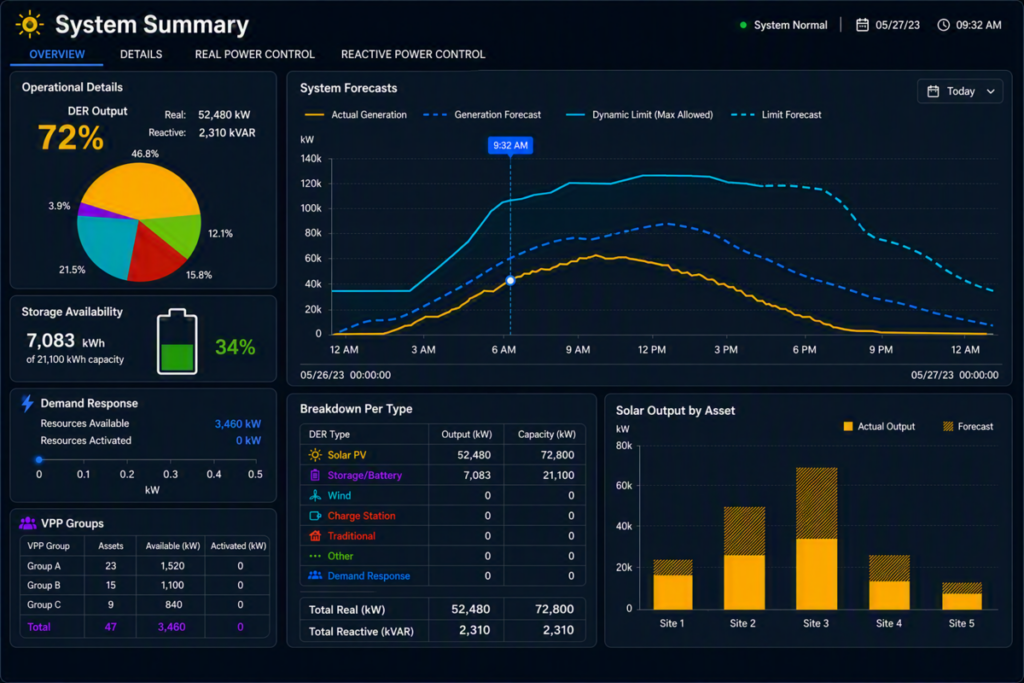
If those projects describe the ambition in the aggregate, the most concrete near-term example of AI reaching toward the control room is a project led by Siemens Energy. Titled “From Static to Adaptive Grids: Autonomous Topology Control at Scale,” it brings together Siemens Energy, Los Alamos National Laboratory, the University of Virginia, and the Orlando Utilities Commission to pursue “topology control”—strategically switching grid components to relieve congestion, improve power flow, and shore up reliability in real time, using infrastructure utilities already own rather than steel that has yet to be built.
Vanessa Santisteban, head of Siemens Energy’s Grid AI Lab, described a system meant to work alongside operators rather than over them. It will “use AI to quickly evaluate grid conditions, generate safe switching options, and rank recommendations based on risk, technical constraints, and operator preferences,” she said. The project’s Phase I is set to produce an open-source prototype tested against traditional power-flow methods, with the explicit goal of proving AI can deliver faster recommendations that operators will actually accept. Human operators, the company emphasized, would remain in control, reviewing any recommendation before action is taken.
For a professional audience wary of AI hype, how these projects were chosen matters as much as what they promise. Dr. Darío Gil, DOE under secretary for science, described a science-first, two-tier review: each program office first selected proposals on the merits of the underlying science, after which a separate expert panel judged the novelty of the AI methodology. Funding, he stressed, stayed within the programs that awarded it rather than being redirected into a central AI pot—the grid projects were selected as grid science, not as AI showpieces.
That distinction points to the real test ahead. Nearly every award announced is a Phase I effort, structured to demonstrate whether an approach works and merits further investment—not to put AI in charge of anything. The Siemens design keeps the operator in the loop by intent, and the open-source prototype exists precisely to earn operator trust against established methods. Whether these tools reach live dispatch will not be decided by how many scenarios a foundation model can evaluate or how fast an interconnection study runs. It will be decided in the control room, by operators weighing whether to act on what the machine recommends—which is exactly the question Phase I was built to answer.
—Aaron Larson is POWER’s executive editor.