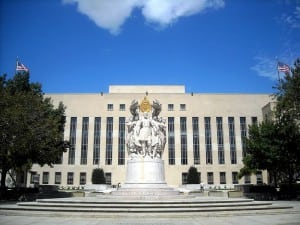
A federal appeals court has upheld the Nuclear Regulatory Commission’s (NRC’s) use of a generic environmental analysis for nuclear plant license renewals, rejecting claims that the agency failed to adequately consider how aging components and climate change could affect the risk of severe reactor accidents.
The July 21 decision from the U.S. Court of Appeals for the District of Columbia Circuit in Beyond Nuclear and Sierra Club v. NRC (No. 24-1318) denied a petition by environmental groups Beyond Nuclear and the Sierra Club that challenged the NRC’s 2024 revision to the Generic Environmental Impact Statement (GEIS), which it uses to evaluate operating-license renewals.
The petitioners argued that the NRC did not adequately consider how long-term aging and degradation of reactor components, as well as climate-driven external hazards such as storms and flooding, could affect the risk of accidents involving reactor-core damage.
Writing for a three-judge panel, Judge Bradley N. Garcia rejected those arguments, finding that the NRC had reasonably supported its generic determination that the environmental impacts of severe accidents during extended nuclear plant operation are “small.”The decision may be significant for operating reactor owners, license-renewal applicants, and advanced nuclear developers because it reinforces the NRC’s ability to resolve common environmental issues generically, rather than reanalyzing them in every individual licensing proceeding.
It also arrives as the NRC is separately pursuing a major rewrite of its National Environmental Policy Act (NEPA) regulations under 10 CFR Part 51. Earlier this month, the agency issued a proposal that moves to narrow the scope of environmental effects the agency reviews, expand categorical exclusions, and make greater use of generic and streamlined environmental analyses. While the court’s ruling does not decide the legality of that proposed Part 51 rewrite, it may give the NRC a timely D.C. Circuit endorsement of several principles that could matter in future NEPA disputes.
A Case Centered on GEIS
In Beyond Nuclear and Sierra Club v. NRC, the dispute essentially stems from contentions on how far the NRC can go in resolving environmental questions generically when individual plants may face different aging, climate, and accident-risk conditions. The case centered on the NRC’s license-renewal GEIS, which the agency first issued in 1996, revised in 2013, and updated again in 2024.
While commercial nuclear plant operating licenses are initially limited to 40 years under the Atomic Energy Act, under current NRC rules, those licenses can be renewed in 20-year increments, including subsequent renewals that can extend plant operation beyond the 60 years of the initial license and the first renewed term. At the end of 2024, 94 commercial reactors were operating at 54 sites, and 85 had renewed their operating licenses at least once, the court noted.
License renewal typically proceeds on two tracks. Under 10 CFR Part 54, the NRC conducts a plant-specific safety review and may renew a license only if it finds reasonable assurance that the plant will continue to operate within its current licensing basis and that aging effects will be adequately managed during the extended operating period. At the same time, under 10 CFR Part 51, the agency conducts an environmental review to comply with NEPA, which requires agencies to take a hard look at reasonably foreseeable environmental effects before approving major federal actions.
To streamline that environmental review, the NRC typically divides license-renewal issues into two categories. While Category 1 issues are resolved generically and generally do not need to be reanalyzed in each plant’s environmental report, Category 2 issues require plant-specific evaluation through a supplemental environmental impact statement. Revision 2 of the GEIS identifies 80 environmental issues, 59 of which are classified as Category 1. Even for Category 1 issues, license-renewal applicants must disclose any known “new and significant information” about environmental impacts.
As petitioners, Beyond Nuclear and the Sierra Club challenged the NRC’s Category 1 treatment of severe accidents, which the GEIS defines as accidents involving substantial reactor-core damage that may release radioactive material into the environment. The NRC concluded that although severe accidents could have significant consequences, they are extremely unlikely, so the “probability-weighted consequences of severe accidents” are low.
However, the D.C. Circuit upheld the NRC’s finding under a deferential NEPA standard. Citing the Supreme Court’s 2025 decision in Seven County Infrastructure Coalition v. Eagle County, the decision said courts should not “micromanage” agency choices about the “depth and breadth” of environmental review so long as those choices fall within a “broad zone of reasonableness.”
“The environmental impacts at issue are those from severe accidents,” the court said, while aging and climate change were “upstream factors that may increase the likelihood of severe accidents.” The court also noted that the NRC’s risk estimate would have to increase “by more than a factor of 100—that is, by more than 10,000 percent” before its severe-accident finding would be called into question.
The federal court also said the NRC reasonably relied on enforceable aging-management requirements, ongoing oversight, and conservative assumptions. The agency used those programs “as part of its explanation for why aging-related degradation would be managed,” which supported its decision not to assume increasing component-failure rates over time, the court said.
On climate change, the court said the NRC had addressed external hazards, including “high winds, floods, tornadoes, and other external hazards,” and reasonably found those risks generally lower than seismic and fire risks. In its ruling, the court said the NRC could decline to model future climate effects on severe storms in more detail because the severe-accident analysis already included a large uncertainty buffer and because “regulatory mechanisms exist to address the issue should circumstances change.”
Finally, the decision also upheld the NRC’s treatment of severe-accident mitigation alternatives, known as SAMAs. Plants that have not previously considered those alternatives must still do so. Plants that have already completed a SAMA or similar analysis do not need to repeat it in later renewal proceedings.
Still, the decision stressed that generic treatment does not foreclose plant-specific review. “The generic ‘small’ determination” is “not a permanent bar to site-specific consideration,” the court said. Parties may still seek waivers of generic findings, raise environmental contentions based on plant-specific evidence, and rely on the requirement that applicants disclose known “new and significant information” about environmental impacts.
Beyond Nuclear Says Climate Risks Still Need Site-Specific Review
In a July 21 statement, Beyond Nuclear sharply criticized the ruling and said it would continue to challenge long-term license extensions. According to the group, the court’s ruling will allow the NRC to rely on generalized severe-accident assumptions while failing to evaluate how worsening climate conditions could affect individual plants over extended operating periods.
“We are stunned by the court’s decision, which let the NRC get away with the generalized claim that large conservatisms in their accident risk analyses can cover the unique and site-specific effects of climate change,” said Diane Curran, who argued the case for Beyond Nuclear and the Sierra Club. “The NRC has never provided a shred of evidence to show that it has, in fact, evaluated the effects of climate change on accident risk—so how could it know that?”
Paul Gunter, director of Beyond Nuclear’s reactor oversight project, said the ruling allows the NRC to assess future climate-related safety challenges “by looking in the rear-view mirror.” He cited wildfires, flooding, sea-level rise, and more frequent severe storms as risks the group believes should receive more detailed treatment in licensing reviews.
Beyond Nuclear said it is evaluating legal options and will continue challenging license extensions at Oconee in South Carolina, Peach Bottom in Pennsylvania, and North Anna in Virginia.
—Sonal Patel is a POWER senior editor (@sonalcpatel, @POWERmagazine).