 |
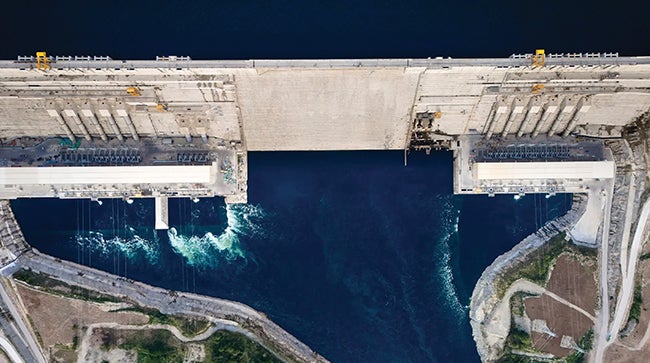
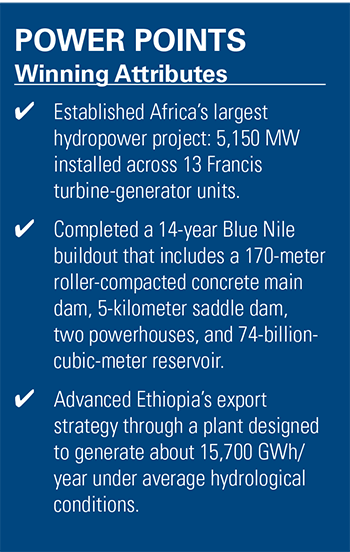
After decades of ambition and 14 years of construction, Ethiopia’s 5.15-GW Grand Ethiopian Renaissance Dam has become Africa’s largest hydropower project. The 13-unit plant gives Ethiopia a single generating asset large enough to roughly double national power capacity and expand East African electricity trade.
The Blue Nile has shaped the fate of empires for more than 5,000 years in Africa and the Middle East, supplying roughly 85% of the main Nile’s flow and delivering the fertile silt that built some of the ancient world’s greatest civilizations. Yet Ethiopia, the river’s highland source, was excluded from the colonial-era treaties that allocated Nile waters downstream.
For Ethiopia—the only African nation never colonized—that distinction was long a persistent contradiction within its proud history and fierce sovereignty. Unlike neighbors whose roads, rails, ports, and power grids were laid, however ruthlessly, by colonial administrations, Ethiopia entered the modern era infrastructure-poor despite grand ambitions, denied foreign financing, stripped by Italian occupation, and constrained by a feudal internal order. Among its longstanding objectives was the ambition to dam the Abbay—the Blue Nile.
In 1957, Emperor Haile Selassie commissioned the U.S. Bureau of Reclamation to survey possible dam sites, declaring it “Ethiopia’s primary and sacred duty to develop her water resources in the interest of her own rapidly expanding population and economy.” While the monarchy collapsed in 1975, decades of upheaval—revolution, military dictatorship, famine, civil war—marred tangible progress. But by the early 2000s, after tapping part of its estimated 45 GW of hydropower potential, Ethiopia had emerged as Africa’s leading hydroelectricity producer through smaller projects that built technical capacity and institutional confidence. These include the 184-MW Gilgel Gibe I, commissioned in 2004; the 300-MW Tekeze Dam, commissioned in 2009; the 420-MW Gibe II and 460-MW Beles Multipurpose Project, both commissioned in 2010; and the 1,870-MW Gibe III, whose construction began in 2006.
On Sept. 9, 2025, Ethiopia inaugurated its most distinctive project yet: the 5,150-MW Grand Ethiopian Renaissance Dam (GERD). Prime Minister Abiy Ahmed presided over the Blue Nile ceremony, flanked by the presidents of Kenya, Djibouti, South Sudan, and Somalia—a display of regional solidarity given Egypt and Sudan’s fierce opposition. The heads of state stood alongside Ethiopian Electric Power, Webuild, Tractebel, and Electroconsult, which had spent more than a decade executing the project. Abiy put GERD in the language of national sacrifice: “A drop of blood, a drop of sweat, a drop of tears, and a drop of water.” Its strategic logic was explicit: GERD would end rolling blackouts, power Ethiopia’s industrialization push, and position the country as a regional electricity exporter.
A Symbolic Plant
Originally conceived as the “Millennium Dam” to reflect Ethiopia’s alignment with the United Nations Millennium Development Goals, the project was formally renamed the Grand Ethiopian Renaissance Dam in April 2011, after Prime Minister Meles Zenawi laid the cornerstone. In Amharic, Hidase means “renaissance”—a term that linked the project to national renewal and sovereign self-determination. Crucially, Zenawi also pledged that the dam would be funded domestically, a promise Ethiopia pursued through Renaissance Bonds sold to citizens and the diaspora. (The final financing structure proved more complex, relying heavily on state-bank lending and reported Chinese financing for electromechanical equipment and transmission.)
In This Issue
Full issueState utility Ethiopian Electric Power (EEP) picked the site in northwestern Ethiopia’s Benishangul-Gumuz region, about 700 kilometers (km) northwest of Addis Ababa and near the Sudanese border. The location offered a narrow Blue Nile gorge, steep rock walls for natural abutments, enough elevation drop to concentrate hydraulic head, and a position that captures the river’s Ethiopian catchment before it crosses into Sudan. When Italian infrastructure firm Webuild—then operating as Salini Impregilo—mobilized to the site in 2011 as EEP’s main civil contractor, it reported arriving to “nothing but harsh and untouched land.”
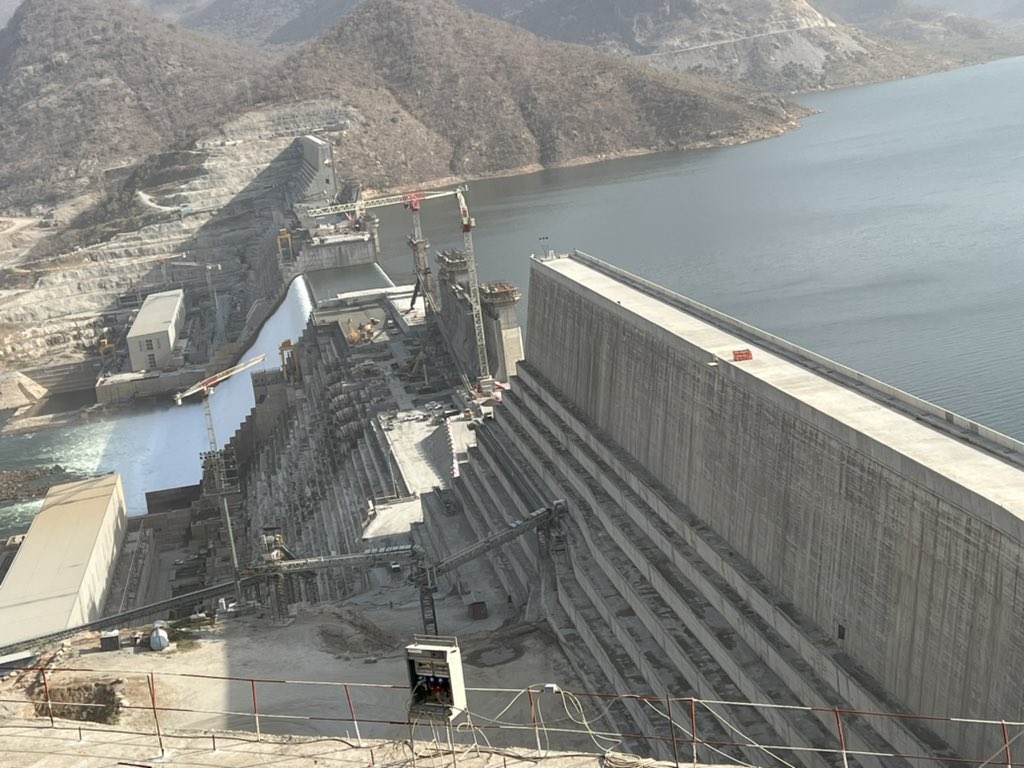
As Webuild notes, GERD was the largest project it undertook in Africa, much larger than Gibe III, the 1,870-MW Omo River plant that had briefly held the title of Africa’s largest hydroelectric project. The new plant is built around a 170-meter (m)-high, 1,800-m-long roller-compacted concrete (RCC) gravity dam that used 10.7 million cubic meters of RCC, making it Africa’s largest RCC structure by volume.
A 5-km rockfill saddle dam closes a natural depression and helps retain a reservoir designed for 74 billion cubic meters of storage at a 640-m full-pool elevation. The reservoir covers about 1,875 km2 and can store roughly 1.6 years of average Blue Nile inflow. Two powerhouses, one on each bank, house 13 Francis turbine-generator units, supplied primarily by Voith Hydro. Two are rated at 375 MW and 11 at 400 MW, totaling 5,150 MW of installed capacity. A 500-kV line financed by China’s State Grid Corp. connects GERD to Ethiopia’s national grid and export corridors.
A Massive Construction Project
When construction finally kicked off, the site hosted 25,000 workers over the project’s life. According to Webuild, peak onsite staffing reached 10,000, more than 95% of whom were Ethiopian workers. The works required three housing camps, an internal road network, two bridges over the Blue Nile, a landing strip for connections with Addis Ababa, schools, canteens, recreation facilities, a central hospital, and two satellite clinics.
 |
|
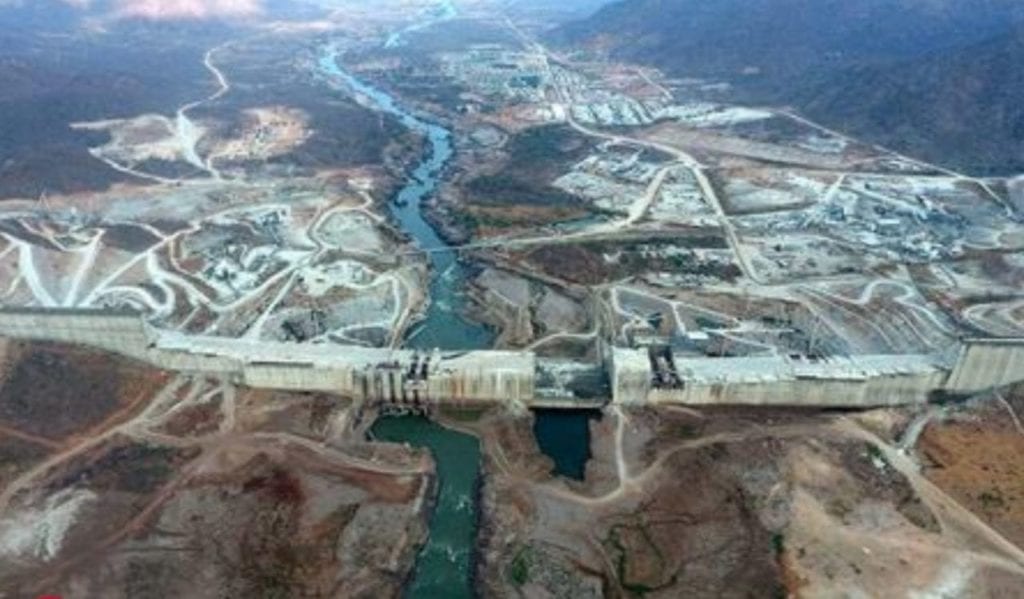
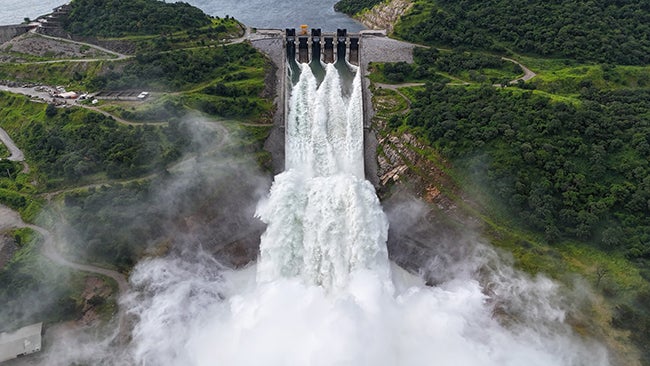
1. The Grand Ethiopian Renaissance Dam’s gated spillway releases water downstream from the Blue Nile reservoir. Tractebel said the spillway has a capacity of 14,700 cubic meters per second. Courtesy: Webuildologies |
But as work progressed, the massive project experienced several setbacks. Ethiopia’s original plan changed several times, from a 15-unit, 5,250-MW concept to 16-unit versions rated at 6,000 MW and then 6,450 MW, before a 2019 revision settled on 13 units and 5,150 MW. Webuild also said one of GERD’s main challenges was “a diversion system to shift the Blue Nile River course from one bank to the other as needed.” Because rainy-season flows can average 8,000 cubic meters per second (m 3/s), temporary diversion and redirection works were used to control the river during construction. A gated spillway (Figure 1) was built to release water downstream when reservoir levels exceeded projections. Tractebel, which worked with Electroconsult as owner’s engineer, said the spillway has a capacity of 14,700 m3 /s.
 In another major disruption, Ethiopia’s military-linked Metals and Engineering Corporation (METEC), which had been awarded the electromechanical contract, failed to deliver any of its contracted obligations. After that contract was canceled, Ethiopia re-tendered and ultimately contracted with Voith Hydro and its subsidiary, Voith Hydro Shanghai, as turbine suppliers. China Gezhouba Group (CGGC) later signed a $40.1 million contract in February 2019 to complete the generating station’s civil, mechanical, and electrical works, as well as the spillways.
Reservoir filling proceeded in five stages: 2020 at 540 m, 2021 at 575 m, 2022 at 600 m, 2023 at 625 m, and 2024 at full pool of 640 m. In February 2022—nearly 11 years after groundbreaking—the project delivered first power. While a second turbine came online in August 2022, all 13 turbines were “in action,” according to Tractebel, in September 2025.
GERD’s engineering scope also extended into dam surveillance and plant monitoring. Webuild noted the main dam includes an advanced monitoring system installed in its gallery network, which tracks hydrostatic pressure and reservoir levels, integrity of the concrete block joints, millimetric structural shifts, and turbine and mechanical component performance. High-sensitivity pendula run from the crest to the base of the dam, recording small changes in structural condition. The data feed a right-bank control center, where operators can monitor structural and mechanical performance in real time and use the records to support predictive maintenance.
A Disputed River
Another reason for the project’s slow progression—it ultimately came online seven to eight years behind the original schedule—is that GERD’s construction unfolded against a sustained diplomatic confrontation. Egypt and Sudan—downstream states that depend on the Nile for much of their freshwater—fiercely opposed the project, arguing that Ethiopia’s unilateral reservoir filling threatened their water security and violated colonial-era treaty rights they maintained were still binding. Ethiopia rejected both claims and proceeded with five staged reservoir fills between 2020 and 2024 without a negotiated operating agreement.
While African Union, United Nations, and U.S.–brokered talks produced a 2015 Declaration of Principles, the parties have not yet reached a legally binding operational framework. By the September 2025 inauguration, GERD’s completion was a “fait accompli,” as University of Bayreuth analyst Biruk Terrefe put it. While disputes continue, they appear focused more on how Ethiopia will manage releases, drought-year operations, and coordination with downstream states.
Despite the geopolitical complexity, GERD has given Ethiopia a larger role in East African power trade. Its 5,150 MW of installed capacity and projected 15,700 GWh/year of average output create a surplus base for exports to rapidly developing neighbors, including Kenya, Sudan, Djibouti, and Tanzania. In December 2022, a 1,045-km Ethiopia-Kenya high-voltage direct-current (HVDC) interconnector entered service with a 2,000-MW transfer rating, carving out both a high-capacity route into the Eastern Africa Power Pool and a future link toward Tanzania and the Southern African Power Pool.
—Sonal Patel is a POWER senior editor (@sonalcpatel, @POWERmagazine).