 |
A decade after Dominion Energy secured a federal lease off Virginia Beach, the 2.6-GW Coastal Virginia Offshore Wind (CVOW) project has cleared the full U.S. permitting stack, survived a federal stop-work order, and reached a crucial first power milestone. Equipped with 176 Siemens Gamesa SG 14-222 DD turbines, CVOW is the most advanced offshore wind project ever built in U.S. federal waters.
When Dominion Energy first announced the Coastal Virginia Offshore Wind (CVOW) commercial project in September 2019, the proposal was striking. At the time, the U.S. offshore wind market was still fairly nascent, though federal and state permitting activity, lease auctions, and offtake agreements were beginning to advance projects in Rhode Island, Massachusetts, and New York. Rather than proposing the unusually large project through a state procurement or by partnering with an independent developer under a power purchase agreement, Dominion proposed to self-develop, own, and operate 2.6 GW as a regulated, rate-based utility asset. But at that point, no commercial-scale offshore wind project had been built in U.S. federal waters, no U.S.-flagged, Jones Act–compliant installation vessel existed for turbine installation at that scale, and offshore wind was generally viewed as too expensive to justify at utility scale without direct state procurement support.
Dominion’s proposal leaned on a federal lease the company had held since November 2013, when Virginia Electric and Power Co.—doing business as Dominion Virginia Power—submitted the winning bid at the second competitive renewable energy lease sale ever held on the Outer Continental Shelf to secure 112,800 acres about 27 miles off Virginia Beach. As it formally unveiled CVOW, Dominion filed an interconnection request with PJM and outlined a three-phase buildout of roughly 880 MW per phase at a preliminary capital cost estimate of $8 billion.
But by early 2020, the offshore wind strategy was already firmly embedded in Dominion’s overall utility planning, partly given the company’s newly announced net-zero emissions commitment and growing load prospects. The utility, whose operations are today firmly embedded in Virginia’s “Data Center Alley,” was bracing for load growth from data centers and residential demand. In 2019, while Dominion connected 26 data centers, PJM revised its peak-load assumptions for Dominion’s service territory upward by an average of 1.2% annually over the next decade—double the PJM system-wide rate.
In April 2020, the utility won a statutory framework for that strategy when the General Assembly passed the Virginia Clean Economy Act. The law established a 5.2-GW offshore wind target, declared utility-owned offshore wind facilities between 2.5 GW and 3 GW to be in the public interest, and created a clearer regulated cost-recovery pathway under the oversight of the Virginia State Corporation Commission (SCC).
Still, to further reduce risk before committing offshore construction capital to the full commercial array, Dominion initiated a two-turbine, 12-MW CVOW pilot in the same lease area. Ørsted served as offshore engineering, procurement, and construction lead, while L.E. Myers Co. performed onshore construction. Dominion also selected Siemens Gamesa as the preferred turbine supplier in January 2020 and Ramboll as the owner’s engineer in March.

In This Issue
Full issueBy June 29, 2020, the pilot’s construction was complete, making CVOW the first offshore wind project installed in U.S. federal waters. The pilot generated environmental baseline data, right-of-way experience, export-cable routing work, onshore interconnection experience, and installation protocols that carried forward into the commercial Construction and Operations Plan, which Dominion filed with the Bureau of Ocean Energy Management (BOEM) on Dec. 18, 2020.
Six years later, the pilot-to-commercial sequence reached the larger milestone: CVOW delivered power to the Virginia grid for the first time in March 2026, even as turbine installation and commissioning continued across the 176-turbine commercial array.
From Turbine to Grid
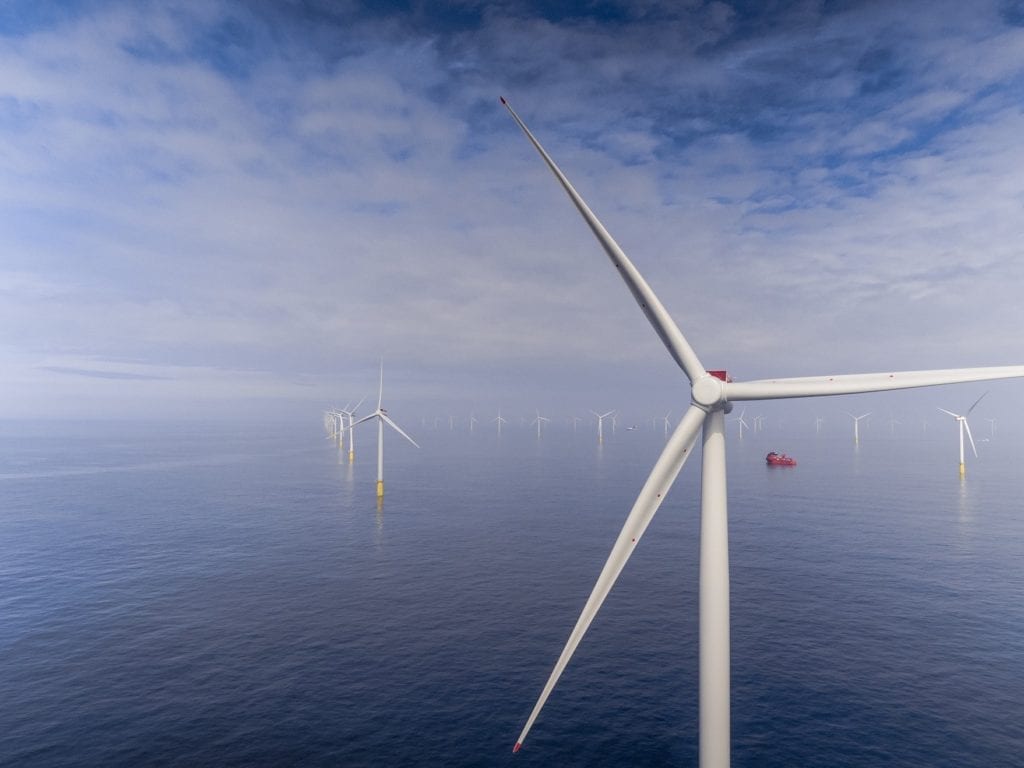
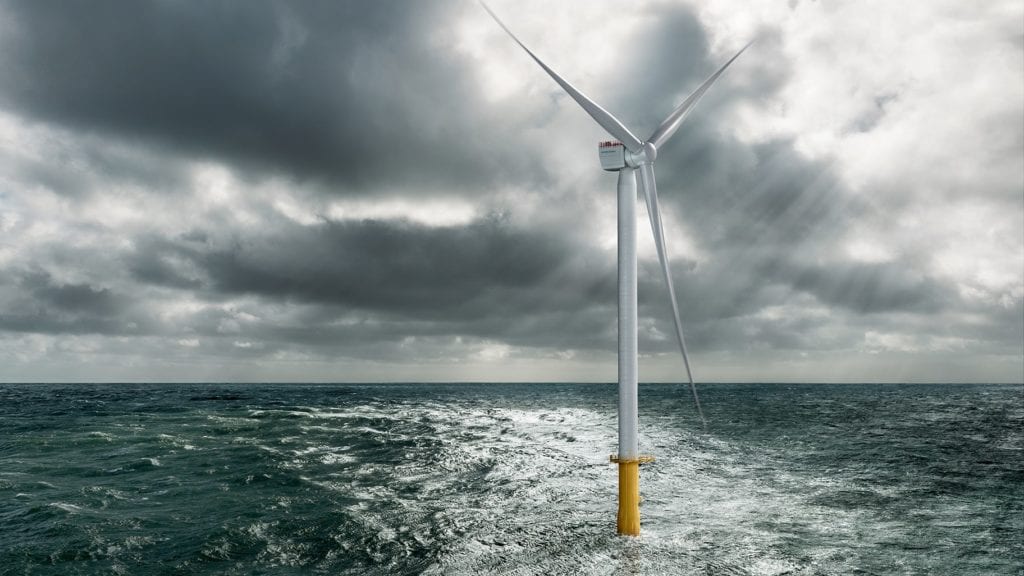
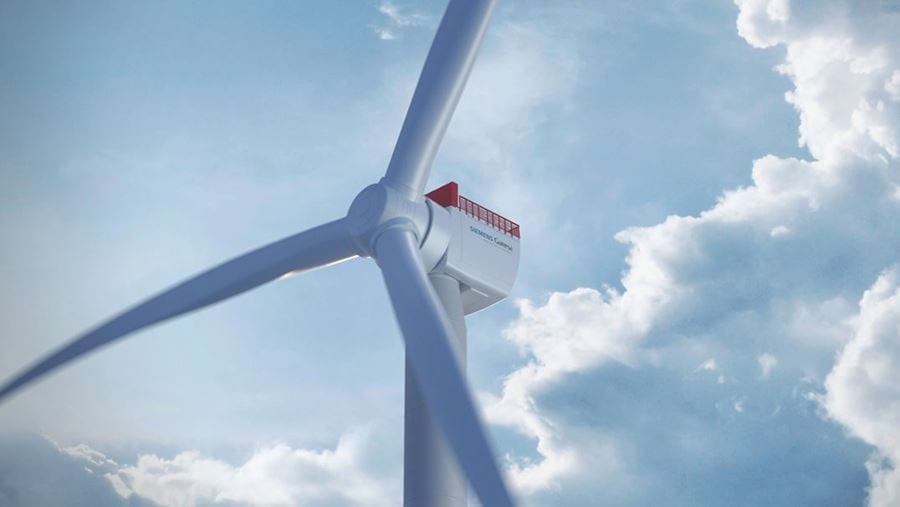
At full buildout, CVOW will comprise 176 Siemens Gamesa SG 14-222 DD wind turbine generators (WTGs), each with a 14.7-MW direct-drive rating and a 222-meter rotor diameter, mounted on monopile foundations in the federal lease area. “A single rotation of the turbine blade produces enough power for one residential home for a full day,” the company notes. The array functions as a collection-and-export system: roughly 231 miles of inter-array cables gather output from the turbines and route it to three offshore substations, with cable sections averaging 5,868 feet between WTGs and substations.
From there, nine buried high-voltage alternating-current offshore export cables—a combined 350 miles—carry power to shore at the State Military Reservation in Virginia Beach. The export system continues underground through the military reservation to the new Harpers Switching Station at U.S. Naval Air Station Oceana, then ties into Dominion’s existing and expanded Fentress Substation in Chesapeake, where power can be stepped up to 500 kV for inland delivery or stepped down to serve nearby load. Dominion’s approved onshore route maximized the use of publicly owned land and existing rights-of-way, using trenchless methods, including direct pipe beneath the beach, horizontal directional drilling to bypass Lake Christine and Lake Rudee, and duct-bank construction for the remaining underground segments.
Building the fixed offshore infrastructure required a tightly sequenced marine campaign. EEW SPC fabricated the 176 monopile foundations, each weighing more than 1,000 tons, while DEME Group’s heavy-lift vessel Orion installed them using Vibro Hammer technology. BOEM conditions barred pile driving from Nov. 1 through April 30 to protect North Atlantic right whales; protected species observers and a double big bubble curtain supported marine-mammal protections.
 |
|
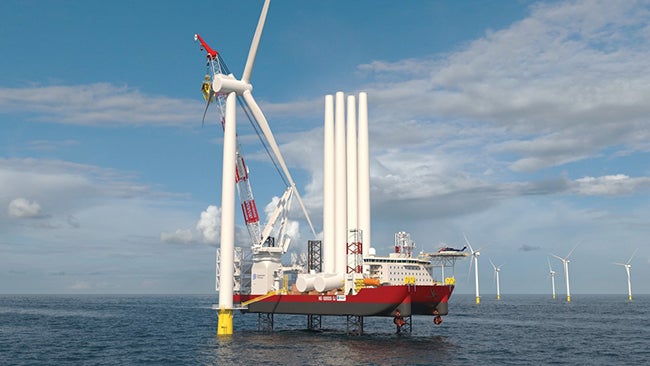
1. Dominion Energy’s Charybdis, the first Jones Act–qualified offshore wind turbine installation vessel in the U.S., was built to remove a key installation constraint for domestic offshore wind projects. The 472-foot vessel, constructed in Brownsville, Texas, with domestic steel and homeported in Hampton Roads, Virginia, is being used to install turbines for the 2.6-GW Coastal Virginia Offshore Wind project. Courtesy: Dominion Energy |
Because the Jones Act requires U.S.-built, U.S.-flagged vessels to move merchandise between U.S. points, turbine installation relied on Charybdis (Figure 1), the first U.S.-built, Jones Act-compliant offshore wind turbine installation vessel, which can carry four turbine generators per load from Portsmouth Marine Terminal.
As of June 2026, all 176 monopile foundations, transition pieces, and scour protection were complete; all three offshore substation (OSS) foundations and topsides were complete; 16 turbines had been installed; 87 of 176 inter-array cable sections were in place; all nine deepwater export-cable sections were installed; and six of nine shallow-water sections were complete. OSS #2 had been energized and providing power to the grid since March 23, while commissioning continued across the offshore substations.
Permitting, Risk, and Capital
CVOW’s bigger legacy for the power industry may endure in its permitting record, an arc that spanned nearly three years and touched every major federal authority. BOEM issued the project’s final environmental impact statement in September 2023 and its record of decision in October 2023. The Construction and Operations Plan approval and the Army Corps of Engineers individual permit followed in January 2024, and the Environmental Protection Agency issued its Outer Continental Shelf air preconstruction permit in April 2024. CVOW also completed the FAST-41 (Fixing America’s Surface Transportation Act, Title 41) federal permitting coordination program, a streamlined interagency review process, making it the largest project to graduate from the program.
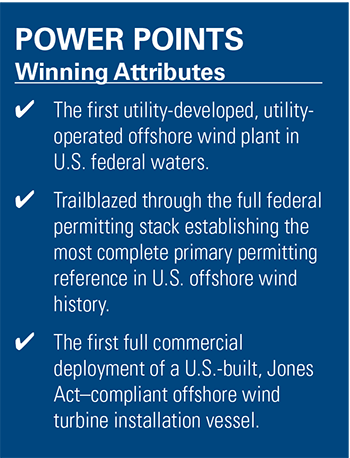 However, the project has not been insulated from political risk. On Dec. 22, 2025, the U.S. Department of the Interior issued a 90-day stop-work order affecting CVOW and four other East Coast offshore wind projects. Dominion sought immediate judicial relief, and on Jan. 16, 2026, the U.S. District Court for the Eastern District of Virginia granted a preliminary injunction allowing construction to resume. “Stopping CVOW for any length of time will threaten grid reliability for some of the nation’s most important war-fighting, AI [artificial intelligence], and civilian assets,” the company said.
As construction progressed, the project’s ownership and financing evolved. In 2024, Dominion brought in Stonepeak as a 50% noncontrolling partner; the transaction closed in October 2024, generating about $2.6 billion for Dominion while Dominion Energy Virginia retained operational control. By early 2026, CVOW’s budget stood at about $11.4 billion—up from the original $8 billion estimate—but still under SCC oversight and subject to customer cost-protection provisions.
CVOW’s next corporate chapter could unfold under a larger platform. In May 2026, Dominion Energy and NextEra Energy announced an all-stock merger that would create a company with an enterprise value of about $420 billion, with Dominion Energy’s name and local operations slated to remain unchanged in Virginia. NextEra CEO John Ketchum, who would lead the combined company, addressed CVOW directly on the merger call, saying Dominion had made “excellent progress” and the project remained “on track” for service in mid-2027. Pointing to the test-energy milestone, he said: “We know once you’ve achieved that milestone, you’re in really good shape in bringing that project in COD [commercial operations date].” Given the investment already made, he added, “it’s the right thing to do to finish it.”
Dominion has projected up to 9.5 TWh of annual output and about $5 billion in customer fuel savings over the project’s first 10 years. On Aug. 14, 2024, the company also won a BOEM bid for an additional 176,505-acre lease area at $17.7 million, renamed CVOW-South, which could support approximately 800 MW of additional offshore wind development in the 2030s.
—Sonal Patel is a POWER senior editor (@sonalcpatel, @POWERmagazine).