Centrus Energy has finalized a $900 million task order with the U.S. Department of Energy (DOE) that clears the way for the company to transition its pioneering high-assay low-enriched uranium (HALEU) cascade in Piketon, Ohio, from a government-funded demonstration to private commercial operation.
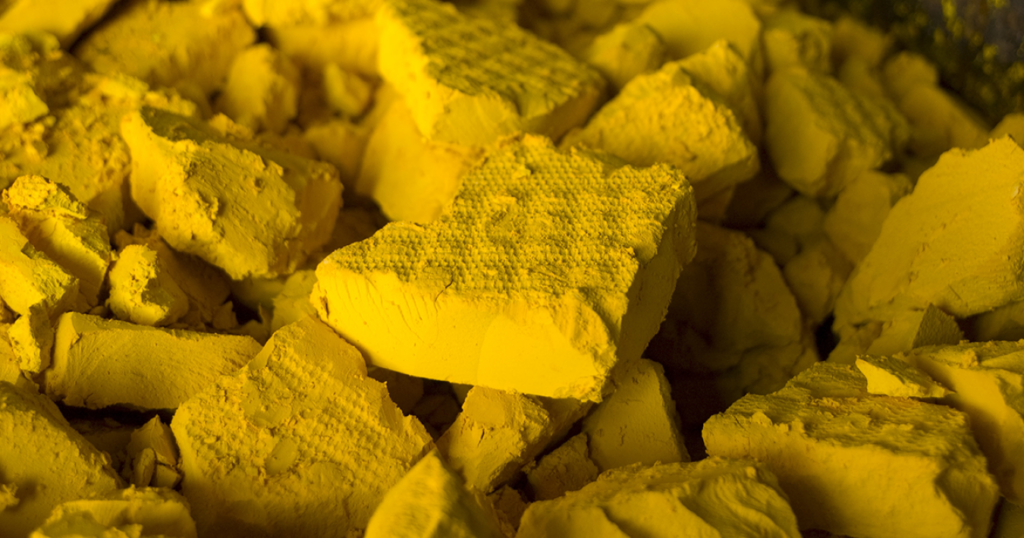
The Bethesda, Maryland-headquartered firm on July 1 announced that its wholly owned subsidiary American Centrifuge Operating LLC (ACO) signed the $1 billion fixed-price contract on June 30 to formalize the competitively awarded task order it received in January under DOE’s $2.7 billion domestic uranium enrichment program. Under terms disclosed in an 8-K filing, the $900 million base award will be paid incrementally as performance-based milestone payments. ACO will be required to deploy the specified commercial-scale enrichment capacity and deliver 1 metric ton of uranium (MTU) of HALEU UF6 enriched to a nominal 19.75% U-235 by March 2032.
The DOE also holds two options, exercisable at its sole discretion, each covering up to a 12-month delivery of 5 MTU of HALEU at a firm-fixed price of $17 million per MTU—$85 million per option—bringing the total potential contract value to $1.07 billion. Upon completion of its obligations, ACO will take title to the newly deployed enrichment capacity.
“Today’s announcement marks another milestone in our expansion, as we pivot from a technology demonstration contract to the new, larger contract aimed at commercial scale production,” Centrus President and CEO Amir Vexler said in a statement. He added that the government investment “will be matched several times over with billions of dollars in capital, including other non-dilutive, non-debt funding as well as customer contracts to restore America’s ability to enrich uranium at a large scale.”
From Demonstration to Commercialization
The signing caps a compressed sequence of federal and corporate efforts that sought to close a nuclear fuel supply gap as U.S. utilities move away from Russian enrichment services and advanced reactor developers race toward first fuel loads.
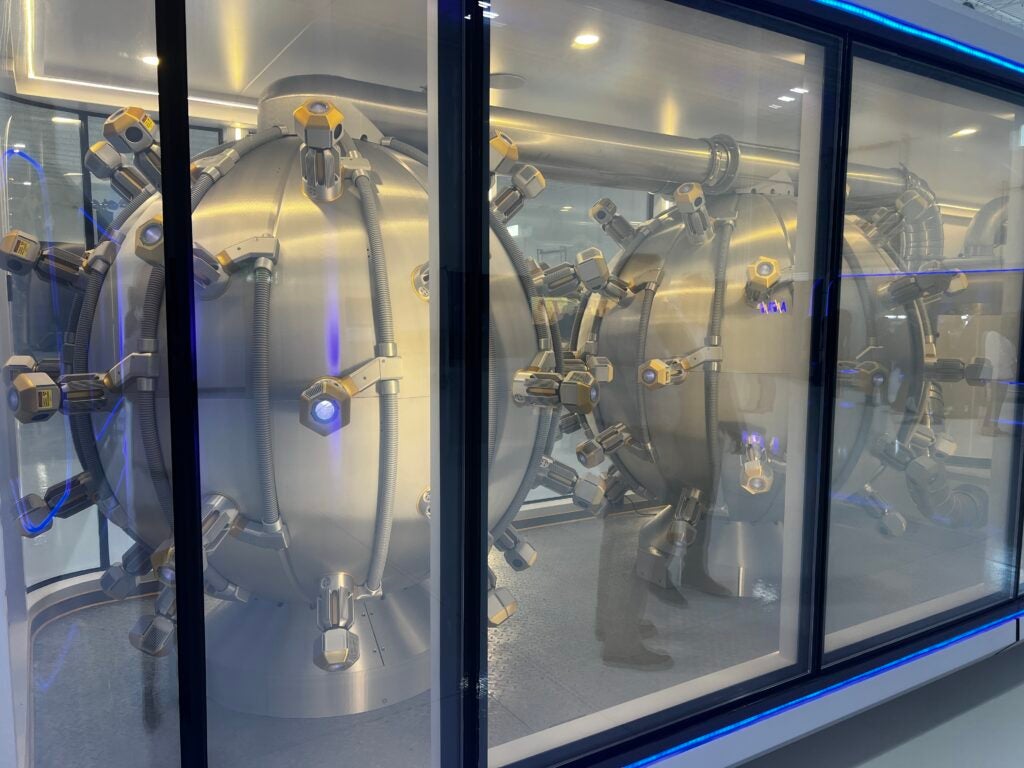
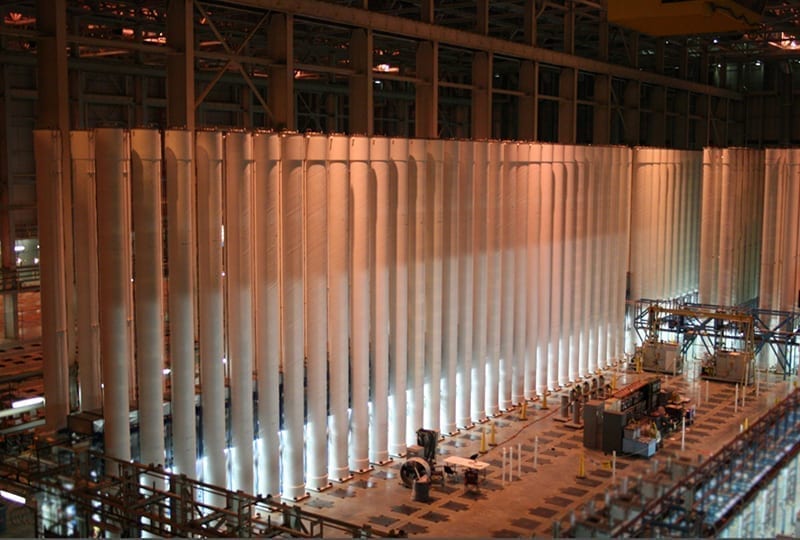
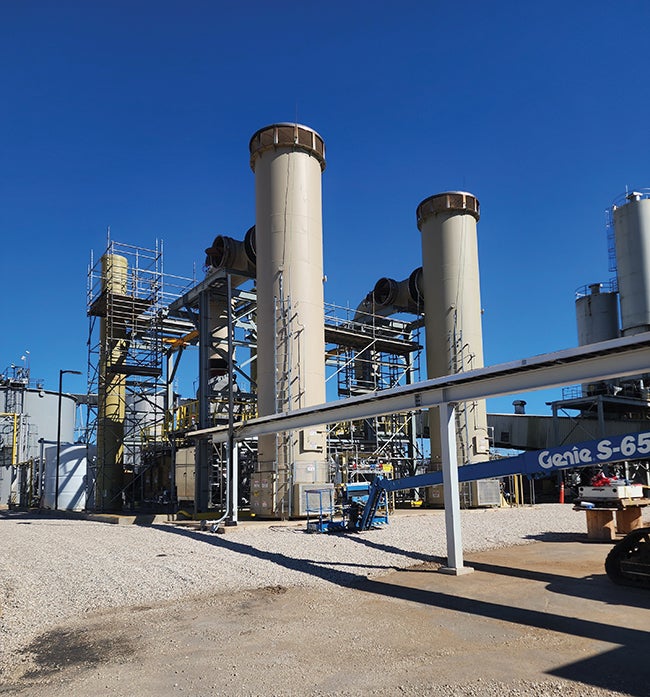
Centrus originally won a competitively awarded DOE contract in 2019, under the first Trump administration, to build and operate a 16-machine AC100M cascade at the former Portsmouth Gaseous Diffusion Plant site in Piketon to demonstrate that HALEU—enriched between 5% and 19.75% U-235—could be produced with U.S. technology. That demonstration contract was modified and extended in 2022, and again through June 30, 2026, allowing the company to continue producing 900 kilograms (kg) of HALEU uranium hexafluoride (UF6) per year on a cost-plus-incentive-fee basis.
Centrus on Wednesday said it has now completed all HALEU production called for under the existing demonstration contract. Production of the final 900 kg required in that phase was wrapped up in mid-June, two weeks ahead of schedule, bringing cumulative output over the life of the contract to more than 1,900 kg of HALEU UF6. The company delivered its first 900-kg batch to DOE in June 2025, marking the first significant domestic production of the fuel since the U.S. lost its enrichment capabilities decades ago.
To ensure the handoff will be smooth, Centrus and DOE have signed a three-month, $15 million extension covering HALEU storage while the parties finalize agreements needed for commercial operation. Chief among those is a long-term lease extension for the American Centrifuge Plant (ACP) site, which Centrus leases from DOE.
The new fixed-price task order calls for Centrus to deploy commercial-scale HALEU production capacity at Piketon. “The first new capacity is expected to come online by 2029. In the interim, Centrus intends to privately operate the existing HALEU cascade on a commercial basis to begin supplying the near-term needs of its customers,” it said.
That would make the Piketon cascade—the first U.S.-owned, U.S.-technology enrichment plant to begin production in 70 years—the country’s only source of privately produced HALEU while other domestic entrants build up.
A $2.7 Billion Federal Bet
The signing operationalizes the largest of the awards DOE unveiled in January under its Task Order 2 solicitations, which distributed $2.7 billion across three companies to rebuild domestic enrichment: $900 million to ACO and $900 million to General Matter—both for HALEU capacity—and $900 million to Orano Federal Services for LEU output at its planned Project IKE facility on former Manhattan Project land in Oak Ridge, Tennessee.
All three awards flow from a competitive contracting framework DOE established in 2024, when it pre-qualified six companies for LEU and four for HALEU. Additional vendors—including Urenco USA’s Louisiana Energy Services subsidiary, which is separately expanding America’s only operating commercial enrichment plant in Eunice, New Mexico—remain eligible to bid on future task orders, DOE has said.
Centrus said its expansion at Piketon will proceed in modular fashion, sized to customer demand and available capital. The initial build-out will include 12 metric tons of annual HALEU production capacity, along with new LEU capacity earmarked to work down a commercial LEU backlog Centrus pegged at more than $2.4 billion. Beyond that, additional HALEU and LEU cascades can be added as offtake contracts materialize, with the aim of eventually achieving nth-of-a-kind centrifuge manufacturing costs.
During the company’s Q1 2026 earnings call in May, Chief Financial Officer Todd Tinelli said Centrus finished the quarter with $1.9 billion in unrestricted cash, which—combined with the $900 million HALEU award, which will now be flowing in as milestone payments—gives the company “about $2.8 billion” of firepower to underwrite the build-out. Tinelli said Centrus continues to weigh “many pools of low cost of capital,” including a potential National Nuclear Security Administration (NNSA) sole-source award, third-party investment, and foreign direct investment, and declined to tap its at-the-market equity program in the quarter because market conditions “just didn’t feel it provided the right shareholder value.”
Vexler has moved aggressively to compress the project’s cost curve. In late January, Centrus launched a $560 million investment to expand its centrifuge manufacturing plant in Oak Ridge, Tennessee, and has since signed engineering, procurement, and construction giant Fluor; data-and-AI platform provider Palantir; and Ohio-based Geiger Brothers—a construction partner on Centrus’s earlier HALEU and 2013 LEU demonstration cascades—to accelerate the build. Vexler told analysts the partnerships have already identified roughly $300 million in potential cost savings, and said Palantir’s Foundry-based AI layer is transformative well beyond the first cascade because it “provides us with real-time data” and “allows us to shorten our lead times and cycle times” across a supply chain that spans hundreds of vendors.
Centrus estimates the project will support roughly 1,000 construction jobs and 300 new operating positions in Ohio, plus 150 retained jobs at Piketon; 430 jobs at the Oak Ridge centrifuge facility; and hundreds of additional supplier positions nationwide.
Commercial Homegrown HALEU
The contract is significant given that HALEU is the fuel of choice for most advanced reactor designs, the DOE, the Pentagon, and private developers—from TerraPower’s Natrium and X-energy’s Xe-100 to a lengthening list of microreactor concepts—and it has been effectively unavailable in the West outside Russia.
Vexler told analysts in May that after years in which advanced-reactor developers focused on licensing rather than fuel procurement, “the market is actually starting to mature now on the advanced reactor side,” and that reactor customers are moving into “significant and serious committed fuel procurements.” He said hyperscaler customers, in particular, are pushing “faster and stronger” to lock in supply before their projects reach final investment decision because unresolved fuel risk is “not a risk they should have on their books” as they raise capital.
Centrus is also exploring a joint venture with Oklo to establish HALEU deconversion services—converting HALEU UF6 into the oxide and metal forms that most advanced reactors require. That capability, Vexler said, “does not exist commercially,” and co-locating it with enrichment would let Centrus “vertically integrate” and further differentiate its HALEU offering.
—Sonal Patel is a POWER senior editor (@sonalcpatel, @POWERmagazine).