
The Nuclear Regulatory Commission (NRC) has proposed what may be its most consequential reactor-licensing overhaul in a generation, a 553-page rulemaking that seeks to rewrite core pieces of the regulatory framework governing how commercial nuclear plants are sited, licensed, built, modified, operated, renewed, fueled, and ultimately decommissioned.
Issued July 1, the proposed rule, “Modernizing Reactor Licensing, Safety Oversight, and Siting Practices,” (Docket ID NRC-2025-0975 and RIN 3150-AL44) reaches across 10 CFR Parts 2, 50, 51, 52, 53, 54, 71, and 100. Rather than advancing a single licensing reform, the NRC moved to bundle 17 distinct modernization measures into one package, targeting everything from the legal definition of “construction” to emergency preparedness, quality assurance, siting criteria, license renewal terms, advanced fuel deployment, and the use of risk-informed alternatives to long-standing prescriptive requirements.
The proposal is the NRC’s most visible implementation step to date under Executive Order 14300, “Ordering the Reform of the Nuclear Regulatory Commission,” issued in May 2025, which directed the agency to undertake a “wholesale revision” of its regulations and guidance.
In the proposed rule, the NRC says the changes are intended to modernize Part 50, the traditional two-step construction permit and operating license framework, and Part 52, the combined-license, design-certification, and early-site-permit framework, conform NRC regimes to Part 53, the new risk-informed, technology-inclusive framework for commercial nuclear plants, and support “additional generation to the electrical grid.”
The agency also tied the package to the ADVANCE Act’s direction to support increased availability of, and innovation in, nuclear power for economic and national security purposes. “NRC’s regulations have not kept pace with new technologies and our energy needs,” said NRC Chairman Ho Nieh, adding that the proposal would “strip out rigid frameworks and unnecessary conservatism” while accelerating safe deployment of new reactors and expansion of existing capacity.
On a July 1 media call, Nieh signaled an aggressive schedule for finalizing the proposed rule. In response to a POWER question about timing, he said the NRC is targeting commission review of a final reactor licensing modernization rule “around the end of this year or perhaps early next year,” even as the agency works through a “significant amount” of other draft rules and comment periods. The proposed rule notes that the striking breadth of changes stems from “a culmination of decades of combined experience, feedback from nuclear experts, lessons learned by the NRC and industry, international experience, and prior efforts to modernize the regulatory framework.”
However, Nieh stressed that the proposal is intended to create optional regulatory pathways rather than force applicants into a single model. “The name of the game right now is optionality,” he said, noting that the NRC is seeking frameworks that can accommodate light-water and non-light-water reactors, large reactors, small and microreactors, onsite and factory construction, and both first-of-a-kind and later deployments. He also said the agency does not intend to “force fit new technologies into licensing frameworks that are no longer fit for purpose,” calling exemptions “inefficient,” “not predictable,” and “not clear.”
Finally, Nieh acknowledged that the value of the reforms will depend on NRC’s execution, suggesting that the agency will need staff skills and internal management discipline to deliver licensing decisions under the new risk-informed programs. “What we don’t want to happen,” he said, is for “risk-informed, beneficial, safe programs” to be available but difficult to use in practice, which could discourage later applicants
Separately, the NRC on July 1 proposed a radiation protection rule that would strip ALARA—its long‑standing “as low as is reasonably achievable” standard, built on a strict linear‑no‑threshold view of cancer risk at any dose—from the regulations and replace it with a graded, dose‑based framework that leans on explicit numerical limits, multi‑year exposure caps, and defined reporting thresholds. Agency officials in the media call said decades of operating experience show ALARA has driven excessive conservatism and open‑ended, subjective expectations at very low doses. They suggested that codifying when additional controls are required will reduce burden, sharpen regulatory consistency for all licensees (and Agreement States), and still maintain existing dose limits and “reasonable assurance” of protection. Nieh emphasized that the efforts aim to raise the bar on regulatory clarity rather than lower safety, and are in line with the administration’s push for risk‑informed, science‑weighted nuclear regulation.
A Striking Breadth of Reactor Licensing Changes
The proposed Modernizing Reactor Licensing, Safety Oversight, and Siting Practices, part of the NRC’s wider modernization agenda, follows several significant rules proposed or finalized over the past year. While the agency is separately pursuing or implementing other reforms tied to Part 53, advanced reactors, environmental reviews, licensing timelines, advanced fuel, and risk-informed oversight, Wednesday’s rulemaking is unusually broad, packaging numerous long-running reactor-licensing modernization efforts that relate to construction, design changes, siting, emergency preparedness, license renewal, quality assurance, decommissioning funding, and fuel for both the existing and advanced reactor fleet.
As NRC officials told reporters, the rule’s scope directly aligns with EO 14300’s most specific reactor-licensing directives, which ordered a wholesale review of the NRC’s Title 10 regulations and guidance. Essentially, the rule responds to three EO Section 5 mandates: tightening the circumstances under which the NRC may require reactor design changes once construction is underway; replacing qualitative safety tests with determinate, data-backed thresholds focused on “credible, realistic risks”; and revisiting how long renewed licenses can run in light of operating experience and aging-management data.
But the NRC staff also used the EO-driven review to bundle a broader set of process changes into the proposal. Those measures range from expanded use of risk-informed alternatives to prescriptive requirements to more flexible siting, emergency preparedness, decommissioning funding, and fuel-related provisions. Overall, the package seeks to improve the efficiency and predictability of licensing for new and existing nuclear capacity while keeping formal safety findings anchored in the NRC’s “reasonable assurance” standard.
The suite of targeted changes is slated to affect nearly every phase of a nuclear project’s lifecycle. Several measures seek to reduce front-end uncertainty for new construction. Others would broaden the use of risk-informed and performance-based methods, create alternatives to prescriptive requirements, update licensing-basis change controls, and make existing frameworks more adaptable to advanced reactor designs, advanced fuels, and longer operating lives.
The following is a synopsis of the major measures in the proposed rule.
Core Licensing Architecture and Change Control
Setting Clearer Rules for Design Changes Once Construction Starts. The NRC would revise Parts 52 and 53 to address both NRC-directed and licensee-requested design changes during construction and operation. In response to EO 14300 Section 5(f), the agency proposes to “raise the threshold for changes required during construction” by eliminating “increased standardization” as a criterion for commission-directed modification of design certification information. The NRC also proposes to define and clarify categories of design information, including Tier 1, Tier 2, and Tier 2* information under Part 52, after finding that some applications included more information in Tier 1 than necessary, creating approval burdens for changes with “minimal safety significance.” For licensee-requested changes, the NRC would provide greater flexibility for certain departures from Tier 1 design description information without requiring an exemption, provided specified criteria are met.
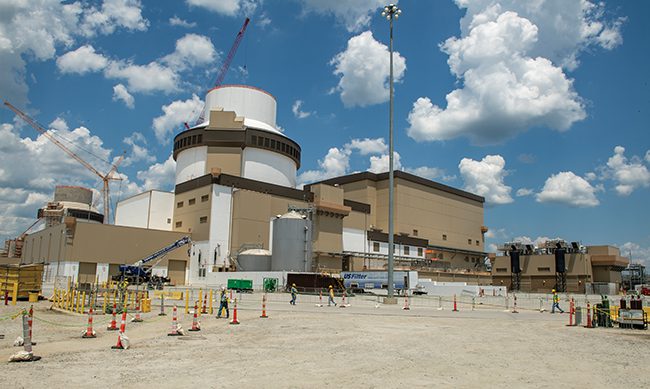
The NRC cites construction experience from Vogtle Units 3 and 4, suggesting that some Tier 1 change requests “may not have been important to safety,” and that added flexibility could “reduce burden on licensees and minimize possible construction delays due to licensing reviews without impacting safety.” The proposed rule would preserve the policy goal of standardization while making the change-control process less rigid during construction and operation.
Safety Assessments Focused on Credible, Data-Backed Events. The NRC would add definitions for “design basis event” and “beyond design basis event” to 10 CFR 50.2, with a conforming change in 10 CFR 50.49, to focus safety assessments on “credible, realistic risks.” The agency says selecting design basis events is a “critical prerequisite” because those events determine which SSCs need more stringent treatment and what performance they must demonstrate.
According to the commission, the current light-water-reactor framework can have “limited applicability” to evolutionary light-water reactors and non-light-water designs, creating challenges for “clarity and reliability” in identifying which components warrant special treatment. Defining beyond design basis events would support “graded regulatory treatment” for events that require attention but do not warrant mitigation exclusively through safety-related SSCs or conservative safety assessments. The NRC says the guidance would provide determinate, data-backed thresholds “without adding regulatory burden,” while allowing applicants to justify unique approaches without exemptions.
Giving Applicants a Path Around One-Size-Fits-All Criteria. The NRC would add new voluntary provisions in 10 CFR 50.220 and 10 CFR 52.220, allowing applicants and licensees to propose technology-inclusive, risk-informed, or performance-based alternatives to existing prescriptive acceptance criteria. The NRC says many current criteria are fixed numerical limits, such as temperature, pressure, or dose, that were developed based on the “state of knowledge and technology” at the time the rules were written and may not reflect later advances in safety analysis, probabilistic risk assessment, or reactor design.
Rather than rewriting each prescriptive rule in Parts 50 and 52, the agency would create a structured pathway for the review of alternatives without exemptions. The proposal would also clarify that applicants may justify deviations from the General Design Criteria in Appendix A to Part 50 within a licensing application, rather than filing separate exemption requests. For General Design Criterion 28, the NRC would allow applicants to propose a design-specific reactivity-control accident instead of prescriptively analyzing a control rod ejection or drop accident. The commission says the approach would reduce “cost and regulatory uncertainty,” preserve the existing licensing bases of operating reactors, and support new technologies while maintaining reasonable assurance of adequate protection.
Letting Licensees Make More Low-Risk Changes Without Prior NRC Approval. The NRC would create an optional pathway for licensees to use probabilistic risk assessment results in 10 CFR 50.59 reviews, which determine when plant changes, tests, or experiments require prior NRC approval. The proposal would allow risk metrics such as core damage frequency and large early release frequency, along with defense-in-depth and safety-margin considerations, to show that a change does not result in a “more than minimal increase” in accident likelihood or consequences.
The NRC says this would not “replace or supplant the deterministic licensing basis,” but would supplement it with a modern analytical tool to better distinguish changes that require prior review from those that do not. The rule would also allow some changes to analytical methods described in the final safety analysis report without prior NRC approval if the licensee uses an NRC-approved verification, validation, and uncertainty quantification program. However, the NRC noted that advances in computing and modeling now allow “more realistic and accurate safety analyses” than legacy methods, but current rules can require license amendments simply because a better tool departs from the method described in the safety analysis report. The proposed approach would shift the NRC from reviewing each model or simulation individually toward reviewing the structured process used to establish model credibility, a change the agency says could be “particularly beneficial for new and advanced reactor designs.”
New Reactor Deployment and Project Execution
Earlier Construction Starts for Safety-Bounded Work. The NRC seeks to revise the definition of “construction” in 10 CFR 50.10, with conforming changes in Parts 51 and 53, to focus pre-license construction controls on structures, systems, and components (SSCs) whose installation could affect their ability to perform a safety-significant function. The agency says the existing definition, last updated in the 2007 limited work authorization rule, may “unnecessarily restrict construction of nuclear power plants using modern construction techniques on optimized schedules.”
The proposal responds to developers who want to move ahead with work, such as permanent materials in an excavation or balance-of-plant systems, before a construction permit or combined license, where the work lacks safety significance. It would also create a general license pathway for the construction of certain “important component parts” once an application is docketed, supporting advanced reactor business models and rapid deployment strategies while preserving NRC review of safety, security, and environmental conditions.
Less Prescriptive Construction Permit Applications. The NRC would revise 10 CFR 50.34, which governs the technical information submitted with construction permit and operating license applications, to better tie the level of detail in a preliminary safety analysis report to the findings the agency must make before issuing a construction permit. The agency notes that the requirement for a preliminary safety analysis report was originally “intended to provide early and adequate information” to reduce “time-consuming exchanges” with staff, but most of 10 CFR 50.34 has remained unchanged since 1968.
The proposal would clarify that varying levels of technical detail may be acceptable if the information allows the NRC to make the required findings under 10 CFR 50.35, 50.40, and 50.50. It would also remove prescriptive light-water reactor language, including detailed references to loss-of-coolant accident analyses and containment assumptions, and replace parts of the rule with more “technology-inclusive” language for designs using mechanistic source terms or functional containments. Conforming Part 52 changes would extend the same approach to early site permits, combined licenses, standard design certifications, standard design approvals, and manufacturing licenses, reducing unnecessary exemptions and making application content more consistent across licensing pathways.
More Durable Early Site Permits. Significantly, the NRC also moved to remove the fixed expiration date for early site permits (ESPs), which are intended to resolve most site-specific safety and environmental issues before a developer applies for a construction permit or combined license. Under current rules, an ESP can run no longer than 20 years and must be renewed to preserve its benefits, but the NRC says that requirement can “artificially constrain” development planning because the need to renew is not tied to a change in the site or to when the permit holder actually plans to use it. The proposal would allow a permit holder to keep a site “banked” indefinitely, while limiting the finality of time-sensitive safety and environmental information to 20 years unless the holder updates the ESP through an amendment.
For utilities, developers, and site owners, the change could make ESPs more useful for long-lead nuclear development, especially where market conditions, offtake, technology selection, or project financing may take longer than 20 years to mature. The NRC would still require updates for information that can become stale, such as seismic, meteorological, hydrologic, geologic, population, and environmental data. But instead of forcing renewal at a fixed date, the proposed rule would let the ESP holder decide when an update is “advantageous” to support a future construction permit or combined license application.
Longer Manufacturing License Terms for Factory-Built Reactors. The NRC would extend the maximum initial and renewed term of a manufacturing license from 15 years to 40 years, while keeping the five-year minimum term. Notably, while manufacturing licenses under Part 52 allow approval of a final reactor design and manufacturing process to produce more than one reactor, no such license has yet been issued. The NRC says the change would align manufacturing license terms with the 40-year duration now used for design certifications, reflecting the “similarities between the scope of the two approvals.”
Notably, the provision appears to be aimed at microreactors, small modular reactors, and other deployment models that may rely on factory fabrication and repeated production. A 40-year term would provide more “regulatory stability” and reduce renewal burden by decreasing how often a manufacturing license holder must seek renewal. The rule says the longer term would not reduce safety or security because issue-finality provisions still allow the agency to impose requirements if a safety or security issue emerges during the license term.
Operational Programs Can Be Reviewed Earlier, but Not Always Up Front. The NRC would also allow manufacturing license applicants under Parts 52 and 53 to submit “essentially complete” operational program information with the manufacturing license application, rather than waiting for later construction permit, operating license, or combined license reviews. The change is aimed primarily at standardized microreactors and other “low consequence reactors,” where developers are seeking rapid, high-volume deployment and repeatable licensing models. If the NRC reviews and approves those programs with the manufacturing license, later applicants could reference them, use their own programs, or combine both approaches. The provision is designed to “enhance regulatory certainty and expedite review timelines” without making early program submittal mandatory.
The NRC says the information would be optional for developers to provide and optional for later applicants to reference. The flexibility is important, given that operational programs differ from design information, and changes may need to be controlled under program-specific rules rather than the manufacturing license design-change process. The proposal would also preserve public engagement by providing opportunities to hear about operational program information included in the manufacturing license review.
A Modern QA Option for Repeat Reactor Builds. The NRC would add a voluntary Appendix T to Part 50 as an alternative to Appendix B, the quality assurance framework that has governed nuclear power plants and fuel reprocessing plants since 1970. The new option would be available to applicants who meet specified conditions and would establish performance-based quality assurance criteria using a graded approach tied to the safety and risk significance of structures, systems, and components. The NRC says Appendix T would incorporate quality-assurance terminology and methods used in other industries, provide “enhanced regulatory certainty,” and allow the agency to remove supplier and vendor oversight where appropriate. The proposal is meant to support more repeatable licensing and construction models while retaining Appendix B for applicants that do not use the alternative.
Fleet, Siting, Fuel, and Long-Term Operations
Extending Renewal Terms and Trimming Application Burdens. The NRC would revise Part 54 to allow renewed operating licenses to run for up to 40 years, rather than the current 20-year renewal term, in response to EO 14300’s direction to reconsider how long renewed licenses remain effective. The NRC says the original 40-year license limit in the Atomic Energy Act was adopted for “antitrust and financial reasons,” not safety or security, and that its oversight experience has confirmed licensees are “effectively detecting and resolving aging issues in a timely manner.” The proposal would also allow applicants to voluntarily use risk-informed and performance-based alternatives in aging management reviews, remove the 20-year limit on how early a renewal application may be submitted, and eliminate several application and recordkeeping requirements that the NRC now considers duplicative or unnecessary.
The agency says the changes would “enhance regulatory flexibility and efficiency” and support operational extensions for the current fleet, while still requiring applicants to address aging and environmental issues for operation beyond existing guidance bounds
Scaling Emergency Planning to Reactor Risk. The NRC would expand the performance-based emergency preparedness framework in 10 CFR 50.160 so it could be used by all reactor applicants and licensees, not only small modular reactors, non-light-water reactors, and certain non-power facilities. The agency says the change would create “adaptable licensing pathways,” reduce exemptions, and provide “regulatory certainty for the deployment of new reactor technologies.” The proposal would also make emergency planning zones more scalable, recognizing that emergency planning is an operational safety program and that protective actions should be planned so they produce “more benefit than harm.”
However, the NRC would retain the core requirement for reasonable assurance that adequate protective measures can and will be taken in a radiological emergency, but would remove or revise some prescriptive requirements of lower safety significance. That includes more flexibility for preoperational exercises, alert and notification systems, and emergency plan changes. The agency says the approach would allow planning requirements to be scaled to the facility’s relative radiological risks and hazards while preserving the ability to expand the response beyond the emergency planning zone if conditions warrant.
Scaling Siting Reviews to Reactor Risk. The NRC would revise Part 100 reactor siting criteria to better account for differences in reactor type, size, output, source term, and potential radiological consequences. Today, all stationary power reactor applications submitted after Jan. 10, 1997, must use the more prescriptive Subpart B siting criteria, which the NRC says were developed primarily with large light-water reactor sites in mind. The proposal would create a tiered framework: lower-consequence “Tier 1” power reactors, including some non-stationary reactors, could use a revised and less prescriptive Subpart A, while “Tier 2” reactors would remain under Subpart B. The NRC says this would allow site investigations to be scaled to site-, design-, and hazard-specific conditions, rather than requiring smaller or lower-risk designs to perform the same level of characterization as large light-water reactors.
The NRC would also retain its longstanding preference for siting reactors in low-population-density areas, but would allow siting in more populated areas when justified by an assessment comparing societal risks and benefits. The agency says the approach would support a more risk-informed and performance-based siting review while maintaining reasonable assurance of adequate protection, especially for external hazards such as seismic, meteorological, geological, and hydrological conditions.
Creating a Path for Higher-Enriched LWR Fuel. The NRC would amend several regulations to support licensing of conventional and accident-tolerant light-water reactor fuel enriched above 5.0 weight percent uranium-235, in most cases without exemptions. The agency says accident-tolerant fuels could improve performance during normal operation, transients, and accident conditions, while higher enrichment could support higher burnup, longer fuel cycles, and more energy extracted from each fuel rod. Current rules were built around enrichments up to 5.0 weight percent uranium-235, even though the industry expects to seek approvals for fuel enriched up to about 10.0 weight percent.
The proposal would address several regulatory areas affected by higher enrichment and burnup, including criticality accident requirements, uranium fuel cycle environmental tables, transportation impacts, fissile material packaging, and emergency core cooling system acceptance criteria. It would also address fuel fragmentation, relocation, and dispersal, which the Commission directed the staff to evaluate for fuels with higher enrichment and burnup. The NRC said the goal is to make reviews of increased-enrichment and accident-tolerant fuel more efficient and consistent while continuing to provide reasonable assurance of adequate protection.
Right-Sizing Decommissioning Funding for Smaller Reactors. The NRC would amend 10 CFR 50.75 to let certain new reactor applicants and licensees use a design-specific decommissioning cost estimate instead of the existing minimum funding “formula” amount, which the agency says was developed for large light-water reactors. The current formula is not meant to represent actual decommissioning costs for a specific reactor, but to ensure that the “bulk of the funds” needed for safe decommissioning is considered early in a plant’s life. The NRC says smaller or different reactor technologies may not need the same funding level, and requiring them to assure amounts above what is needed could be “financially limiting and unnecessary.” The design-specific estimate would still require NRC review and approval, annual escalation, and later replacement by a site-specific decommissioning cost estimate as the plant nears permanent shutdown.
Targeted Standards and Cleanup Changes
Updating Codes-and-Standards Flexibility. The NRC would make two targeted changes to modernize how incorporated standards are handled. First, it would delete an outdated footnote in 10 CFR 50.49 that linked “safety-related” electrical equipment to “Class 1E” equipment under IEEE-323-1974, because the agency says that connection is now established in the more current IEEE Standard 308, which is endorsed in Regulatory Guide 1.32. Second, it would broaden 10 CFR 50.55a(z), so applicants and licensees could request alternatives to any regulatory requirement in 10 CFR 50.55a, not just selected paragraphs, using the existing showings of an “acceptable level of quality and safety” or “hardship or unusual difficulty without a compensating increase” in quality and safety. The NRC says the changes would “improve regulatory clarity,” avoid “unanticipated exemptions,” and provide “additional flexibility” without changing the underlying safety standard.
—Sonal Patel is a POWER senior editor (@sonalcpatel, @POWERmagazine).