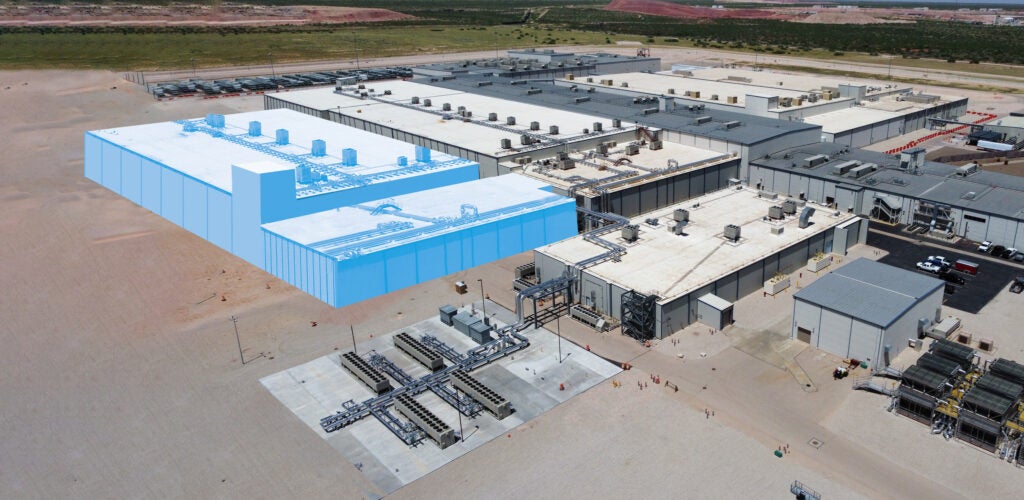
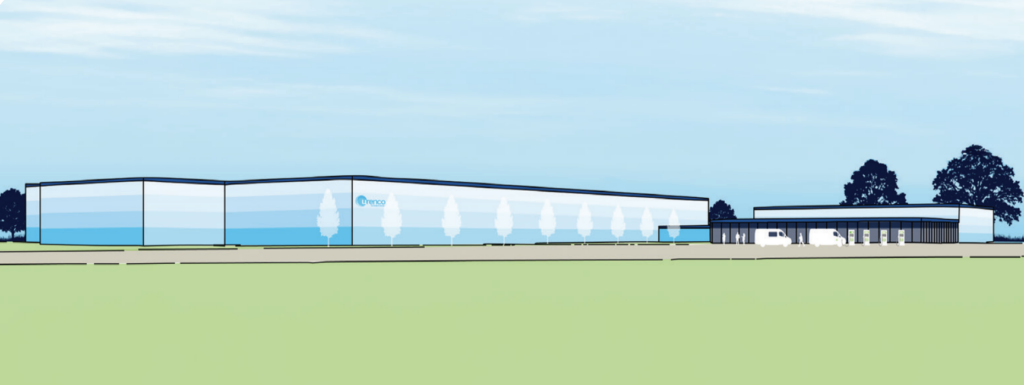
Urenco USA, operator of the only U.S. commercial-scale uranium enrichment facility, will expand low-enriched uranium (LEU) capacity at its National Enrichment Facility (NEF) in Eunice, New Mexico, by nearly 50% through a privately funded, multibillion-dollar investment that includes construction of a new enrichment plant. The project will add 2.1 million separative work units (SWU) of new enrichment capacity.
The expansion, announced June 2, will install up to 24 gas centrifuge cascades at the licensed New Mexico site. While construction is slated to begin at the new plant in 2029, the first cascades are scheduled to begin production in 2032, and additional cascades are slated for installation through 2036. The NEF site is already licensed by the Nuclear Regulatory Commission (NRC) for up to 10 million SWU of capacity—well above the projected buildout, Urenco told POWER.
The new buildout follows an ongoing 700,000-SWU expansion scheduled for completion in 2027 and planned refurbishment of existing cascades beginning that same year. All four cascades installed under that program came online ahead of schedule and on budget, Urenco reported on April 2. The NEF currently has 4.3 million SWU of annual capacity, which represents approximately one-third of current U.S. enrichment demand, Urenco said. Total installed capacity at the facility is expected to exceed 7 million SWU over the next decade.
“This is the most transformative expansion decision for Urenco in the past decade, and our New Mexico employees are ready to fuel the continued growth of the U.S. nuclear power industry by bringing this additional capacity online,” said John Kirkpatrick, managing director of Urenco USA. “We are thrilled to be making this major investment in New Mexico, and for the jobs and economic benefits it will bring to our local communities and the state.”
Addressing a Widening Supply Gap
Urenco USA’s move comes as the U.S. nuclear fuel market braces for a potential supply transition gap in the late 2020s and early 2030s, driven in large part by the Russian uranium import ban and its scheduled end of waiver authority on Jan. 1, 2028. At a March uranium supply-chain panel at CERAweek 2026 by S&P Global, industry participants described the ban as a test of timing for the front end of the fuel cycle. While one participant warned that depleted inventories could create a shortage in the early 2030s, another emphasized that utilities had used long-term contracts to cover near-term needs through 2028, 2029, and 2030 as new non-Russian supply moves toward the market.
The Energy Information Administration’s (EIA’s) most recent uranium marketing data show owners and operators of U.S. civilian nuclear power reactors purchased 15 million SWU under enrichment services contracts in 2024. U.S.-origin SWU accounted for 19% of that total, while foreign-origin SWU accounted for 81%. Russia supplied 20% of the SWU purchased by U.S. reactor operators, followed by France at 18%, the Netherlands at 15%, the UK at 9%, and Germany at 7%.
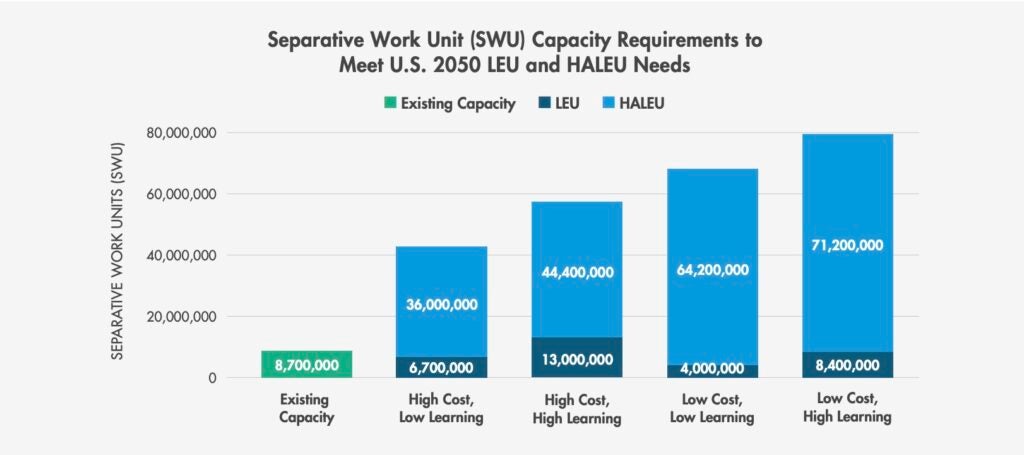
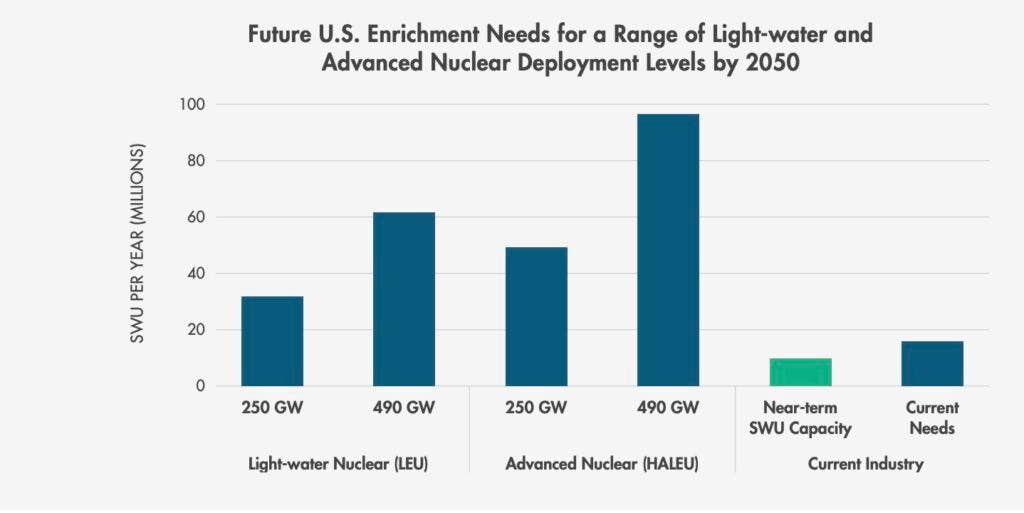
For now, Urenco USA’s NEF remains the nation’s sole commercial enrichment facility. However, a recent Breakthrough Institute analysis (published in November 2025) found that if the U.S. nuclear fleet grows to between 250 GW and 490 GW by 2050—a range that includes the Trump administration’s 400-GW target— annual U.S. SWU needs could range from 4 million to 13 million for conventional light water reactors and 36 million to 71 million for advanced reactors. Those projections assume a significant decline in conventional light-water reactor capacity from today’s 92 GW, but the authors acknowledge: “This result may no longer be plausible considering a strong recent trend toward relicensing of existing reactors and even recommissioning of decommissioned facilities amid rising U.S. electricity demand forecasts.”
Running a wider bounding analysis that accounts for that trend, the report found that total U.S. enrichment needs in 2050 could range from 31.4 million to 96.5 million SWU—“around five to ten times greater than the 8.8 million SWU of potentially available U.S. enrichment capacity in the near term,” which the report calculates as the combined output of the Urenco USA facility and the Centrus plant currently under development.
Urenco USA’s NEF in Eunice, New Mexico, has 64 cascades online and produces about 4.3 million SWU per year, “which is approximately one-third of current U.S. demand,” the company says, and since the plant began operating in 2010, it has surpassed 50 million SWU of cumulative production. To expand that base ahead of the Russian import ban’s full effect, Urenco USA began bringing new cascades online in May 2025, launching a program to install 700,000 SWU of additional capacity at the New Mexico site by 2027. Three cascades came online throughout 2025—in May, September, and December—and a fourth followed in late March 2026, marking the halfway point of the expansion. All four came in ahead of schedule and on budget, the company notes. In October 2025, the Nuclear Regulatory Commission (NRC) authorized the facility to enrich uranium to 10% U-235, a higher grade known as LEU+, and the company completed its first production run at 8.5% enrichment in December—a first for any U.S. commercial enrichment facility.
For now, “Urenco USA also intends to refurbish existing capacity at the site starting in 2027 as part of ongoing capital investments in the facility to maintain a long-term, reliable supply of enrichment services for its customers.” The newly announced 2.1 million SWU addition—and funding for “the construction of a new enrichment plant” at Eunice will boost the facility’s capacity “to more than 7 million SWU over the next decade,” the company said on June 2.
Federal Effort Bolstering More Enrichment
Responding to the looming domestic nuclear fuel supply gap, the DOE has moved to issue $2.7 billion in task orders. Under its Domestic LEU Supply Chain Program, the DOE pre-qualified six companies under Task Order 1 in 2024—including Urenco USA subsidiary Louisiana Energy Services—giving each company $2 million to prepare bids. But in January 2026, the agency issued a single Task Order 2 award under that program, allocating $900 million to Orano Federal Services to develop Project IKE, a $5 billion gas-centrifuge LEU enrichment plant planned for a 624-acre parcel of former Manhattan Project land in Oak Ridge, Tennessee.
Orano submitted its full license application to the NRC in March for Project IKE, and the federal body accepted it for an accelerated 12-month review on May 21, setting a decision deadline of April 30, 2027. According to those filings, Project IKE—which is also backed by the State of Tennessee’s Nuclear Energy Fund— is slated to have a licensed capacity of 7.4 million SWU per year, which Orano says “alone can replace the enriched uranium America is currently importing from Russia.” The plant will use centrifuge technology developed by Enrichment Technology Company (ETC) (a joint venture Orano co-owns with Urenco) and already proven at commercial scale at Orano’s Georges Besse 2 facility in Tricastin, France, which has operated at 7.5 million SWU per year since 2016 and is currently undergoing a 30% capacity expansion.
Notably, under its $2.7 billion task orders, while the DOE pre-qualified four companies under Task Order 1 for its separate HALEU enrichment services program, it doled out two Task Order 2 HALEU awards of $900 million each: one to Centrus’s American Centrifuge Operating to scale production at its Piketon, Ohio, facility and one to General Matter.
Bethesda, Maryland-based Centrus Energy—which has produced just over 920 kg of HALEU under a DOE contract from a 16-machine demonstration cascade at its Piketon, Ohio, facility—began manufacturing centrifuges in December 2025 to support a commercial LEU expansion at the same site and anticipates first new production capacity in 2029. General Matter, a California-based startup, holds a DOE lease at the former Paducah Gaseous Diffusion Plant in western Kentucky; in March 2026, it outlined plans—backed by U.S. Export–Import Bank indications of support—to supply American-enriched uranium to allied utilities in Japan and South Korea.
While Urenco’s Louisiana Energy Services pre-qualified both federal programs—for LEU and HALEU—the June 2 expansion will proceed without federal funding. “Urenco has always aligned its capacity with the signed, long-term contracts it has in its orderbook,” as Urenco spokesperson Jeremy Derryberry explained to POWER. “As of December 31, 2025, that orderbook extended into the 2040s with a record value of €21.3 billion, an increase of 14% on 2024.”
Sarah Riedel, head of Sales for Urenco, on Tuesday also suggested the move is buoyed by market signal. “Urenco USA has always focused on being a reliable long-term supplier to America’s commercial nuclear power plants, with a proven record of delivering fuel from our New Mexico facility to U.S. utilities,” she said. “We thank our customers for their trust in us and the confidence they have in our capabilities. Their commitments through new long-term contracts support our investment decision to expand this vital facility that will fuel their operations for decades to come.”
Eunice Is Just One Part of Urenco’s Global Expansion
However, Urenco’s expansion of its New Mexico facility comes amid a broader buildout of its international operations. A privately held company incorporated in the UK and owned in equal thirds by the British, Dutch, and German governments, Urenco operates gas centrifuge enrichment facilities at Capenhurst in the UK, Almelo in the Netherlands, Gronau in Germany, and Eunice, New Mexico. Installed capacity across the four sites amounted to 17.2 million SWU as of Dec. 31, 2025, Derryberry confirmed to POWER.
![Urenco's core service is uranium enrichment, a key step between conversion and fuel fabrication. After natural uranium hexafluoride (UF₆) is delivered by approved suppliers at enrichment facilities in cylinders, it is heated to gas and fed into cascades of centrifuges that spin at high speed, a process that separates the fissile isotope U-235 from the heavier U-238 by mass until the desired enrichment level is reached. The solidified, enriched UF₆ is weighed, verified against NRC, Euratom, and IAEA accounting requirements, and shipped to fuel fabricators. The depleted byproduct, known as tails, is stored or processed into uranium oxide for long-term management. Source: Urenco 2025 Annual Report]](https://www.powermag.com/wp-content/uploads/2026/06/urencobusinessmodel-2026-1024x631.png)
According to Urenco’s 2025 annual report, the current capacity buildout stems as a direct response to Russia’s 2022 invasion of Ukraine, which triggered a sharp increase in demand for Western enrichment services. Along with the expansion at Eunice—which, including the June 2 announced expansion, will add a combined 2.8 million SWU/year—Urenco is also adding 1.5 million SWU of new capacity at Almelo, which represents a doubling of its original expansion plan there, in part to help European utilities diversify away from Russian enrichment supply. At Gronau in Germany, the first two new centrifuge cascades are on track for installation in 2026. At Capenhurst in the UK, Urenco has brought two enrichment plants back online following major upgrades.
And beyond new SWU capacity, the report shows Urenco investing across adjacent parts of the nuclear fuel cycle. At Capenhurst, the Advanced Fuels Facility is on schedule to move from groundworks to construction in 2028. Initially designed to produce up to 27 metric tons of HALEU per year, it features a modular design that could at least double that output if demand develops. The company is also progressing tails management work at its UK Tails Management Facility and conducting a feasibility study for deconversion in the U.S. At Almelo, Urenco commissioned the Blaise Pascal cascade in 2025 to expand production of stable isotopes for medical, industrial, and research uses.
Expanding Beyond LEU—to LEU+ to HALEU
Eunice, notably, has also become Urenco’s first LEU+ production platform. Following an exhaustive readiness program, Urenco USA on Sept. 30, 2025, received the NRC’s authorization to enrich uranium up to 10% U-235. In December 2025, the company completed its initial production run of uranium enriched to 8.5% U-235, marking a first for the U.S.
“LEU+ will support longer operating cycles for the current fleet of light-water reactors, which will reduce their operating and maintenance costs, and supports the deployment of new accident-tolerant fuel designs,” the company explained. “Many advanced reactor designs will be able to utilize LEU+ for fuel, speeding their deployment timelines and providing them a domestic source of enrichment. LEU+ can also serve as feedstock for producing high-assay low-enriched uranium (HALEU), which is uranium enriched to between 10-20% U-235, increasing the potential output of future HALEU enrichment facilities.”
For now, Urenco USA plans to begin producing commercial quantities of LEU+ for its customers in mid-2026 and anticipates shipping the first LEU+ to a fabricator in 2026 or 2027.
Urenco’s HALEU plans, however, remain centered on the UK. Its Advanced Fuels Facility at the Capenhurst site, which is backed by a £196 million co-investment with the UK government and is slated to come online in 2031, plans to produce HALEU enriched between 10% and 20% U-235, with an initial output of up to 27 metric tons per year. The company says the first plant module would produce enough HALEU to supply up to 30 advanced reactors. Urenco, on May 6, notably, also produced LEU+ enriched uranium during its first trial run at Capenhurst. “Urenco plans to make LEU+ commercially available from the UK in the near future, which will support existing capability from our U.S. site that had been achieved in late 2025. LEU+ could be transported to fabricators from early 2027 to complete the next stage of the fuel cycle,” it said.
So far, the company has already cemented deals with several pioneering advanced nuclear firms. In July 2025, Urenco signed a contract with Aalo Atomics to supply 5% LEU for its Aalo-X sodium-cooled reactor at Idaho National Laboratory—which marked the first commercial fuel supply contract between a Western enricher and a U.S. advanced reactor developer. In September 2025, that was followed by the first binding commercial HALEU agreement with microreactor developer Radiant, signed at the U.S. Embassy in London during President Trump’s state visit to the UK, to supply HALEU for Radiant’s Kaleidos reactor.
Urenco has also signed LEU and LEU+ contracts with Valar Atomics and Antares Industries. In May 2026, Antares and Urenco signed what Urenco called “the world’s first multi-year” commercial HALEU supply contract. Under the agreement, Urenco will provide enrichment services for HALEU to support Antares’ planned microreactor deployments in North America and allied markets, though the fuel will be produced at the UK Capenhurst HALEU enrichment facility, which, planned for production start in 2031, “is on schedule to be one of the first Western licensed facilities,” said Magnus Mori, Head of Advanced Fuels for Urenco.
“If sufficient demand materializes, we can then use that design to deploy a HALEU facility in the U.S. at the New Mexico site,” Derryberry told POWER. “Any HALEU facility deployed in the U.S. or other countries will require feedstock from either LEU or LEU+ production,” given that a HALEU facility is a standalone plant, he explained. “We anticipate supplying LEU or LEU+ from the U.S. site for future HALEU production.”
As Derryberry noted, the project to build a new enrichment plant at Eunice, which will span through 2036, won’t require additional licensing. “The site is already licensed for up to 10 million SWU of capacity, so no license amendment will be needed to construct this new capacity being announced,” he said.
The company has also leveraged its international foothold to secure an adequate supply chain for its centrifuges. “Urenco has already made commitments to ensure it will have the centrifuge machines needed to support the announced [global] capacity expansions of 4.6 million SWU,” Derryberry noted. “Machine installation will be spread out over a decade, which allows for sufficient ramp-up in manufacturing capacity as needed.”
However, the buildout will also require a larger workforce. Urenco USA currently employs more than 500 U.S. staff and long-term contractors at NEF, and the new enrichment plant is expected to support 300 to 600 construction jobs during peak construction and 70 long-term operations jobs. Derryberry said construction labor will come from contractors, while Urenco is working with local education institutions to build its future site workforce. “For instance, we have partnered with the New Mexico Junior College to build a Nuclear Energy Certificate and Associate Degree Program to prepare the future workforce for a career in the nuclear industry,” he said. “This program is a continuation of the high school workforce training program at the Career and Technical Education Center of Hobbs (CTECH), which we also support. Over the course of four years, Urenco USA is investing $400,000 in educational support to NMJC students that are part of this program. We also have an active internship and a co-op program to introduce college students to potential careers at our facility across several departments.”
Strong Contracts, Surging Demand
According to Urenco CEO Boris Schucht, surging global demand for enriched uranium remains positive, staked firmly in decarbonization goals, energy security concerns, and the rise of artificial intelligence data centers. “The positive momentum behind nuclear energy is clear for all to see, with policy developments and commercial commitments evident across the globe,” he wrote in Urenco’s annual report.
The company’s order book grew for a fourth consecutive year in 2025, reaching a record €21.3 billion as of Dec. 31, 2025 (up from €18.7 billion in 2024). The outcome has been underpinned by new long-term contracts, including an agreement to supply Sizewell C in the UK for its first six years of operation; a new contract covering EDF’s reactor fleet in France and the UK (described by Urenco as its largest ever); and new agreements with several Japanese customers, the company suggests.
However, “Investments must continue, with the reassurance of long-term contracts and the adoption of different ways of working to reduce costs and timescales of projects,” Schucht wrote. “This is essential, including for the development of the SMR/AMR market, if nuclear is to be competitive as a reliable, low-carbon energy source for the planet”.
An independent study commissioned by Urenco and conducted by LucidCatalyst, published during COP30 in November 2025, found that SMRs alone could serve up to 700 GW of industrial energy demand in Europe and North America by 2050, representing a $0.5 to $1.5 trillion investment opportunity. The study, backed by the World Nuclear Association, identified 11 industrial sectors across those two regions that together account for more than 80% of total industrial energy demand—requiring 17,000 TWh of clean, reliable energy annually by 2050—and found that SMRs are technically capable of serving more than 80% of that demand.
The top five sectors, representing more than 75% of the 700 GW opportunity, are synthetic aviation fuels (203 GW), coal plant repowering (110 GW), synthetic maritime fuels (90 GW), data centers (75 GW), and chemicals (55 GW). The report notes, however, that the 700 GW figure is the ceiling—achievable only under a full transformation of nuclear delivery from bespoke construction to mass manufacturing. Under current deployment trends, the study projects only 7 GW would be deployed by 2050, rising to 120 GW under a more programmatic scenario with sustained government support and standardized construction.
—Sonal C. Patel is a POWER senior editor (@sonalcpatel, @POWERmagazine).