The Nuclear Regulatory Commission (NRC) has proposed a materials-licensing rule that would revise several regulatory handoffs outside the reactor license, including pilot fuel lines, spent fuel reprocessing, dry storage cask approvals, advanced-fuel storage definitions, construction timing, and reporting requirements for fuel-cycle and materials facilities.
The proposed rule, Modernizing Materials Licensing, released June 18, seeks to amend 10 CFR Parts 30, 37, 40, 51, 70, 72, and 140. The NRC described the package as “deregulatory,” saying it would streamline licensing for existing and certain new applicants, eliminate unnecessary regulations, revise reporting and recordkeeping requirements, and update radioactive-material storage rules to accommodate new and advanced nuclear fuels.
The proposal is part of NRC’s response to the Trump administration’s Executive Order 14300, which directed the agency to review and revise its regulations and guidance, and it aligns with congressional direction in the ADVANCE Act to make nuclear licensing more predictable, efficient, and technology-inclusive.
“America is rebuilding the front end of the nuclear fuel cycle at a pace not seen in decades,” NRC Chairman Ho K. Nieh said. “These proposed rules support American leadership in nuclear energy through safety-focused and efficient licensing.”
DOE Pilot Fuel Lines
The proposal is significant for advanced reactor developers because it addresses a licensing gap between demonstration work authorized by the Department of Energy (DOE) and future NRC commercial oversight. Under DOE’s Reactor Pilot Program and corresponding Fuel Line Pilot Program, DOE has moved to expedite advanced reactor testing under DOE authority outside the national laboratories and support pilot fuel lines for non-commercial reactors. The NRC says those pilot fuel lines “would establish a domestic nuclear fuel supply chain for pilot reactors for non-commercial purposes.”
Under the proposal, the construction and operation of DOE-authorized pilot fuel lines for non-commercial purposes would be exempt from NRC licensing requirements under Part 70. However, the exemption would not carry over to commercial use. A pilot line seeking commercial operation would still require an NRC license, and the applicant would need to demonstrate how the DOE authorization satisfies NRC regulations and statutory provisions, including any required facility design or operating changes.
However, the provision would allow the NRC to focus a subsequent commercial review on gaps between DOE authorization and NRC requirements, rather than revisiting areas already addressed under DOE authority. For developers, that will include fuel qualification, pilot-scale production, storage, security plans, and, in some cases, reprocessing pathways, each of which can require separate licensing before a project reaches fuel load or commercial operation.
Reprocessing Under Part 70
The proposal would also explicitly bring spent fuel reprocessing facilities under Part 70. While current rules could allow a spent fuel reprocessing facility to be licensed under Part 50 or Part 70, Part 70 does not explicitly include spent fuel reprocessing facilities or address production facilities. The proposed rule would clarify that reprocessing facilities, including those that meet the Atomic Energy Act definition of a production facility, may be licensed under Part 70.
The change could give applicants an alternative to the Part 50 two-step process of a construction permit followed by an operating license. The NRC says it would still assess the safety and security risks of each application and require an equivalent level of safety and security regardless of the licensing path.
The reprocessing proposal is not a complete technology-specific rulebook. A 2009 NRC staff gap analysis identified 23 gaps between existing regulations and the requirements needed to protect public health and safety, common defense and security, and the environment for spent fuel reprocessing facilities. The proposed framework would require applicants to identify gaps relevant to their technologies and address them through application content, exemptions, and proposed license conditions.
For reprocessing facilities that qualify as production facilities, the proposal would require technical specifications, inspections, tests, analyses, and acceptance criteria, an operator licensing program, financial protection, foreign ownership restrictions, and a mandatory hearing. While the NRC says it is not aware today of any reprocessing technology that would fall outside the production-facility definition, the proposed rule leaves room for that possibility.
Dry Storage Cask Certificates and Advanced Reactor Fuel Definitions
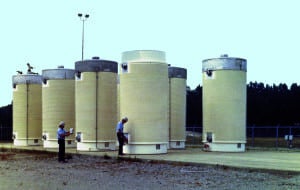
A separate Part 72 change, meanwhile, would affect dry spent fuel storage. The NRC proposes to remove the rulemaking step now used to codify each approved dry storage cask certificate of compliance in 10 CFR 72.214. The agency says it has “almost 25 years of data indicating that these rules are uncontroversial,” citing the limited number of adverse comments in certificate rulemakings.
The safety review would remain. Once NRC makes the required safety findings, it will issue the certificate and list it on the agency’s website, rather than issuing a direct final rule for each cask design or amendment. NRC estimates it receives about eight cask applications a year and spends about 1,500 staff-hours per rule, or about 12,000 staff-hours annually. The agency estimates the change would save approximately $1.9 million a year and $13.3 million over 10 years at a 7% discount rate.
The Part 72 proposal also updates spent fuel storage language for advanced reactor fuels. The current definition includes fuel aged for at least one year before storage, a requirement NRC says “was not based on risk insights.” The revised definition would define spent fuel by irradiation and reprocessing status: fuel withdrawn from a reactor after irradiation, whose constituent elements have not been separated by reprocessing. The rule would also update damaged-fuel language written for light-water reactor fuel so that it applies to advanced reactor designs.
Additional Provisions
The proposal would also create a Part 37 exemption for large components and robust structures containing Category 1 or Category 2 quantities of radioactive material. Proposed rule text defines a large component as “an item weighing 2,000 kg (4,409 lbs) or more,” and lists examples including steam generators, steam dryers, turbine rotors, reactor vessels, reactor vessel heads, reactor coolant pumps, and shielding blocks.
Finally, the NRC also proposed to clarify construction timing for byproduct, source, and some fuel-cycle facilities. For many materials facilities, construction before license approval would no longer, by itself, be grounds for denial if the applicant proceeds at its own risk. That change would not apply to uranium enrichment facilities or spent fuel reprocessing facilities, where construction before the required NRC finding would remain grounds for denial.
The rule would also reduce some reporting requirements, extend some reporting timeframes, and allow relief from criticality accident alarm requirements when a licensee demonstrates that criticality is not credible based on the laws of physics.
Comments on the proposed rule are due Aug. 10, 2026. The NRC is seeking input on the definition of construction, regulatory gaps in reprocessing, decommissioning funding, waste handling, quality assurance, operator licensing, technical specifications, Part 70 change-control processes, and baseline design criteria. The NRC plans to hold a public meeting on the proposed rule.