Integrate high-load data centers and renewable energy without compromising grid reliability.
Grid reliability hinges on the flexibility identified, managed, and optimized by operational technology (OT). The rise of artificial intelligence, and the rapid growth of data centers, is quickly reshaping utility operations and reliability across the country. Total U.S. data center power demand is expected to rise from 61.8 GW in 2025 to 75.8 GW in 2026, and then reach 134.4 GW by 2030. At the same time, renewables such as wind and distributed energy resources (DERs) like rooftop solar and batteries continue to be added to the grid. Their intermittency and lack of inertia pose a growing challenge to maintaining a reliable electric grid.
All these converging pressures mean utilities need to find a way to integrate significant new demand while balancing more variable generation, ensuring reliability and limiting the need for costly infrastructure upgrades.
In this context, traditional fixed-capacity interconnection agreements are proving to be suboptimal. A grid that is subject to two-way power flows and massive demand spikes requires a different approach to interconnection, one that provides operational flexibility while supporting grid reliability.
Modern grid flexibility is not just about curtailment, but about coordinated, location-specific optimization, balancing renewables, storage assets, and controllable loads like data centers in real time. Advanced systems are backed by software-driven automation that enables utilities to monitor network conditions, forecast demand, and dynamically adjust resources across multiple points on the grid. The ultimate goal is to optimize for both reliability and economics.
Flexible Interconnection
Flexible interconnection agreements have emerged as a particularly valuable way to manage both renewable generation sources and large loads like data centers. Rather than requiring the grid to always absorb total resource output, flexible interconnections enable grid operators to actively manage available grid resources (such as large-scale batteries) to avoid adverse grid impacts while also efficiently integrating more capacity. Resources connect to the grid with the understanding that during constrained conditions, utilities’ automation systems may curtail them to maintain grid stability in other areas.

In This Issue
Full issueThis gives utilities the ability to integrate more renewables and distributed resources on existing infrastructure without having to make expensive and time-consuming upgrades. In addition, grid operators gain real-time visibility and control to prevent adverse impacts, while resource owners benefit from faster interconnection approvals and lower upfront costs.
As beneficial as it is, this level of flexibility is requiring utilities to re-think their OT strategies. The manual, phone- or email-based dispatch interconnection processes they’ve used in the past are not built to handle interconnections across dozens or hundreds of sites. There is also a certain amount of regulatory pressure to increase flexibility, including the Federal Energy Regulatory Commission (FERC) recently ordering regional grid operators to specifically address how data centers and other large energy users connect to the electric grid. In short, today’s utilities are being pushed toward a new level of automation and sophistication that can optimize these decisions while remaining within all contractual obligations.
The Technology Enabler: Distributed Energy Resource Management Systems
This is where a distributed energy resource management system (DERMS) becomes critical, providing a foundation to enable real-time monitoring, optimization, and control of dispersed resources, as well as managing them both individually and in aggregate (Figure 1). These systems can be leveraged for either transmission or distribution networks to coordinate a number of capabilities that are critical to automating responses to grid conditions, including real-time communication with distributed assets, monitoring and visualization of energy flows, forecasting of consumption patterns and renewable generation, and automated control based on grid needs and contractual agreements.
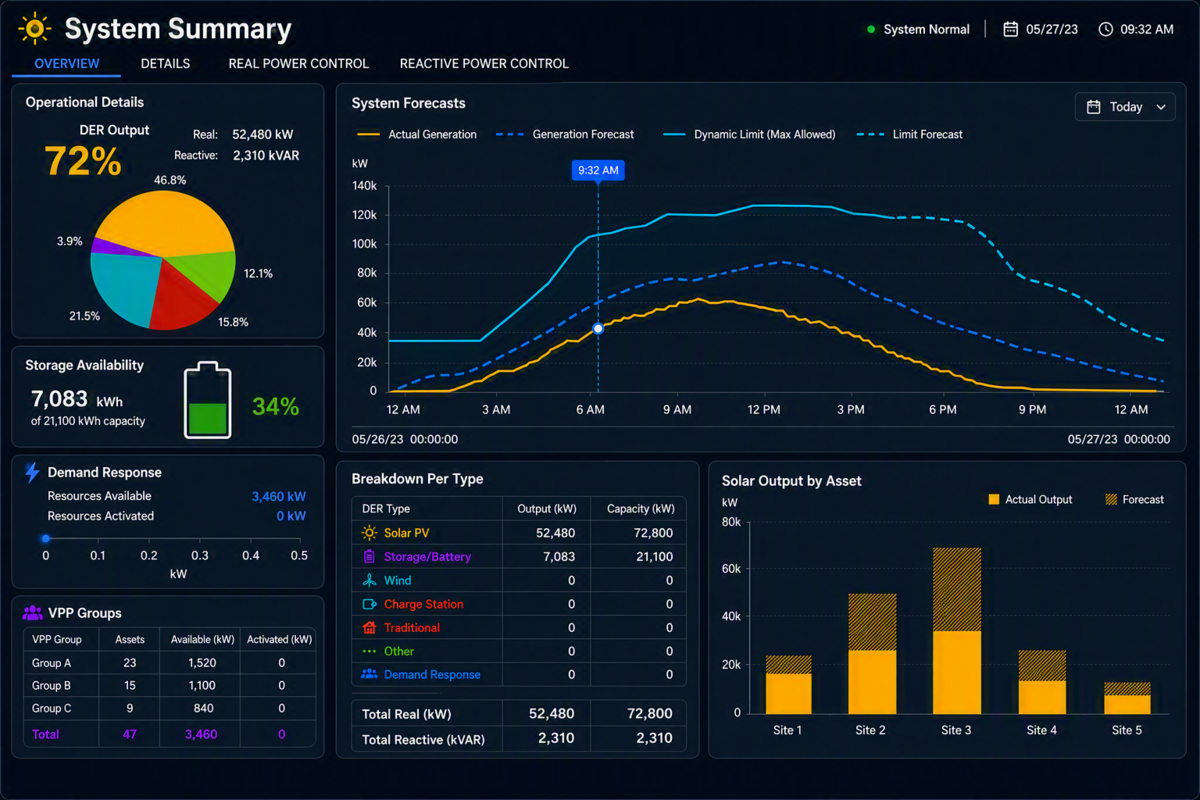
When utilities sign customers to flexible interconnection agreements that specify the parameters for curtailment, DERMS software can automate the entire dispatch and curtailment process by encoding rules and automatically dispatching control signals when needed. The system brings together real-time network state information, allowing the utility to respond to actual grid conditions rather than just worst-case assumptions.
Ideally, this technology is built into the core foundation of the utility’s transmission or distribution operation technology. With DERMS embedded in the control center, operators can see exactly which devices are connected to the grid, their location, and how they impact load, making it easier to balance the load and keep the power on. A direct connection to the supervisory control and data acquisition (SCADA) system means utilities can tailor solutions to specific grid conditions and customer requirements while ensuring grid reliability and expanding capacity for new connections.
DERMS can also provide grid operators with visibility into resource compliance, so enforcement actions can be taken if any sites fail to respond to curtailment requests. The solution allows operators to analyze the impact of DERs on power flow, create alarms for when DERs are causing issues, and control how they operate to mitigate potential issues.
The operational flexibility enabled by DERMS is helping utilities respond to the challenges that come with variable generation and limited infrastructure, while increasing capacity at the same time. For example, one major U.S. utility recently faced a situation where power would backfeed into a substation during periods of high solar output and low local demand, which risked damaging equipment that was not designed to handle reverse power flow. The utility decided to use DERMS to monitor conditions and automatically curtail the solar site whenever backfeeding occurred.
With this software-based solution in place, the utility was able to more than triple renewable hosting capacity (from 2 MW to 7 MW) purely through operational flexibility, without physical infrastructure upgrades. As a result, additional sites were added, and the utility is now opening flexible interconnection across its entire service territory and adding solar sites in other locations.
This is just one example of how operational flexibility can enable capacity growth by managing resources within physical constraints.
Looking Ahead: Operational Flexibility as a Grid Strategy
As data center campuses scale toward multi-gigawatt facilities and distributed energy resources continue proliferating, operational flexibility will become a more urgent necessity. Utilities facing interconnection requests from data centers increasingly recognize that traditional approaches cannot accommodate both the speed and scale of demand growth while maintaining affordability for all customers.
Advanced grid automation allows utilities to serve new loads while managing grid impacts through operational controls rather than just physical upgrades. By leveraging technology, utilities gain a system-wide view that enables them to forecast load, renewable generation, and potential stress points on the electrical network, and proactively remediate issues as needed at specific locations. The approach also helps utilities overcome some of the barriers to renewable energy integration, optimizing DER output and reducing strain on critical infrastructure.
Looking forward, the most successful utilities will be those that implement clear frameworks for flexible interconnection agreements, as well as software platforms for automated management and operational procedures that balance multiple grid objectives and integrate renewable management into real-time operational systems as a single pane of glass. The technology exists today, and it has been proven in deployments managing both renewable generation and large industrial loads.
The question is no longer whether asset flexibility is an effective strategy, but how quickly utilities can scale the implementation and automation needed to keep pace with grid evolution.
—Eric Sortomme, PhD is product management director with AspenTech Digital Grid Management at Emerson, and Jon Curtis is Power industry business unit manager with AspenTech Digital Grid Management at Emerson.