Another U.S.-based energy company said its technology has achieved key performance metrics that advance its goal of commercial fusion by the mid 2030s.
California-headquartered Pacific Fusion on June 2 said its core pulsed power technology is on track to achieve net facility gain by 2030. That’s the state where the “entire fusion machine produces more fusion energy than the energy initially stored in the system used to run it,” according to Keith LeChien, co-founder and CTO of Pacific Fusion.
The company, founded in 2023, said it has raised more than $1 billion in funding led by Massachusetts-based venture capital firm General Catalyst. The Pacific Fusion team includes scientists who have worked on fusion at the Lawrence Livermore lab in California, as well as the National Nuclear Security Administration. The company also on Tuesday said it has engineers with experience scaling hardware at companies including SpaceX and Tesla.
The U.S. Dept. of Energy has said there are more than 50 U.S. companies currently working on fusion technologies. That number was echoed by speakers at this week’s American Nuclear Society conference in Denver, Colorado. (Editor’s note: POWER has written about several of these groups, and interviewed several of their top executives. Fusion was part of POWER’s Special Report in February 2026 on groundbreaking technologies in the power generation sector.)
Government Commitments
ARPA-E Director Conner Prochaska in April, during his plenary remarks at the group’s Energy Innovation Summit in San Diego, California, announced a $135-million commitment to further develop and commercialize fusion technologies. The funding, which will deployed over the next several months, is the largest concentrated investment in fusion technology in the agency’s history, and just more than the $134 million ARPA-E said it has invested in commercial fusion technologies since it entered the space in 2014.
LeChien told POWER, “Fusion is capital intensive, and one of the biggest risks for any first-of-a-kind industrial project is financing risk. We addressed that by raising a $1B Series A in a milestone-based structure. The capital was committed upfront, which enables us to move fast, and it is unlocked as we achieve predefined milestones, which aligns capital deployment with methodical de-risking. So far, we have achieved the first two sets of milestones gating our financing. The final set of milestones will unlock the remainder of the capital.
“This financing structure has enabled us to plan long-lead procurement, hiring, manufacturing and facility development around a clear roadmap, and thus execute a large project much more quickly than would have otherwise been possible,” said LeChien.
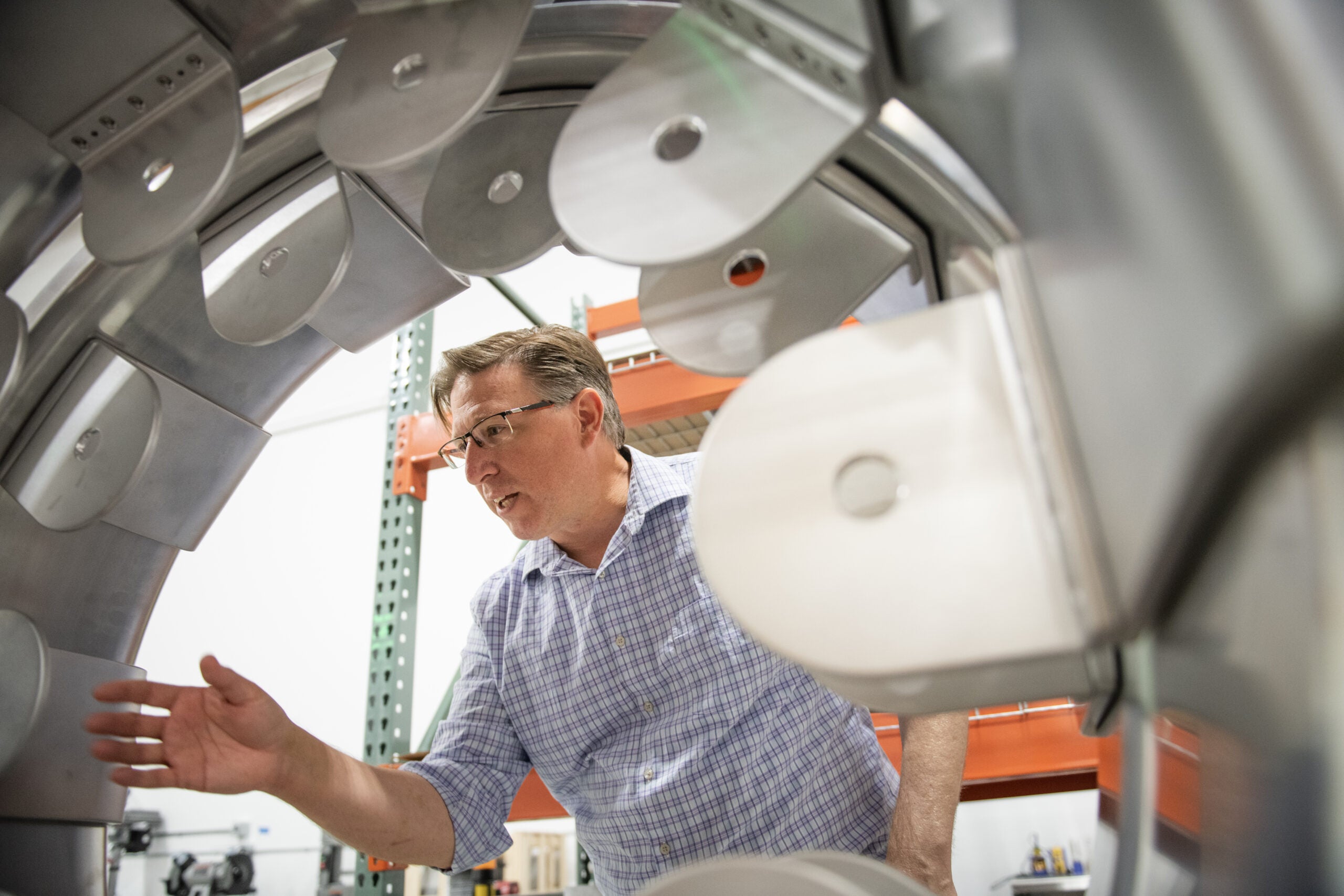
Pacific Fusion said its system is designed to achieve fusion conditions with an architecture that can support affordable fusion power. “Pacific Fusion is focused on building a practical path to scalable, affordable fusion power,” said LeChien. “These results mark meaningful progress, showing that the core driver of our system can perform at the required power levels.”

The power industry’s most urgent decisions are being made right now.
Be in the room where they happen.
View Conference Program
The company provided details of its technical milestone, including:
Power: Output at the scale required to drive fusion conditions (>440 GW of peak output power and ~1.1 MV peak voltage), delivered in an ultra-fast pulse.
Critical components: The low-cost trigger system successfully synchronized all stages into a single, coherent pulse, a key requirement for scaling to full system performance.
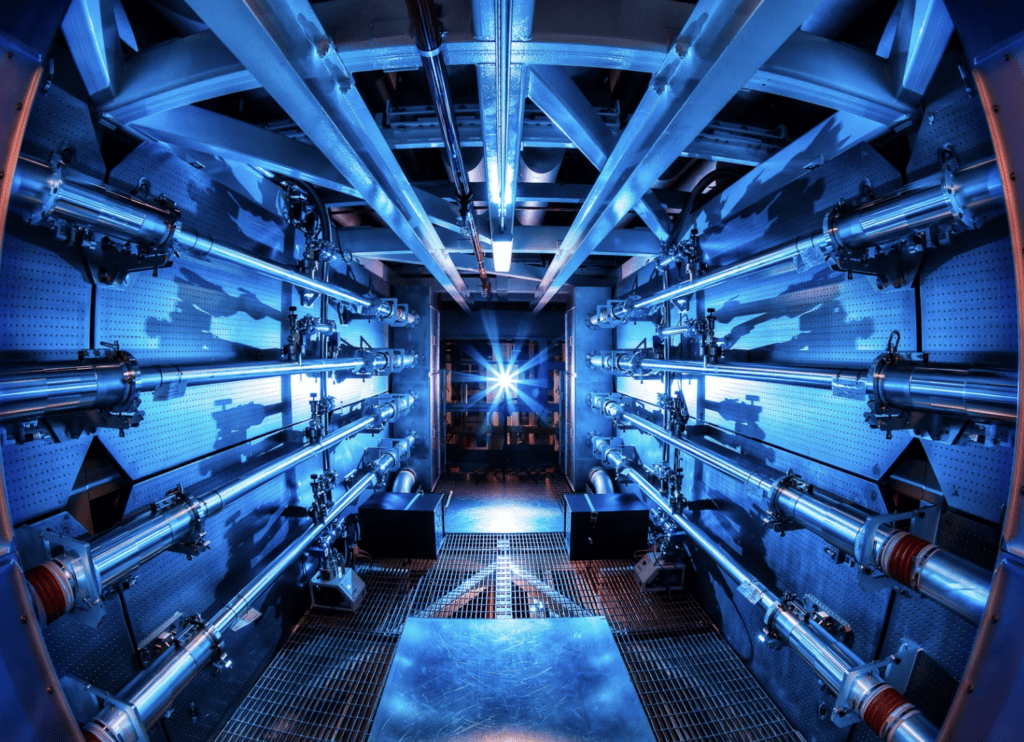
LeChien told POWER, “Our pulser-driven inertial fusion approach builds on the ignition breakthrough at Lawrence Livermore National Laboratory’s National Ignition Facility (NIF) and the basic pulser-driven inertial fusion approach demonstrated at Sandia’s Z Machine. We are taking established science and building an efficient, modular system around it.
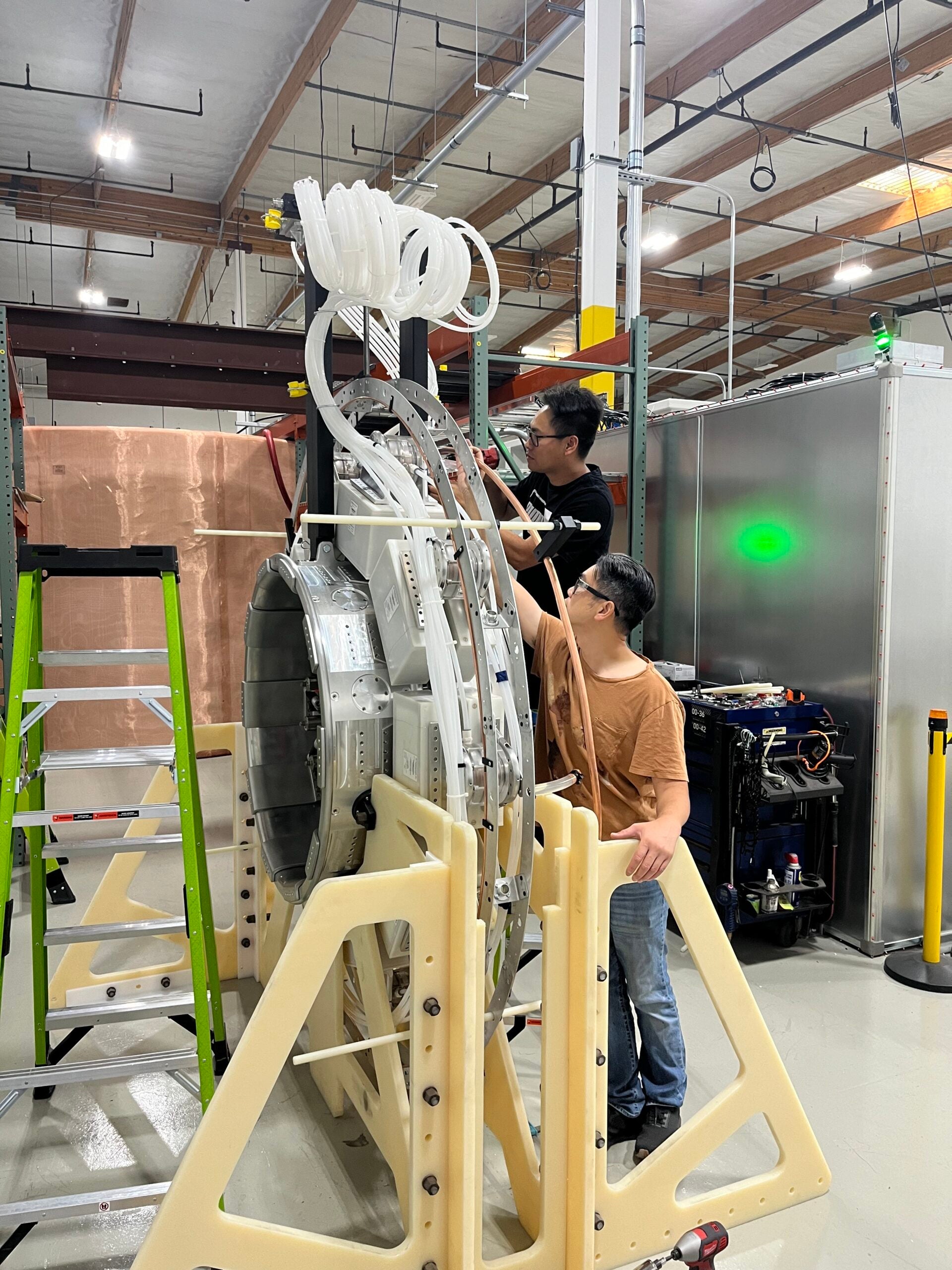
“Equally important, our system is designed to be manufactured at low cost, not custom-built as a one-off research machine. The core building block is a pulser module made from components that can be factory-built and replicated. That modularity is central to our path to affordable fusion power,” said LeChien.
LeChien said his company’s system to produce energy through fusion “does that using very fast, very powerful electrical pulses. We store electricity in capacitor banks, then release it in precisely timed bursts. That pulse creates a huge electric current, which runs across a tiny metal cylinder containing fusion fuel. The current creates a magnetic field that squeezes the fuel extremely hard, driving it to fusion conditions.
“A simple analogy is a lightning bolt: we take a small amount of electrical energy from a wall-plug, turn it into an ultra-fast pulse, and use that pulse to compress fuel and release fusion energy,” said LeChien.
Company Highlights
The group on Tuesday in a news release offered other highlights of its work:
Affordable: Pacific Fusion’s power plants will be built with low-complexity parts made from common materials. In addition, the modularity of the fusion system design provides clear paths to continuous cost reductions as manufacturing grows more efficient with scale.
Manageable: The system will be easily and cost-effectively maintained, without extended downtime. The modularity and simplicity of Pacific Fusion’s system enable the isolation and replacement of individual components, without sacrificing uptime.
Practical: The company’s power plants will deliver firm, dispatchable and zero-carbon energy using conventional balance-of-plant components. These systems have long-established track records of quality and performance, delivering cost-effective, utility-scale generation at capacities from 100MW-300MW per unit.
Scalable: The power plants could be deployed anywhere. They are safe, and they are not restricted by local natural resources (e.g., wind, solar or geothermal) or pipeline infrastructure (e.g., gas).
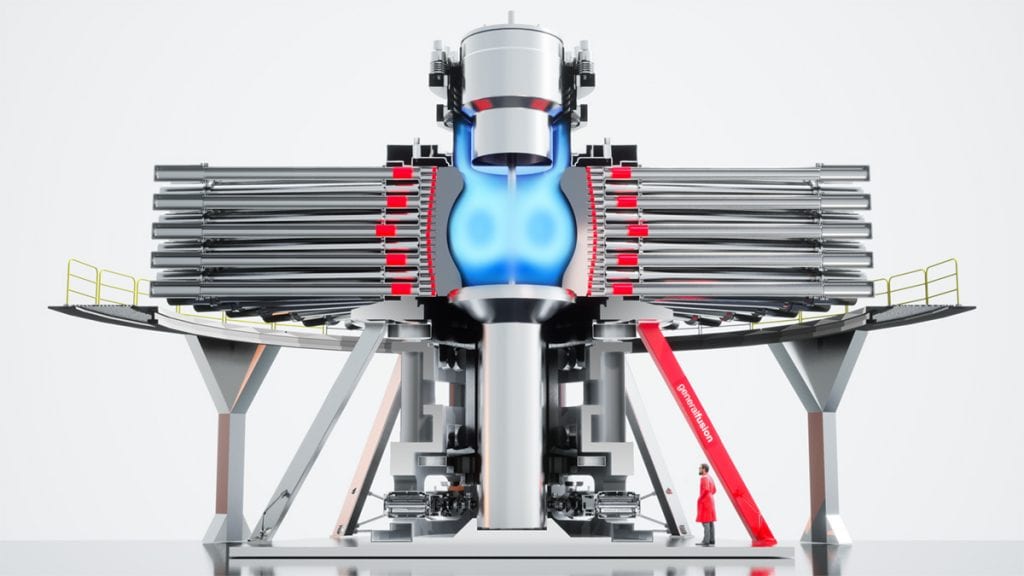
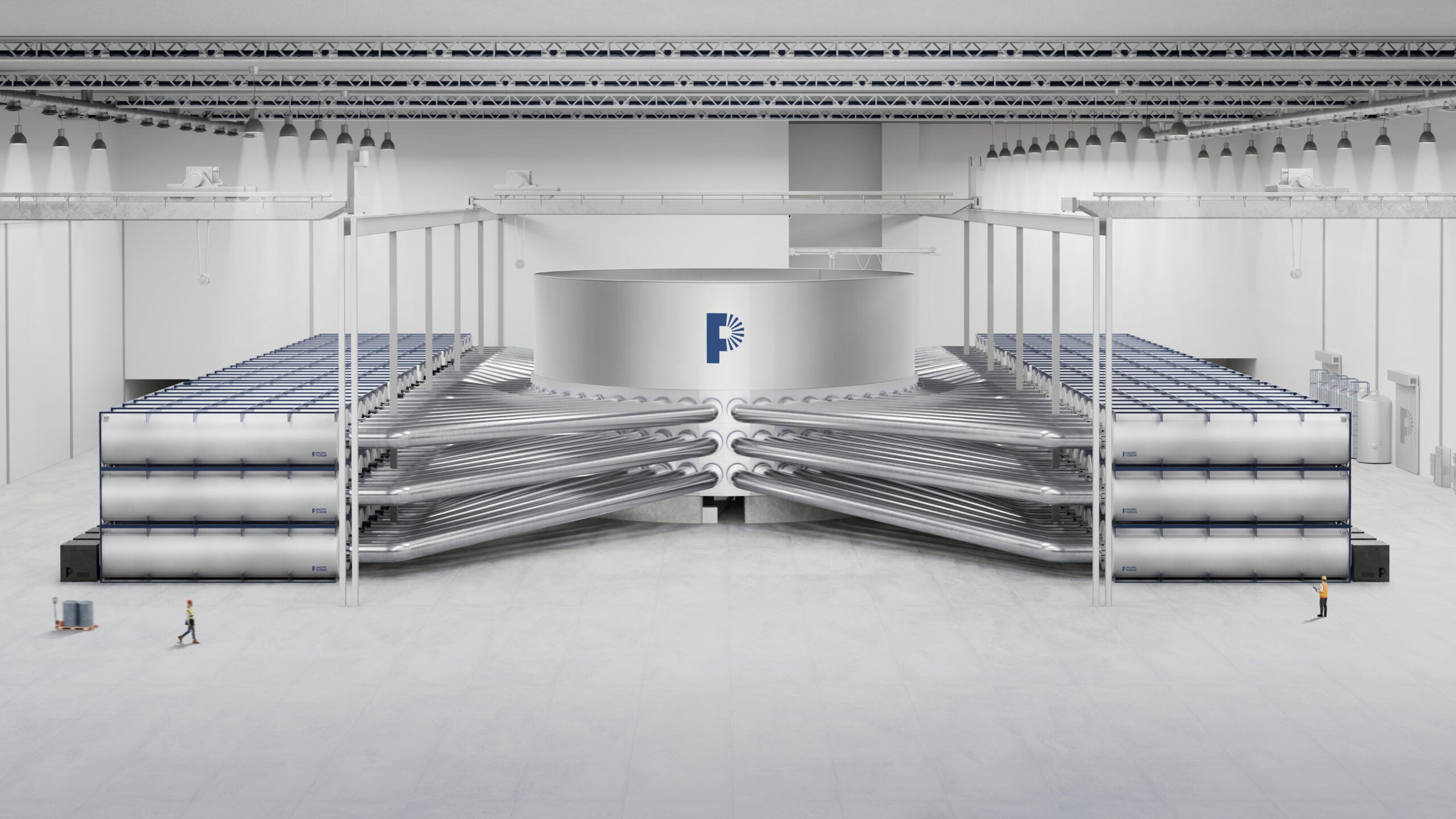
Pacific Fusion said the heart of its system is the pulser module, which is the unit responsible for delivering the bursts of energy required to drive fusion fuel to fusion conditions. The company wrote that each module “is a compact, shipping-container sized system capable of delivering more than a terawatt of peak power in a pulse lasting roughly 100 nanoseconds. In a full system, modules discharge in precise coordination to compress a fusion target and produce energy.”
The company recently shared results that it said showed a scaled prototype of its system, about one-third the size of a full module, “can repeatably deliver the performance required to ultimately drive fusion conditions.” The company said with its foundation in place its focus now is to deliver a full-scale module later this year. The group said to support that transition it is building mass manufacturing assembly lines to build modules at scale, starting at its California Build Center, then expanding to New Mexico by year-end.
Approach to Fusion
LeChien outlined differences between Pacific Fusion’s approach and that of other fusion companies using more traditional technology, such as stellarators and tokamaks.
“Tokamaks and stellarators are steady-state approaches. They work by confining low-pressure, hot plasma for long periods of time, like a furnace, often using large magnetic systems,” said LeChien. “Our approach is different. Our pulser-driven inertial fusion system does not require lasers or superconducting magnets. It works by compressing a small target to release energy, then repeat. That gives us a path to a modular architecture where the driver is built from mass-manufacturable components.
“The advantages we see are efficiency, manufacturability and maintainability. Our pulsed-power driver is designed around modules that can fit in shipping-container-scale footprints, are mass manufacturable and can be swapped out and serviced over time,” said LeChien. “Steady-state fusion, which includes tokamaks and stellarators, attempts to hold plasma at fusion conditions for a sustained period of time. You can think of it as trying to keep a very hot plasma burning continuously like a furnace.
“Inertial fusion compresses a small amount of fuel very rapidly, creating fusion conditions for a tiny fraction of a second. Instead of holding plasma continuously, it repeats many short pulses. It is the only fusion approach so far that has demonstrated ignition—achieved by the NIF in 2022,” said LeChien. “Pacific Fusion is pursuing pulser-driven inertial fusion using fast-rising, high-current electrical pulses to squeeze a small fuel target to fusion conditions.
“Although ‘modular reactors’ is a term traditionally associated with fission, modularity is central to our fusion approach,” said LeChien. “Our full system is designed around 156 identical pulsed-power modules that fire in precise coordination. Each module is made from repeatable, replicable components, which matters because fusion will be affordable if it can be built at scale. A modular design helps reduce cost, improve reliability, simplify maintenance and accelerate deployment. Our long-term fusion power plant designs are intended to be in the 100–300 MW range per unit, which makes them easier to site near load and compatible with more of today’s grid infrastructure.”
LeChien told POWER, “We designed the system from the start to avoid fragile or exotic supply chains. Our modules are built primarily from common industrial materials such as steel, aluminum, plastic, oil and water. That helps us scale supply chains, streamline manufacturing and design systems that can be maintained over time.”
—Darrell Proctor is a senior editor for POWER.