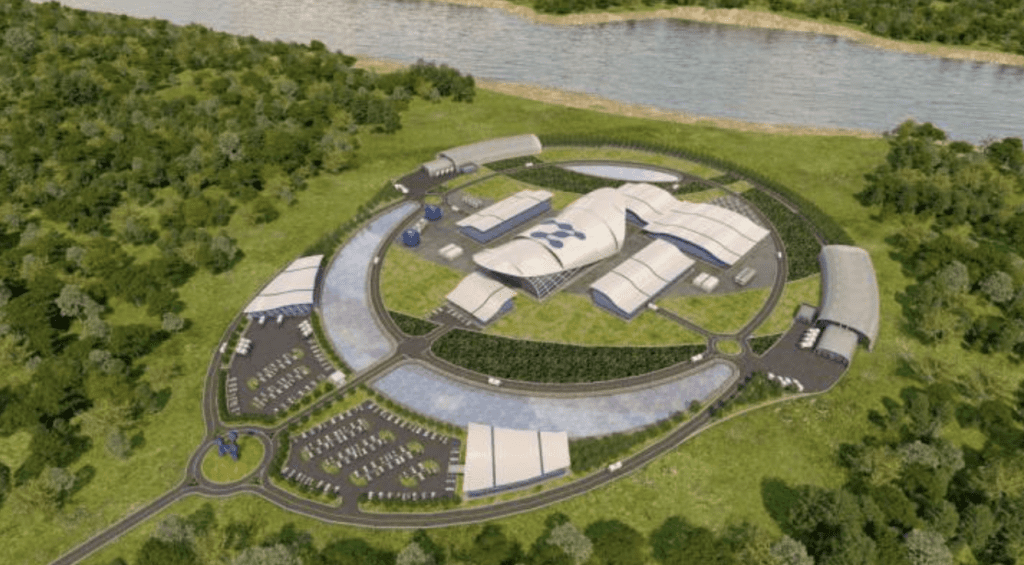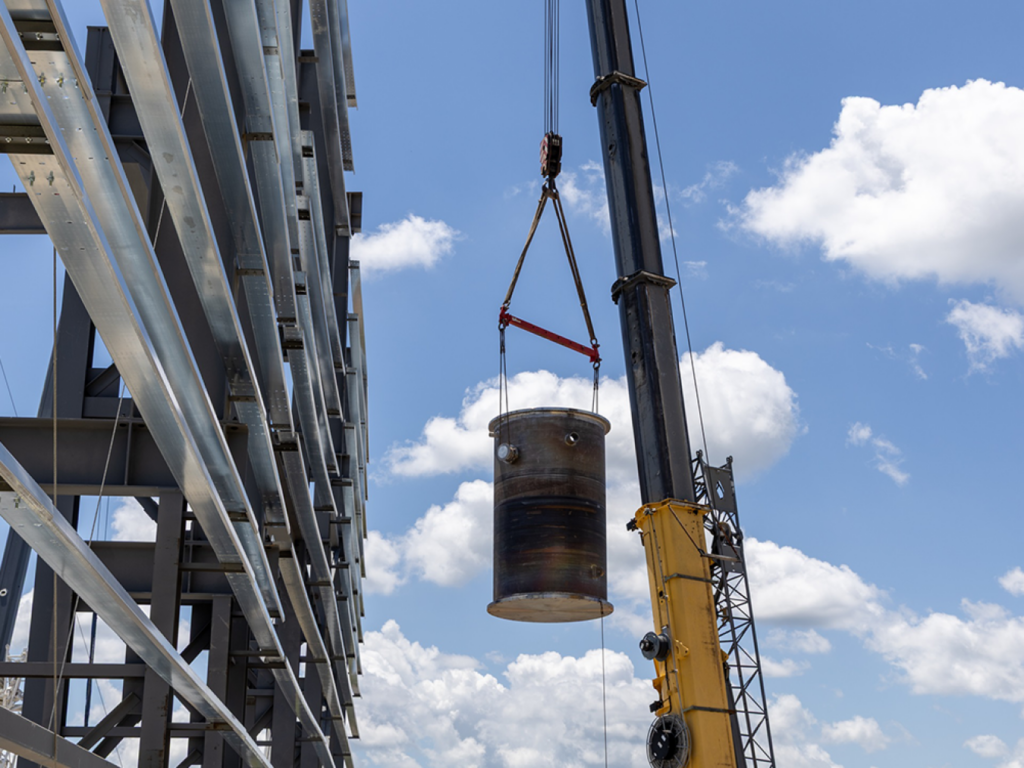
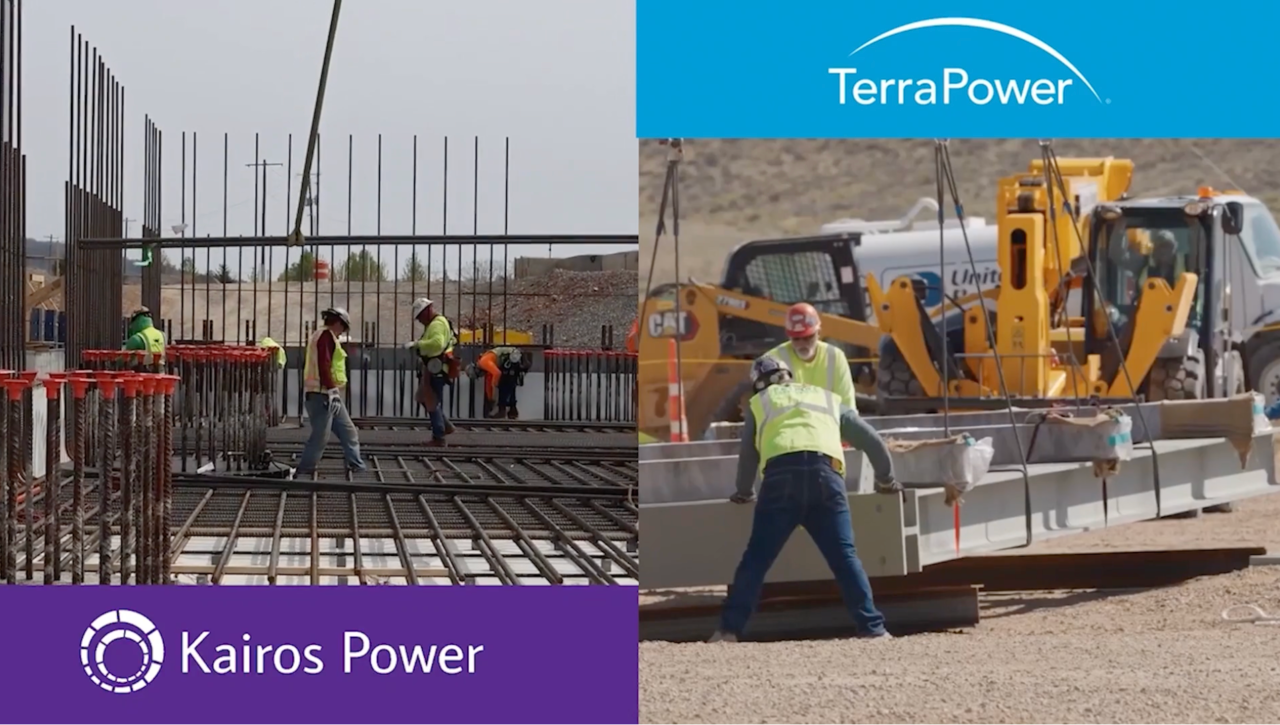
Within a single week last month, Kairos Power broke ground on its Hermes 2 reactor in Tennessee, and days later TerraPower and Bechtel began construction on the Natrium reactor in Wyoming. Maria Korsnick, president and CEO of the Nuclear Energy Institute (NEI), told industry leaders in Washington, D.C., at the Nuclear Energy Policy Forum on May 12 that she could not remember the last time two projects of that scale launched that close together (Figure 1). “The state of the nuclear energy industry is strong and getting stronger,” she proclaimed.
Eight reactors are now under construction across North America, with 90 in development, and many of those projects are aiming for startup by 2030. That tempo framed the central argument of her annual “State of the Nuclear Industry” address. “The question before us is not whether we can build. It’s clear—we’re starting—we’re showing that we can. But the question before us now is whether we have what it takes to build at scale,” Korsnick said. Her answer, threaded through a survey of policy, regulatory, financial, workforce, and project activity, was that the conditions are aligning, but that none of those gains lock in unless the industry treats today’s commitments as a floor rather than a ceiling.
Federal and State Alignment
Korsnick’s policy framing leaned heavily on the four executive orders President Trump signed last year following her 2025 industry remarks. The orders directed federal agencies to support nuclear plant restarts and new construction, modernize the U.S. Nuclear Regulatory Commission (NRC), expand the nuclear workforce, strengthen the domestic fuel cycle, and promote nuclear technology exports. The administration has set a goal of quadrupling U.S. commercial nuclear capacity by 2050.
Westinghouse is working with the federal government on a target of 10 large reactors under construction in the U.S. by 2030. The Department of Energy (DOE) is reviewing a financing proposal Korsnick described as worth “billions of dollars” in long-lead items and equipment for utilities pursuing AP1000 deployment. Meanwhile, 10 companies have been selected for the DOE’s reactor pilot program, and four developers have been chosen for the follow-on Nuclear Launch Pad.
States are moving in parallel, according to Korsnick. Indiana enacted what she called the country’s “first 20% nuclear manufacturing tax credit.” Utah is advancing Operation Gigawatt, its plan to double in-state power production with clean, reliable energy. New York has committed to 5 GW of new nuclear, and Illinois—already operator of the largest reactor fleet in the country—plans to expand it. “So far this year, 13 governors have championed nuclear in their state-of-the-state addresses, more than ever before,” Korsnick noted. Furthermore, after Texas established a nuclear coordination office, eight other states introduced similar legislation, and all six New England governors signed a regional commitment to explore advanced nuclear.
The military is moving on its own track. The Navy is exploring onshore small modular reactors (SMRs); the Army is building out a microreactor program; and the Air Force recently selected Radiant, Westinghouse, and Antares to support its program. BWX Technologies is building a prototype mobile microreactor under Project Pele.
An NRC Beating Its Own Timelines
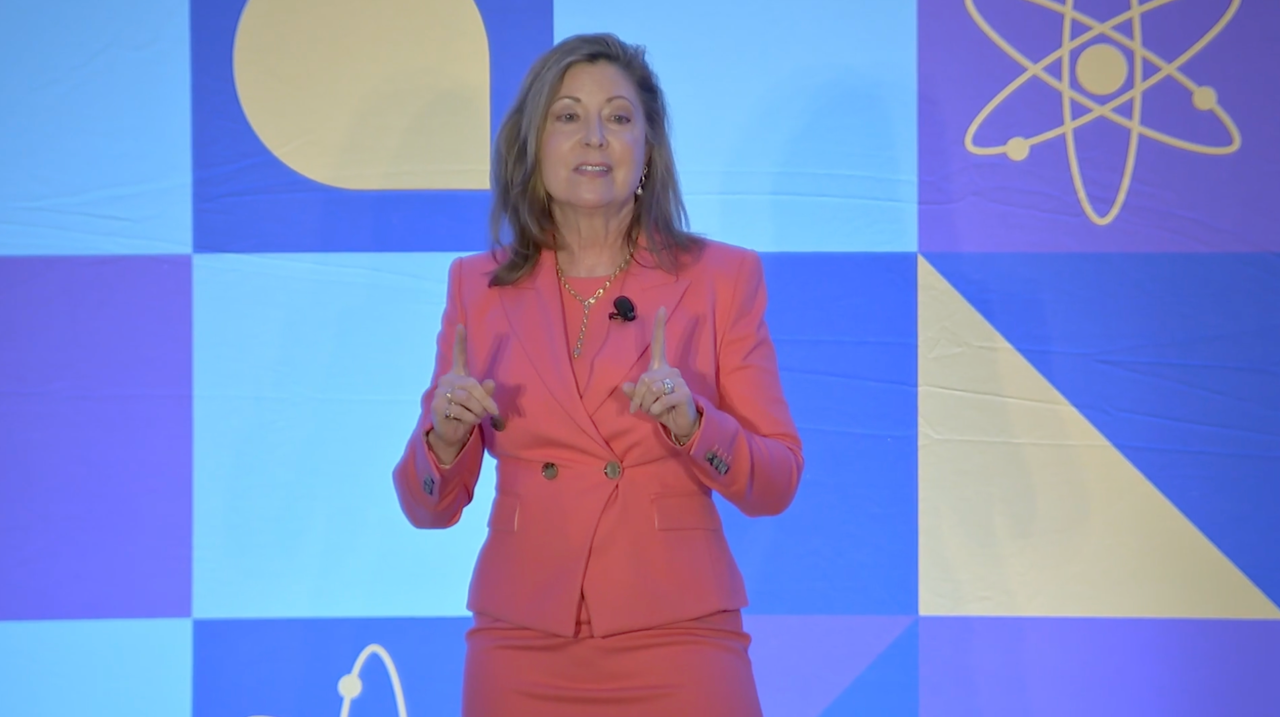
“If quadrupling nuclear capacity is our moon shot, then regulatory change is our launch pad,” said Korsnick (Figure 2), framing NRC modernization as the binding precondition for the industry’s growth plans. An NEI survey of utility members found license renewal work underway at 20 plants and power uprate activity at 29, with members planning to add 23 GW of new nuclear over the next 15 years.
Korsnick said subsequent license renewal timelines and estimated review timelines have been cut by more than 50%, and changes to the reactor oversight process will reduce baseline inspections by 40% without weakening environmental protections. She pointed to three markers. The NRC review of TerraPower’s Natrium reactor finished in 18 months, nine months ahead of schedule, and produced the first construction permit issued to a non-light-water reactor in half a century. The agency is now routinely beating its own review timelines for advanced designs, including Kairos’s Hermes 2 and X-energy’s Xe-100. And last month, the NRC completed what Korsnick called the fastest license renewal in its history, for Duke Energy’s Robinson Unit 2, with Duke planning to replicate that schedule on future applications. New NRC frameworks issued this spring, she added, will accommodate flexibility in advanced reactor design licensing and high-volume deployment. “We cannot address 21st century changes with a 20th century rule book,” she said.
Capital, Domestic, and Global
If regulatory reform is the launchpad, capital formation is the fuel. Korsnick walked through three streams.
Federal and State Dollars
On the federal side, she cited $80 billion pledged for Westinghouse AP1000 construction, $2.7 billion awarded to Orano, General Matter, and Centrus to strengthen domestic uranium enrichment, and $2.5 billion supporting Constellation’s restart of the Crane Clean Energy Center and Holtec’s restart of Palisades. At the state level, Texas opened a $350 million nuclear grant fund, Tennessee has secured more than $90 million on top of $60 million already committed, and Wyoming has announced $100 million to support a new fuel fabrication facility.
Two pieces of pending federal legislation drew direct endorsements. The bipartisan Accelerating Reliable Capacity (ARC) Act, introduced by Sens. Ruben Gallego, D-Ariz., and Jim Risch, R-Idaho, would help “early movers build order books for new plants and bring down construction costs in the process,” Korsnick said. The Nuclear Rate Stabilization Act, introduced in April by Reps. Pat Harrigan, R-N.C., and Jimmy Panetta, D-Calif., would strengthen existing nuclear tax credits to help utilities advance projects while limiting consumer costs. Korsnick urged Congress to pass both. The tax credits Congress protected last June, with Trump administration support, are already flowing. Duke Energy, which operates 11 units across the Carolinas serving 8 million homes, is passing $600 million in credit value directly to ratepayers, Korsnick reported. Her framing on the federal role drew on testimony she gave earlier this year before the House Energy and Commerce Committee: “Developers need certainty, certainty depends on managing risk, and managing risk requires some government investment and support,” she said.
Private Capital and the Hyperscaler Wave
Private capital has moved further than many in the room expected a year ago, Korsnick noted. Morgan Stanley now projects $2.2 trillion in nuclear investment through 2050—a 47% increase from the bank’s projection last year. Nuclear startups raised nearly $3 billion in 2025, including the initial public offering of Terrestrial Energy. More recently, X-energy went public last month, raising more than $1 billion in what Korsnick called “the largest nuclear public offering on record.” On May 4, Brookfield and The Nuclear Company announced a joint venture to execute Westinghouse designs, including the V.C. Summer project in South Carolina.
Hyperscalers are also moving aggressively. “Big tech now has 40 GW of nuclear power in the pipeline,” Korsnick reported. Meta signed a deal with TerraPower, Oklo, and Vistra. Google reached an agreement with NextEra to restart the Duane Arnold plant in Iowa, and it’s also collaborating with Kairos and the Tennessee Valley Authority on data center power. Amazon has invested more than $1 billion in nuclear projects. Fuel-cycle capital is following: Urenco has attracted $5 billion in private capital for its national enrichment plan; Global Laser Enrichment has announced $1.8 billion for a facility in Paducah, Kentucky; and LIS Technologies $1.4 billion for a facility in Oak Ridge, Tennessee.
The International Stream
Internationally, capital and policy are aligning with the U.S. trajectory. Japan, following a trade agreement signed this year, committed $40 billion to SMR construction in Tennessee and Alabama with GE Vernova Hitachi Nuclear Energy (GVH). Amazon and X-energy are working with South Korean companies on a $50 billion supply chain expansion, with Korean firms also manufacturing components for TerraPower. GVH is building four BWRX-300 reactors in Ontario; Poland has secured financing for its first reactor with Westinghouse and Bechtel; the UK has set a framework for advanced nuclear deployment alongside commercial agreements with U.S. developers.
Canada, Hungary, and Bulgaria are expanding capacity. Taiwan and Italy are moving to restart nuclear programs they previously wound down. The Philippines, El Salvador, and Saudi Arabia are positioning to enter the sector. Finland’s deep geologic repository is expected to enter operation soon, with Sweden’s to follow. Korsnick said European Commission President Ursula von der Leyen recently described Europe’s earlier turn from nuclear as a “strategic mistake,” and after the World Bank ended its long-standing ban on financing nuclear projects, its president, Ajay Banga, called it “long overdue.” Korsnick noted, “Quadrupling nuclear output may be a domestic priority, but it’s a global project.”
Workforce: Triple It by 2050
Answering the workforce question is “going to take some work,” Korsnick said. The industry needs to triple its workforce by 2050. She noted that it’s been three years since Vogtle Units 3 and 4 came online. Both were built with the help of more than 8,000 members of North America’s Building Trades Unions. Korsnick said that the unions are seeing their largest increase in apprenticeship programs since the 1950s, but she did not put a detailed figure on the gap that remains.
Restart, Retrofit, and Reimagine
The current build, Korsnick said, runs on three tracks. The first is restart. Holtec’s Palisades plant in Michigan is the first reactor the NRC has ever approved to bring back from closed status, and is scheduled to come online later this year. Constellation’s Crane Clean Energy Center in Pennsylvania is set to restart in 2027, while Duane Arnold in Iowa could follow in 2029.
The second is retrofit. Limerick Units 1 and 2 in Pennsylvania have been approved to digitize their control systems—what Korsnick described as a “first-of-a-kind retrofit” that demonstrates the operating fleet can be made both more resilient and, in some cases, made to produce more power.
The third is reimagining the construction process. The Genesis Mission, she said, is examining how artificial intelligence (AI) can be brought to bear on advanced nuclear design and construction. Meanwhile, Microsoft and Nvidia recently announced a partnership to create generative AI tools aimed at making nuclear permitting more efficient and easier to replicate.
A Line Back to 1955
Beyond the Natrium and Hermes 2 groundbreakings and the microreactor programs at the military services, Korsnick closed on the Natura molten salt reactor at Abilene Christian University in Texas—the first new university research reactor approved in decades and the first molten salt research reactor to be licensed. She drew the line back to the Penn State Breazeale Reactor, first licensed in 1955 under then-Penn State President Milton Eisenhower (brother of U.S. President Dwight Eisenhower), and still the oldest licensed reactor in the country.
The existing fleet—94 licensed reactors generating roughly 20% of U.S. electricity, 95% of them planning to operate for 80 years or longer—is the baseline. Units now under construction, Korsnick said, may still be operating in 2100. “These new units will outlast all of us,” Korsnick observed. “They’re going to power a world that none of us can yet imagine. It’s clear—more than clean energy, more than reliable energy—nuclear energy is generational energy, and every time we build, we’re building the future.”
—Aaron Larson is POWER’s executive editor.