 |
At a 57-year-old hydro plant where the real product is drinking water for 2.7 million people, GE Vernova replaced two original generators on a four-month outage window—proving that reliability, not output, drives the calculus on some aging hydro assets. The project is a POWER Top Plant award finalist.
When the two generators at the Moccasin Powerhouse were installed in 1969, the engineers who set them never imagined the units would still be spinning more than half a century later, carrying the pressure of 85% of the San Francisco Bay Area’s drinking water on hardware that predated the pocket calculator. By 2023, the San Francisco Public Utilities Commission (SFPUC) had a problem it could no longer defer: two aging units, and the unwelcome possibility that both could fail at once. A simultaneous shutdown would not just interrupt power generation. It would threaten the potable water supply for 2.7 million people.
That risk is the key to understanding why the Moccasin Powerhouse Rewind—completed at the end of 2025 by GE Vernova’s Hydro Power team, which replaced the original generators with two new 55-MW units—was never really a power project. At Moccasin, electricity is a byproduct. The plant’s turbines sit in the path of water descending from the Sierra Nevada toward the Bay Area, and their primary job is to break the pressure head of that descent. The generation is incidental to the hydraulics. That inversion of the usual hydro calculus, where output and efficiency dominate the design conversation, shaped nearly every decision in the rebuild: reliability and water throughput came first, and megawatts came a distant second.
Reliability Over Efficiency
The numbers make the point bluntly. The rewind delivered no meaningful change in output. The project retained the original runners and the same power rating, so the plant produces roughly what it always did. According to Louis-Philippe Thibault, project director at GE Vernova, the gain was operational rather than electrical—the new units give SFPUC the flexibility to lean on both machines with confidence, easing day-to-day operations in a way the aging equipment no longer allowed.
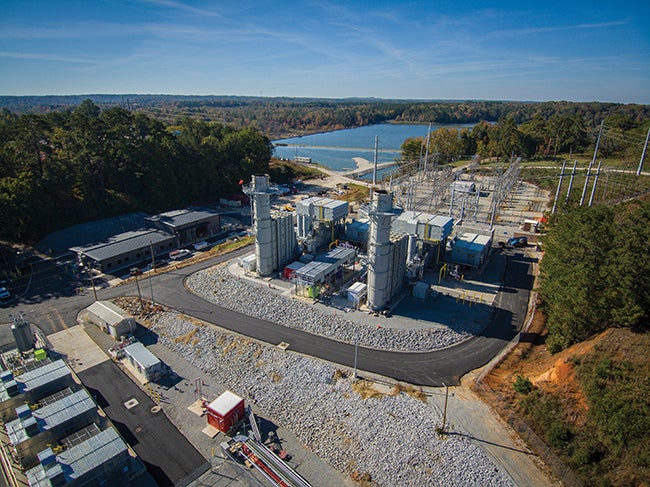
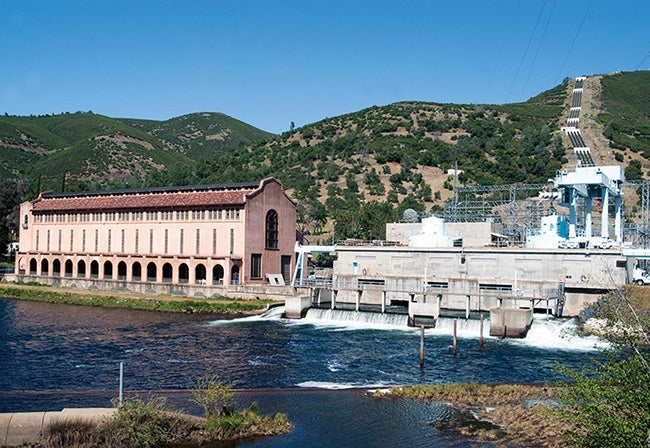
For an asset like Moccasin, that tradeoff is not a compromise but the entire design philosophy. “Reliability and lower downtime have a bigger impact than maximum efficiency in this kind of situation,” Thibault said. The water conveyed through the units originates in Yosemite National Park and is clean enough that it requires no filtration before delivery. The generators function, in effect, as a financially useful way to dissipate energy that would otherwise have to be shed some other way as the water drops from the mountains to the Bay (Figure 1).
 |
|
1. The Moccasin Powerhouse in the Sierra Nevada foothills, where water descending from Yosemite is conveyed to the San Francisco Bay Area. The penstocks visible on the hillside at right feed turbines whose primary job is to break the pressure head of that descent. Courtesy: GE Vernova  In This IssueFull issue |
That water chemistry also drove material decisions. The clean input reduces the need for the large filtration systems other powerhouses require, and the same water is then routed for cooling. Cleaner water means slower wear on seals over time—and, critically for a Pelton installation, less abrasion on the runners. Sand suspended in the flow is punishing to Pelton hardware, and its near-absence at Moccasin is part of why the units lasted as long as they did. Thibault noted that the only operational concern around water quality arises at spring startup, when the units are brought back online after the winter.
The value SFPUC places on the plant follows the same logic. Asked to weigh electricity revenue against the pressure-management function, Thibault was unequivocal that water management is the top priority and declined to assign a dollar figure to it—a hierarchy reflected in the plant’s outage schedule, which follows water demand rather than power markets in a way that would be unusual for a conventional hydro station.
A Window from December to April
The defining constraint of the project was time. Each unit had to come out, be rebuilt, and go back in during a single window running from the start of December to the middle of April the following year—a short runway for a generator rewind of this scale. SFPUC’s seasonal water pattern made the window possible at all: demand is not constant across the year, and in winter both units can be taken down without issue. The commission then restarts the unit not in outage in early March, when water demand returns. By Thibault’s account, one unit at full power can pass enough water to meet the system’s needs, which is what allowed the work to proceed one machine at a time without interrupting supply.
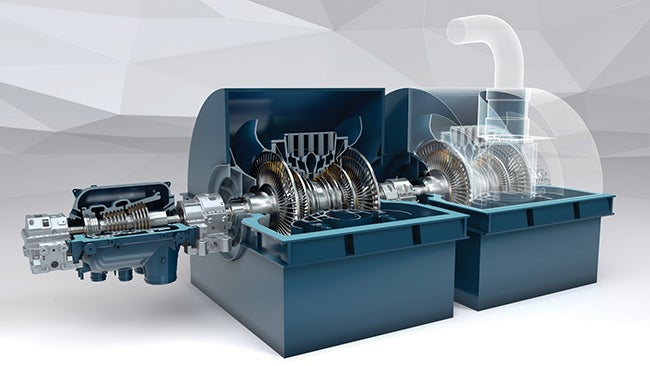
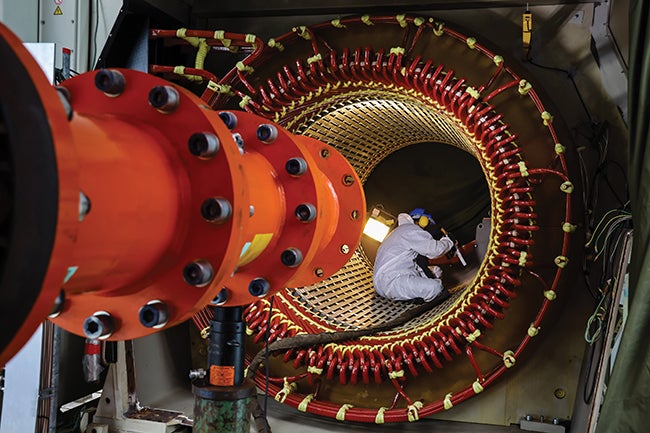
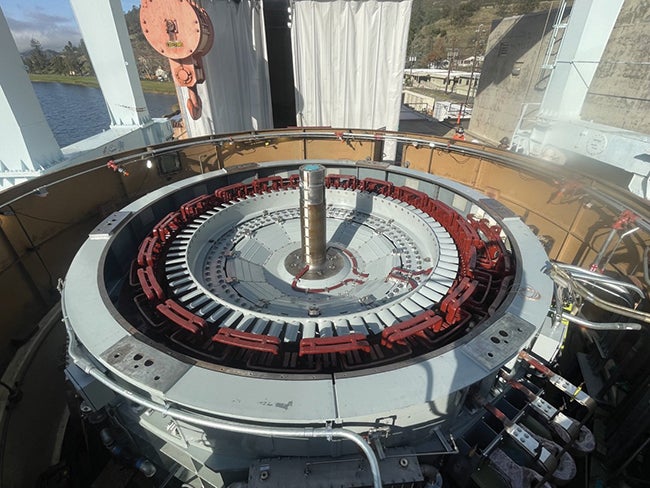
Hitting that window required a swap-ready strategy. There was no time to refurbish the existing structural components in place, so the team had a new stator frame and rotor rim built and waiting to drop in (Figure 2). “There wouldn’t have been enough time if SFPUC had wanted to keep the old frame,” Thibault said. The approach turned the outage into an exchange rather than a rebuild-in-situ, compressing months of potential work into the available months.
 |
|
2. The rotor of one of Moccasin’s two new 55-MW units, set into the stator during the rewind. The pre-built stator frame and rotor rim allowed the team to swap components rather than rebuild in place, a key to fitting the work into the December-to-April outage window. Courtesy: GE Vernova |
Yet, the project nearly fell apart before it began. In the run-up to the first unit’s outage, several major components—the stator frame, the rotor rim, the laminations, and both assembly tents—were not ready in time, putting the schedule at serious risk of delay. Rather than start the outage and gamble on procurement catching up, the team made a deliberate call: push the first outage by a full year while letting procurement continue on its existing track. Supply-chain conditions in the 2023–2025 window forced no design workarounds, according to Thibault, but they were the direct cause of that one-year slip. The decision to absorb the delay up front, rather than risk a stalled unit mid-outage with the Bay Area’s water hanging on the other machine, is what kept the project on track once it actually started.
Moving Iron in the Foothills
Moccasin’s location in the Sierra Nevada foothills shaped the logistics as much as the schedule did. The heaviest single piece handled was the stacked stator, moved with the facility’s own gantry crane. The most complex move was the rotor rim, which was stacked in Sorel-Tracy, Quebec, then trucked to Moccasin and lifted into position on site with a high-capacity mobile crane. For a foothills site without the open staging room of a flatland plant, sequencing those lifts around the compressed outage was among the more demanding parts of the job.
Safety held across the full span of site activity. The project recorded no lost-time incidents over 2.5 years—roughly 78,000 worker-hours—despite multiple high-risk phases, the most acute being the critical lifts of the rotor in and out of the stator. Thibault recalled no near-misses that forced a change in how the rest of the job was run.
The units did hold one surprise. When the team opened the generator compartment, they found it heavily contaminated with asbestos from no visible source. The unexpected part came once they opened the units themselves: there was no sign of contamination inside, except where it had been trapped in components already flagged. The asbestos was around the units, but not within them.
A Case for Acting Early
The new generators are expected to deliver 50 years of normal operation. The more pointed takeaway is for the utilities watching their own hydro assets age past the half-century mark. Thibault’s advice to owners of 50- and 60-year-old units is direct: schedule the rewind on your own terms, while the equipment still runs, rather than waiting for a failure to dictate the timing. Moccasin shows what that looks like when it goes well—a year of deliberate delay, a swap-ready rebuild, and a clean safety record—on a plant where the cost of getting it wrong was never measured in megawatts.
—Aaron Larson is POWER’s executive editor.