Seatrium Limited, the Singapore-based offshore, marine, and energy engineering group formed in 2023 from the merger of Sembcorp Marine and Keppel Offshore & Marine, delivered its first electrons from its Floating Living Lab (FLL) into Singapore’s national electricity grid on July 3, becoming the first operator in the world to export power from a remotely operated, grid-connected floating distributed energy resource (DER) platform.
The milestone, witnessed at Seatrium’s Pioneer Yard by Dr. Tan See Leng, Singapore’s Minister for Manpower and Minister-in-charge of Energy and Science & Technology, validates a novel class of offshore energy infrastructure that combines liquefied natural gas (LNG) bunkering, stacked battery storage, and shore-based remote operations into a single grid-integrated asset. “Critically, this milestone validates how a floating energy asset can generate, store, manage, and export power to the grid, while being remotely monitored and operated from shore,” the company explained.
 |
|
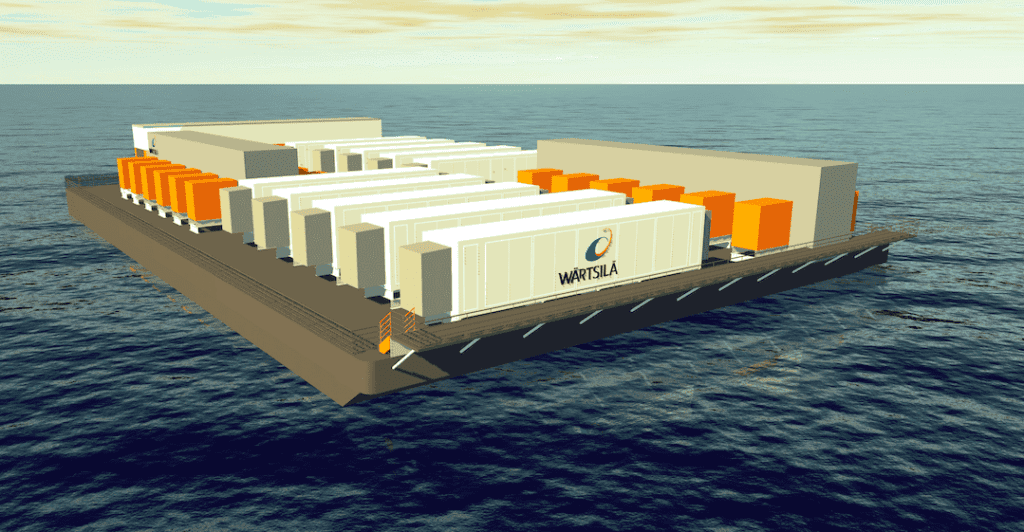
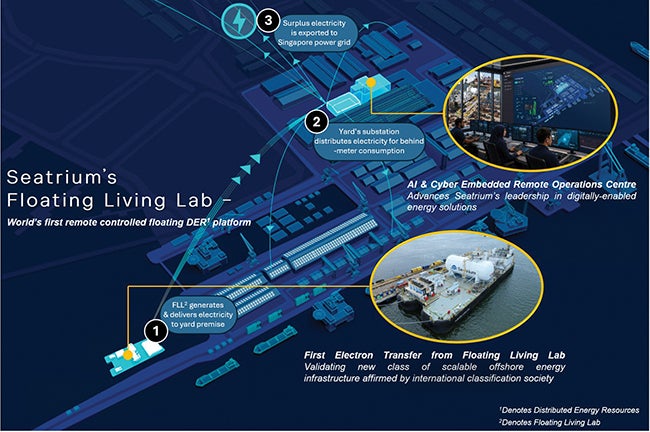
1. Seatrium’s Floating Living Lab—the world’s first remote-controlled floating distributed energy resource platform—generates electricity onboard, delivers it behind-the-meter through the yard’s substation, and exports surplus power to Singapore’s grid. Operations are monitored and dispatched from a shore-based remote operations center built on DNV assurance frameworks. Courtesy: Seatrium |
The FLL (Figure 1) is the first floating asset globally to carry the American Bureau of Shipping’s (ABS’s) Remote-CON notation for a distributed energy resource platform. Its shore-side remote operations center (ROC) has been engineered against DNV’s assurance frameworks for remote operations. The two credentialing pathways address twin regulatory gaps that have historically slowed floating power projects—marine classification of a generation-and-storage asset, and the safety case for unmanned, remotely dispatched control of that asset from land.
The platform’s marine-fuel systems were commissioned in early 2024, when FueLNG—the Seatrium-Shell joint venture that has held one of Singapore’s LNG bunker supplier licenses since 2016—used its 18,000-cubic-meter bunker vessel FueLNG Venosa to complete the gassing-up, cool-down, and initial LNG bunkering of the FLL’s onboard tanks at Seatrium’s Benoi Yard, a ship repair facility on Benoi Road in Singapore’s western Jurong industrial belt.
As Seatrium explained, the FLL received its first operational parcel of LNG in March 2026 “via ship-to-ship bunkering,” and “the LNG is converted into electricity using onboard gas engines to support Seatrium’s operational energy requirements, with surplus power exported to the Singapore electricity grid.” Paired with the platform’s onboard stacked battery energy storage system, the gas engines give the FLL what Seatrium calls a “dual capability” to firm on-site load at its yard while exporting surplus power to the national grid—enough surplus, the company estimates, to cover the monthly electricity consumption of roughly 1,500 four-room flats built by Singapore’s Housing and Development Board (HDB), the public-housing authority whose apartments shelter about 80% of the city-state’s residents and whose four-room unit—a three-bedroom apartment of roughly 90 square meters—serves as the country’s standard residential-load benchmark.

In This Issue
Full issueThe battery stack of the FLL was co-developed with Singapore’s Energy Market Authority (EMA), the statutory board under the Ministry of Trade and Industry that regulates the country’s electricity and gas industries and plans its power system. EMA describes the stacked BESS as “an innovative testbed that allows emerging energy technologies to be validated in real-world conditions.”
The collaboration reflects how “public-private partnerships can drive the development of cutting-edge solutions,” said Violet Chen, director of EMA’s Solar and Grid Solutions Department. She added that “as Singapore’s grid incorporates more variable renewable energy, storage solutions like this will be important to maintain grid stability and resilience.” The FLL, she noted, is one product of a broader Seatrium-EMA partnership to develop and validate new energy solutions for Singapore’s marine and offshore sector.
ABS’s Remote-CON notation, which the FLL received after progressing through approval-in-principle for its remote-control arrangements, certifies “the integration of advanced automation, secure communications, and control system architecture, enabling key onboard systems to be operated remotely while meeting stringent safety and redundancy standards,” according to Seatrium.
“Safety is fundamental to the successful deployment of new remote-control and distributed energy technologies in offshore and nearshore environments,” said Patrick Ryan, ABS senior vice president and chief technology officer, adding that the FLL “marks the progression from concept to implementation of advanced automation and communications to enable remote-control capability in accordance with rigorous ABS requirements.”
Layered on top of ABS class, Seatrium’s ROC has been built on DNV’s assurance frameworks, integrating “secure communications, data pipelines, and human-in-the-loop decision support for centralized monitoring across the FLL and broader connected offshore assets.” Seatrium says the ROC applies artificial intelligence (AI) and AI-operations to automate data processing, optimize energy use, and accelerate decision-making, while cybersecurity—including post-quantum encryption—protects system interactions with the ROC. Digital twins and data-driven optimization tools round out the stack.
For EMA, the FLL serves as a crucial operational testbed for technologies the agency has been developing to firm up Singapore’s grid as it absorbs more variable renewables. Among recent projects it has backed, Singaporean utility Sembcorp expanded its Jurong Island battery energy storage system (BESS), one of the largest of its kind in the region, from 285 MWh to 326 MWh via a vertical battery-stacking pilot in 2025 without increasing land use, and EMA is now working with Sembcorp to test the expanded system’s ability to provide inertia. In October 2025, at Singapore International Energy Week, notably, EMA launched a roadmap and a virtual power plant pilot aimed at tapping “underutilized” distributed energy resources such as BESS and backup generators on what the agency called a “near-continuous basis.”
Beyond the technical milestone, Seatrium says the FLL supports two emerging business models: power-as-a-service (PaaS) and what the company calls “new energy infrastructure ownership.” The effort is notable for Seatrium, which operates across 15 countries and has more than 24,000 employees, and counts oil and gas newbuilds and conversions, offshore wind, and repairs and upgrades among its core segments.
Under a PaaS model, customers contract for delivered electricity and grid services rather than owning generation assets outright—shifting the capital burden and operational risk to the provider, and letting industrial hosts, port operators, or utilities procure firm floating capacity the way they might procure a utility contract. Seatrium says the FLL’s combination of “a stacked battery energy storage system and gas bunkering infrastructure” positions the group “at the forefront of offshore energy as power demand in heavy consumer markets grows.”
“The FLL brings together Seatrium’s deep capabilities across digital, engineering, and energy systems to reimagine offshore energy for a more connected, resilient, and lower-carbon future,” said Lee Wey Lii, senior vice president of Seatrium Digital. He said the first electron transfer demonstrates the company’s ability to “galvanize industry partners to shape next-generation operating models, enabling more intelligent, agile, and scalable digitally enabled energy infrastructure.”
Seatrium now plans to scale the FLL’s proven capabilities into nearshore electrification solutions across Singapore and the broader region, which could expand its engineering, procurement, and construction pipeline in decarbonization projects and build out floating energy storage as a new infrastructure asset class.
—Sonal C. Patel is a POWER senior editor (@sonalcpatel, @POWERmagazine).