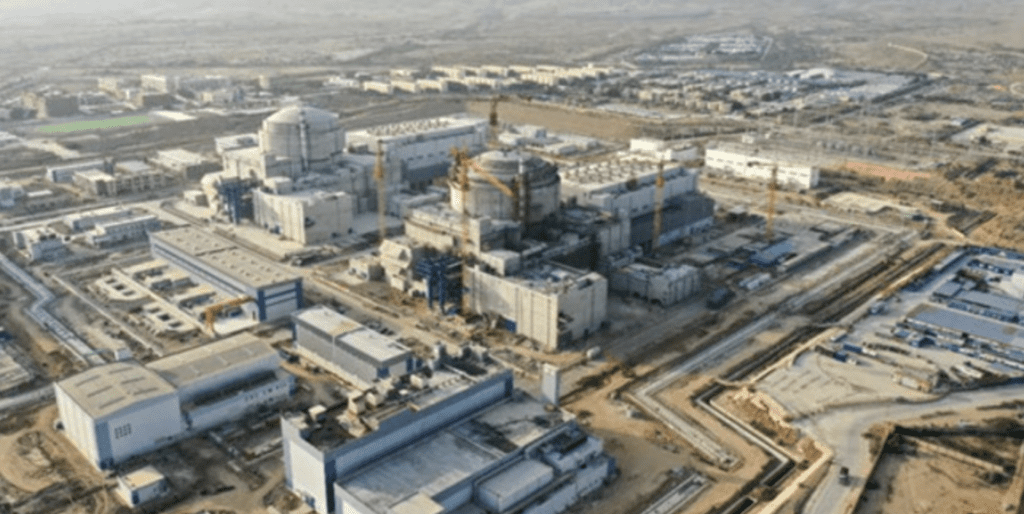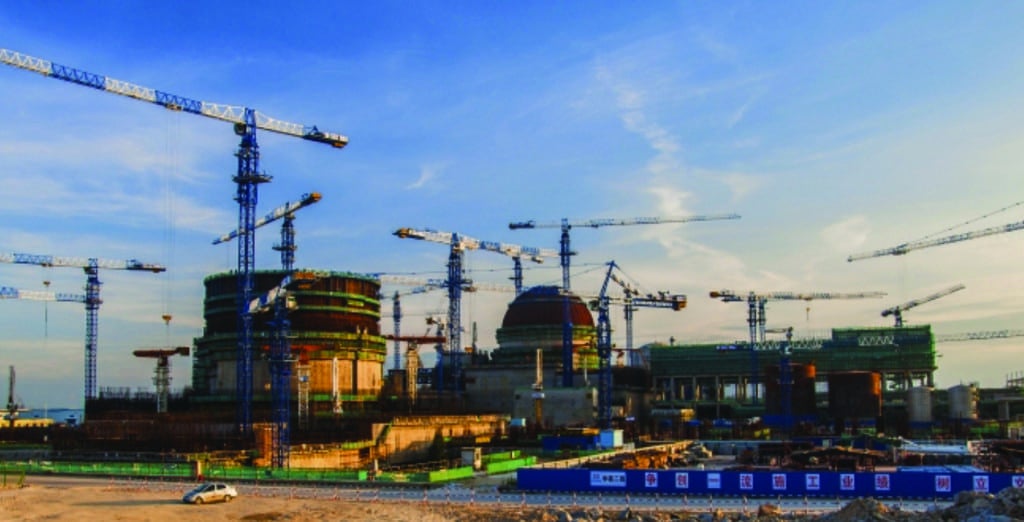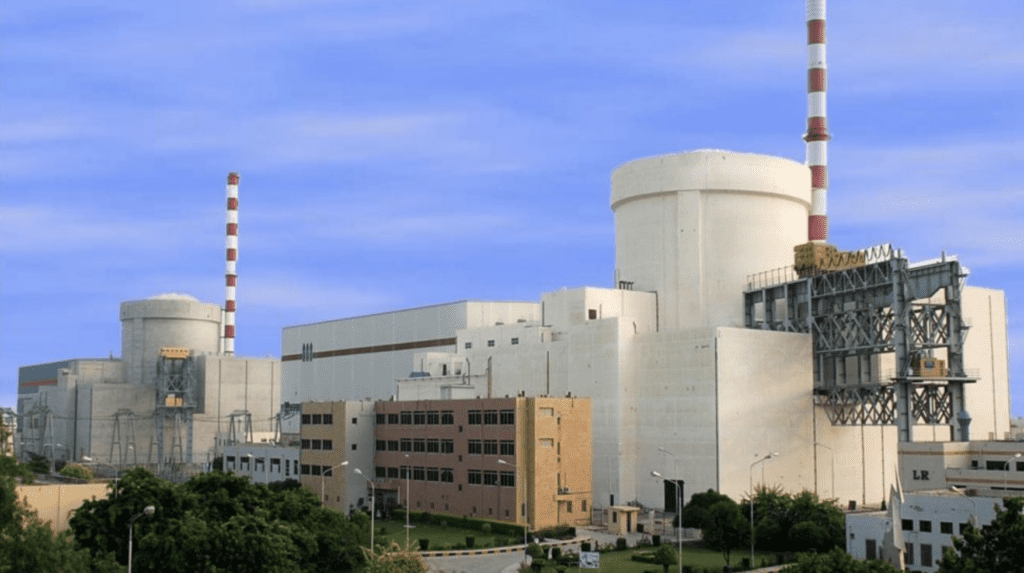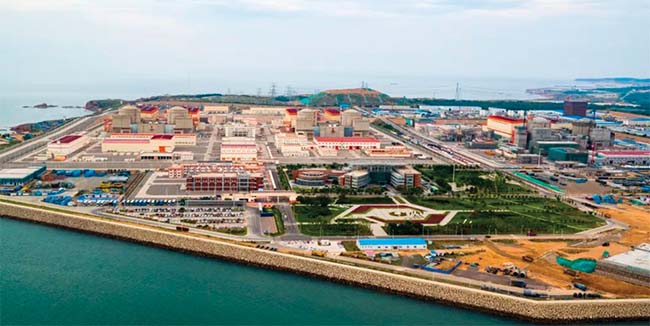
Government officials in China have given the green light for construction of eight new nuclear reactors, as the country looks to add more electricity to meet growing demand for power.
Regulatory filings posted on July 31 show China’s State Council approved new units in Guangdong, Liaoning, Zhejiang, and Shandong. The filings show each reactor is rated for 1,127 MW of generation capacity. Documents show CGN Power, China National Nuclear Power (a subsidiary of China National Nuclear Corp.), and SPIC Industry-Finance are the project developers.
Chinese media said the reactors will be HPR1000 (Hualong One) third-generation pressurized water reactors. Some of the eight new units are designated as demonstration projects for version 2.0 of the the Hualong One technology, according to a release by China National Nuclear Corp. (CNNC). Reports said the projects represent investment of more than 170 billion yuan ($25 billion).
The news comes at the same time that the Statistical Review of World Energy said global nuclear power generation reached a record high last year, totaling 2,845 TWh, a 1.3% increase from 2024. The report said the growth was driven exclusively by China, which added more than 34 TWh of nuclear generation capacity in 2025. The report said global output otherwise would have dropped year-over-year if not for China.
The report said the U.S. still leads the world in nuclear power output, with China rapidly gaining after tripling its nuclear generation over the past 10 years, with an annual growth rate of about 11% according to government data.
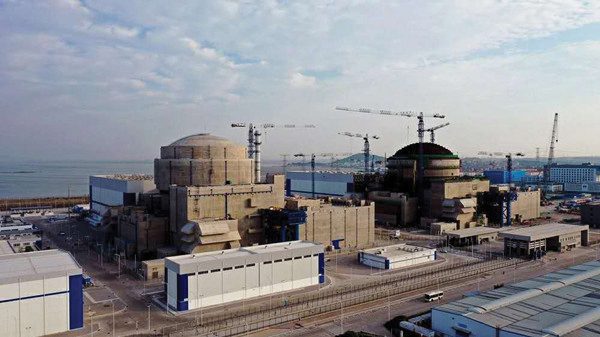
The new reactors approved in China include Units 5 and 6 at Taipingling Nuclear Power Plant in Huizhou, located in Guangdong province. The first two units at Huizhou entered commercial operation this year, with construction continuing on Units 3 and 4 at the site. China General Nuclear Power Co. (CGN Power), the country’s leading nuclear generator, operates the Huizhou station.
Other new reactors will be built by CNNC at its Zhuanghe project in Liaoning, and its Jinqimen plant in Zhejiang. SPIC Industry-Finance Holdings Co. was approved to move forward with its Laiyang development in Shandong.
CNNC said Phase II of Jinqimen nuclear power plant, as well as Phase III (Units 5 and 6) of the Taipingling nuclear power plant have been confirmed as demonstration sites for Hualong One 2.0 reactors.
The Chinese government has said 10 Hualong One reactors currently operate in the country, with another 37 approved and under construction.
Nuclear and Renewables
China continues to lead the world in renewable energy, with more solar and wind generation capacity than any other country. Officials, though, have said the country needs more baseload power (including emissions-free generation to hit climate targets) to ensure a reliable power supply. The country had about 61 GW of installed nuclear power capacity at the end of 2024, which fell short of China’s goal of 70 GW of nuclear capacity by 2025. The country has a target of 110 GW of operating capacity by 2030, and 200 GW by 2035.
Industry analysts note the Beijing government will need to approve several new reactors annually to reach those targets.
The Statistical Review of World Energy report said the U.S. generated 826 TWh of electricity from nuclear power in 2025, about 29% of the global total. That was more than any other country, with the report noting second-place China produced about 485 TWh, just more than 17% of the world total. France was third with 390 TWh, about 13.7% of the global nuclear output.
Russia (219 TWh), South Korea (185 TWh), Japan (94 TWh), and Canada (85 TWh) round out the top seven countries in nuclear output.
France has long been the global leader in terms of nuclear power as a percentage of a country’s overall energy supply; nuclear supplied about 47% of France’s power last year. Other countries with large shares of nuclear power in their energy mix include Finland (33%), Sweden (31%), Ukraine (25%), and the Czech Republic (23%).
Nuclear power accounts for about 9.6% of the total electricity supply in the U.S. Notably, even with China’s No. 2 spot behind the U.S. in overall nuclear capacity, nuclear energy’s share of China’s total power supply is about 3.3%, according to the Statistical Review report.
Units 1 & 2: Unit 1 entered commercial operation in early 2026, and Unit 2 recently connected to the grid.Units 3 & 4: Construction on Unit 3 began in 2025, and first concrete for Unit 4 was poured in May 2026.Units 5 & 6: Approved by China’s State Council in late July 2026, expanding the total project footprint.
—Darrell Proctor is a senior editor for POWER.