What is the best mix of power generation to build and use in the years ahead? For U.S. integrated electric utilities balancing reliability, affordability, and state and federal policy, resource plans are the answer. But like with any model, these plans are only as robust as the information that is fed into them. Investors are increasingly scrutinizing the underlying assumptions that underpin utility resource plans, connecting the dots between resource planning, shareholder value creation, and emissions trajectories.
COMMENTARY
For vertically integrated utilities, investing in clean energy creates value because the return they are allowed to earn by regulators on capital investments exceeds their actual cost of equity. Deployed successfully, as Berkshire Hathaway’s subsidiaries and Xcel Energy have done, this strategy lets utilities convert operating expenses (such as fuel costs, which can only be recovered at cost) into capital expenses for assets utilities can earn a return on.
In a previous piece, we demonstrated how cost assumptions used to model generation resources vary to a surprising extent across utility resource plans, with some utilities modeling solar at twice the cost of their peers. When clean energy costs are overstated or gas plant costs are understated, models can produce skewed analysis. And that can result in tilting away from a clean energy build that would best serve reliability, affordability, and shareholder value creation.
Utilities often use other modelling practices in their integrated resource plans that can significantly bias their analysis against clean energy.
Three issues are especially important for building supply-side resources.
Excessively constraining clean energy builds. Often, utilities apply subjective constraints that prevent their modelling software from selecting clean energy resources for future grid buildout plans. These constraints can cap how much clean energy can be built each year or overall or these constraints can completely block the software from selecting a given resource in the early years of the planning period, even when there is enough advance time for the resource to be sourced, permitted, and sited.
Best practice is to let the model determine the optimal combination of resources to reliably and affordably meet capacity needs. Some constraints might be justifiable for managing risks related to permitting, project financing, supply chain, transmission, and land availability. But this depends on the technology, and these are not reason enough for the overly restrictive constraints that some utilities apply.
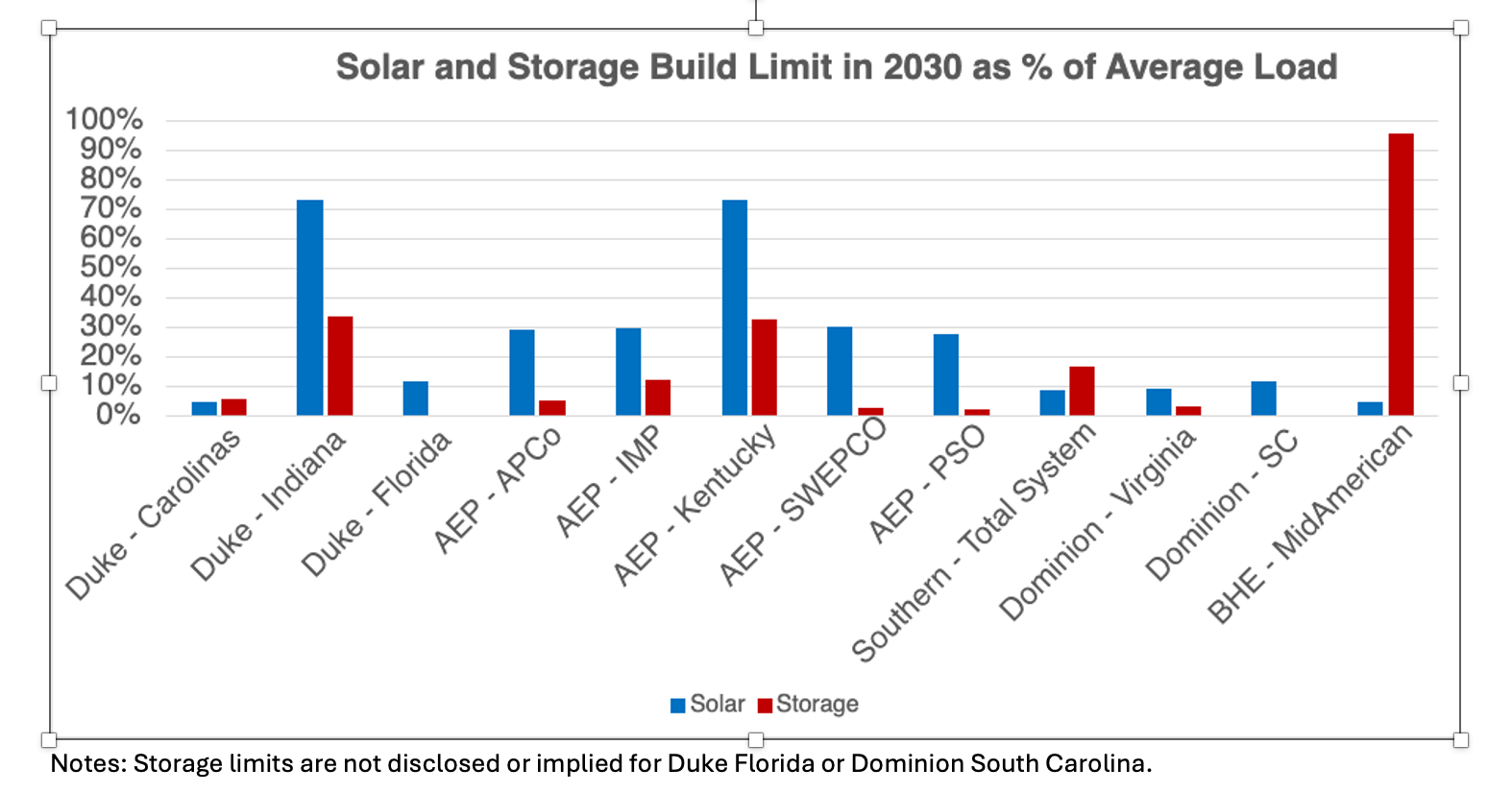
Constraining storage is particularly detrimental. Storage is low risk to build since it can solve transmission constraints, is modular, fast to deploy, and proven at scale. It also contributes to reliability. Yet companies subjectively apply a wide range of annual build limits, with some companies applying strikingly different limits across their own subsidiaries.
Not modeling solar-plus-storage. Every integrated resource plan (IRP) we assessed models of solar and storage as separate, individually selectable resources. But it actually makes more sense to model them together. Solar-plus-storage has an important cost advantage because it shares the cost of an inverter and grid interconnection, reducing costs by 10% when compared to building two equally sized independent facilities, according to NRL’s Annual Technology Baseline. Because these models are designed to find the lowest-cost combination of resources, and solar, storage, and gas often price out similarly, even a modest cost advantage can be enough to shift the model’s choice toward the cleaner mix. The combined asset also has a far better capability of helping meet winter peak capacity needs than standalone solar.
Georgia Power, Xcel’s Public Service Co. of Colorado, BHE’s Pacificorp, and Ameren Missouri all fail to include solar-plus-storage as a selectable resource in their IRPs. Dominion Virginia also does not model solar-plus-storage for its base case preferred plan, but it does in a scenario directed by the North Carolina Utilities Commission (NCUC), because the NCUC recognized the potential advantage of these resources to system cost and reliability. Duke Carolinas has signaled it will not model solar-plus-storage in its 2026 Carolinas Plan that will be submitted in South Carolina. This is especially odd considering solar-plus-storage was included with accompanying justification in its 2025 Carolinas Plan submitted in North Carolina.
Modeling low output for solar and wind resources. Companies can also apply bias against clean energy resources by modeling pessimistically low energy output assumptions, expressed as capacity factors. As a result, modeling software designed to optimize for affordability can overestimate the cost of clean energy, making them appear more expensive higher than they actually are.
One example that stands out is Appalachian Power Company. Its 2025 plan submitted in West Virginia assumes capacity factors of 37%, 24% and 18% for wind, standalone solar, and solar-plus-storage respectively.
The 18% assumption for solar-plus-storage is a surprising choice. While there is a slight efficiency loss on the share of output going through storage, there is a larger output advantage over standalone solar because it has the flexibility to minimize clipping and curtailment. At least Appalachian Power didn’t repeat its wildly low assumptions for wind and standalone solar it included in its earlier 2025 RPS Plan submitted in Virginia of just 27% and 20% (well below the levels in RFP responses of 37% and 24% respectively).
Looking at these constraints and assumptions, alongside our prior analysis of the wide variety in cost assumptions that utilities are applying, a picture emerges that certain utilities are biasing their resource plans against building clean energy. They are not fully capturing the shareholder value creation opportunity before them. And that’s concerning to investors. Integrated utilities should let models objectively decide how clean energy fits into a reliable and affordable system, considering policy settings, with robust inputs and defendable constraints. Give clean energy a fair chance, and the results may surprise.
—Colette Lamontage is the senior director of electric power and Luke Angus is the director of utilities at Ceres, a nonprofit advocacy organization.