Utilities and power generation companies are bolstering operational efficiency and plant reliability by implementing advanced analytics and artificial intelligence (AI)–driven predictive maintenance modeling, providing insight to service the right equipment exactly when it is needed.
Predictive maintenance has become a strategic lever for power and utilities companies navigating rising demand, aging infrastructure, and an increasingly complex power generation mix. Instead of relying solely on fixed-interval inspections or reacting after alarms trip, industry leaders are using modern technologies, including advanced analytics and artificial intelligence (AI), to turn real-time operational data into early-warning signals regarding equipment health.
This shift is significant because unplanned trips have outsized consequences, including lost megawatt-hours, higher startup and ramping costs, regulatory scrutiny, and direct impacts on customer reliability metrics. To mitigate these and other risks, continuous monitoring of critical indicators reveals subtle patterns of degradation long before they cause outages.
By implementing these measures and adopting predictive maintenance practices, power generation companies can preserve availability on their highest-value assets, while also using planned outages more intelligently. This results in fewer operational surprises, more stable capacity, and a clearer view of how asset performance connects to safety and sustainability goals.
Conventional Equipment Optimization Challenges
Despite the well-documented benefits of predictive maintenance, its implementation remains more aspirational than reality for many manufacturers and asset-intensive operators in the power and utilities sector. Data is often fragmented across disparate platforms, including process historians, supervisory control and data acquisition (SCADA) systems, distributed control systems (DCS), condition-monitoring platforms, and maintenance applications that were not designed to work together.
As a result, engineers and reliability specialists must devote considerable time to manually exporting tags to spreadsheets, aligning timestamps, and reconciling work order histories to understand a single failure event. That manual effort does not scale effectively, which leads to isolated and one-off analyses instead of a standardized, fleet-wide program.

In This Issue
Full issueMeanwhile, traditional calendar-based service schedules produce a combination of both over- and under-maintenance. This sometimes results in critical equipment being taken offline prematurely as a precaution, which consumes outage windows and budget, while other times, heavily utilized equipment in need of service continues to operate under increasing stress until failure or performance degradation occurs.
As fleets diversify across a mix of generation sources—including gas, coal, nuclear, hydro, geothermal, wind, and solar—the complexity only grows. Mixed original equipment manufacturers (OEMs), evolving duty cycles, and variable renewables make it harder to establish consistent performance benchmarks. Without a way to contextualize and analyze data holistically, utilities face ongoing challenges in identifying emerging risks across turbines, transformers, and other critical balance-of-plant equipment before they impact grid reliability and customer outcomes.
Predictive Maintenance Algorithms Improve Fleet Reliability and Operational Efficiency
Modern technologies, such as advanced analytics and AI platforms, are designed to close this gap by turning messy operational and maintenance data into actionable and scalable predictive maintenance workflows that fit the ways power and utilities teams work. Instead of forcing traditional rip-and-replace capital improvement projects, these technologies connect directly to existing data sources so information remains in its system of record while engineers work against a single analytical layer.
Within these analytics environments, subject matter experts can rapidly contextualize signals by operating mode, start-up and shutdown cycles, ambient conditions, and maintenance events. Additionally, they can isolate periods of “healthy” versus “degraded” behavior, and define specific failure modes—such as bearing wear on a gas turbine, fouling in a condenser, or thermal stress in a transformer—without writing code.
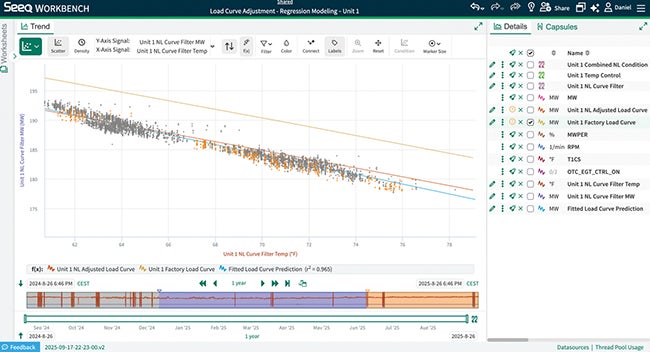
With this foundation in place, teams can build health indicators and forecasting models for high-value assets, use event overlays and pattern recognition to validate early-warning signals, and then templatize those analyses for use across entire fleets (Figure 1). The same analytics then feed asset-health dashboards, exception-based monitoring views, and automated maintenance notifications that integrate directly with existing systems.
Instead of scanning hundreds of alarms, reliability engineers must only review the conditions that matter, accompanied with clear context and sufficient time until failure. This approach empowers power and utilities organizations to move from isolated pilots to repeatable, enterprise-grade predictive maintenance programs that strengthen both reliability and margin across the grid.
Increasing Gas Turbine Reliability with Advanced Analytics and AI
RWE, a global leader in power generation, is using its existing gas fleet to support a massive foray into renewable energy, with the goal of carbon neutrality by 2040. This strategy requires high availability and reliability in its gas-fired plants, which must deliver flexible backup capacity whenever wind and solar production dip. To ensure reliability, RWE prioritized modernizing its maintenance approach, moving from labor-intensive condition monitoring and rigid preventive schedules to a predictive analytics–driven model that maximizes uptime and focuses effort where it matters most.
Before beginning the transition, RWE already relied on condition monitoring to track critical assets, but the approach had clear limits. A dense network of thermocouples on GT26 gas turbines frequently drifted, causing inaccurate exhaust temperature readings and triggering unnecessary trips and extended outages. These events overwhelmed maintenance teams by the effort required to collect, validate, and interpret data, and the group was struggling to determine the ideal inspection cadence for components such as brush gear, which runs in response to demand rather than on a fixed schedule. As a result, the organization dealt with avoidable stoppages, inefficiencies, and inconsistent execution of maintenance strategies across plants.
To address these and other challenges, RWE implemented Seeq—an industrial analytics, AI, and enterprise monitoring platform—to collect and analyze raw condition data, and to develop a repeatable predictive maintenance program. Within the platform, engineers built a custom thermocouple monitoring model to calculate four statistical key performance indicators (KPIs) across recent startups for each of the 24 sensors on every turbine, then used threshold-based amber and red alerts to flag drifting or inconsistent sensors before they caused trips (Figure 2).
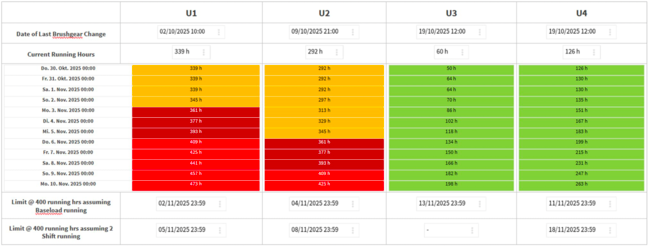
In parallel, the technical team pulled inspection records, historian data, and commercial demand forecasts into a single analysis to calculate brush gear operating hours since the last inspection, as well as to predict when the next inspection would be required. These insights fed into the company’s fleet-level dashboards, where reliability and operations team members reviewed asset health scores, upcoming predicted maintenance needs, and targeted failure mode models.
Empowered by these capabilities, RWE has built a scalable, data-driven maintenance program that has quickly reduced unplanned outages, improved visibility into asset health, and increased the reliability and efficiency of the company’s gas generation fleet. This has increased power generation capacity to effectively support the broader energy transition and carbon neutrality goals.
Scaling Renewable Energy Reliability
Meridian Energy, New Zealand’s largest electricity generator, is an internationally recognized leader in sustainable generation, with 100% of its energy produced from renewable sources including wind, water, and solar. To ensure long-term reliability, Meridian prioritized modernizing its operations, transitioning from routine-based maintenance and rigid schedules to a data-informed and condition-based maintenance (CBM) approach that minimizes operations costs, maximizes uptime, and improves asset health.
Before beginning this transition, Meridian’s maintenance strategies were limited by fragmented data pipelines and manual workflows. Exploratory data analysis was spread across complex tools, creating a technology gap between data teams and on-site subject matter experts. Site crews relied on time-consuming manual checks—such as biweekly physical inspections of SF 6 circuit breakers—and scheduled maintenance plans that often led to over- or under-servicing assets like turbine brakes. Furthermore, prior reliance on simple email-based alerting sometimes caused delayed receipt of critical notifications.
To overcome these challenges, Meridian implemented Seeq to centralize data from its AVEVA PI System and Databricks models into a cohesive, low-code environment. This democratization of data empowered domain experts to build high-value CBM models rapidly. For example, engineers integrated industrial internet of things (IIoT) devices to monitor potent SF 6 greenhouse gas levels continuously, using the advanced analytics and AI platform to flag low-pressure states and phase deviations. These insights were then forwarded to a custom Power BI and Power Apps alerting dashboard, eliminating the reliance on email.
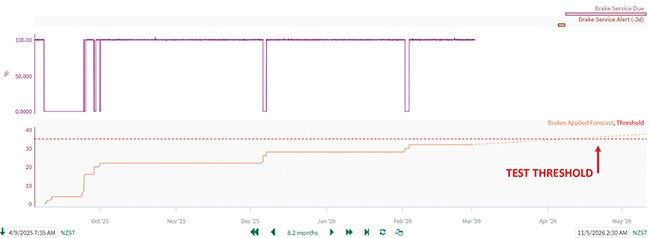
In parallel, the team used the platform to track operational cycles of hydro unit brakes, creating forecasting models to predict exactly when service would be due based on actual usage, rather than a calendar (Figure 3). They also calculated the daily rate of change in turbine bearing oil levels, dynamically setting operational thresholds based on historic standard deviations to safely detect slow leaks without requiring visual inspections in confined spaces.
Empowered by these capabilities, Meridian delivered measurable operational and financial outcomes—including improved asset reliability, increased uptime, and reduced maintenance costs—in just 90 days. By democratizing data and building trust in predictive models across the organization, Meridian has accelerated its shift toward condition-based maintenance, ensuring uninterrupted power for its consumers.
Achieve Sustainable Efficiency
Advanced analytics and AI platforms significantly simplify the steps to increase power generation efficiency, which is becoming ever more critical in the face of rising energy demand. These capabilities are fostering growing grid availability, lower fuel consumption, and reduced emissions.
When plants and OEMs empower their engineers with analytics and AI, it allows experts to identify high-impact fixes, take targeted actions in controls and operations, and quickly show results. These gains are available now by implementing software systems without the need for any new equipment, turning everyday data into actionable insights to benefit revenue streams, sustainability outcomes, and facility reliability.
—Daniel Foster-Roman leads the power and utilities practice at Seeq with more than a decade of experience in process engineering and enterprise industrial software and analytics.