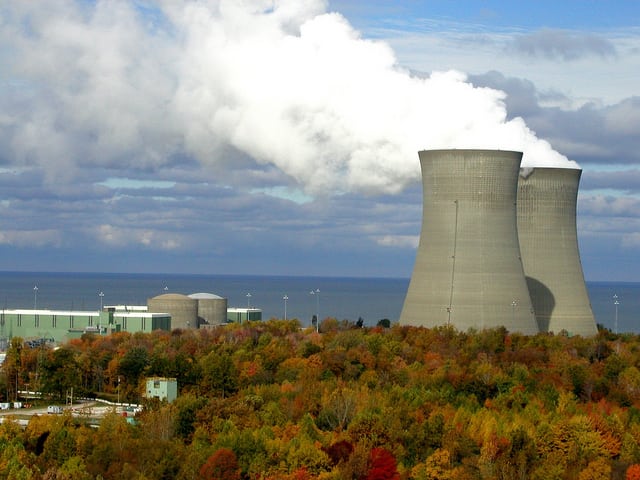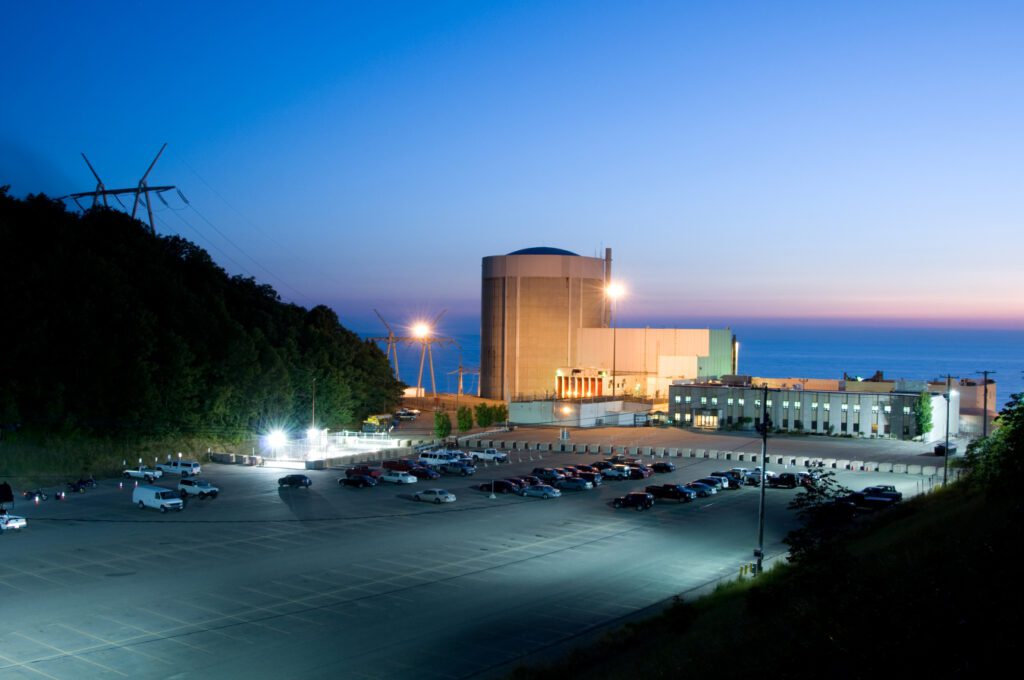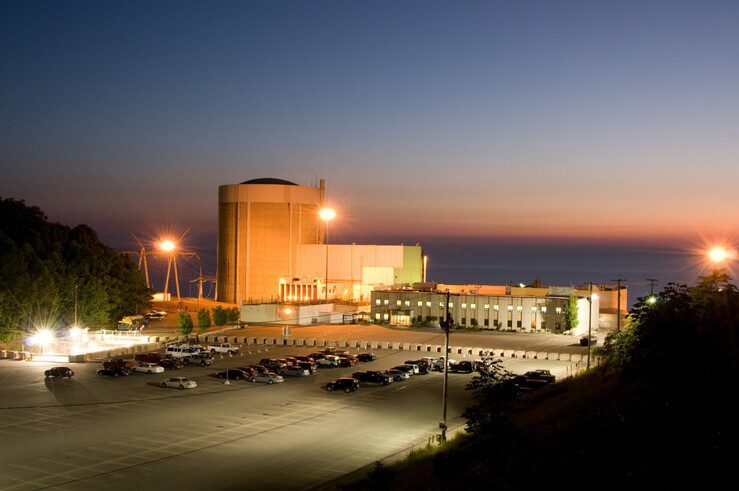

On Aug. 30, workers at the Palisades Nuclear Plant in Covert Township, Michigan, began loading 204 fuel assemblies into a reactor vessel that had sat empty since the plant shut down in 2022—the first time in U.S. history that a commercial reactor that had entered decommissioning began reloading fuel. Holtec International Chairman and CEO Dr. Kris Singh called it a reflection of “what can be accomplished when government and private industry work together.” Palisades is no longer a singular experiment, though. It’s the leading edge of a template now being applied, in staggered fashion, at two other shuttered plants: Constellation’s Crane Clean Energy Center (formerly Three Mile Island Unit 1) in Pennsylvania, and NextEra Energy’s Duane Arnold Energy Center in Iowa.
What links the three is not just the novelty of reviving shuttered reactors. Each restart is running through the same two pieces of federal machinery: an environmental review process built by the Nuclear Regulatory Commission (NRC) and the Department of Energy’s (DOE’s) Pacific Northwest National Laboratory (PNNL), and financing from a single DOE lending office—the Loan Programs Office (LPO), rebranded in October 2025 as the Energy Dominance Financing (EDF) Program. Three utilities, three reactor histories, one federal playbook getting faster with each pass.
A Reusable Environmental Review
Restarting a plant that had begun decommissioning had never been attempted in the U.S. before Palisades. When the LPO issued a Record of Decision in July 2024 approving a loan guarantee for “general restoration and maintenance activities” at Palisades, it explicitly limited its scope. The review adopted the NRC’s existing 2006 license-renewal analysis, but activities tied to actual refueling and repowering were deemed “not yet ripe” and left for a separate, later NRC review. That later review is the one PNNL and the NRC ultimately built out—and it became the template reused since. “We had to look at it as two different stages: the impacts from preparations for the resumption of power operations and impacts from operations for the remainder of the license term,” said Leah Hare, a PNNL Earth scientist and deputy lead for the Palisades review, which examined Lake Michigan water withdrawals, decades of groundwater data, and cultural and public-health concerns, completing the assessment in under a year.
“Our work with PNNL on Palisades established a baseline for our environmental reviews on other proposed restart projects,” said Daniel Barnhurst, an NRC senior environmental scientist. PNNL is now running comparable reviews for Crane and Duane Arnold, with formal National Environmental Policy Act (NEPA) timelines opened by separate Federal Register notices in early 2026. Crane’s draft assessment was issued June 9, 2026; Duane Arnold’s followed Aug. 3. Both found no significant environmental impacts. “Working with the NRC, we were able to leverage experience and knowledge from previous environmental reviews to improve efficiency,” said Cyler Conrad, a PNNL Earth scientist and environmental assessment team lead.
One Office, Two Administrations
The financing side is less tidy than it may seem. Palisades’ loan guarantee, worth up to $1.52 billion, closed in September 2024 under the Biden administration, through the LPO’s Energy Infrastructure Reinvestment Program, authorized under Section 1706 of the Energy Policy Act of 2005. By September 2025, the DOE had disbursed six tranches totaling $491 million, with Energy Secretary Chris Wright announcing the sixth ($155.9 million) as evidence of “the next American nuclear renaissance” under an executive order signed months after the original loan had already closed.
That continuity wasn’t automatic. In October 2025, Wright rebranded the office as the EDF Program, using new authority under the One Big Beautiful Bill Act to raise its lending cap to $250 billion through 2028. Wright signaled the office would keep funding legacy applications that fit current priorities—“not all of them were nonsense,” he reportedly said—and a January 2026 DOE release showed the follow-through. EDF restructured or eliminated more than $83 billion of the roughly $104 billion in loan obligations it inherited, cutting nearly $9.5 billion in wind and solar loans while redirecting toward natural gas and nuclear projects. Palisades’ loan survived that review. Crane’s $1 billion loan, closed in November 2025, and Duane Arnold’s loan of up to $1.9 billion, closed Sept. 8, 2026, were both written after the rebrand, under the EDF name outright. All three trace back to the same lending desk—it just changed names, expanded its authority, and narrowed its portfolio in between.
The shared groundwork doesn’t make the projects identical. Palisades is furthest along. Restart work included steam generator tube reinforcement, control rod drive mechanism nozzle replacement, primary system passivation, and a new fuel handling machine, with fuel loading now underway. Crane trails by roughly a year. Constellation pointed to 2027 as its restart target on the company’s August 2026 earnings call, after the NRC approved Crane’s fuel license amendment and the Federal Energy Regulatory Commission (FERC) cleared transfer of capacity interconnection rights from Constellation’s Eddystone units. Duane Arnold is furthest out, targeted no later than the first quarter of 2029. The Iowa Utilities Commission issued a construction and operation certificate in June 2026, but substantial inspection and engineering work remains.
The Real Takeaway
Palisades is the only one of the three actually loading fuel, and the harder test—sustained commercial operation after a permanent shutdown—hasn’t been done anywhere in the country. But what Crane and Duane Arnold’s progress really demonstrates isn’t a long line of other plants waiting for the same treatment—there aren’t many decommissioned reactors left that could take this path. It’s that the NRC and DOE, when given a clear policy mandate, built an institutional process that moved fast and didn’t need reinventing twice. The more durable lesson from Palisades isn’t about restarts specifically. It’s that these agencies can move considerably faster than they’re usually given credit for when the direction to do so is unambiguous.
—Aaron Larson is POWER’s executive editor.