Engineers at Purdue University have, for the first time in the U.S., adjusted a nuclear reactor’s power experimentally, remotely and automatically in real time—a demonstration they say offers an early glimpse of how next-generation reactors could be monitored and controlled from hundreds or even thousands of miles away.
The demonstration, revealed in July, linked PUR-1, Purdue’s 64-year-old research reactor, with Idaho National Laboratory (INL) and a Microsoft cloud system in a three-site loop spanning Indiana and Idaho. However, according to Stylianos Chatzidakis, the Purdue assistant professor and associate PUR-1 director who led the work, while the milestone is significant, he is careful to qualify it. “We showed that you can achieve remote monitoring and remote control of a reactor,” he told POWER in an interview. “This is an experiment. We didn’t actually remotely control the reactor.”
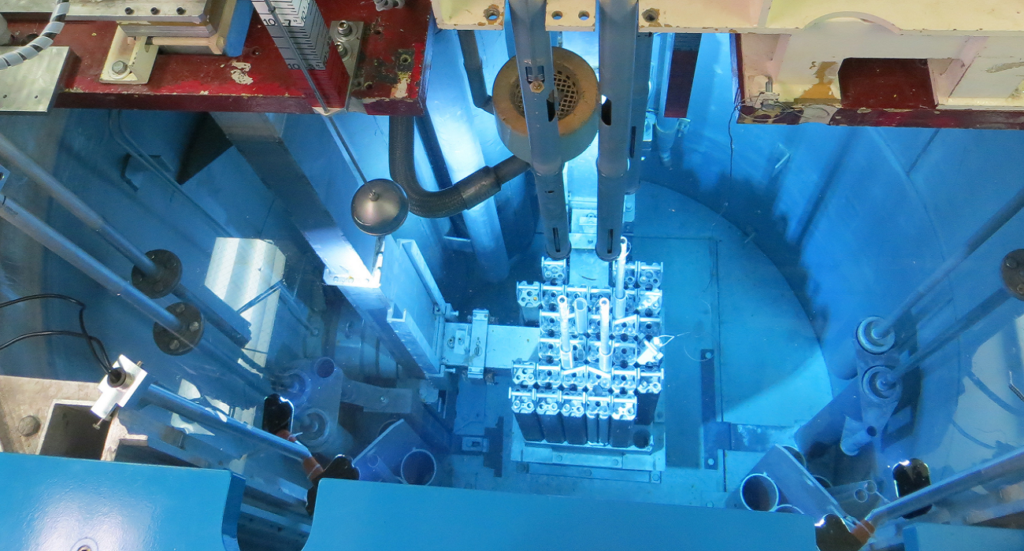
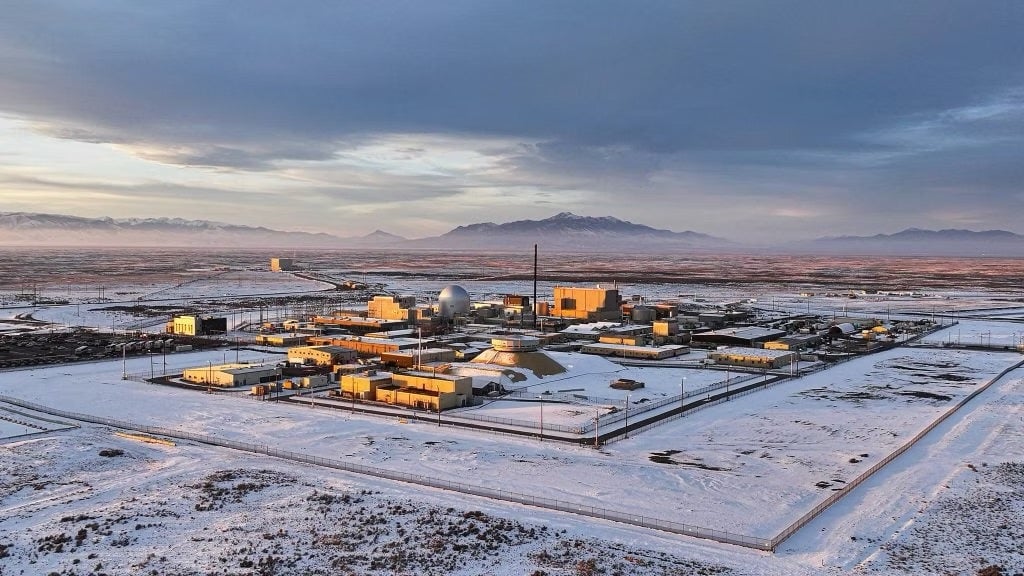
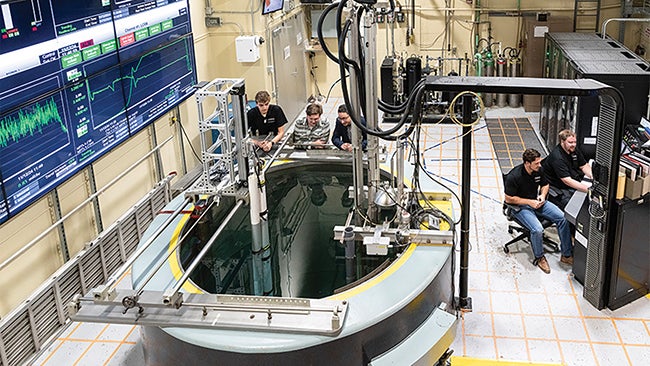
The work builds on PUR-1, Purdue University Reactor Number One (Figure 1), a teaching reactor converted in 2019 to the first fully digital instrumentation and control (I&C) system licensed by the U.S. Nuclear Regulatory Commission (NRC). The U.S. Department of Energy (DOE)–funded conversion, under grant DE-NE000498, provided researchers a platform for testing I&C architectures that future small modular reactors (SMRs) and microreactors are expected to use.
On that digital backbone, Chatzidakis and his team built what Purdue describes as the first live digital twin of a U.S. reactor. Completed in 2023 under DOE nuclear energy grants DE-NE0009174 and DE-NE0009268, the twin uses real PUR-1 sensor data to support experiments on a high-fidelity digital copy without perturbing the operating core. In 2025, the team added secure communications, including a quantum-secure layer over its remote-access framework.
“As you can understand, a nuclear reactor is a critical infrastructure, and we want everything to be secure and not open to adversaries,” Chatzidakis said. That work later drew interest from a United Nations working group examining quantum threats. “They reached out to us, and they were really interested to learn more because they think that this can have international implications,” he said, particularly as quantum computing technology improves.
Closing the Loop Across Three Sites
As Chatzidakis explained, the July experiment closed the control loop across three geographically separated sites. INL supplied the use case and ran the analytic side from its high-performance computing systems in Idaho. Microsoft Azure provided the cloud environment in Virginia, while the University of Illinois Urbana-Champaign assisted with data handling between the nodes.
During the demonstration, the distributed system calculated and delivered instructions for movement of an auxiliary control rod at PUR-1. Those instructions moved through INL’s DeepLynx advanced data and control platform, cloud-based connectivity, PUR-1’s digital twin, and INL’s high-performance computing systems. From Idaho, researchers used the loop to fine-tune reactor power, reduce small power fluctuations, and maintain steady reactor operation without manual control-rod manipulation on site.
Notably, the experiment tested more than whether reactor data could be viewed from another location. Purdue had already demonstrated remote access to reactor measurements through its digital twin. The July work tested whether measurements from an operating reactor could move outward to remote computing systems, be analyzed, generate a control response, and return quickly enough to influence the reactor’s physical behavior while PUR-1’s own safety systems retained control.
The use case was tied to the rapid power swings possible at large data centers. “These data centers, the power requirements change very fast,” Chatzidakis said. INL wanted to determine whether a reactor supplying a data center could respond rapidly enough to follow those changes, including a scenario involving a 100-MW change in demand. “Can the reactor respond fast enough to support the data center? Does it make sense to have a reactor next to a data center?” he said.
The experiment linked PUR-1’s measured state to predictive models running at INL and then back to Purdue. PUR-1’s digital systems collect thousands of data points per second, so one early challenge was determining which signals mattered and how frequently they needed to be sampled. “Someone can just send everything… but then you have latency. Things will be slow. You have to spend more time processing,” Chatzidakis said. “Not very useful.”
Simply transmitting raw numbers would not have been sufficient, he suggested, given that the remote models also needed to know what each measurement represented, including the sensor’s location and units. Researchers therefore had to determine the priority signals, appropriate sampling rates, and metadata needed by the models before integrating the data streams with the databases and computing systems used at INL.
Once that data set was defined, measurements from PUR-1’s I&C system were pre-processed and transmitted to INL. Models representing the hypothetical data center load and reactor dynamics generated predictions about where power would be needed. Those outputs returned to Purdue as control-relevant information. PUR-1 applied bounded adjustments, and the resulting reactor data went back to Idaho to update the models and repeat the cycle.
“For the first time we were able to achieve that between Indiana and Idaho,” Chatzidakis said. The loop had to account for network latency and the time required for plant hardware to respond. Signals had to travel between the sites, software had to process them, and the reactor’s motors then needed time to execute the resulting instructions before updated measurements could move back through the system.
Integration across three sites, multiple software stacks, and the full path from reactor sensors to remote models and back was the main technical challenge. “That took us quite a bit of time to put everything together,” Chatzidakis said.
Remote control authority, however, remained limited and subordinate to PUR-1’s existing protection systems. PUR-1 is a roughly 10-kW research reactor configured for experimental work. “It’s not a commercial reactor. It’s not a small modular reactor. It’s not a microreactor. It’s a research reactor specifically designed for experiments of that sort,” Chatzidakis noted.
The demonstration also extended beyond the basic digital control loop. Researchers introduced a reinforcement-learning model running in software that simulated the physical behavior of the reactor, testing whether the system could make increasingly autonomous adjustments while remaining bounded by PUR-1’s safety controls. INL described the architecture as one in which the system could analyze conditions, predict outcomes, and make adjustments while the reactor’s independent safety systems retained final authority.
Remote Monitoring First, Autonomy Much Later
According to Chatzidakis, a key, broader objective of the project is to understand what similar architectures could enable in reactors designed around digital controls from the start. Chatzidakis expects next-generation nuclear systems to face tighter cost constraints and different operating modes than today’s large light-water reactors. “The new generation of [nuclear systems] will need to be more efficient,” he noted. “They have to have better performance.”
An all-digital I&C system feeding a digital twin could also process far more information than a human operator can absorb in real time. “We collect all the data from the reactor, and these are [thousands] of data [points] per second that would be impossible for an operator to look at… in real time,” he said. Instead, the digital twin uses artificial intelligence (AI) and physics-based models to analyze the information in real or near real time and provide information back to operators. Those models could flag deviations, recommend operating changes, or identify ways to reduce fuel use, maintenance, or degradation, he suggested.
PUR-1’s digital architecture already offers a level of measurement precision unavailable with its former analog controls. Purdue reactor supervisor True Miller has said the analog system indicated power to within roughly 5%, while the digital system can resolve changes down to a fraction of a watt. Purdue researchers have also used the digital twin to test a machine-learning algorithm developed with Argonne National Laboratory that predicted changes in a reactor stability indicator with 99% accuracy.
For now, Chatzidakis sees remote monitoring as the nearer-term application, particularly for reactor fleets. A single control room might monitor five or six SMR modules at one site, while a utility headquarters could aggregate operating data from “100 small modular reactors around the country.” That architecture could allow operators and technical teams to compare reactor performance, identify deviations, and use the digital twin’s AI and physics-based models to interpret data that would otherwise be difficult to process in real time.
Purdue has previously suggested that such an architecture could help reduce operating and maintenance costs by allowing centralized staff to monitor multiple reactors from hundreds or thousands of miles away. Its researchers are using PUR-1 to begin quantifying what those benefits could look like.
However, autonomous operation is a different proposition. “Traditionally, we have an operator… and that’s not going to change,” Chatzidakis noted. “For small modular reactors, for conventional reactors, this is not going to change.” His group is instead looking potentially “30 years ahead, 40 years ahead” toward specialized microreactors where permanent staffing may be impractical, he said.
He points to concepts for microreactors on the moon as an example. “It’s really hard to operate over there. So you want the reactor to operate autonomously,” he said. For such applications, the group is exploring reinforcement-learning models to determine whether they could support “some level of semi-autonomous control” while remaining inside safety and design constraints. Chatzidakis stresses that the research is early and aimed at specialized future systems. “This is not something that we will apply to existing reactors. This is for specialized cases,” he said.
Any deployment would also require NRC approval. Chatzidakis said his group communicates with the agency, DOE, and industry to understand technical criteria, regulatory requirements, and whether utilities see value in the approach. Other national laboratories and universities are also studying autonomous control. “This is an area that has benefits, but also has challenges,” he noted.
Aligning With the Genesis Mission
Purdue’s work also aligns with DOE’s Genesis Mission, which includes autonomous nuclear operation among its research challenges. INL said the July demonstration directly advances that effort, though Chatzidakis stressed that the project itself was not formally part of Genesis.
Since the demonstration, DOE has notably selected INL-led Prometheus—the Genesis Mission’s “Delivering Nuclear Energy that is Faster, Safer, Cheaper” challenge—for a $60 million Phase II award over three years, subject to appropriations. The 32-partner effort is intended to apply AI across reactor design, licensing, manufacturing, construction, and operations through human-in-the-loop workflows. Chatzidakis said he hopes Purdue’s findings, particularly around integration and practical implementation, can feed into that broader effort.
Prometheus: AI Built for Nuclear DeploymentThe Department of Energy’s Prometheus project is a three-year Phase II effort under the Genesis Mission aimed at applying artificial intelligence across the nuclear reactor lifecycle—from design and licensing through manufacturing, construction, and operation. DOE selected the Idaho National Laboratory-led effort in July for a $60 million award over three years, subject to appropriations. INL says the 32-partner team has also assembled more than $200 million in industry cost share and more than $30 million in industry capital. Prometheus grew out of the Genesis Mission challenge DOE calls “Delivering Nuclear Energy that is Faster, Safer, Cheaper.” INL and NVIDIA began publicly advancing the effort earlier in 2026, targeting at least a twofold acceleration in reactor deployment schedules and operating-cost reductions of more than 50% through human-in-the-loop AI workflows. The broader team now includes Argonne, Oak Ridge, Sandia, four universities, and more than 20 industry partners. The project intends to link AI with engineering models, nuclear data, and high-performance computing across several workstreams. According to INL, the platform will support reactor design and licensing, manufacturing and construction planning, autonomous operations, and data curation. A crucial goal is to maintain a continuous digital thread connecting design decisions, licensing documentation, manufacturing records, construction activities, and eventual plant operation. Unlike many laboratory software demonstrations, Prometheus is also being developed as a production-scale platform intended for industry use. INL has said the system is expected to run in commercially hosted environments and support deployment through the Genesis Mission platform, commercial cloud marketplaces, and private on-premises installations where companies can keep proprietary information behind their own firewalls. The effort is designed to measure its own value against non-AI workflows. INL says AI-enabled improvements will be benchmarked against documented baselines, with datasets and evaluation protocols published at major milestones so claimed gains can be independently reviewed. An initial prototype has already been developed under earlier seed funding. INL says the production platform is targeted for initial deployment on the Genesis Mission platform in March 2027, followed later that year by transferable specifications intended to support broader DOE and commercial adoption. |
In the near term, Purdue plans to continue testing the architecture around PUR-1. The university is also building a second PUR-1 digital twin in a new full-scale reactor control room. That facility will house a digital twin of the Purdue University Multidimensional Integral Test Assembly (PUMA), a scaled advanced light-water reactor facility that Purdue plans to upgrade with digital instrumentation and controls for research on SMRs and other advanced reactor technologies.
—Sonal Patel is a POWER senior editor (@sonalcpatel, @POWERmagazine).