A widening gas turbine supply crunch has prompted Ansaldo Energia to explore a new path back into the U.S. generation market after more than 30 years. The Italian manufacturer will supply California-based energy infrastructure developer Pacifico Energy with eight AE64.3A gas turbines and associated generators for a Texas power project supporting major data center infrastructure. First equipment deliveries are scheduled for 2027, Ansaldo said in July.
The order introduces another heavy-duty turbine platform into a U.S. market where data center development, utility load growth, demand for dispatchable capacity, and long equipment queues are testing the production limits of established suppliers. Ansaldo’s 2025 consolidated report said final sales in the broader 60-Hz gas turbine market exceeded 61 GW in 2025—the market’s second-best result since 1980—driven particularly by U.S. demand for data center applications. The company also warned that rising gas turbine orders have lengthened original equipment manufacturer (OEM) delivery times, raised costs, and increased the risk of industrial supply-chain bottlenecks.
While the move highlights prospects for midsized turbines in a market where they are gaining relevance for data center power projects, it also raises new questions about whether a smaller original equipment manufacturer can convert a scarcity-driven U.S. order into a durable service and execution position.
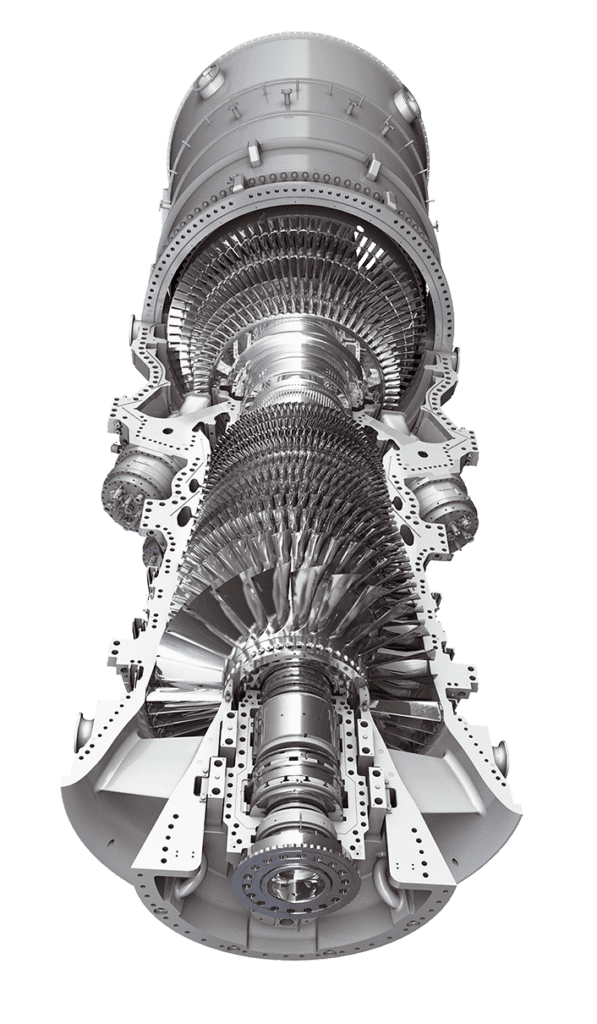
A mid-sized F-class gas turbine, the AE64.3A offers Ansaldo a compact entry point into data center power projects that may value staged capacity, redundancy, and earlier equipment availability over a single large combined-cycle block. According to Ansaldo, the machine is well-suited to modular grid-connected and behind-the-meter applications, citing fast-start capability, fuel flexibility, and cogeneration potential. Based on its 78-MW simple-cycle rating, the eight-unit Pacifico order represents about 624 MW of nominal generating capacity before the addition of any steam cycle.
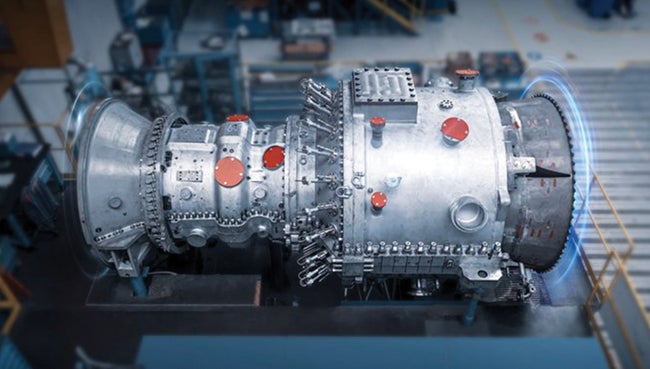
Ansaldo lists AE64.3A combined-cycle configurations ranging from 120 MW to 243 MW. The platform has more than 70 installed units and more than 4 million equivalent operating hours, up from more than 50 combined-cycle units, four open-cycle units, one barge-mounted installation, and 2.5 million operating hours reported in 2022. The AE64.3A, notably, is a scaled-down derivative of its larger AE94.3A platform, whose operating history has more recently honed in on distributed combined-cycle generation in China, cogeneration in Serbia, and industrial combined heat and power projects in Poland and Italy.

In This Issue
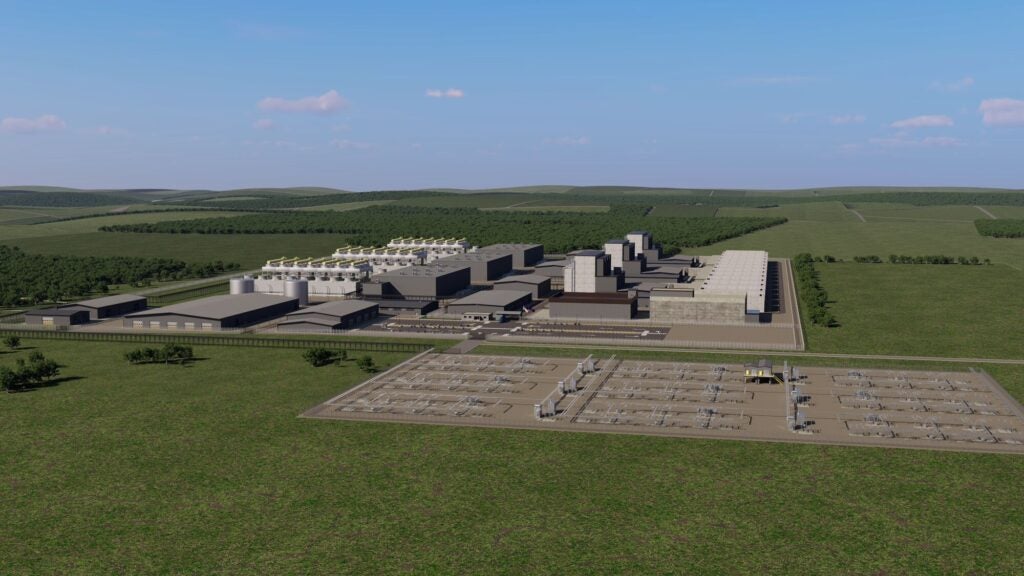
Full issueWhile Ansaldo did not identify Pacifico’s Texas project, Pacifico has publicly identified two major data center power developments in the state. GW Ranch, in Pecos County, is a private-grid campus permitted by the Texas Commission on Environmental Quality for up to 7.65 GW of generation using a mix of small and large gas turbines. Pacifico says the project could deliver first power in the first quarter of 2027, install up to 1 GW in 2028, and exceed 5 GW by 2031. Its planned energy system also includes 1.8 GW of battery storage and up to 750 MWac of solar. Pacifico’s Fort Spunky project, meanwhile, is slated to be sited on a 563-acre site in Hood County near central Dallas and is listed at 432 MW of natural gas generation and 80 MW of battery capacity. Pacifico says the project has received its air permits and is designed around dual redundant gas supplies, generating-unit redundancy, and electrical distribution capable of accommodating the loss of any generating unit. The developer expects the plant to deliver more than 450 MW to data center customers in 2028.
For Ansaldo, the project marks a high-profile notch in its effort to rebuild its new business and expand beyond its established 50-Hz markets in Europe and Asia. The company reported €2.3 billion in orders in 2025, a 24% annual increase, and €1.2 billion in revenue, up 10%. Its 2026–2030 industrial plan, which targets revenue above €2 billion in 2030, identifies new units, including gas turbines, steam turbines, generators, and synchronous condensers, as contributors to higher profitability. Ansaldo has also noted that its Genoa factory increased production volumes in 2025 and launched a capacity-growth program for 2026 and 2027. So far, the company says it has scaled up the factory’s workforce, primarily for machining operations, and invested in blade and turbine-line machinery, tooling, maintenance, and supply-chain equipment.
The company also indicates a refined contracting strategy, shifting its New Units business toward equipment and power-island supply rather than higher-risk turnkey engineering, procurement, and construction work, although it retains engineering, procurement, and construction (EPC) capability selectively. High demand for flexible gas-fired generation is a crucial driver, as Stefano Gianatti, executive vice president for Thermal New Units at Ansaldo Energia, noted in July. “As data center operators seek reliable and scalable power solutions, Ansaldo Energia’s technology portfolio is strongly positioned to provide secure, efficient, and resilient energy supply for mission-critical applications,” he said.
Ansaldo’s re-entry also comes amid rapid expansion in the U.S. gas turbine market. Disclosures from the three largest manufacturers—GE Vernova, Siemens Energy, and Mitsubishi Heavy Industries (MHI), the parent of Mitsubishi Power—suggest all are increasing production, securing long-lead components, and reorganizing factory operations. All three also seem to be treating the current order cycle as the beginning of a much larger service opportunity.
Based on their latest disclosures in July and August 2026, these four original equipment manufacturers alone report at least 157.6 GW in firm gas turbine orders or contract backlog worldwide. Including slot reservation agreements disclosed by GE Vernova and Siemens Energy, the combined volume rises to about 246.6 GW, spanning firm orders and reserved manufacturing slots extending across the remainder of the decade and, in some cases, into 2031.
| OEM | Latest Demand Signal | Manufacturing Response |
|---|---|---|
| Ansaldo Energia | Eight AE64.3A turbines representing about 624 MW for Pacifico Energy’s Texas data center project. | Expanding workforce and equipment at its Genoa factory under a capacity-growth program for 2026 and 2027. |
| GE Vernova | 116 GW under contract, including 53 GW in firm backlog and 63 GW under slot reservation agreements. Mostly sold out through 2030. | Increasing annual gas turbine output from 20 GW to 24 GW in 2028 and 30 GW in 2030. |
| Siemens Energy |
95 GW across firm backlog and slot reservation agreements, comprising 69 GW in firm backlog and 26 GW under reservation agreements. Booked 15 GW and shipped 6 GW during fiscal Q3 2026. |
Increasing annual mid-sized turbine capacity from about 50 units in fiscal 2025 to about 100 in fiscal 2028, and large-turbine capacity from roughly 35 units in fiscal 2026 to more than 50 in fiscal 2028. |
| Mitsubishi Heavy Industries | Large-frame backlog of 80 turbines totaling 35 GW. Booked 10 turbines totaling 4 GW during fiscal Q1 2026. | Targeting at least 30% higher GTCC shipments by fiscal 2028 and evaluating a subsequent increase of 50% or more. |
Note: Reporting periods and definitions differ. GE Vernova and Siemens Energy disclose firm gas turbine backlogs and slot reservation agreements separately. MHI’s figure covers its large-frame contract backlog. Siemens Energy’s €73 billion Gas Services backlog includes new equipment and services, while Ansaldo’s figure reflects the disclosed Pacifico Energy order.
GE Vernova Reveals 116 GW Under Contract
At the end of the second quarter of 2026, in July, GE Vernova reported 116 GW of gas turbine capacity under contract, up from a combined 100 GW three months earlier, including 53 GW in firm backlog and 63 GW under slot reservation agreements. It attributed about 80% of that volume to traditional power-sector customers and 20% to data centers across a portfolio of roughly 100 customers in 26 countries. GE Vernova expects its combined gas turbine backlog and slot reservations to reach at least 125 GW by year-end 2026. The company is mostly sold out through 2030 and expects to contract more than half of its planned 2031 production by the end of this year.
“First, to serve this accelerating demand, we are expanding our production capacity in Power and Electrification through lean and capital-efficient investments. In Gas Power, given that we’ve now reached our 20 GW annualized run rate and are on track for 24 GW in 2028, we now see further opportunity to serve this growing demand with 30 GW of annual output in 2030 in a capital-efficient manner, utilizing lean and incremental machinery in our existing factory footprint and have already secured significant supply chain capacity, all funded by customer down payments,” Scott Strazik, GE Vernova CEO, said during the company’s second-quarter earnings call in July.
The capacity increase will extend from final assembly into labor and critical-component supply. GE Vernova had installed 325 production machines across its gas factories by July and expected that total to approach 400 by year-end. Castings and forgings arriving in 2027 will support the increase to 24 GW in 2028, while supply-chain capacity secured through customer advances will underpin the 30-GW target. The company also began hiring and training workers about a year before increasing annualized output from 15 GW to 20 GW, giving new employees time to train alongside its existing workforce before the additional equipment entered production. Aeroderivatives provide a separate response to projects that cannot wait for heavy-duty manufacturing and construction schedules. “Demand is very strong for the heavy-duty. In a number of cases, the aero are complementary to the heavy-duty over the longer term,” Strazik noted.
GE Vernova noted an aeroderivative could be commissioned in about six months, while a heavy-duty turbine might require another 18 months of site work after shipment. That could allow customers to bring an initial block of generation online while securing EPC resources for heavy-duty machines scheduled for shipment in 2030 or 2031 and expected to enter service in 2032 or 2033. Strazik said aeroderivatives are “buying customer time with the first tranche of incremental electrons” until larger projects can be completed.
The expanding fleet will eventually require the same manufacturing resources now being added for new equipment. GE Vernova’s total backlog reached $176 billion in the second quarter and was divided approximately evenly between equipment and services. The company’s second-quarter presentation said 130 HA turbines had been commissioned in 21 countries and another 195 were under contract, which brought its installed and contracted HA fleet to 325 units. “We only have 130 of our HAs running right now. We have 325 on contract. As these run baseload and every four years, they go through a major outage,” Strazik said.
Siemens Energy Says Conventional Power Remains the Core Demand Driver
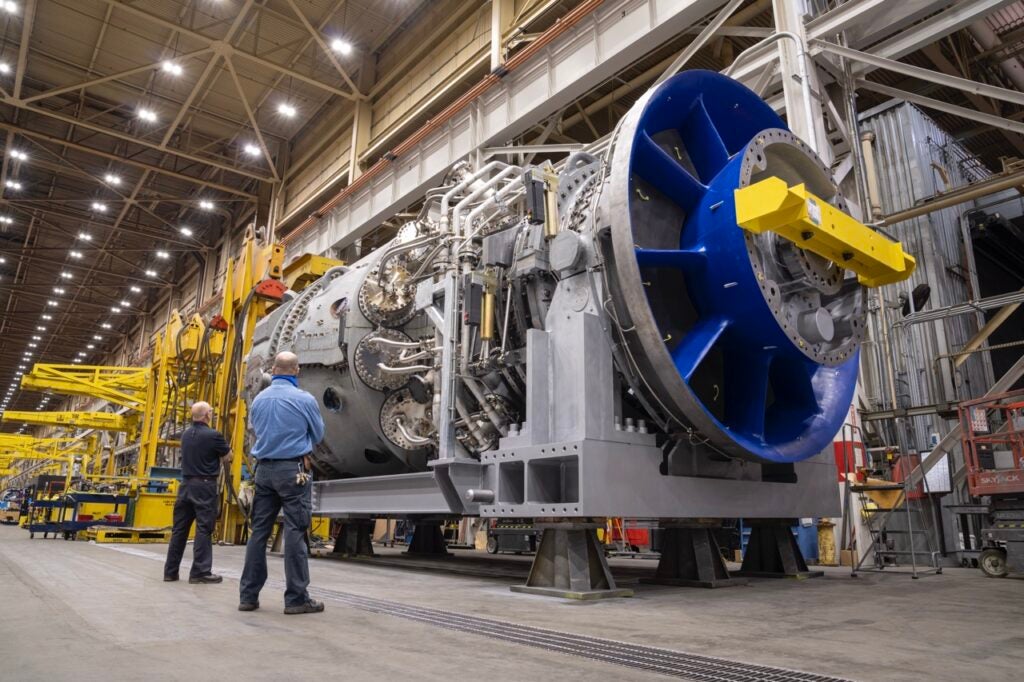
Siemens Energy, headquartered in Munich, also pointed to the U.S. as the largest source of near-term gas turbine demand, though it treated data center development as upside to a broader conventional-power cycle, not specifically as the cycle’s foundation. Asked during the company’s Aug. 5 fiscal third-quarter earnings call about its estimate of a 110-GW to 120-GW annual addressable market for gas turbines that are larger than 10 MW, CEO Christian Bruch said the U.S. would likely account for about half of that demand, with as much as 20 GW of additional upside depending on data center development.
The company’s broader market explanation, however, is focused on conventional power generation, including U.S. requirements for reliable and dispatchable capacity and large combined-cycle and independent power producer projects in the Middle East and Asia.
“It is important to remember that the conventional power market is our primary growth driver,” Bruch said during Siemens Energy’s Aug. 5 call. “It represents the largest share of our backlog and benefits from strong structural demand driven by electrification, rising electricity consumption and the need for reliable baseload and dispatchable capacity.”
Siemens Energy booked 15 GW of gas turbine orders during the quarter, including the conversion of previously signed reservation agreements into firm customer orders, and shipped 6 GW. At quarter-end, Siemens Energy separately reported 69 GW of firm gas turbine backlog and another 26 GW under slot reservation agreements. Bruch estimated that full-year shipments could reach about 15 GW to 16 GW. Gas Services recorded €10 billion of orders and increased its backlog to €73 billion. The company booked 73 turbines for power generation and oil and gas, including 25 large gas turbines and 48 industrial gas turbines. Driven by the large-turbine orders, Siemens Energy said its share of the market for gas turbines above 100 MW reached 42% during the quarter.
The company has moved to divide its production response by turbine class, increasing annual mid-sized turbine capacity from about 50 units in fiscal 2025 to approximately 80 units in fiscal 2026 while preparing additional large-turbine capacity to begin contributing in fiscal 2027. Its Aug. 5 analyst presentation shows mid-sized capacity reaching about 100 units in fiscal 2028, while large-turbine capacity is expected to rise from roughly 35 units in fiscal 2026 to about 50 units in fiscal 2027 and more than 50 units in fiscal 2028. “Medium-sized gas turbines are often selected for distributed power generation and data center applications where customers require reliable power solutions that can be deployed quickly,” Bruch said, pointing specifically to the SGT-800’s ability to operate in combined-cycle configurations.
Beyond those announced expansions, Bruch said Siemens Energy sees no reason to change its existing capacity plan. The company is seeking incremental output—including perhaps one or two additional turbines—through productivity measures, robotics, and artificial intelligence on the shop floor at existing sites.
Siemens Energy also expects more manufacturers to position themselves in the mid-sized segment and potentially move into somewhat larger turbine frames. Bruch characterized the influx as a response to unusually high demand and said it did not signal a permanent restructuring of the competitive field.
The company is also supporting its U.S. manufacturing response through a broader $1 billion U.S. manufacturing program announced in February, although the total also covers grid and compression equipment. Siemens Energy plans to resume gas turbine manufacturing in Charlotte, North Carolina, produce gas turbine parts in Winston-Salem, and expand its Tampa, Florida, facility to manufacture more blades and vanes. The program spans six states and is expected to create more than 1,500 manufacturing, operations, and engineering jobs. Nearly 29% of its global order volume went to the U.S. in fiscal 2025, the company has noted.
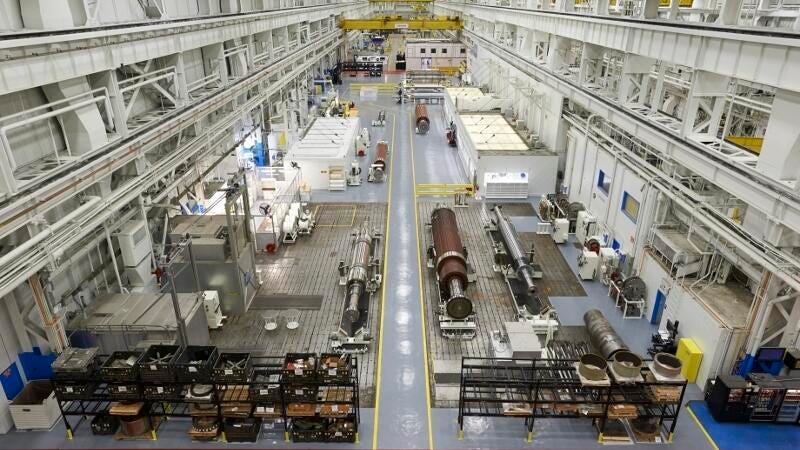
The company is also notably pairing the additional output with firm pricing and project selection. “Pricing remains attractive,” Bruch said. “And at the same time, we prioritize value over volume, maintaining strict project selectivity and pricing discipline.” During the call, Chief Financial Officer Maria Ferraro noted that orders entering the backlog carry higher margins than earlier work, which should support continued margin expansion as those projects move into execution over the next several years.
Boosting its supply chain efforts, Bruch said the company had made substantial progress addressing forgings and castings, an area he described as a major concern six to nine months earlier, although he expects rapid production growth to create supply-chain “teething pains” for several more quarters. The company is also investing in capabilities under its direct control, including ceramic-core production and casting operations in Tampa. Bruch said the vast majority of those parts will ultimately support the service fleet instead of new-unit manufacturing.
“Every gas turbine installed today creates long-term service with substantial business opportunity in maintenance, upgrades and operational support throughout their lifetime,” Bruch noted. About two-thirds of Gas Services orders during the quarter came from new units and one-third from services. Bruch said service agreements associated with those new units would be booked later. The company’s long-term gas turbine service agreements now average 17 years, two years longer than a year earlier, while its estimated lifetime service opportunity remains approximately €400 million per gigawatt of equipment backlog. Together, those figures give the current equipment backlog a revenue tail extending well beyond delivery and commissioning.
MHI Raises Combined-Cycle Outlook as Large-Frame Backlog Reaches 35 GW
Japanese industrial conglomerate Mitsubishi Heavy Industries (MHI), whose power business includes Mitsubishi Power, booked 10 large-frame gas turbines totaling 4 GW during the first quarter of fiscal 2026, which ended June 30—four for U.S. projects and six for Japan. At quarter-end, its large-frame contract backlog stood at 80 units totaling 35 GW, up from 74 units and 33 GW at the end of fiscal 2025 and 53 units and 23 GW a year earlier. Gas turbine combined-cycle (GTCC) order intake—which includes after-sales services and varies according to project scope—rose 54% to ¥930 billion ($5.9 billion) from ¥602.5 billion ($4.1 billion), while revenue increased 40% to ¥274.9 billion ($1.75 billion) from ¥196.8 billion ($1.35 billion).
At its Aug. 6 first-quarter results briefing, MHI raised its full-year GTCC order-intake forecast by ¥100 billion (about $640 million) to ¥2.4 trillion ($15.3 billion). Chief Financial Officer Hiroshi Nishio said MHI built its initial forecast by identifying prospective projects and assigning each a probability of award, noting that first-quarter progress and sustained North American demand supported the increase.
Worldwide, market orders for power-generation gas turbines reached 96 GW in 2025, MHI estimates. The company expects demand to average about 70 GW annually during the next five years, approximately twice the level recorded five years earlier. MHI President and CEO Eisaku Ito said during the company’s May 27 update on its 2024 Medium-Term Business Plan that strong inquiries and order intake should continue through fiscal 2027, and MHI’s total unit orders should continue rising over the next several years.
MHI has also noted that it focuses on large-frame projects for core utility customers in the U.S. Asked whether concerns about possible softening in the small- and midsized gas turbine segments also applied to large-frame machines, Nishio said, “In the large-frame gas turbine market on which we focus, particularly among our core U.S. utility customers, we are being selective in the projects we contract.” He added, “Within this market and customer segment, there has been no change in the strong supply-demand environment or in the trend of improving profitability on new orders.”
For now, the order surge has extended MHI’s delivery queue. Projects booked during the first quarter are generally scheduled for delivery between 2028 and 2030, while projects now under discussion would typically be delivered in 2030 or 2031. “Projects in Japan generally involve a relatively broad scope of work, which is one factor contributing to the higher average order value. In the Americas, commercial discussions continue against the backdrop of extremely strong demand,” Nishio explained. “Order pricing has not declined, and the profitability of newly booked projects continues to improve gradually.”
To meet the gas turbine demand surge, MHI’s first step has been to increase output from existing facilities before considering major facility additions. More than 1,000 improvement proposals have emerged from technical design and manufacturing teams at Mitsubishi Power’s Takasago Machinery Works, which may give MHI a line of sight to increase GTCC shipments by at least 30% by fiscal 2028. In tandem, the company is evaluating a subsequent increase of 50% or more from that expanded level, which could raise shipments to approximately twice the fiscal 2024 volume.
In August, MHI noted its capacity expansion was progressing smoothly. However, the expected doubling does not mean the company will immediately seek twice as many orders, Nishio said. “We are building the order book while carefully monitoring progress on the capacity expansion and confirming the extent to which additional capacity can be brought on stream with sufficient certainty,” he said.
Officials noted that production sequencing will be imperative to the expansion. Takasago previously assembled turbines in the order customers placed them, requiring frequent changes between models. “By adjusting the production sequence and consecutively manufacturing five to ten units of the same model, we can reduce changeover time and cost,” Ito explained in May. He added that gas turbines and hot-gas-path components for LTSAs can benefit quickly from production methods closer to mass manufacturing. “After improving the production process to reduce lead times as much as possible, we will deploy capital investment and automation to generate efficiencies very quickly,” he said.
MHI is also applying digital tools to boost manufacturing. While its Factory Innovation Center has fewer than 200 specialists drawn from manufacturing sites and research operations, the center is deploying a common artificial intelligence scheduling platform across job-shop factories where up to 1 million parts can move through production. Its teams are also using numerical simulation, image processing, and sensing to automate skilled work and codify veteran workers’ expertise, while additive manufacturing specialists work with design teams to reduce production man-hours.
Parallel upgrades to MHI’s precision-casting facilities will expand production of hot-gas-path components for new turbines and the installed fleet. Because many MHI turbines operate as utility baseload units, the company said it can forecast replacement-component demand with considerable accuracy. After-sales services accounted for 45% of GTCC revenue during the first quarter, down from 55% a year earlier as original-equipment activity expanded, but MHI said service revenue continued to rise. Margins on newly booked long-term service agreements (LTSAs) are also increasing. The U.S. projects booked during the quarter include LTSAs, while MHI generally contracts after-sales services for Japanese projects separately each year.
—Sonal C. Patel is a POWER senior editor (@sonalcpatel, @POWERmagazine).