
A recent flurry of state and federal action points to a marked pivot from treating data center growth as a grid-planning challenge to requiring large-load customers to show who pays for grid upgrades, what capacity supports the load, and how projects will operate during system stress. Morgan Lewis partner Arjun P. Ramadevanahalli spoke with POWER about governor-led interventions, federal tariff pressure, and why behind-the-meter power is now part of the broader regulatory debate.
In the past few months alone, four governors have moved to slow, condition, or verify data center development in their states. Pennsylvania Gov. Josh Shapiro on Aug. 18 signed Executive Order 2026-05, tying favorable permitting and tax treatment to compliance with the Governor’s Responsible Infrastructure Development (GRID) Requirements and directing his special counsel for energy affordability to press the Pennsylvania Public Utility Commission for tariff, curtailment, and cost-allocation changes. Texas Gov. Greg Abbott earlier in August ordered an audit of every data center advancing through the Electric Reliability Council of Texas (ERCOT) interconnection queue, covering roughly 474 GW of pending requests, building on Texas Senate Bill 6, which he signed in June 2025 to direct the Public Utility Commission of Texas to set new interconnection standards, cost-sharing rules, site-control requirements, and curtailment protocols for large loads of 75 MW or more. Those orders followed similar action by New York Gov. Kathy Hochul, who on July 14 signed Executive Order 62, imposing the nation’s first statewide moratorium on new hyperscale data centers of 50 MW or more, and by Illinois Gov. JB Pritzker, who on June 5 paused processing of Data Center Investment Program tax-incentive agreements after the Illinois General Assembly failed to advance broader legislation.
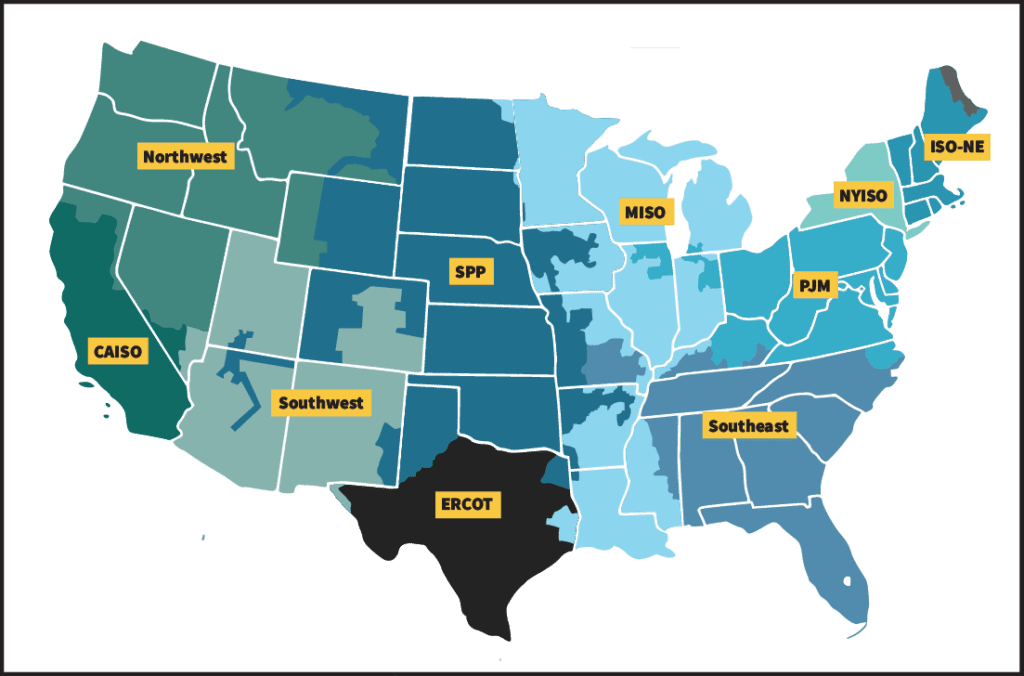
Federal regulators are moving as aggressively. In June, the Federal Energy Regulatory Commission (FERC) issued show-cause orders under Section 206 of the Federal Power Act to all six regional transmission organizations and independent system operators under its jurisdiction, directing them to defend or reform tariff rules governing how large loads access the transmission system. In July, FERC directed the North American Electric Reliability Corp. (NERC) to file mandatory reliability standards for computational loads by year-end, opening the door to registering data centers directly under Section 215 of the Federal Power Act. State utility regulators, meanwhile, are moving to replace fragmented, permit-by-permit review of multigigawatt campuses with coordinated load forecasting, uniform large-load interconnection standards, specialized tariffs, and shared economic-development criteria applied before sites and incentives are locked in.
Grid operators have opened their own front. ERCOT is transitioning from single-project studies to a batch interconnection process that clusters large-load requests every six months and reserves allocated capacity, ending the restudy loops that had extended timelines by years. On Aug. 13, PJM Interconnection filed its Interim Resource Adequacy Service (IRAS) proposal, which would allow limited procurement of demand-response commitments from new large loads that agree to be curtailed ahead of other customers during Energy Emergency Alert Level 1 events.
Even as Congress has yet to enact binding federal standards on how large-load costs are allocated, the executive branch has moved toward clearer consensus. On July 23, the White House expanded its Ratepayer Protection Pledge to 187 organizations—55 investor-owned utilities, 105 electric cooperatives and public-power entities, and 27 data-center developers—alongside 23 governors and the seven AI companies and hyperscalers that first signed on March 4. Signatories commit to building or buying new generation to serve their loads, paying the full cost of transmission and distribution upgrades, and honoring separately negotiated large-load rates whether or not they use the power.
A common thread runs through those actions, according to Arjun P. Ramadevanahalli, a partner at Morgan Lewis in Washington, D.C.: growing public and regulatory scrutiny of large-load projects. “Eighteen months ago, maybe two years ago, it was a totally different environment, at least from our vantage point, where large loads, data center developers, and hyperscalers were moving quickly,” he said. “Everyone is still moving quickly in the industry, but that scrutiny—maybe that public education—was not there.” That scrutiny, he said, has surfaced uncertainties across project readiness, generation supply, transmission upgrades, cost recovery, and behind-the-meter arrangements. Behind-the-meter projects bring those issues together at the customer-generation-grid interface. “There is this overarching issue about codependency between the grid and the customer,” he said.
Ramadevanahalli advises developers, independent power producers, and utilities on rates, wholesale markets, transmission and interconnection, and utility transactions before FERC and state commissions. On Aug. 14, he spoke with POWER about ERCOT’s cluster pivot, governor-led interventions, the regulatory questions surrounding behind-the-meter and islanded projects, and the factors developers should examine when assessing project readiness.
Ramadevanahalli will moderate “Bring Your Own Power: Behind-the-Meter Reality” on Oct. 1, day two of POWER’s Data Center POWER eXchange (DPX 2026), at the Omni Shoreham in Washington, D.C.

This interview has been lightly edited for length and clarity. POWER added bracketed material for context.
POWER: Texas may be the natural starting point, given the amount of activity around large-load growth. ERCOT has shifted from evaluating requests individually to studying them through a batch process. What does that process involve, and why is it such a pivot for the region?
Ramadevanahalli: [ERCOT’s batch process operates as] a cluster, much like clusters are studied for generation interconnection in different independent system operators (ISOs) and regional transmission organizations (RTOs). It is a bit of a pivot in the ERCOT region because it looks at large groups of load the same way you would look at large groups of generation interconnection at the same time.
It is supposed to be the first of a phased approach where Texas is really looking at this incredible growth in large load requests, particularly those that are coming from data centers, and requiring those applicants to go through a standardized process as opposed to evaluating large load requests on a case-by-case basis. The amount of requests that have been coming onto the grid in Texas, and the scale, is what has driven this pivot, which borrows some concepts from the generation interconnection process.
POWER: Texas’s response now spans ERCOT data requests on commercial readiness, Public Utility Commission of Texas (PUCT) implementation of Senate Bill 6, and Gov. Abbott’s standards and audit. How do those actions fit together, and why has the governor’s office become more directly involved?
Ramadevanahalli: The way I look at it is there has been a gradual conversation growing around commercial readiness for these projects, even before everything that has happened this summer with the audit and the governor’s large load standards in Texas, which preceded the audit.
But even before that, ERCOT was issuing data requests to large loads and co-located loads seeking information on commercial readiness—how far along the project is, the timelines, whether any definitive agreements have been executed. Projects have been required to respond to ERCOT with that detailed information.
Now, you see this progression of ERCOT running into challenges with the scale and the amount of load that is seeking to connect to the grid. You see the PUCT trying to manage that from a regulatory standpoint, particularly within the context of [Texas] SB 6, which has required the PUCT and ERCOT to approve new interconnection standards and new frameworks for co-located generation and load. And then you see the governor’s office, which is like a lot of other state executive branches in this country, that are dealing with constituents’ affordability concerns.
Thus, there are multiple moving pieces here, and it has all been accelerated over the course of the last few months by this conversation about cost shifting, affordability, and impacts on ratepayers. That has driven a lot of governors to take a really hard look at what is happening, maybe in a manner that they have not before. New York is a good example. In Pennsylvania, being in PJM, Gov. Shapiro has been very active and has also issued standards similar to Texas. State authorities have also been active in utility proceedings. For example, here in Virginia, the governor has formally intervened in a utility merger proceeding. There is just an uncommon amount of attention on energy issues coming from governors’ offices.
POWER: Across the states, what is driving the heightened scrutiny—ratepayer costs, environmental and community impacts, or pressure from federal and state officials?
Ramadevanahalli: What we have seen is a trend toward more scrutiny for a lot of these projects. The scrutiny has been both at the public level and at the regulatory level. Eighteen months ago, maybe two years ago, it was a totally different environment, at least from our vantage point, where large loads, data center developers, and hyperscalers were moving quickly. Everyone is still moving quickly in the industry, but that scrutiny—maybe that public education—was not there previously.
Today, data center development is more of a kitchen-table issue. It is something that is in the newspapers almost every day, and that inertia has driven much more public scrutiny about a few discrete topics. Affordability—what is the impact on rates? What is the impact on the community? The environment? There is a lot of discussion about the impact of these large loads and what the generation required to serve them could mean for the environment. There are also questions about water usage. A lot of this discussion is generating questions that require customer education and regulator education, given that these projects are so distinct, the grid is so complex, and some of these commercial transactions are more complicated than building a gas plant and plugging it into a data center. They also vary from state to state.
From the regulatory standpoint, regulators are absolutely responding to that pressure. There is pressure coming from the public. I also think there is top-down pressure. The White House has been really involved. Affordability was a central component of the last State of the Union and has been a focus of the National Energy Dominance Council. The [White House] ratepayer protection pledge has been a central feature in the Trump administration’s response. Other federal bodies, like FERC, are also looking at this and directing ISOs and RTOs under show cause orders to explain why their tariffs can adequately address some of these issues.
Generally, there has been a growing chorus of voices that are opposing data centers similar to or the same way as other large infrastructure projects. I see a lot of similarities with, for example, opposition to a large transmission project.
POWER: Given speculative queues and growing political and community opposition, what should developers evaluate first to establish that a large-load project is commercially ready?
Ramadevanahalli: It will look different from jurisdiction to jurisdiction. But first, what is the political climate in the jurisdiction? Is there already a significant amount of [scrutiny] coming from the [state public service commission (PSC)] or maybe the attorney general? We have seen in some states where even if the PSC has signed off on a special tariff or a special contract, that arrangement is now being challenged in courts because an attorney general or a governor is placing more scrutiny on it. The political climate is absolutely one significant factor.
Also, what is the generation strategy? If you are a utility, some utilities are net long on available capacity. That helps solve an immediate issue, because right out of the gate you have got the ability to serve up to X megawatts. It is a significantly more complicated story when you are approaching a utility, and it is faced with the challenge of solving a new resource adequacy issue because of a new large load customer. If the utility is in an ISO or RTO market, it might have a different challenge than an entity outside an ISO or RTO region that has a different portfolio of options available to solve that resource adequacy issue.
The generation strategy is one of the bigger issues I have seen lately that really speaks to commercial readiness for a project. Some utilities have addressed this issue in large load tariffs that have been approved by the state, where resource adequacy or capacity accreditation risk gets passed on to the ultimate customer. There are also utilities that are not in that position, without a roadmap already approved by the regulator, and so it becomes more of a bespoke generation supply strategy.
Then there is solving the transmission story. What does this project look like in terms of network upgrades? Who is paying for it? How is it getting worked into the broader transmission planning process? On the payment front, what does that actually mean for the end-use customer, and how is that getting translated into rates? This is a multi-pronged approach affecting the transmission planning process, cost recovery at the federal level [through FERC-jurisdictional rates], and retail recovery, which could be through assignment to a specific class of customers.
I do not know that there is a consensus emerging yet, other than the overarching preference that data centers pay their own way.
POWER: Behind-the-meter arrangements are a flagship topic at DPX. How are you looking at the legal and regulatory questions that are developing for data center developers and utilities right now?
Ramadevanahalli: Behind-the-meter arrangements are incredibly interesting because they lump in all these questions about cost, affordability, and cost allocation that we just talked about. But there is also a component that is really technical and operational in nature. There is this overarching issue about codependency between the grid and the customer. It also implicates reliability issues that are still being worked out at NERC and at the state level. For example, NERC has recently issued draft registration requirements for “computational large loads” that could ultimately bring data center owners and operators into NERC reliability scope.
For projects that are in some way, shape, or form grid-connected, how are these actually being treated by the grid operator in terms of visibility and planning? What is the reliability concern of having these co-located arrangements? What does that mean in terms of operations?
There has also been discussion about what load flexibility can offer for the grid. Data centers that are operating at four- and five-nines [reliability] may be more limited in terms of how much load flexibility they can offer if they are reliant on the grid without a backup power source. That is really going to change your operational profile compared to a project with a co-located gas generator that is also participating in the market. There are all these interesting operational and technical issues that come into play.
From a regulatory standpoint, that narrative is still evolving. How do we treat these facilities? How should we interconnect them? [FERC] is still looking at these issues.
POWER: What about fully islanded, off-grid projects—how do those complicate the analysis?
Ramadevanahalli: There has been quite a bit of discussion about fully islanded off-grid projects over the last year or so, given all the challenges with interconnection processes and the scrutiny related to transmission upgrades. Theoretically, you can avoid a lot of those initial development hurdles and control a little bit more of your own destiny going completely off the grid.
But then the natural question is, for these off-grid projects: Is there a desire to interconnect now or in the future? Is it going to be fully islanded? And if it is going to be interconnected in the future, what does that look like?
That opens up a whole host of legal issues, not just from a transmission and interconnection standpoint—because that process will have to take place under whatever the state has developed at the distribution level, or whatever the grid operator has developed at the transmission level—but for the existing customers that are on that islanded grid, what does that actually mean? How are you paying for those connections? How does that change your operational capabilities? What does that mean for your data center and your computational load?
From a legal and commercial standpoint, making a really big investment for an off-grid scenario, but planning for a grid-connected scenario that may or may not occur in the future has been a huge challenge—a really interesting one—and it is not as simple as saying, “Well, we will just amend all these contracts or renegotiate everything,” because that is not going to work for the amount of complexity in these arrangements.
POWER: PJM Interconnection, the Southwest Power Pool (SPP), and ERCOT are all moving on large-load rules at different paces. How would you characterize where the markets are converging, where the gaps are, and how quickly they can resolve them?
Ramadevanahalli: Reading the tea leaves a little, all the markets are generally coalescing around the idea that they need to solve this issue. There is a concerted effort to look at this problem a little bit differently. It is not as simple as saying we need to tweak a couple of interconnection reforms and call it a day. The show cause orders that FERC issued earlier this year have definitely placed pressure on the stakeholder process in all these regions. Ensuring that there is a clear pathway for these projects, where one has not existed in some of these markets, will be front and center.
PJM, to me, is a bit of a different beast simply because of the amount of attention that it has received and the capacity challenges that the region has had. Putting aside the large load rules for data centers, its latest [2028/2029] capacity auction was forecasting a shortfall of something like six gigawatts [6,831.3 MW], and that is significant.
I look at that differently than SPP, which does not have a traditional capacity market, or [the California Independent System Operator (CAISO)], which is a completely different single-state entity heavily reliant on investor-owned utilities and municipalities implementing a resource adequacy framework. It is not an apples-to-apples comparison.
The broader discussion of “beneficiaries pay” and what that means will have to be translated at the retail level, and it means different things in different regions. I candidly do not know where some of these markets will go with some of these concepts because so much of it is defined by what is happening at the state level, particularly on the resource adequacy front. And that looks different from region to region.
POWER: Do you expect the political landscape around data centers to change materially after the November elections?
Ramadevanahalli: You mentioned the political dimension earlier, and I was remiss in not raising that myself. What we are seeing today in terms of the ratepayer protection pledge, the actions by these governors, the data center moratoria across the country—my expectation is we will have a different landscape after November. In my view, there has not been a real market slowdown in response to these developments. They are being viewed as hurdles that require a little bit of scrutiny, a little bit of customer education, and a slower, more gradual approach instead of a full 180-degree turn.
POWER: The ratepayer protection pledge came together with unusual speed and consensus. When you say the landscape may look different after November, do you mean because more states will be involved, or because the substantive requirements for data centers and power companies may shift?
Ramadevanahalli: I think it is probably the latter. The ratepayer protection pledge is a great example of how a policy position may shape substantive requirements. 300-plus companies have signed it already, and that has helped provide a framework for how states are looking at these issues, and the core concepts in the pledge—beneficiaries pay, no [cost] impacts [on other ratepayers], bring your own generation, bring your own capacity.
Some state actions also leave room for development to continue later. In New York, the governor issued a moratorium that is statewide and sweeping. It is also not permanent and was issued with an eye toward arming communities with technical support to evaluate whether they want to have a data center. To me, that is a little bit more of a “let’s slow down and evaluate these things,” which we have not really scrutinized the same way. The ratepayer protection pledge and all the messaging from state governments and others have been a big part of that.
—Sonal Patel is a POWER senior editor (@sonalcpatel, *@POWERmagazine).*