Unprecedented scale and load volatility are pushing developers beyond traditional generation strategies toward integrated, digitally orchestrated power systems built for speed, stability, and resilience.
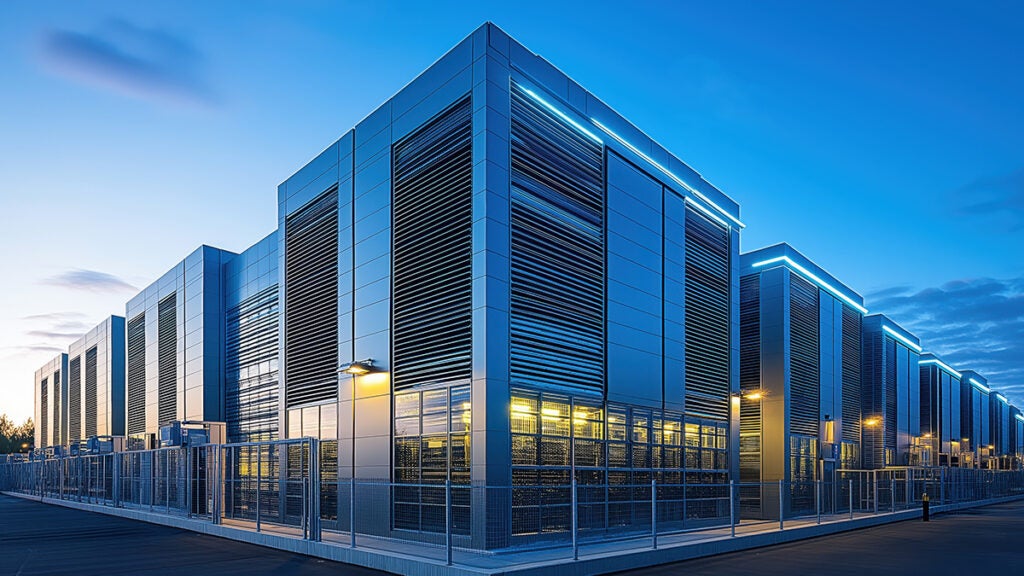
As artificial intelligence (AI) continues to reshape the way people work around the globe, the demand for increased power supply infrastructure is growing beyond anyone’s expectations. The global AI data center market is projected to reach $810 billion by 2033 as an increasing number of companies build out massive AI factories to support this rapid growth. These AI factories are creating a fundamentally new type of power demand because AI data centers are not incremental loads but are instead grid-scale consumers compressed into a single, and typically massive, site.
While AI factories are not the first major consumers of power, their behavior is different from traditional sites, which typically exhibit distributed, asynchronous demand. In contrast, AI factories create synchronous, highly volatile, and massive load swings. Therefore, the power demand that formerly came from many users across multiple sites can now happen inside a single facility.
Thus, organizations building out AI data centers must be prepared not just to meet the amount of power necessary to operate their facilities, but they also must be ready for how fast that power must respond. Meeting this need is not just a generation problem; it is also a digital orchestration challenge.
AI Breaks Traditional Power Design
With traditional grid usage, load changes are gradual and diversified. For example, residential consumers turn lights or air conditioning on and off at different times, but in the aggregate their demand is predictable. Even massive, power-hungry industrial machinery typically ramps slowly enough for load balancing via traditional grid management.
In contrast, with AI workloads, demand spikes and drops multiple times per minute. Banks of thousands or tens of thousands of processors ramp up simultaneously and unpredictably, and then drop off just as fast. Traditional power generation was not designed for these types of swings. The most reactive original equipment manufacturer (OEM) power generation equipment might be designed around expectations of approximately 20-MW swings per minute. The reality for AI factories is potential swings of 100 MW in seconds or less.

In This Issue
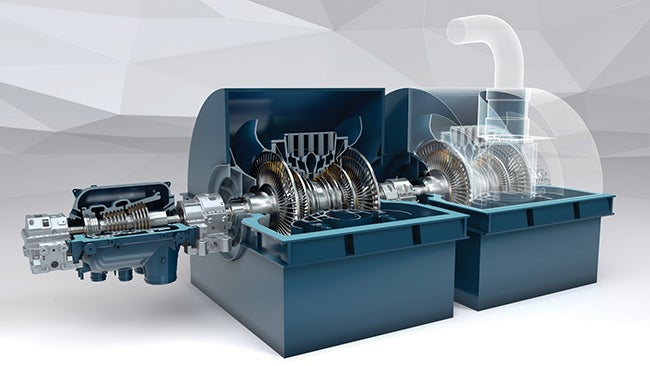
Full issueRotating machinery is not engineered for this type of behavior. The rapid stop-start nature of powering an AI data center can cause a wide array of issues including mechanical stress, torque damage, reduced asset life, and even potential catastrophic failure. This is not just a challenge to produce more power—it is essentially different physics applied at scale.
Solving the AI Factory Challenge
While it seems like the obvious solution to the AI factory consumption challenge is to simply add more generation, the true problem is more complex. Gas turbines, reciprocating engines, and other rotating assets have both physical limits and mechanical inertia constraints. They cannot ramp up or down infinitely fast, nor can they easily absorb high-frequency oscillations.
Ultimately, the core problem is not one of capacity, but rather an issue of response time and stability. As organizations build out AI factories, they need a way to maintain frequency stability, voltage balance, reactive power, and system inertia as part of a carefully balanced system.
BESS as a Shock Absorber
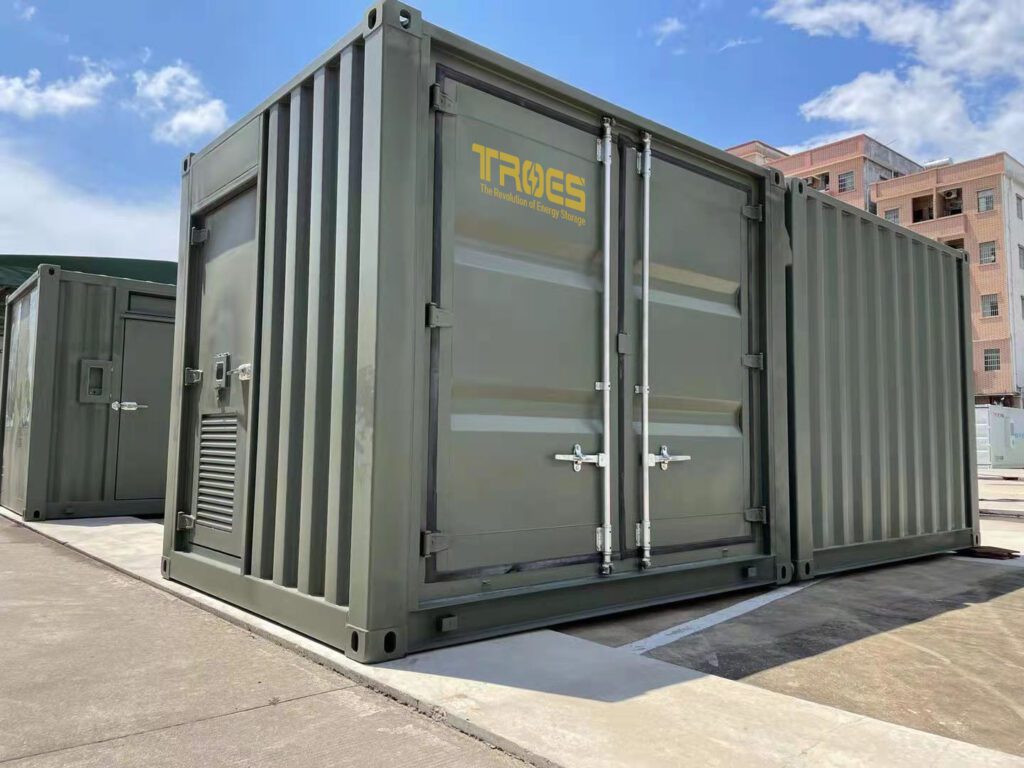
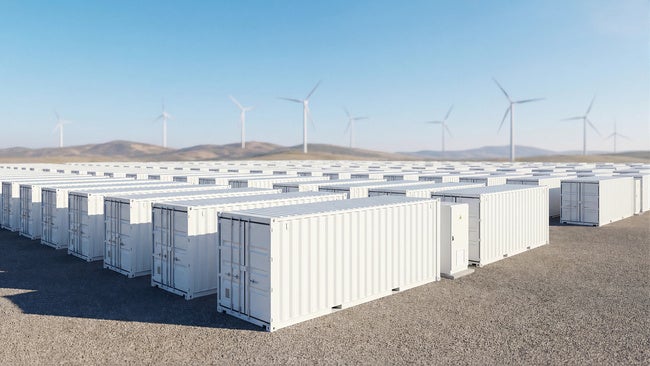
Today, many organizations building out AI data centers are turning to battery energy storage systems (BESS) to act as a buffer between volatile load and slow-to-respond generation. A BESS is a technology that stores electrical energy in batteries, so it can be used later as needed. In addition, it can help absorb energy for balance when production exceeds demand. By capturing energy from the grid, behind-the-meter generation—sometimes combined with renewable energy sources like solar, hydro, and wind—helps absorb rapid spikes, smooth oscillations, and protect rotating assets by balancing supply and demand in real time to prevent blackouts and frequency fluctuations.
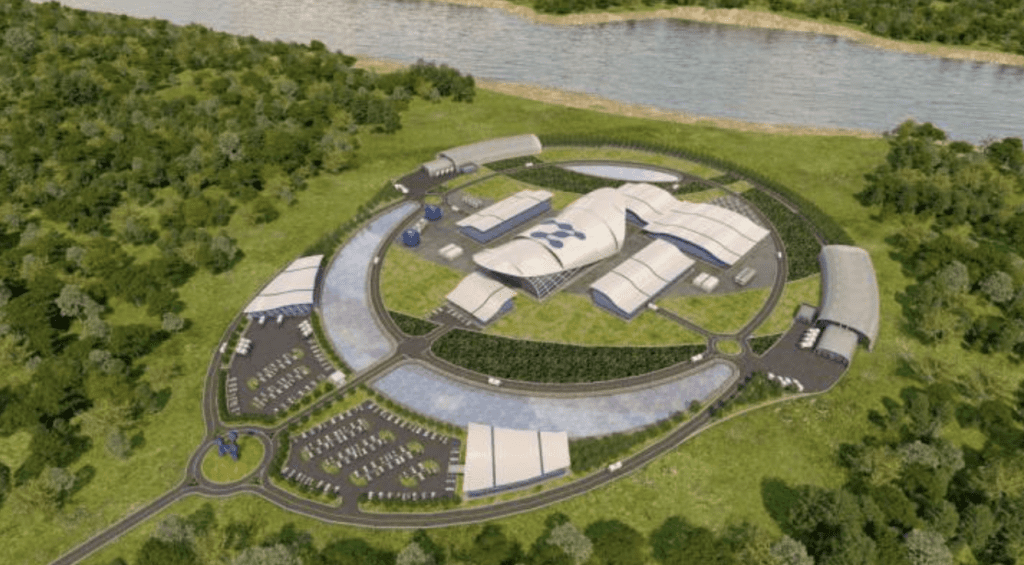
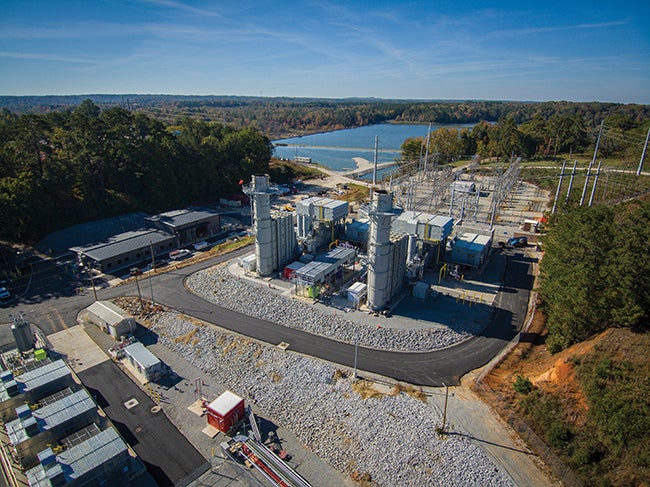
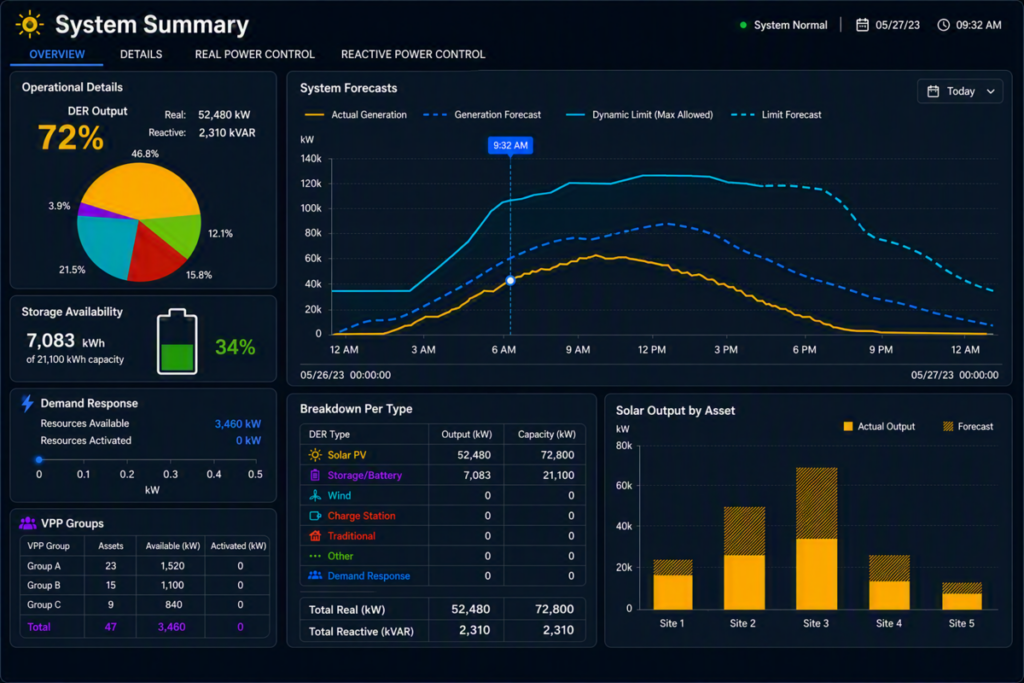
When used as part of an AI data center’s power infrastructure, a BESS does not replace generation, but instead enables generation to function safely under extreme conditions, maintaining system inertia and momentum. The best BESS solutions, when managed properly, can deliver continuous balancing over time (Figure 1).
BESS Is Just the Beginning
A BESS is a critical shock absorber to help drive safer, more efficient, and more effective power management for AI factories; however, it cannot do so effectively in isolation. Simply installing a BESS is not enough. Organizations operating AI data centers must ensure the BESS is properly sized, effectively and accurately models loads, is integrated seamlessly with generation assets, and is coordinated thoughtfully and intuitively by a fit-for-purpose energy control system.
BESS is an essential tool in the AI factory’s power generation and management toolbox, but it is just one piece of the puzzle. The real enabler of success is the way the BESS is controlled and coordinated. Effective digital control is key.
The Conductor of the Energy Orchestra
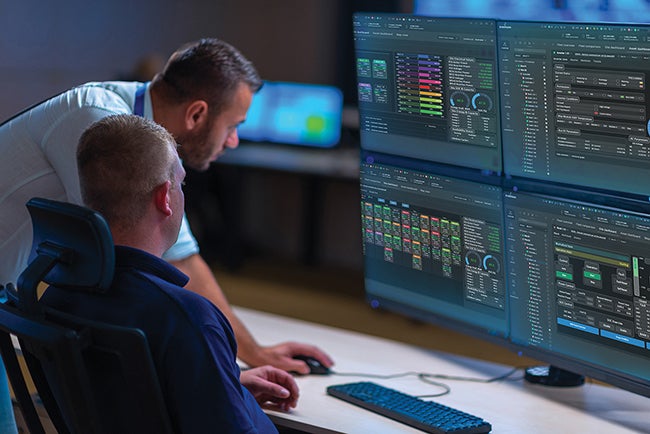
While a BESS does much of the heavy lifting in shock absorption for AI data center energy infrastructure, a fit-for-purpose digital control system is the brain that makes this complex interaction possible. Today’s most advanced energy control systems act as an orchestrator of all assets, coordinating BESSs, gas turbines, engines, grid connection, and more.
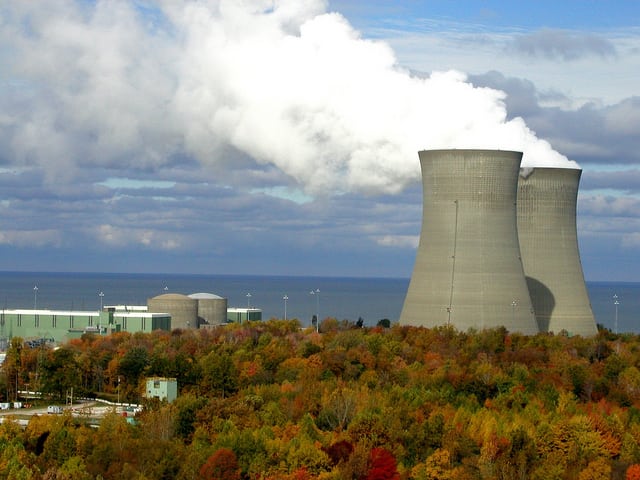
The key capability making this coordination possible is simultaneous parallel processing across all inputs and outputs. By bringing all power elements together into a single, standardized system, organizations unlock more effective real-time control and fully synchronous operation, whether they are managing utility power, on-site islanded generation, or a combination of both. Without orchestration, power generation infrastructure is a collection of assets. With orchestration, it becomes a comprehensive power system (Figure 2).
AI Factory Projects Face Many Complexities
Today’s AI factory projects are focused on fast buildouts to capitalize on an explosion in market demand. Accomplishing those fast startups means harnessing speed-to-power for greenfield projects that are unlike any other previous industrial manufacturing projects. As project teams navigate this new reality, they are facing a wide new array of challenges.
Integration Complexity. As teams race to build out their new facilities as quickly as possible, they often must rely on an array of assets from mixed OEMs with different control philosophies and interfaces. In most cases, the systems do not naturally interoperate. As a result, teams risk building fragmented solutions that are overly complex for operators to navigate and increase the number of potential failure points during operation.
Timeline Pressure. Traditional industrial projects often followed three- to four-year project timelines. During that time, project teams would follow a linear execution pattern. First, they would perform a detailed engineering and design process. Then, based on the results of the design stage, they would procure all assets necessary for execution. Once all assets were in place, the building phase would begin and see the project through to startup.
Today’s AI factory projects move far faster to capitalize on a booming market. These projects require months—not years—to execute, and procurement often happens before design is finalized. Under this new paradigm, many teams are forced to build with the equipment they can get, creating heterogeneous systems and a need for adaptive design and control.
Inversion of Traditional Engineering. Today’s AI data center project teams are sourcing first and engineering after. For example, a project team might approach a turbine manufacturer only to find out the manufacturer can only supply some of what they need. They purchase those assets and then make up the difference with reciprocating engines—perhaps from one manufacturer or maybe even from many different OEMs. Then the team must also integrate its BESS into this mix. Suddenly they face a wide array of control technologies, none of which are designed to integrate with each other out of the box.
The result is complexity. Teams need a way to manage systems with different ramp rates, different control systems, and different performance characteristics. This increases the need for digital coordination and modeling to help teams bring all these varying technologies into a single, manageable pane of glass.
Experience and Ecosystem Matter More Than Ever
One of the key reasons why AI factory projects face so many complications is the fact that many of them are first-of-a-kind projects. Moreover, they are often being executed by investment companies rather than power companies. This shift leads to a core challenge: when it comes to delivering the power necessary for AI data centers, leadership often does not know what they don’t know.
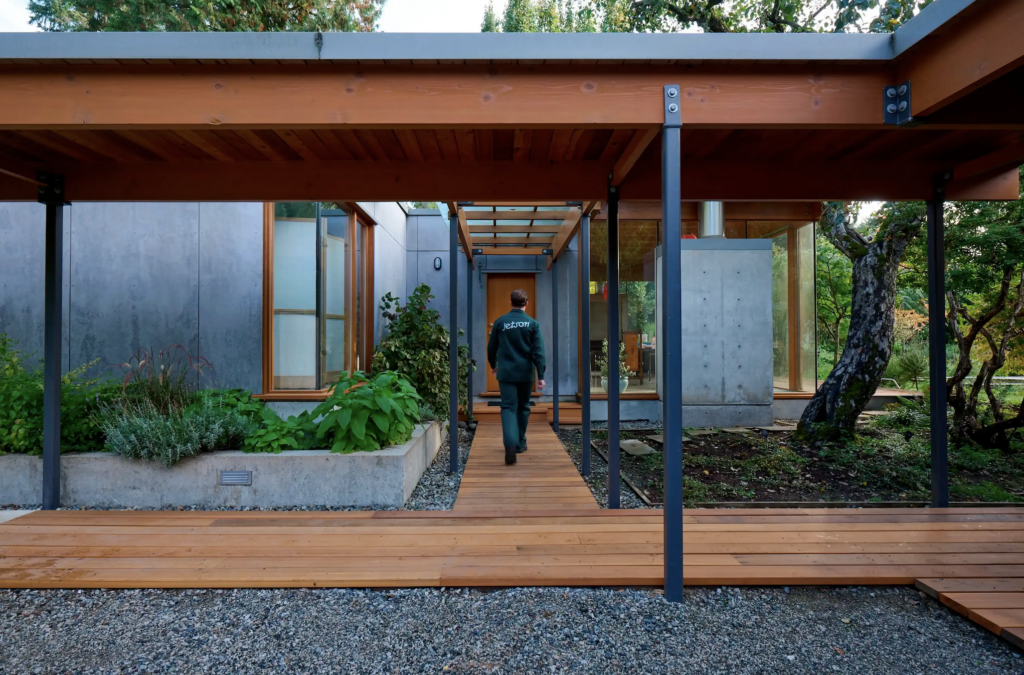
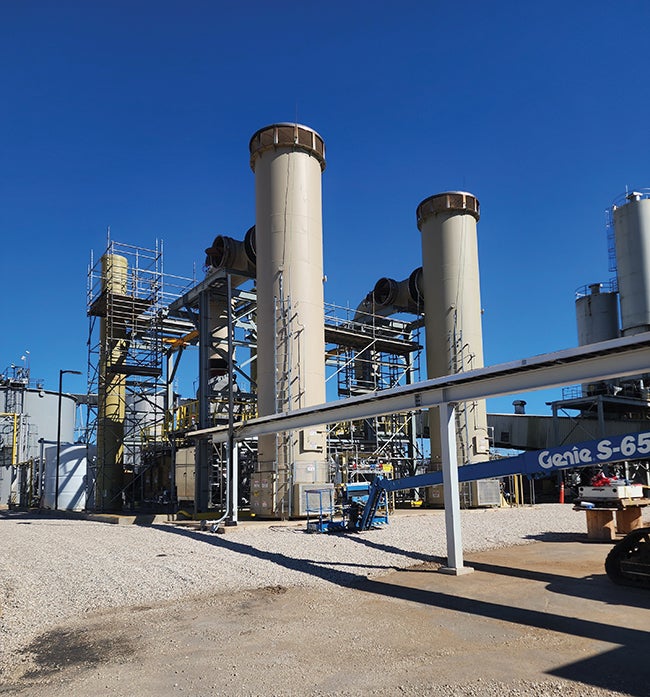
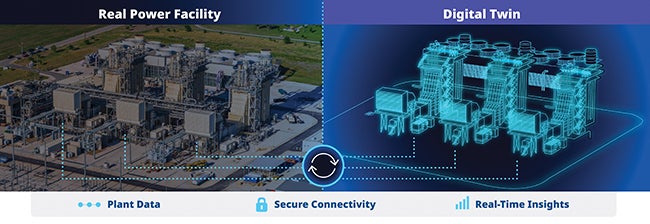
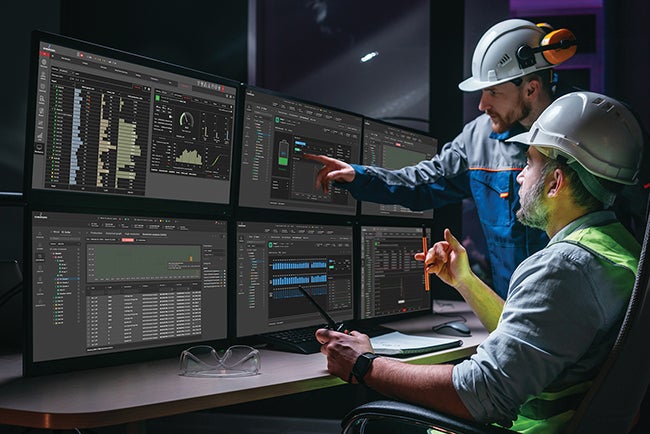
To help navigate this challenge, forward-thinking organizations are partnering with an expert automation solutions provider with decades of experience in the power industry. Experienced partners provide proven architectures, lessons learned from previous projects, and pre-integrated ecosystems driven by a control system designed to seamlessly connect disparate systems, and to empower operators with intuitive control via a single pane of glass (Figure 3).
A partnership with an expert automation solutions provider not only helps project teams avoid their project being “serial number 1,” it also leverages the existing partnerships the automation solution provider maintains, resulting in faster alignment and execution.
Another critical but often overlooked benefit of working with an expert automation solutions provider is an improved cybersecurity posture. The more disparate systems that must be connected to power an AI factory, the broader the surface area for cyberattack. This is especially true for behind-the-meter systems that often lack dedicated security teams.
Working with an automation solutions provider helps ensure cybersecurity is engineered into the system from the start. The best automation solutions providers engineer cybersecurity into their design process. They have certification from the Department of Homeland Security to demonstrate they deliver anti-terrorism technology, putting organizations in the best possible situation to not just be compliant with current and future regulation, but to also protect themselves and their customers from a cybersecurity incident.
Digital Orchestration Is the Real Enabler of AI Power
AI demand is forcing a rewrite of power system design. Whether a new AI data center will be connected to the grid, rely on islanded power, or a combination of both—energy infrastructure will have to be built with a focus on safely navigating dramatic load swings, while being delivered with incredible speed-to-power to ensure delays do not inhibit profitability and return on investment.
Success depends upon BESSs, advanced control systems, integrated architectures, and partnerships with experts who can leverage a history of iteration and expertise to help deliver the best possible solutions in the shortest possible time. The future of power is not just generated—it is orchestrated.
—Phil Jones is director of AI data centers and microgrid sales for Emerson’s Power and Water Solutions business.