
PJM Interconnection has proposed a new framework that would allow large data centers and other major electricity users to enter service without first securing enough new capacity to cover their demand—but would make the uncovered portion of that load available for reduction before PJM calls on existing pre-emergency demand-response resources if electricity supplies become dangerously tight.
The regional transmission organization (RTO) on Aug. 13 asked the Federal Energy Regulatory Commission (FERC) to approve a new Interim Resource Adequacy Service (IRAS), along with a Large Load Registry, rules defining what qualifies as new capacity brought by large customers, and changes to how uncovered large loads are treated in PJM’s capacity market.
The proposal would initially apply to new large loads entering service after June 1, 2027. PJM has proposed to define a “Large Load” as end-use customer demand with a cumulative peak of at least 50 MW at a single electrical site, including affiliated load facilities within a one-mile radius under specified configurations. PJM also urged FERC to approve the rule changes by Oct. 12, which would give the grid operator time to set up the new framework before IRAS could take effect on June 1, 2027, beginning with the 2027/2028 delivery year.
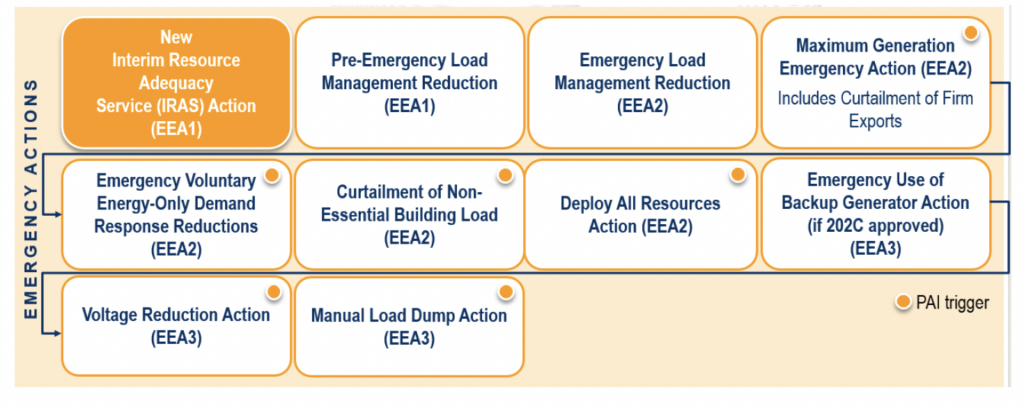
The proposal effectively adds a new rung to PJM’s existing emergency procedures. PJM plans to first dispatch available generation and economic demand response, curtail applicable non-firm interchange transactions and, if available, certain non-firm transmission service. If reserves remained constrained, PJM could then call an IRAS action before moving to Pre-Emergency Load Management reductions, as Christopher Pilong, PJM’s senior director of operations planning, explained in an affidavit accompanying the filing.
“Thus, in real-time, IRAS provides a new step, at PJM’s disposal, prior to impacting existing customers,” Pilong said. If IRAS reductions did not resolve the emergency, PJM dispatchers would move into the existing sequence of escalating emergency procedures, he said.
Significantly, an IRAS obligation would not mean a data center or other large load is routinely curtailed. The framework would establish a quantity of load available to PJM as a reliability resource, but actual reductions would occur only when real-time system conditions warrant them, Pilong said. “The IRAS framework therefore does not require PJM to reduce affected load whenever an IRAS requirement exists,” he said. “Rather, the IRAS requirement establishes an operational reliability resource available to PJM, which can be called upon when actual system conditions indicate that the reliability need addressed by the IRAS requirement is materializing.”
A Capacity Shortfall Is Driving the New Framework
The filing, docketed as ER26-3515-000, is the second of two market interventions PJM has made in six weeks to address a growing resource adequacy gap that its 2025 Long-Term Load Forecast traced overwhelmingly to data center growth. PJM moderated parts of that outlook in its January 2026 Long-Term Load Forecast, but its Aug. 13 filing points to a forecast that shows peak demand surging by about 32 GW between 2024 and 2030—roughly 30 GW of it attributable to data centers.
Longer-term projections are steeper. PJM’s Board of Managers has warned that new large load demand could rise by about 70 GW by 2038, even as roughly 15 GW of generation has retired in the PJM footprint since 2022. So far, two consecutive capacity auctions have cleared short of the reliability requirement. PJM’s 2028/2029 Base Residual Auction, held June 30 through July 7, cleared 6,831.3 MW of unforced capacity (UCAP) short at the FERC-approved $325/MW-day cap. The preceding 2027/2028 auction cleared 6,623 MW short at $333.44/MW-day. “In other words, the addition of new supply has not kept pace with rapid large load demand growth, thus giving rise to the significant tightening of the capacity market in recent years and subsequent resource adequacy shortfalls,” PJM said in the Aug. 13 filing.
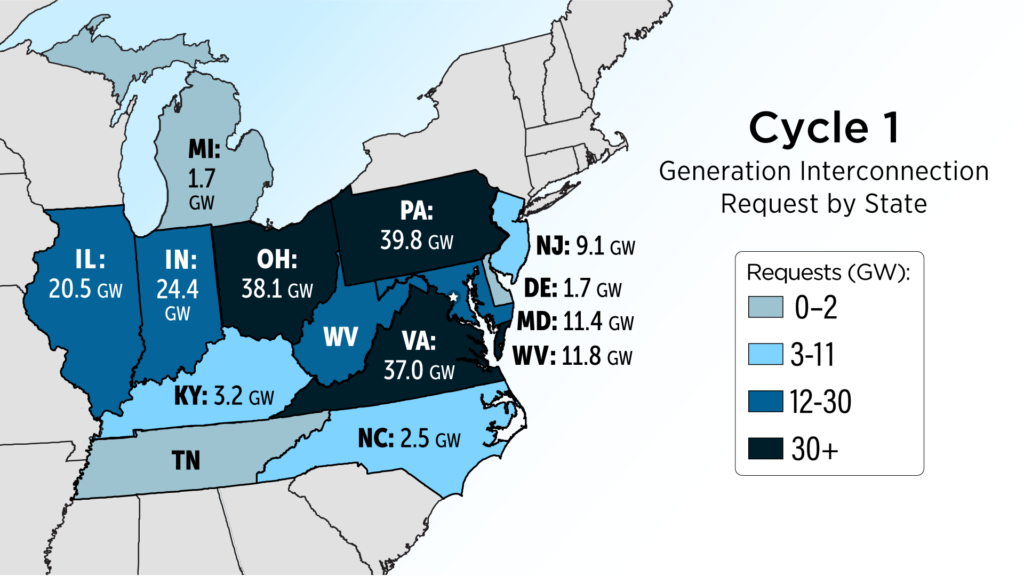
Meanwhile, PJM has moved to accelerate new supply through a reworked interconnection process. On Aug. 3, the grid operator said 715 projects totaling 201.5 GW of nameplate capacity qualified for study in the first cycle of its new “first-ready, first-served” process, which is designed to complete interconnection studies in one to two years. The application window drew 811 proposals before an initial screening for technical information, financial deposits, and proof of site control, with natural gas accounting for the largest share of proposed capacity at 99.8 GW, followed by storage at 60 GW and nuclear at 17.3 GW. Solar, hybrid, and wind projects made up most of the remainder, while storage led by project count, representing 314 of the 715 projects accepted for study. PJM noted the cycle clears the backlog from its prior queues and that 51 GW of projects have signed interconnection agreements to date. It also noted, however, that many of those projects “are either not being built at all or are being slowed by hurdles such as state permitting and supply chain backlogs.” For now, the grid operator plans to post its summer peak model on Aug. 28, followed by the winter peak and light-load cases on Sept. 11, giving developers an early view of potential Phase 1 system impacts.
The IRAS proposal—previously known as the “Connect and Manage” mechanism—follows PJM’s July 31 Reliability Backstop Procurement (RBP) filing, a one-time procurement intended to cover the remaining 6,831.3 MW shortfall from the 2028/2029 auction after crediting new capacity brought by new load. In that filing, PJM asked FERC to approve the RBP framework by Sept. 29 and said it plans to open the procurement on Sept. 30, followed by up to six weeks for clearing and selection. The RBP is intended to conclude before PJM’s next capacity auction in December.
The RBP filing indicates PJM plans to procure new generation, storage, demand response, or distributed energy resources for terms of up to 15 years, capping the MW-weighted average levelized cost of selected offers at $555/MW-day. PJM set an initial target of 6,831.3 MW of UCAP, equal to the 2028/2029 shortfall, and intends to reduce that target to reflect verified new capacity already being brought by new load through bilateral contracts, self-supply, or qualifying demand-side arrangements, along with certain limited opt-outs. Any remaining backstop procurement costs would be allocated through PJM to load-serving entities, and states would determine how those wholesale costs are assigned among retail customers, including data centers.
PJM Is Now Implementing the Board’s Four-Part Framework
The RBP and IRAS proposals are the two principal arms of a broader framework PJM’s Board of Managers outlined July 27, following extensive engagement with market stakeholders—states, regulators, consumer advocates, utilities, generators, and large-load interests—through an April 2026 Critical Issue Fast Path (CIFP) process. In July, the board directed PJM staff to advance four major elements at FERC: a Large Load Registry, the Reliability Backstop Procurement, IRAS, and a compensation mechanism for large loads directed to reduce consumption under IRAS. Given that PJM filed the RBP framework on July 31, its Aug. 13 filing implements the other three board directives, along with a separate load-forecasting instruction.
Large Load Registry. PJM proposes to create a central registry of large loads across its footprint, using information reported by the utilities serving those customers and supplemented by electric distributors and other relevant entities. It will track location, in-service dates, peak demand, planned growth, backup generation, and the qualifying new capacity associated with each load. PJM said the registry will help it “better forecast load growth, plan and manage the transmission system” and determine which new large loads are subject to IRAS and how much load-reduction capability is available in each area. State regulators, utilities, PJM’s market monitor, and FERC will have access subject to confidentiality protections, and PJM plans to publish aggregated data.
Bring Your Own New Capacity (BYONC). PJM’s Aug. 13 filing also establishes Bring Your Own New Capacity (BYONC), the mechanism through which a new large load can reduce or eliminate its IRAS exposure by bringing qualifying new capacity to the system. PJM deliberately defines BYONC as a quantity of capacity, allowing a large load to contract with multiple resources and a physical resource to support more than one large load without double-counting the same megawatts. But the capacity must actually add to PJM’s supply. PJM said its eligibility rules are designed to ensure BYONC is “new and not repackaged” and that its capacity benefits are “real and lasting.” Qualifying resources generally must offer that capacity into PJM’s Reliability Pricing Model (RPM) auctions as price takers for 10 consecutive delivery years.
Compensation for Reduced Load. PJM also proposes to compensate eligible large loads that actually reduce consumption under IRAS. The proposed maximum wholesale rate is 50% of PJM’s Non-Performance Charge Rate, a level FERC has already accepted for PJM’s pre-emergency demand-response program. The rate can be lower if a large load accepts less under its retail rate, and a customer can waive compensation entirely. In that case, PJM said, “a rate of zero dollars for IRAS would apply.” Electric distributors will administer the program in coordination with state regulators, which will determine how compensation is funded at the retail level.
Capacity-Market Treatment. Beginning with the 2029/2030 delivery year, PJM also proposes to exclude uncovered incremental new large-load demand from the demand curve used in its capacity auctions. The exclusion applies to new large-load growth beyond the amount already reflected in the 2028/2029 forecast and continues until the load has qualifying BYONC or an allocation of capacity procured through the RBP. Once that capacity is offered into the same RPM auction, the corresponding load returns to the demand curve. The rule applies whether or not PJM actually triggers IRAS in that delivery year. PJM explained its rationale explicitly: “the rest of PJM’s load should not be exposed to the price impacts” caused by new large loads procuring capacity through the regular auctions instead of bringing sufficient new supply themselves.
PJM Signals a Broader Reset: Reaffirms Reliability as the RTO’s ‘North Star’
The filings arrive as PJM prepares for a wider strategic pivot, shaped by mounting concern over whether its existing market, planning, and governance structures can keep pace with rapid load growth, constrained supply, and the need for faster decisions. On July 23, FERC convened a technical conference devoted specifically to PJM governance and stakeholder reforms. FERC said the conference was intended to identify “concrete, actionable reforms” that could improve PJM’s ability to address operational and market needs in a timely manner, including possible changes to board authority, state participation, filing rights, stakeholder voting, transparency, and fast-track decision-making.
At stake—and particularly challenging for PJM given the size and diversity of its footprint—is how to move with urgency to preserve reliability across a region serving 67 million people while coordinating states, utilities, generators, large-load customers, consumer advocates, and other stakeholders whose authorities and interests do not always align. During FERC’s technical conference, commissioners broadly agreed that PJM’s decision-making processes must move faster, but they also cautioned against treating governance as the source of every problem. The conference examined possible changes ranging from a stronger role for states and greater board independence and transparency to changes in stakeholder voting and accelerated decision-making. Commissioners also stressed that faster PJM action alone will not resolve the region’s resource adequacy challenges: state action remains critical on retail rate design, large-load curtailment priorities, cost allocation, permitting, and transmission development.
On Aug. 19, PJM released Shaping a Powerful Change, a five-year enterprise strategy approved by the Board of Managers in July that reaffirms reliability as the RTO’s “North Star” and states that “reliability is not possible without resource adequacy.”

“Our strategy will align PJM and its stakeholders on the actions required to meet the challenges in front of us,” said PJM Chief Strategy Officer Aftab Khan, who presented the document to the Members Committee. “Making sure we have the resources to support reliability is in the public interest, which demands a partnership that includes PJM, states, utilities, generators and customers. This strategy provides the framework to get us there.”
The document is candid: “One thing is clear: Over a decade of predictably flat load growth is over,” it says, warning that PJM must plan for “a future of higher load growth, constrained supply and macroeconomic volatility.” Load growth “is likely to remain elevated through 2035, with data centers representing most incremental demand,” and even in “an AI downside scenario, system stress may increase through 2031 given the large pipeline of Large Loads and data centers already under construction.” At the same time, PJM said generation “is struggling to come online faster” because of “persistent siting and permitting delays,” similar constraints on midstream natural gas infrastructure, and equipment, engineering, regulatory, and supply chain bottlenecks that “have systematically increased costs for bringing new generation technology.”
The strategy commits PJM to four priorities: reliably operating an increasingly dynamic grid, ensuring durable market incentives and state alignment, proactively adapting planning processes, and improving decision-making efficiency. It ties the second directly to the May 6 Powering Reliability Through Market Design white paper, saying PJM will “advance urgent market reforms” to “create durable, investable market signals and ensure the resources the system needs are built.”
In the document, PJM President and CEO David Mills and Board Chair Paula Conboy jointly told stakeholders that “while this is a five-year strategy, we do not have five years to deliver on most of these priorities.” PJM said it is now developing a stakeholder priority roadmap to sequence the work, and that many initiatives will begin in the next year or two.
—Sonal C. Patel is a POWER senior editor (@sonalcpatel, @POWERmagazine).