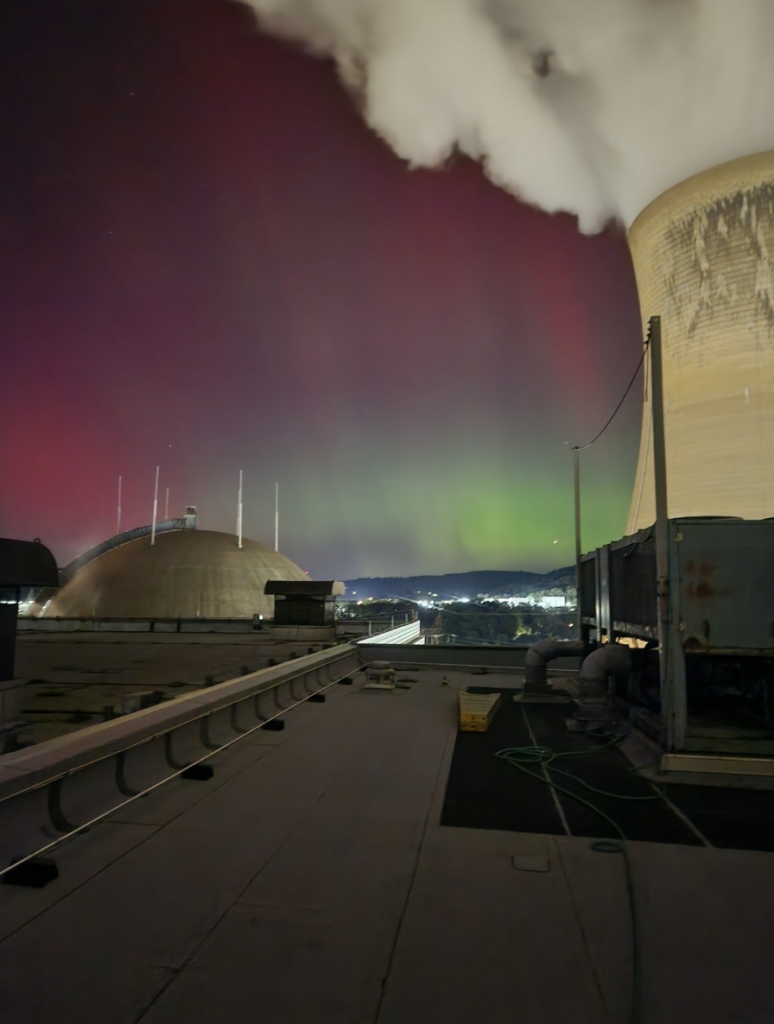
The Department of Energy’s (DOE’s) Office of Energy Dominance Financing (EDF) has announced a conditional loan commitment of up to $4.2 billion to finance uprates and modernization at Vistra’s Beaver Valley nuclear plant in Pennsylvania and its Davis-Besse and Perry plants in Ohio. The projects could add 433 MW of new nuclear capacity and preserve nearly 4 GW of existing baseload output, the DOE said. The conditional commitment also includes an option to finance potential future uprates at Vistra’s two-unit Comanche Peak plant in Texas.
While the conditional commitment indicates “DOE’s intent to provide a loan, Vistra must satisfy certain technical, legal, environmental, and financial conditions before the Department enters into definitive financing documents and funds the loan,” the agency noted on Oct. 5. The DOE also said the investments would support the plants’ operation “for an additional 20 years beyond their existing licenses.”
“President Trump and Secretary Wright have set a clear direction for America’s nuclear future, and EDF is financing the projects that advance that mission,” noted EDF Director Gregory A. Beard in a release. “These investments will extend the life of existing reactors, increase nuclear generation, and deliver abundant, around-the-clock power to lower costs and power American prosperity for decades to come.”
The announcement follows weeks of groundwork. On Sept. 15, EDF, the former Loan Programs Office, told Ohio’s State Historic Preservation Office that it was evaluating a proposed federal loan guarantee to Vistra Operations Company LLC for an extended power uprate at Perry. The EDF’s letter describes a new auxiliary mechanical-draft cooling tower, two support buildings, and potential replacement of the main turbine, generator rotor, moisture separator-reheaters, and in-vessel steam dryer. The letter states that construction “is anticipated to begin in October 2026.”
However, Vistra laid out its capacity expansion plans for the three plants in a Jan. 14 letter to the Nuclear Regulatory Commission (NRC) as a voluntary response to a Regulatory Issue Summary 2025-02, which the agency issued in February 2025 to ask every reactor licensee to report planned uprate filings so it could budget staff and technical resources for the reviews. According to that letter, Vistra planned to pursue two kinds of uprate at each of its four reactors at the three plants—Perry Unit 1, Beaver Valley Units 1 and 2, and Davis-Besse Unit 1.
While the NRC recognizes three categories of power uprate, they differ sharply in scale, cost, and review time, as POWER reported in March. A measurement uncertainty recapture (MUR) uprate typically recovers less than 2% of a unit’s licensed power by installing more precise feedwater-flow instruments, which lets the plant shrink the safety margin its original license holds back to account for uncertainty in measuring reactor power. A stretch uprate, typically up to 7%, adjusts instrumentation setpoints and operating procedures without major hardware changes. An extended power uprate can add up to 20% but is the most capital-intensive of the three, and often requires significant modifications to turbines, condensate pumps, main generators, and transformers. The NRC targets reviews of six months for measurement uncertainty recapture applications, nine months for stretch uprates, and 12 months for extended uprates.
Vistra in January planned to file a combined extended power uprate and MUR application at each unit, one unit per year. Perry, which would lead the uprates, includes MELLLA+ (Maximum Extended Load Line Limit Analysis Plus), an expanded operating domain which allows a boiling water reactor to run at higher power across a wider range of core flow. Vistra in January said it planned to file in the second half of 2029 for a target of 4,356 MWt, which is 16% above Perry’s current licensed thermal power, and expects to reach the higher power in the second quarter of 2031. Counting a stretch uprate Perry already completed, which added 5% over its original licensed power, the unit is slated to add a combined uprate of 21.7% above its starting point.
The two pressurized water reactor (PWR) plants would see smaller gains given they had already captured some of their margin. Beaver Valley Units 1 and 2 previously completed MUR and extended uprates totaling 7.8% above their original licensed power. Under the plan, Unit 2 would file in the second half of 2030 and Unit 1 in the second half of 2031. Each would target 3,100 MWt, a 6.9% increase, to potentially bring each unit 15.3% above its original rating, and the higher power would arrive in the second quarters of 2032 and 2033.
Davis-Besse, which earlier added 1.6% through a MUR uprate, would file last, in the second half of 2032, for a 7% increase to 3,014 MWt and power ascension in the second quarter of 2034. Because Beaver Valley and Davis-Besse have already implemented MUR uprates, the letter notes, “The licensing actions described in this table reflect the intent to pursue further uncertainty recapture via improved technologies.”
The NRC’s expected-applications list suggests Perry is the only uprate application the agency expects in 2029, at about 197 MWe. Beaver Valley 1 and Davis-Besse are the only filings expected in 2031 and 2032, at about 66 MWe and 65 MWe. Combined, the estimates amount to roughly 390 MWe.
That timeline aligns with 20-year power purchase agreements (PPAs) that Vistra signed in January with hyperscaler Meta. As POWER reported, under those deals, Meta will buy 433 MW of uprate capacity. However, the PPAs also cover 2,176 MW of existing output from Perry and Davis-Besse, for a total of 2,609 MW. Vistra said in January that Meta’s purchases would begin in late 2026 and the uprate capacity would come online through 2034.
At the time, Vistra and Meta described the 433 MW as the largest nuclear uprates ever backed by a corporate customer. Vistra said more than 15% of the contracted capacity would be new supply for PJM Interconnection, where the 2026/2027 and 2027/2028 capacity auctions both cleared at the Federal Energy Regulatory Commission–approved cap of more than $329/MW-day.
All three nuclear plants hold renewed operating licenses, which expire in January 2036 (Beaver Valley 1), April 2037 (Davis-Besse), November 2046 (Perry), and May 2047 (Beaver Valley 2). Vistra said in January that the Meta contracts gave it the certainty to seek subsequent license renewals (SLRs) that would extend each unit to 80 years of operation. In a separate Jan. 14 notice to the NRC, Vistra said it intends to file the SLR applications in the third quarters of 2027 for Perry, 2028 for Beaver Valley, and 2029 for Davis-Besse. At each plant, the renewal filing could arrive about two years ahead of the uprate application. Without subsequent renewals, notably, the uprated output at Beaver Valley 1 and Davis-Besse would have less than three years of service before the current licenses expire.
The DOE commitment could change how Vistra pays for the program. On the company’s May and August earnings calls, CFO Kris Moldovan listed the Meta-backed PJM nuclear uprates among the growth investments Vistra planned to fund from cash it expects to generate in 2026 and 2027. On the May call, CEO Jim Burke also cited an opportunity for more than 200 MW of uprates at Comanche Peak, the Texas plant.
The Vistra commitment extends EDF’s push into the existing nuclear fleet. The office has financed restarts at Holtec’s Palisades plant in Michigan, Constellation’s Crane Clean Energy Center in Pennsylvania, and NextEra’s Duane Arnold in Iowa. It also closed a $26.5 billion package for Southern Co. subsidiaries that includes nuclear uprates and license renewals. Under that package, EDF opened environmental reviews on Sept. 1 for extended uprates at Georgia Power’s Hatch and Vogtle Units 1 and 2, which would add about 95 MW and 106 MW.
Uprates are also central to DOE’s Utility Power Reactor Incremental Scaling Effort (UPRISE), which targets 2.5 GW of added nuclear capacity by 2027 and 5 GW by 2029. While Vistra’s 433 MW would arrive largely after both milestones, the administration’s longer-range goal, set in May 2025 executive orders, is to quadruple U.S. nuclear capacity to 400 GW by 2050.
—Sonal Patel is senior editor at POWER magazine (@sonalcpatel, @POWERmagazine).