Activated metallic components generated during reactor operation, maintenance, and decommissioning rarely present a uniform packaging challenge. They can vary widely in shape, mass, dose rate, and radiation profile, and may include thimble plug assemblies (TPA), poison rod assemblies (PRA), reactor control cluster assemblies (RCCA), rod segments, and cut portions of vessel internals. Managing these materials often requires operators to make a series of practical decisions—how much segmentation is necessary, whether loading should take place underwater, how components will be lifted and stabilized, how radiolysis will be controlled, and how the package will move both on site and eventually off site.
The Robatel R86 was developed to bring greater flexibility to those decisions without requiring the certified outer package to be redesigned for each campaign. Operators can instead select among three basket configurations and add lifting and dewatering options to match the package to the waste stream and site workflow. That adaptability, combined with a defined certified performance envelope and operating experience already established at ENGIE Electrabel’s Doel and Tihange plants, is at the heart of the R86 design.
Passive Safety Built into the Package
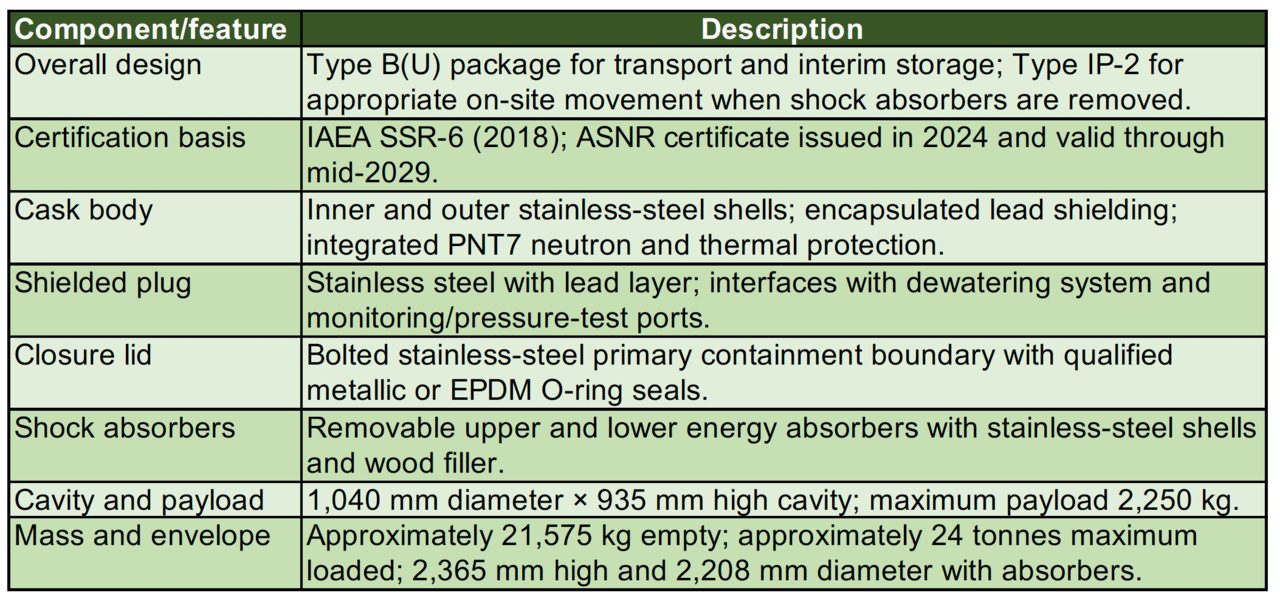
The R86 is built around a passive safety philosophy. Shielding, thermal protection, and containment are provided by fixed materials and engineered geometry, without relying on active cooling, powered ventilation, or forced circulation. The package is organized around four principal subassemblies: the cask body, shielded plug, closure lid, and upper and lower shock absorbers (Figure 1).
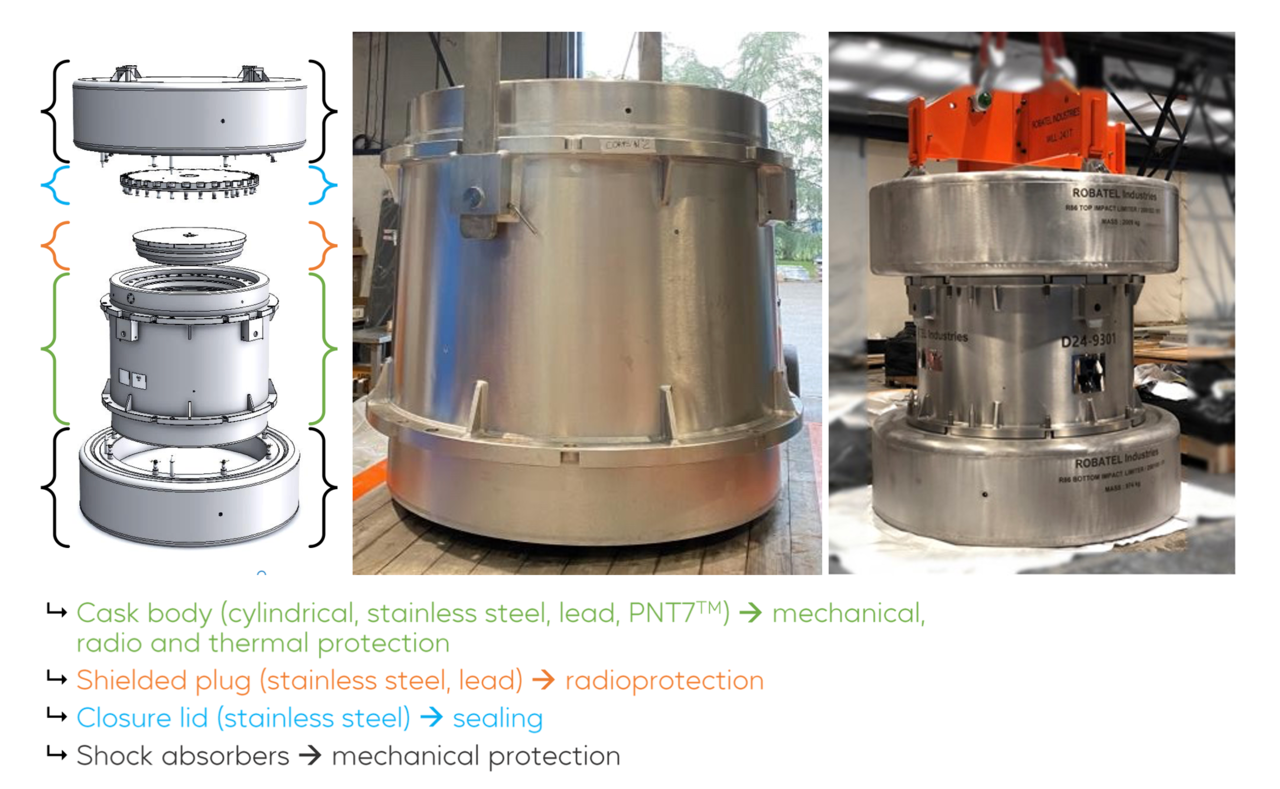
At the center of the design is a cylindrical cask body formed by inner and outer stainless-steel shells surrounding the shielding system. Lead provides the principal gamma shielding, while a 30-millimeter (mm) layer of Robatel’s PNT7 compound provides neutron moderation, thermal insulation, and fire resistance. A removable shielded plug closes the cavity and adds further lead shielding. Above it, a bolted stainless-steel lid forms the primary containment boundary, using qualified metallic or EPDM (ethylene propylene diene monomer) O-ring seals with provisions for leak testing.
For off-site Type B(U) transport—a regulatory designation meaning the package is approved by its country of origin to safely carry highly radioactive waste over public routes—removable shock absorbers at the top and bottom of the package provide mechanical protection under accident conditions. Each uses a stainless-steel shell filled with energy-absorbing wood to manage severe impact loads. With the absorbers installed, the R86 is approximately 2,365 mm high and 2,208 mm in diameter, with an internal cavity measuring 1,040 mm in diameter and 935 mm in height. The package can accommodate a maximum payload of 2,250 kilograms (kg), with a maximum loaded mass of approximately 24 tonnes. The result is a compact package in which containment, shielding, thermal performance, and impact protection are integrated into the basic architecture (Table 1) rather than added through active systems.
Layered Protection Without Active Systems
That passive-safety philosophy carries through the R86’s shielding, thermal management, and containment systems. Rather than relying on active or replaceable components, these functions are built directly into the package body. Encapsulating the lead within stainless steel protects the shielding material while providing durable, cleanable, and corrosion-resistant external surfaces.
The 30-mm PNT7 layer complements the lead by performing several functions at once: moderating neutrons, providing thermal insulation, and maintaining protection under the regulatory fire environment. Thermal management is similarly passive, with allowable payload decay heat limited to 500 watts (W) and no requirement for powered cooling, ventilation, or forced circulation.
Containment is provided by the stainless-steel body, shielded plug, bolted closure lid, and qualified sealing system. Metallic or EPDM O-ring seals, together with dedicated pressure-test interfaces, allow operators to verify leak-tightness after closure without disturbing the protected contents. Taken together, the shielding, thermal, and containment systems illustrate the basic design logic of the R86: safety functions are embedded in the package itself and remain available without dependence on active equipment.
One Package, Three Ways to Match the Waste
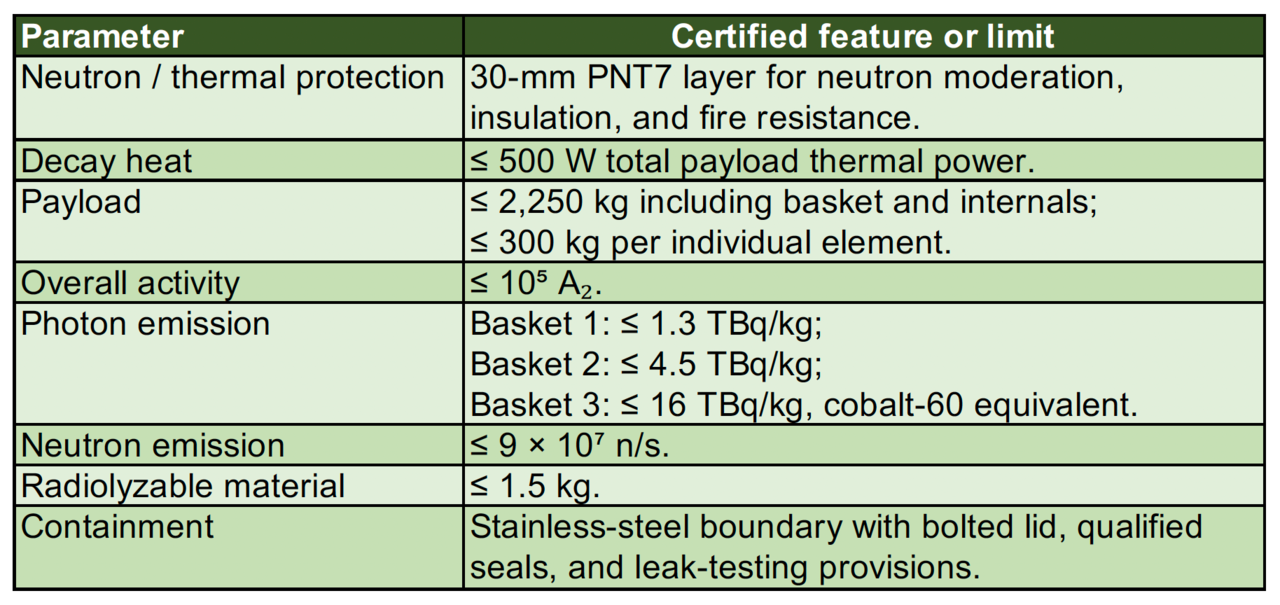
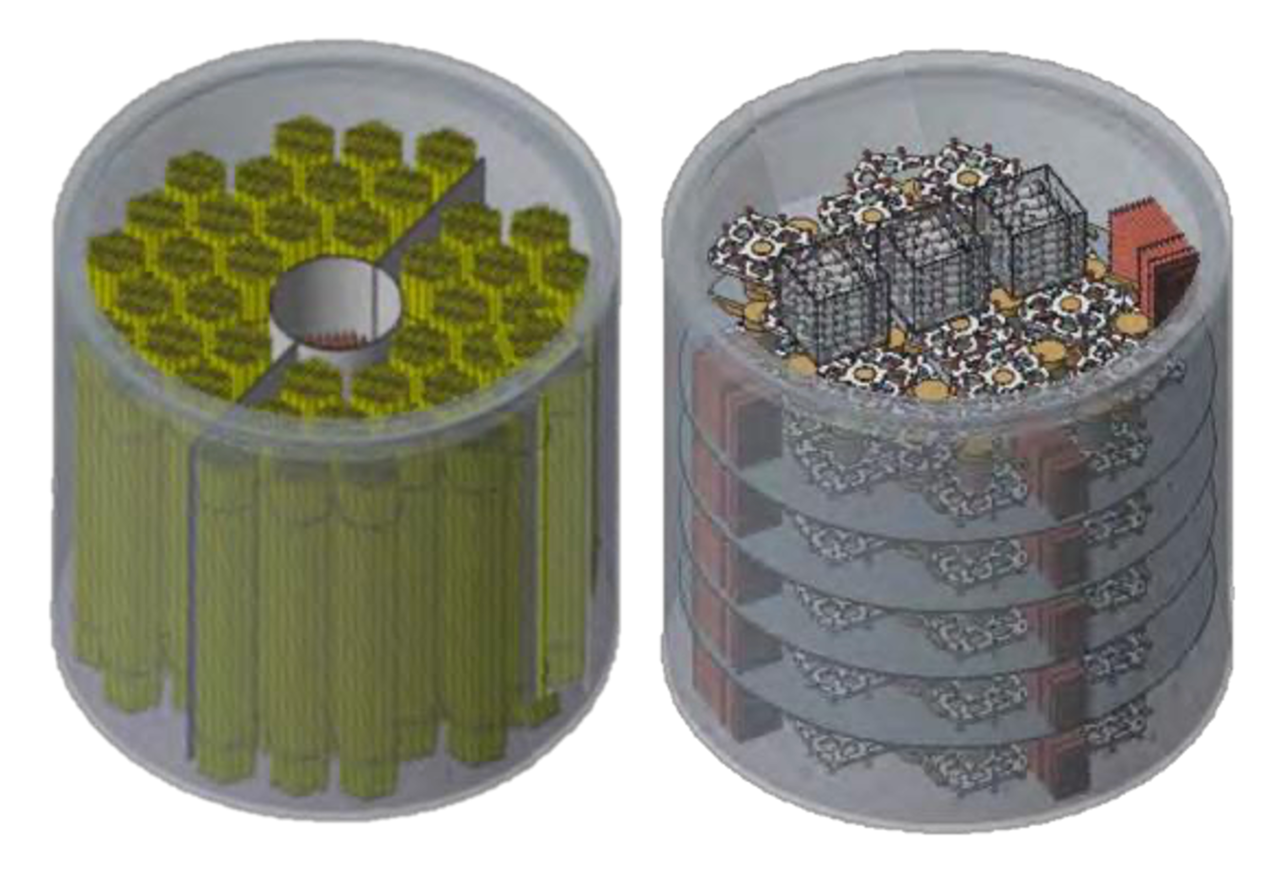
If passive safety defines the R86’s outer architecture, adaptability defines what happens inside it. The package is designed around three interchangeable basket configurations that allow operators to match the internal arrangement to the radiation profile and geometry of the waste while remaining within a common certified package envelope.
The Robatel R86 can accept up to 2,250 kg in its cavity, including the basket and internal hardware, with individual elements limited to 300 kg. Total decay heat is limited to 500 W, total activity to 105 A2—a baseline safety value used to measure radioactive risk—neutron emissions tp 9 x 10⁷ neutrons per second (n/s), and radiolyzable material to 1.5 kg. Within those limits, the three baskets provide progressively higher photon-emission capability: approximately 1.3 terabecquerels per kilogram (TBq/kg) of cobalt-60 equivalent for basket 1, 4.5 TBq/kg for basket 2, and 16 TBq/kg for basket 3.
The importance of that flexibility (Table 2) becomes clear when dealing with activated metallic waste, which is rarely uniform. A single campaign may involve rods, clustered components, short segments, and cut portions of reactor internals, each with different geometries and source terms. Instead of forcing all of that material into one conservative internal configuration, operators can select a pre-engineered basket better suited to the actual payload.
That can reduce the need for custom internal structures, campaign-specific engineering, and additional segmentation before loading. The certified outer package remains the same; what changes is the internal arrangement used to accommodate the waste. In practical terms, the R86 combines the repeatability of a standardized transport package with the flexibility needed for very different waste streams (Figure 2).
Built for the Way Plants Actually Work
The R86’s adaptability does not stop with the basket system. A second layer of flexibility comes from its configurable C, W, and CW operating options, which address the realities of nuclear facility handling: lifting redundancy, underwater loading, dewatering, radiolysis control, and site-specific operational constraints.
Option C adds a second independent set of lifting points on the cask body and top shock absorber. This provides an additional load path for critical lifts and can be particularly valuable at facilities with restrictive handling requirements or where lifting redundancy is required.
Option W adds an internal dewatering system that supports underwater loading and unloading. Self-sealing connections and basket drainage allow water to be removed after loading, followed by a pressure-rise dry test to verify the post-dewatering condition and support radiolysis control. Keeping higher-dose components submerged during loading also supports ALARA (as low as reasonably achievable) objectives by maintaining the shielding benefit of the pool water for as long as practical. This option is compatible with all three basket configurations, so underwater handling can be combined with the basket selected to match the waste’s radiation profile and geometry.
Option CW combines both capabilities—redundant lifting and dewatering.
Together, the basket system and the C, W, and CW options give operators two distinct ways to adapt the R86 to a campaign. The basket can be selected to match the characteristics of the waste, while the operating configuration can be selected to match the way the facility needs to load, lift, drain, test, and move the package. That separation between payload flexibility and operating flexibility is an important part of the R86 design.
Proving the Design Under Accident Conditions
A flexible package still has to prove that its core safety functions remain intact under the conditions assumed in transport regulations. For the R86, that validation came through certification to the International Atomic Energy Agency (IAEA) Safety Standards Series No. SSR-6 requirements by France’s competent authority, ASNR (Autorité de sûreté nucléaire et de radioprotection), in 2024. The certification basis combined engineering analysis with physical testing under both normal transport conditions and hypothetical accident scenarios.
Mechanical qualification included the regulatory 9-m free-drop and 1-m puncture conditions, demonstrating that the package could protect its containment boundary and shielding geometry under severe impact. The external shock absorbers are central to that performance, absorbing and dissipating impact energy before it reaches the protected cask body and closure system.
Thermal qualification included analysis and fire testing at 800C, while shielding evaluations confirmed that external dose rates remained within the required limits for authorized contents. Leak-tightness testing separately verified the performance of the closure and containment system. Pressure-test and monitoring interfaces also allow operators to confirm package condition after loading and during required inspections.
The package also supports standard four-arm lifting and can be secured on a dedicated transport frame, an important element of operating flexibility. With the shock absorbers installed, the R86 is configured for Type B(U) transport. When they are removed, the same core package can meet Type IP-2 requirements for applicable on-site movements. This allows the package to move between different stages of a handling and transport campaign without changing the fundamental cask architecture.
Certification therefore does more than establish regulatory compliance. It confirms that the same passive design, shielding system, containment boundary, and configurable architecture described earlier remain functional under the demanding conditions against which a Type B(U) package must be qualified.
From Design to Demonstration
The R86 combines passive shielding and containment with the flexibility required for nuclear plant operations. Lead and PNT7 provide radiological and thermal protection, while three interchangeable baskets accommodate different waste geometries and radiation profiles. The C, W, and CW options support redundant lifting, underwater loading, and dewatering, and the removable shock absorbers allow the package to be configured for Type B(U) transport or, where applicable, Type IP-2 on-site movements. Certification under IAEA SSR-6 and ASNR oversight established its performance under prescribed transport and accident conditions.
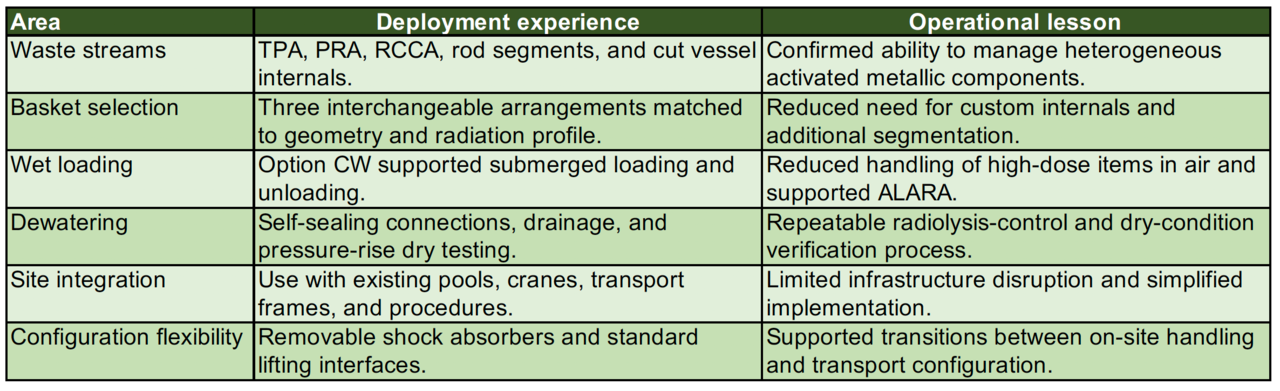
In 2024, the first production units entered commercial service at ENGIE Electrabel’s Doel and Tihange nuclear plants in Belgium (Figure 3), in partnership with Westinghouse. The R86 handled thimble plug assemblies, poison rod assemblies, reactor control cluster assemblies, rod segments, and cut portions of vessel internals. The units were incorporated into existing procedures for packaging, on-site movement, interim buffering, and road transport using plant pools, cranes, and transport frames already in service.
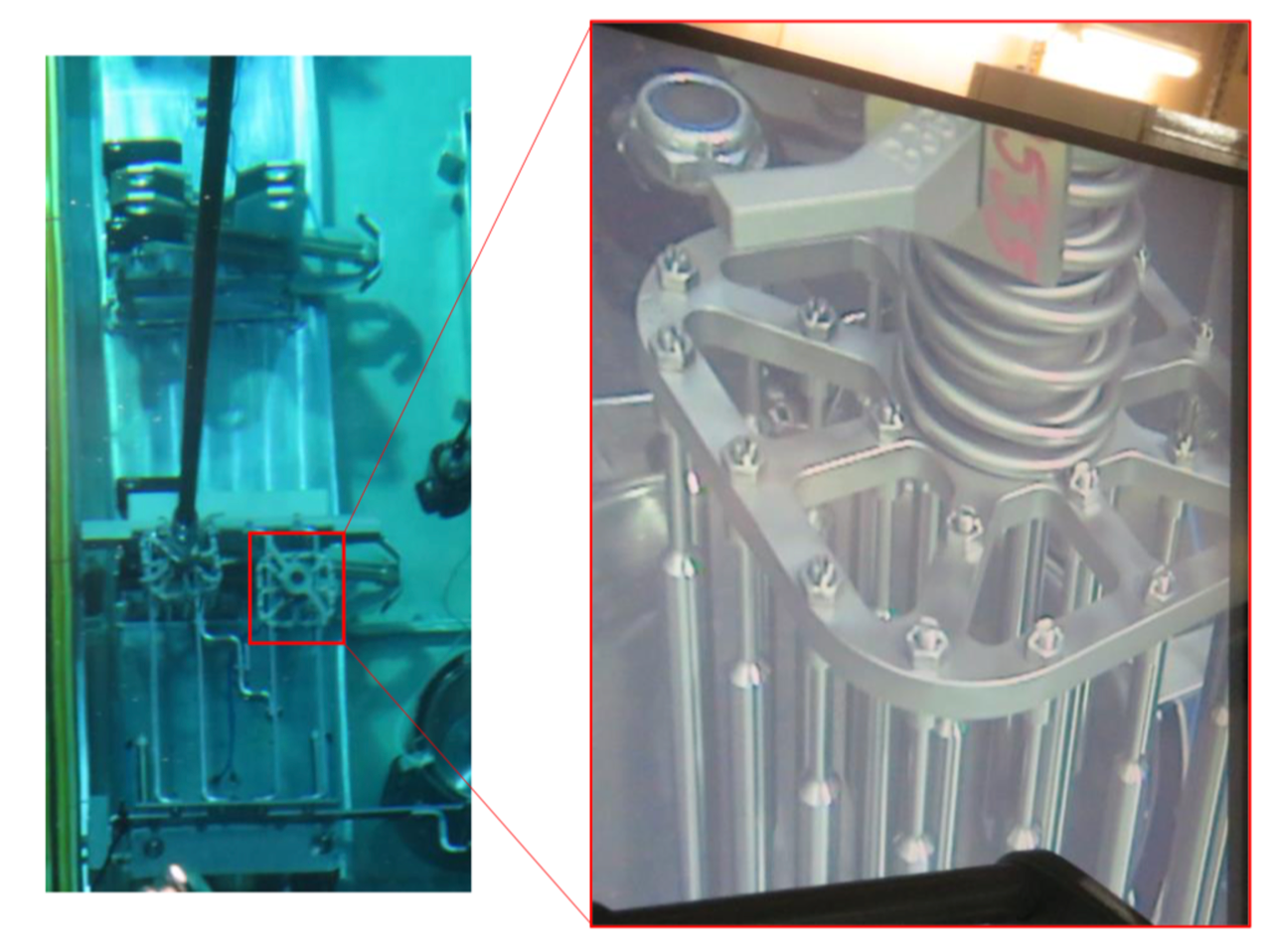
The CW configuration provided redundant lifting points and allowed higher-dose components to be loaded underwater. After loading, the integrated dewatering system removed water from the package, and a pressure-rise dry test verified the transition to a controlled dry condition and supported radiolysis control. This demonstrated that the R86 could be introduced into established plant workflows without requiring an entirely new handling system (Figure 4).
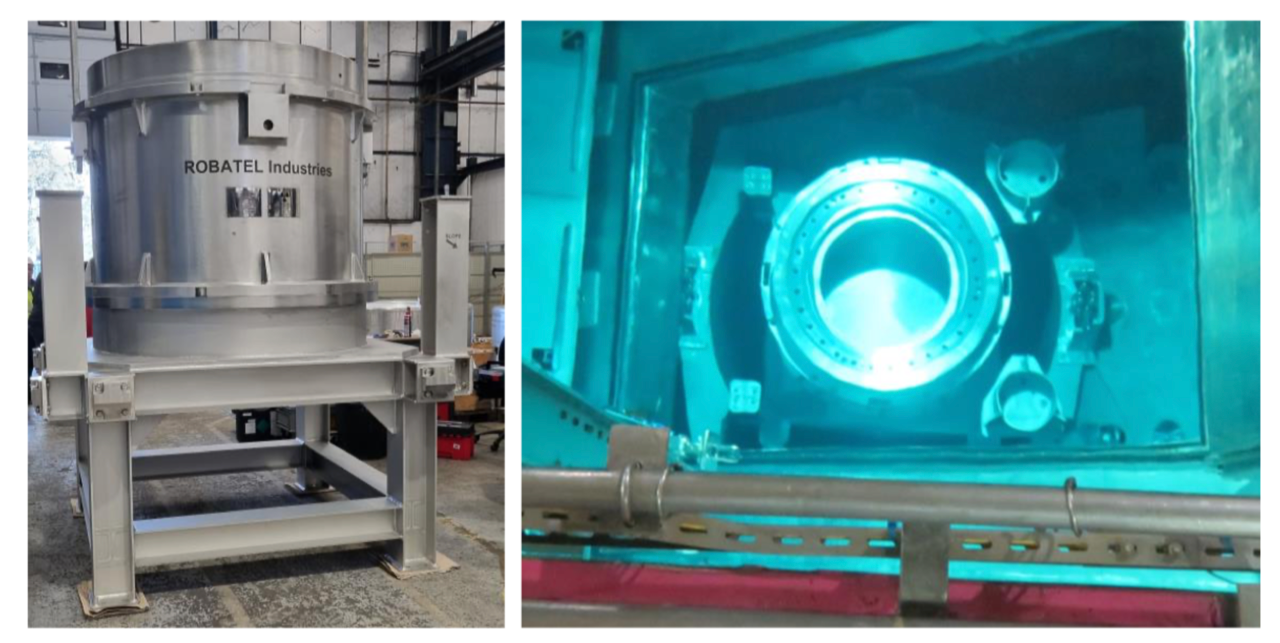
The deployment also confirmed the practical value of the interchangeable basket system. Basket configurations could be matched to component geometry and gamma-emission levels, reducing the need for custom internals and additional segmentation. Limiting unnecessary cutting can reduce occupational exposure, secondary waste, contamination-control requirements, and preparation time. The deployment also showed that interchangeable baskets can reduce engineering burden and that the dewatering and pressure-rise dry-test sequence can be performed repeatably in pool-side operations.
The Doel and Tihange experience connected the R86’s certified design with actual plant operations (Table 3). The package was manufactured, delivered, loaded, handled, dewatered, and moved with representative activated metallic waste. The result is a certified, passively safe, and adaptable system whose principal design and operating features have now been demonstrated in a nuclear facility.
—Jay Horin is CEO of Robatel Technologies.