Artificial intelligence (AI) data centers are being built at an unprecedented pace. There are more than 12,000 active projects in the U.S. currently seeking grid interconnection representing 1,570 GW of generator capacity and 1,030 GW of energy storage. Analyst firm Omdia predicts that AI will drive more than 50% of installed power generation capacity over the next five years.
A survey of energy industry stakeholders by Black & Veach found that lack of power was the biggest issue standing in the way of AI ambitions. 53% of utilities cited available power as the top obstacle to getting data centers online, with transmission (47%) and substation upgrades (46%) close behind.
In response, data center developers have been gobbling up gas turbines. Some intend to power their own facilities while others are partnering with utilities to strengthen the ability of the grid in their areas to supply the energy needed for AI. Unfortunately, lead times on equipment are long and getting longer.
“Orders for gas turbines today might not be delivered until 2032,” said Wes Cummins, chairman and CEO of Applied Digital, a data center developer and operator with multiple GW of data centers either operating, under construction, or in development. This includes two AI facilities operating in Ellendale and Harwood, North Dakota.
He can’t afford to wait for gas turbines. His company has ordered 1.2 GW of steam turbines fed by gas-fired industrial boilers for another data center being built in North Dakota and two more are being finalized. Each will have this industrial boiler/steam turbine setup. The first one is scheduled to begin operation late in 2028.
Applied Digital signed this $2.4 billion design/build agreement in conjunction with independent power producer Base Electron.
“You need a lot of power for an AI data center, whether it is one focused on training of AI models or on delivering AI results to users (known as inferencing),” said Cummins. “To deal with the scale of AI, the boiler and steam turbine combination is proven.”
When gas turbines become available in a few years, Applied Digital intends to convert the facilities into combined cycle plants to boost efficiency further. But the boilers will continue to be used. Boiler steam will supplement the steam produced using exhaust heat from the gas turbine in a heat recovery steam generator (HRSG).
Packaged Boilers Preferred
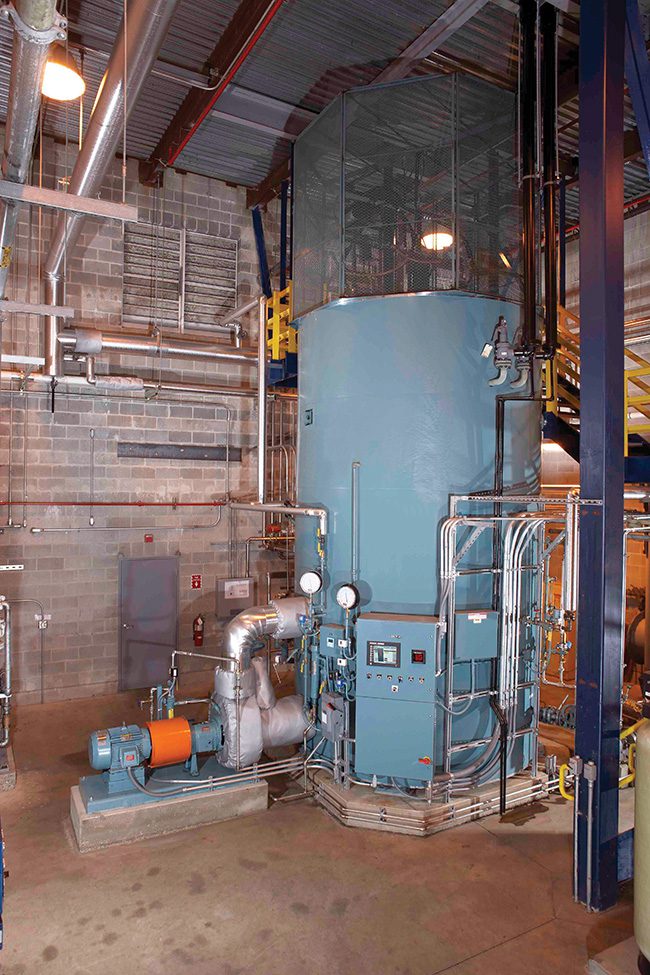
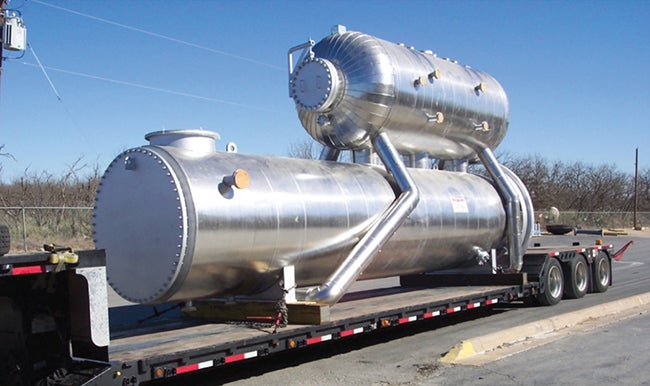
To align boiler manufacturing to the pace of AI, packaged boilers are the preferred option. Instead of building them onsite, they are made and assembled in the factory and packaged along with burners and controls. This enables them to be delivered as a complete system that can be shipped (Figure 1). When the unit arrives, it only requires minor installation work and the establishment of basic connections for fuel, water, and electricity. If a boiler is too large for road or rail transport, it is assembled into modules. Each module is shipped to the site for final assembly. But even in that case, onsite work is nominal as the modules are designed to be quickly integrated.
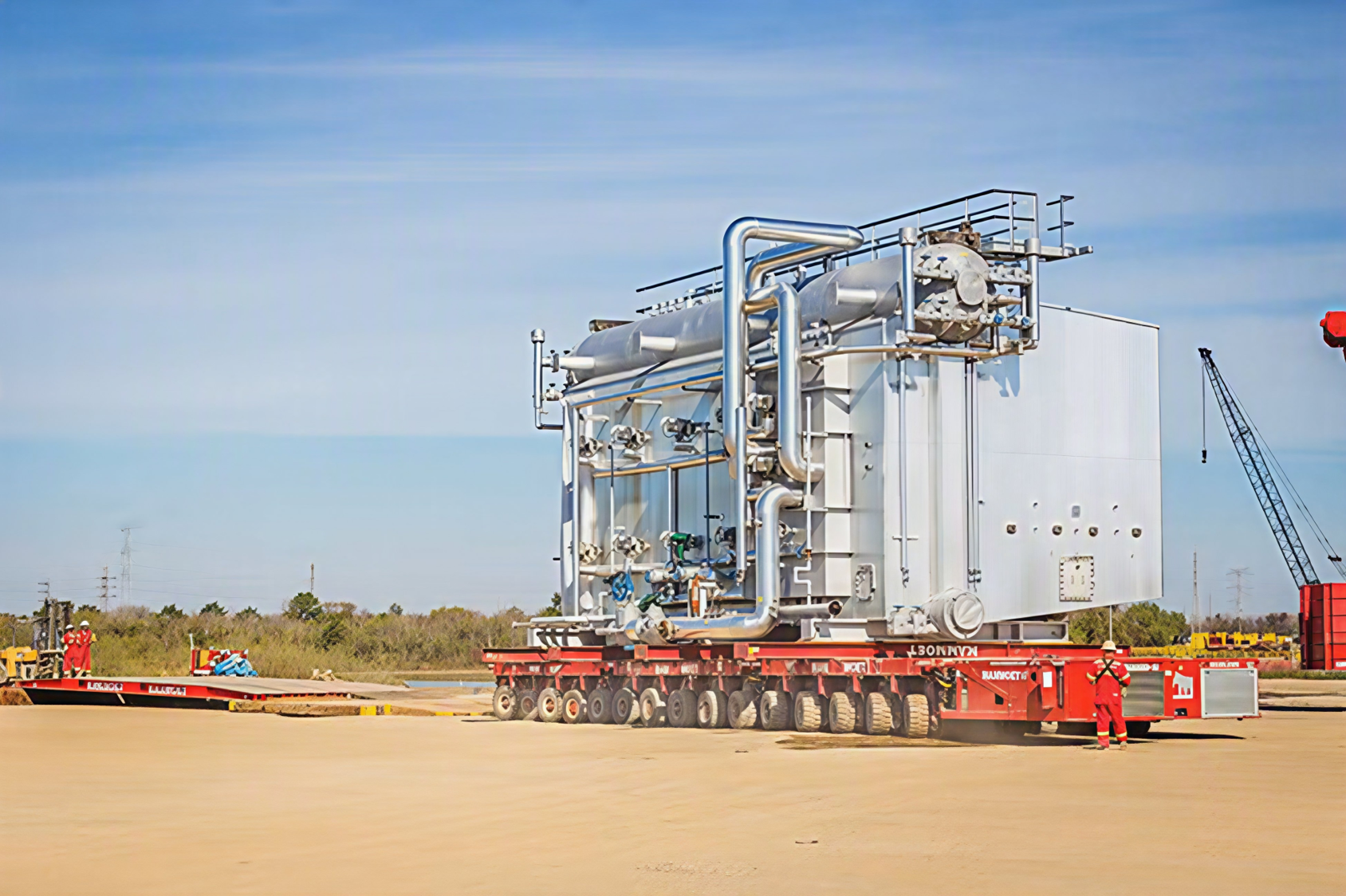
“Boilers and steam turbines can currently be delivered faster than other generation solutions,” said Cummins.
Rentech Boiler Systems of Abilene, Texas, for example, can manufacture and deliver a packaged boiler within a year of receiving an order, according to Gerardo Lara, the company’s vice president of Boiler Sales. Rentech has delivered more than 1,000 boilers and HRSGs across its 30-year history ranging from 20,000 to 650,000 pounds per hour of steam at pressures from 200 to 2,000 psi. Lara said its models are best suited for steam turbines ranging from 10 MW to 20 MW, while modularized designs can accommodate turbines up to 50 MW, which are available from many different suppliers.
“There are two basic design types for packaged boilers: fire-tube and water-tube,” said Lara. “The former is generally better for smaller commercial loads and the latter for higher pressure/temperature capacities in industrial applications.”
Rentech produces fired watertube models that are built with water-cooled, full membrane wall construction providing a low maintenance and tight gas-side seal.
“The packaged boiler is the workhorse of the industry, the market is very strong, and there is plenty of interest from the data center community,” said Lara. “A boiler and steam turbine offers typical Rankine cycle efficiency.”
His company offers conservatively designed boilers with large furnaces to ensure optimal circulation, efficient heat transfer, and the delivery of a large volume of steam while meeting emission guarantees. This lowers the maintenance burden on facility personnel. Its steam drums are built for high retention times and robust steam separation internals.
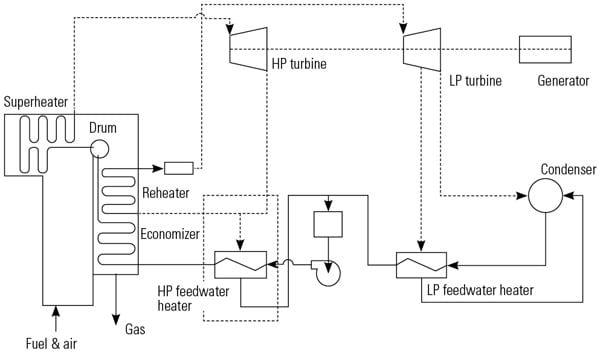
Packaged boilers are used across almost every industry including manufacturing, chemicals, food processing, and oil & gas. When paired with a steam turbine, the boiler burns natural gas. Water inside the boiler tubes is turned into steam. An intricate series of tubes, channels, and drums inside the boiler feed steam directly to the steam turbine at the temperature and pressure required to generate electricity.
“We have been very busy over the past year with lots of projects being done for data centers,” said Lara. “With such a long backlog on gas turbine delivery, there is rising interest in pairing packaged boilers with steam turbines to deliver the vast amount of energy consumed by AI.”
Bypassing the Gas Turbine Backlog
The gas turbine backlog is long and getting longer. GE Vernova reported more than 100 GW of orders and slot reservations. Even with the company adding more shifts, investing billions in new manufacturing space, and streamlining production, it can’t keep up with demand. Other suppliers such as Siemens Energy, Solar Turbines, and Mitsubishi Power report similar supply delays.
Despite extended delivery timelines, data center developers continue to place orders for more gas turbines. They are also hedging their bets—purchasing gas engines, too, in record numbers as well as fuel cells, battery energy storage systems (BESS), and renewable energy. Further, they are investing in geothermal power, nuclear-based small modular reactors (SMRs), and any other source of energy that looks promising. AI is driving a wave of innovation across all forms of electricity generation.
The boiler/steam turbine combo is a relatively new addition to the roster of technologies being requested by developers. Steam turbines and package boilers offer immediate advantages. They both represent proven technology, lead times are much shorter, and capacities can be good.
“Lead times for a package boiler are typically a year or less,” said Lara.
Industrial boilers have been around for so long that the supply chain and manufacturing capacity is extensive. The industry has been through many cycles of boom and depression. It is used to rapid shifts between ramping down and ramping up production. Expect to see boiler manufacturers stepping up output rapidly to capitalize on the lack of power availability from many other sectors.
Similarly, a broad range of steam turbine manufacturers exists. As well as Siemens Energy, there is GE Vernova, Mitsubishi Power, Howden, Ebara Elliot, Doosan Skoda, Toshiba Energy, Shanghai Electric, Everllence (formerly MAN), Baker Hughes, Triveni, and Bharat. Between them, these companies have a well-established supply chain. According to McCoy Reports, the industry’s most recent peak production year happened in 2015 (Figure 2). That year, close to 140 GW of steam turbines of at least 5 MW were manufactured. It fell to below 50 GW in 2019 and has yet to fully recover.
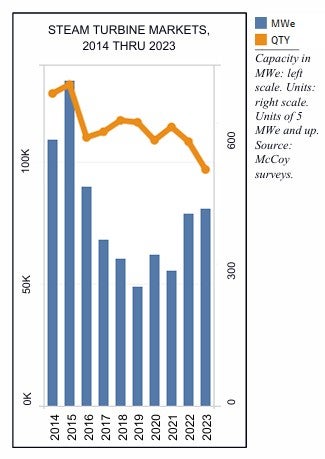
Thus, it can reasonably be concluded that there might be 50 GW of increased manufacturing capacity potential in the existing supply chain. Once data center developers hear about it, that excess capacity can be expected to evaporate quickly. Perhaps in a couple of years, steam turbine order backlogs will begin to extend out as far as those for gas turbines.
That is already beginning to be the case for the very large steam turbines. With nuclear plants being reopened, demand for steam turbines above 1 GW is rising. A record build-out of combined cycle power plants, too, means steam turbines larger than 300 MW are in demand. Similarly, with many SMR projects under development, steam turbines in the 150 MW to 300 MW range are beginning to experience a renaissance. However, there remains plenty of spare supply chain capacity among the mid-sized and smaller steam turbine sectors. But for how long?
Global Market Insights predicts that the steam turbine market will grow by almost three times between 2025 and 2034. The industrial boiler market is expected to see a similar growth trajectory.
“We expect to see many data centers opting for package boilers and steam turbines over the next couple of years,” said Lara. “It is feasible to install a series of package boilers and steam turbines in one location to provide a large quantity of power.”
—Drew Robb (drewrobb@sbcglobal.net) has been a full-time freelance writer for more than 25 years specializing in engineering and technology.