Emerald Horizon plans to sell a hybrid battery and molten-salt storage system now and add an accelerator-driven thorium generator later. The generator remains at an early stage of development.
Austria decided against nuclear power in the late 1970s and has not revisited the question since, according to Mario Müller, vice president of research and development (R&D) at Emerald Horizon AG. Even so, the Graz-based start-up now wants to sell a thorium-fueled machine that fits in shipping containers and runs only while a particle accelerator drives it.
Founded in 2019 and listed on the Vienna Stock Exchange in June this year, Emerald Horizon calls its system SMRX, short for subcritical micromodular reactor. The company says the X stands for its approach and technology: a “neXt generation” of energy production, an “Xternal” neutron source, and an “Xcelerator,” a nod to the accelerators used to generate neutrons in modern cancer treatment, a principle the company says it applies to generating energy. It describes the system as combining energy storage and generation, which is its tagline.
The system has two parts. The first, DUALstorePLUS, is a storage system the company expects to have available as soon as this year, battery units first and molten-salt units in 2028. The second, ADES (accelerator-driven energy source), is a thorium generator that the company’s website says will reach prototype completion in 2029. The company’s materials place ADES at technology readiness level (TRL) 4.5 on a nine-point scale. They describe the integrated system as not yet demonstrated, with the remaining work in integration, commissioning, and scale-up. In a written response, the company told POWER it is targeting a demonstration plant in 2031, followed by serial production. It said many development steps run in parallel rather than one after another, and that from its perspective today, regulation will be the most important challenge.
In an interview with POWER, Florian Wagner, Emerald Horizon’s CEO, said the design is meant to answer the objections that have dogged nuclear power in his home country. “Austria is extremely against nuclear,” he said.
Storage First
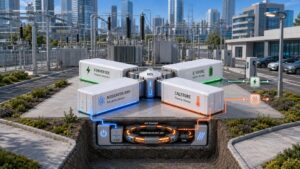
The commercial plan is sequenced around cash flow. DUALstorePLUS pairs a battery container with a molten-salt thermal store, both controlled by an artificial intelligence (AI)-based master control unit. According to company materials, the battery side is roughly 5 MWh of lithium iron phosphate (LFP) per module, with about 94% roundtrip efficiency. The thermal side is 5 MWh(th) of solar salt (a mixture of potassium nitrate [KNO3] and sodium nitrate [NaNO3]) per module, operating between 200C and 550C. A system can be configured from 5 MWh to 100 MWh, with up to 10 modules of each type.
Wagner said the company buys the battery containers from the market, which he described as removing development risk. The molten-salt unit, called CALstore, is the company’s own design. Wagner said its prototype is running and moving toward serial production, and Müller said it has been transferred to the Netherlands for industrial reproduction. Emerald Horizon said battery energy storage system deliveries could begin as early as the fourth quarter of 2026. It expects CALstore will be available from 2028. Müller said the thermal unit can hold heat at 550C for up to 14 days.
Emerald Horizon intends to lease the DUALstorePLUS units under 20-year energy-as-a-service contracts rather than sell them. Wagner said the arrangement gives the company early revenue while the generator is developed, and gives it two to three years to build customer relationships and connect storage to grids, heat networks, or industrial processes before generation arrives. The company has not yet offered energy-as-a-service contracts to any potential SMRX customers, but it said “numerous” nondisclosure agreements with interested parties have been signed.
How ADES Is Meant to Work
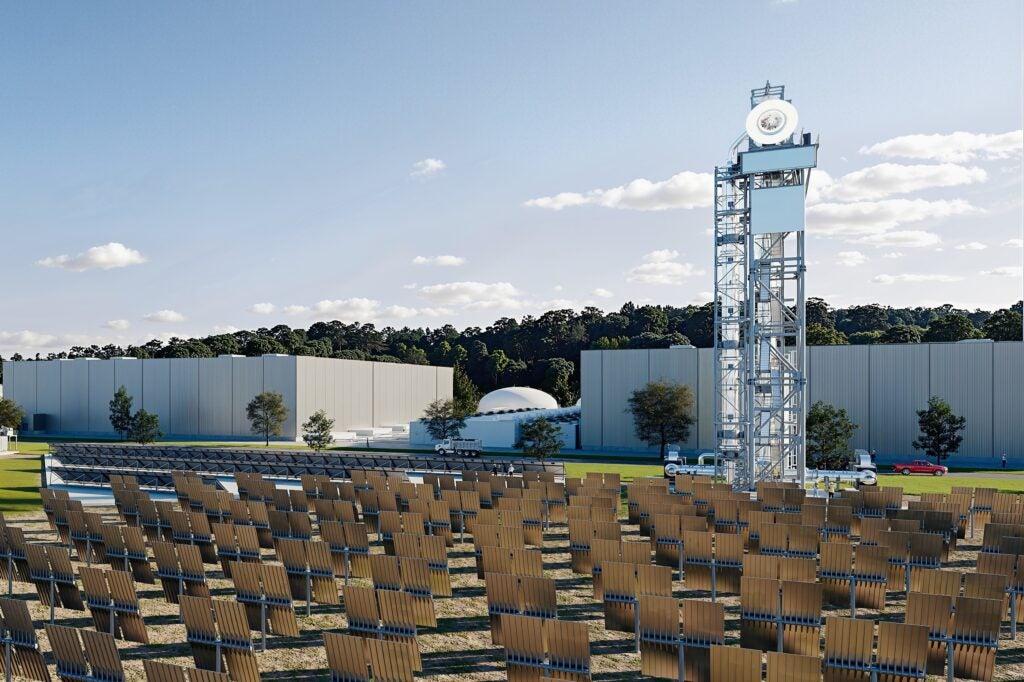
ADES replaces the self-sustaining chain reaction of a conventional reactor with an external neutron source. According to the company, that source is an accelerator, and a component called the X-Amplifier Box connects it to the thorium loop (Figure 1) and amplifies the neutron flux. The company said that when the accelerator is switched off, the reaction stops. The neutrons strike thorium dissolved in a circulating fluoride salt. The salt serves as both fuel carrier and heat-transfer fluid, and heat exchangers pass the energy to a converter that can produce electricity, hydrogen, or process heat.
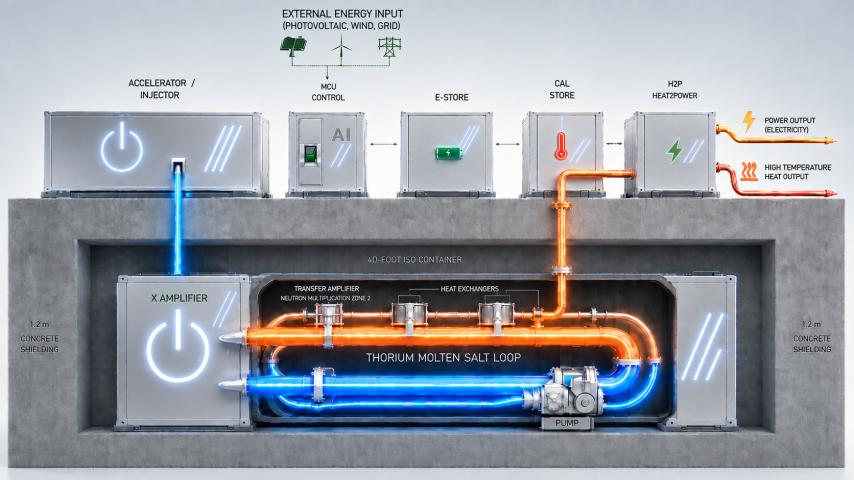
“When you activate the accelerator, you get heat back, and when you’re not activated, nothing happens,” Wagner said. The company’s materials specify an effective neutron multiplication factor below one, meaning the reaction does not sustain itself.
Müller said the engineering question now under study is how close to criticality the system can run while remaining safe. The second question is how to keep the energy release stable. The company is working in simulation, using Monte Carlo codes for neutron transport and multiphysics models for salt heating, heat flux, and loop dynamics, followed by progressively larger functional models. Müller said a 1-MW molten-salt loop is being built in the Netherlands and will be completed next year, to demonstrate pumps, heat exchangers, and salt handling at megawatt-scale heat transfer. The company said in a written response that more than 70% of the mechanical testing of ADES has been completed, owing to work on CALstore.
One ADES module is rated at 25 MW thermal and roughly 10 MW electric. The company says it needs no refueling for 20 years, after which the 40-foot container holding the salt loop would be swapped out. Müller likened it to “a cartridge.” The company states a design target of converting roughly 80% of the fuel into usable energy and says the system produces virtually no transuranic waste, with the remaining waste consisting mainly of fission products with relatively short half-lives. However, those are design targets, not demonstrated results.
Why Thorium, and Why Now
Müller said thorium was sidelined during the Cold War because uranium reactors can also supply weapons material. Oak Ridge National Laboratory’s molten-salt reactor program was aimed at developing a breeder reactor that would run on the thorium–uranium-233 fuel cycle, though the Molten-Salt Reactor Experiment the lab operated from 1965 to 1969 ran on uranium-235 and later uranium-233. Müller added that corrosion, long the obstacle for molten salts, can now be managed with redox control of the salt chemistry and with nickel alloys such as Inconel.
Wagner said the company’s timing bet was on accelerators. When the concept took shape about nine years ago, he said, Emerald Horizon wagered that more powerful accelerators would become available. “This is exactly now,” he said. Current accelerators are not yet powerful enough to fit in a single container with the required output, he acknowledged, so early units may use two or three accelerator containers. Wagner said first-generation modules might deliver closer to 7 MW electric than 10 MW. He said the full-power version would follow the prototype by about 18 months.
Built Like a Product
Emerald Horizon’s central claim is that it is building a machine, not a plant. “What we’re building is not a nuclear power plant, we’re building a machine,” Müller said. Wagner said the containers can be produced “like a car or a truck in a factory.”
The manufacturing partner is VDL Groep, a Dutch industrial conglomerate having more than 13,500 employees. According to Emerald Horizon, VDL completed a five-month due diligence and confirmed co-development and manufacturing on April 30, 2025, and VDL would build the first SMRX factory at its own site. VDL supplies another Dutch company, ASML, whose lithography machines chipmakers use to print their most advanced microchips; ASML says it is the only supplier able to produce the extreme ultraviolet (EUV) version of that equipment. Wagner acknowledged that the accelerator makes the design more complex than a conventional small modular reactor, but said VDL’s experience building such precision equipment gives the company a realistic path to serial production and lower prices.
The asset-light approach is meant to avoid the factory capital a standalone developer would need. Wagner said U.S. competitors might raise $2 billion to build a plant, whereas Emerald Horizon expects its modular approach to avoid a mega-factory, and also to avoid the grid build-out that a large plant would require.
Wagner said the use cases that fit a 10 MW unit include data centers, where a site needing 10 to 20 MW could use a small cluster of containers. Multiple units give built-in redundancy, he said: “If you add six, let’s say, and one would have a problem, the other five are working still.” Other targets include heavy industry, hydrogen production, desalination, and remote or military sites. The company puts the footprint of a complete system at roughly 1,000 square meters, and Müller said the system should run largely under remote control with AI-driven predictive maintenance, though regulators may require staff on site.
The Economics
Wagner said the company is targeting a contract price for SMRX of 8.5 euro cents per kilowatt-hour (¢/kWh) for 20 years under its energy-as-a-service model. He described about 2.2¢ of that as the company’s own cost, paid largely to its manufacturing partner, and about 3.8¢ as profit, with the remaining 2.5¢ a flex margin that the presentation describes as a buffer against cost overruns and room for price negotiation. In the presentation, Emerald Horizon compared that price with 18¢/kWh for German industrial customers including grid fees, levies, and taxes, and 11.5¢/kWh for on-site power without a grid fee. It also calculates that 250 modules at the 3.8¢ margin would produce €790 million in annual profit. The company labels that figure an illustrative calculation based on stated assumptions.
Funding the prototype is a separate matter. The presentation assumes a €75 million prototype cost and up to €150 million more for industrial scale-up. The company reported revenue of about €0.2 million for 2025, which it said in a written response reflects the fact that it has so far been an R&D company. The presentation cites a NuWays AG estimate that group breakeven is not expected before 2029.
Regulation Is the Open Question
Müller said the Netherlands is the best place to start, in part because its government is seeking sites for small modular reactors (SMRs). He said the country is looking for four sites by the end of 2028, and that Haskoning, an engineering consultancy he said employs about 6,000 people, is advising on pre-licensing. He also said the International Atomic Energy Agency expects to release its first SMR guidelines early next year, and that national licensing law will follow.
Emerald Horizon said it plans to build an ADES prototype in Eindhoven, Netherlands, in 2029, together with VDL Groep. Slovakia, where Emerald Horizon has a subsidiary, is a possible location for a demonstration plant, but the company also has “concrete inquiries” from other European countries.
In the U.S., Emerald Horizon has retained Pillsbury Winthrop Shaw Pittman LLP to assess whether ADES would fall under a non-reactor, accelerator-and-radiation licensing pathway or a limited advanced-nuclear framework at the Nuclear Regulatory Commission. The company has set up a U.S. subsidiary and is seeking U.S. investors. The evening before the interview, Müller said, company officials held a video call with staff at Idaho National Laboratory. Müller said the lab’s message was that “even foreign companies and startups are invited to come over,” though he acknowledged it is “not that easy as for U.S. companies based in the U.S., but there are some options.”
Wagner’s hope is that regulators will classify ADES as “nuclear adjacent” rather than as conventional nuclear. The company’s presentation bases that case on three features: subcritical operation, an external on/off neutron source, and no plutonium or highly enriched uranium added as initial fissile fuel. Whether any regulator will agree is still unknown. “We don’t know it yet,” Wagner said.
—Aaron Larson is POWER’s executive editor.