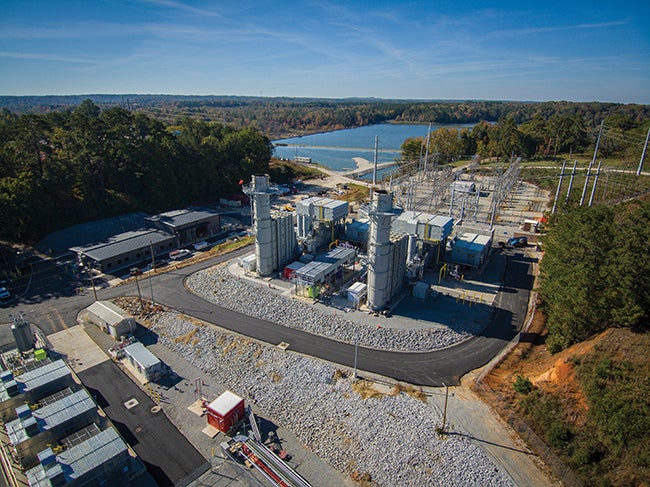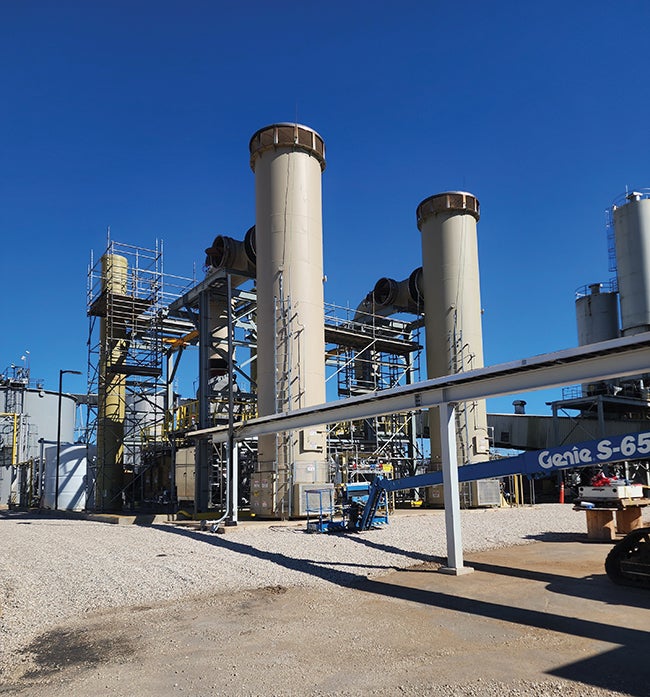
American Electric Power (AEP), which said in July that it had secured about 13 GW of gas turbines for deployment through 2031, this week announced plans for a $4 billion, 702-MW Bloom Energy fuel cell plant in Wyoming to supply Google and purchased 190 MW of Mainspring Energy linear generators under an agreement for up to 1.6 GW through 2034.
Combined, the two announcements represent 892 MW of planned generation and purchased equipment, and pose the potential to reach approximately 2.3 GW if AEP buys the full amount available under the Mainspring agreement.
AEP said on Oct. 14 that Google will buy the Wyoming plant’s output under a 20-year power purchase agreement (PPA) from Cheyenne Fuel Cell LLC. AEP owns and controls about 92% of the company, and funds advised by Basalt Infrastructure Partners own nearly 8%.
The Wyoming plant alone is about seven times the size of AEP’s previous fuel cell deployment. AEP’s Ohio utility signed contracts in 2025 for about 98 MW of fuel cell service to supply two Central Ohio data centers that Amazon Web Services and Cologix operate, as AEP said in June 2025. Still, the nearly 900 MW of planned generation and purchased equipment announced this week equals less than 3% of the roughly 33,000 MW of owned and contracted generating capacity that AEP reports.
A 702-MW Wyoming Bloom Fuel Cell Plant
AEP said it and its partners plan to start construction of the Wyoming fuel cell facility in 2026, and the plant is expected to be fully operational by the end of 2028. The company said Bloom Energy’s technology “can be deployed rapidly and provide reliable, on-demand power to meet the needs of large-load customers.” It also noted that the technology “generates electricity without combustion of natural gas,” and that the project includes plans to integrate carbon capture technology to deliver what AEP described as “reliable, near-zero-emissions power.”
The plant’s Cheyenne location and 20-year term echo an offtake AEP disclosed in January. In that filing, an unregulated AEP subsidiary entered into an unconditional agreement to purchase “a substantial portion of its option for solid oxide fuel cells” for about $2.65 billion. The subsidiary also signed a 20-year agreement with an unnamed “high investment grade third party customer” for all of the facility’s output. The January filing said that in November 2024 an AEP subsidiary had agreed to buy 100 MW of solid oxide fuel cells, with an option for 900 MW more. That month, Bloom announced a supply agreement with AEP for up to 1 GW and an initial 100-MW order.
In its Oct. 14 announcement, AEP noted the Wyoming project follows agreements, effective Sept. 30, under which another utility holding company, Black Hills Corp., will serve Google’s planned Cheyenne data center through 2048. Black Hills expects to serve the development through a 2.7-GW resource portfolio, including reserves, comprising up to 590 MW of grid-connected service and approximately 2.1 GW of third-party contracted resources managed through a private microgrid. The company plans to invest $1.8 billion in 564 MW of natural gas generation at its existing Cheyenne Prairie Generating Station through a nonregulated affiliate. Service is scheduled to begin in late 2027 and ramp to peak demand in 2030. Black Hills said the agreements are structured so that Google bears all costs of serving the data center.
The agreements support Google’s proposed $17 billion Project Tembo data center campus, which it is developing in partnership with Tallgrass Integrated Logistics Solutions, according to a Sept. 10 report by the Wyoming Tribune Eagle. The development was originally known as Project Jade, a partnership between Tallgrass and Crusoe Energy, before Crusoe withdrew in April 2026. A July 8 Laramie County memo identified Google, operating as Jupiter Star Holdings LLC, as the company pursuing revised plans for the campus at Switchgrass Industrial Park, south of Cheyenne.
The revised development comprises four data center buildings totaling approximately 3.08 million square feet. Tallgrass is developing an associated natural gas power hub, which Laramie County said was already under construction in July. At a Sept. 9 public meeting in Cheyenne, Ellen Zuckerman, Google’s head of energy regulatory work, said the campus would also use fuel cells combined with carbon capture and storage, according to the Wyoming Tribune Eagle. Neither AEP nor Black Hills has confirmed whether AEP’s 702-MW Bloom project is part of Black Hills’ 2.1-GW third-party resource portfolio.
“As power demand continues to grow, AEP is bringing together new technologies and strong partnerships to deliver reliable, innovative energy solutions quickly and at scale,” AEP Chairman, President and CEO Bill Fehrman said on Oct. 14. “This project demonstrates how we are creating new opportunities to meet evolving energy needs for customers both within and beyond our traditional service territory.”
The January filing said AEP expected the offtake conditions to be satisfied by the second quarter of 2026, and that if they were not, “AEP will be financially compensated for all capital and costs incurred.” The second-quarter 10-Q says the arrangement “remains subject to specified conditions” and that the deadline was extended in June by mutual agreement. “Should the revised conditions not be satisfied in December 2026, AEP will be entitled to additional consideration to account for the extended timeline,” the filing states.
During AEP’s July 30 earnings call, meanwhile, Fehrman said the amendment “modified some key protection terms so that AEP is adequately compensated for their requested timing accommodations.”
“Under the original December 2026 milestone, which remains intact, the hyperscaler has the ability to choose to deploy the fuel cells at an alternate location if the Cheyenne, Wyoming site does not advance. If the December 2026 milestone is not met or if there are additional requests to change the agreement terms, AEP retains financial protections for our shareholders,” Fehrman then added.
AEP’s October announcement identifies Google as the customer and confirms plans for the Cheyenne facility, although the company has not explicitly said whether all remaining offtake conditions have been satisfied.
190-MW of Mainspring Generators Set for Delivery by 2027
The Mainspring agreement, which the Menlo Park, California, company announced on Oct. 13, includes AEP’s purchase of an initial 190 MW for delivery beginning in 2027. Mainspring’s product page says the generator compresses air and fuel until “a uniform, non-combustion reaction occurs” that “pushes oscillators through copper coils 13 times per second to generate electricity.”
A recent datasheet lists 2.5-MW packages of ten 0.25-MW units that run on any blend of biogas, natural gas, hydrogen and propane. At that rating, the first tranche is equivalent to 76 packages.
Mainspring called the agreement “the largest procurement of linear generators to date.” It said the deal extends the company beyond the commercial, industrial and data center markets “into the investor-owned electric utility sector at gigawatt scale.”
The datasheet lists 46% electrical efficiency on an LHV basis, a heat rate of 8,233 Btu/kWh on an HHV basis and nitrogen oxide emissions below 1.5 ppm. Mainspring said it began commercial shipments in 2020 and has “hundreds of megawatts in advanced development and field operations.” AEP and Mainspring signed a 2022 memorandum of understanding to pilot the technology in Oklahoma.
“We continue to pursue new, innovative solutions to help meet the rapid growth in energy demand, support economic growth and deliver long-term value for our customers,” Fehrman said in Mainspring’s Oct. 13 release. “Mainspring’s linear generators can provide additional capacity quickly and efficiently, allowing us to better support growing energy needs.”
AEP’s Broader Business
AEP reported 69 GW of contracted load additions through 2030 during its second-quarter earnings call, up 6 GW from the previous quarter. On the July 30 call, Chief Financial Officer Trevor Mihalik said Texas accounts for 45 GW of that and Ohio for 12 GW, while Oklahoma, Indiana, Kentucky, Louisiana, and Virginia account for the remaining 12 GW. The commitments are supported by a combination of executed electric service agreements and letters of agreement.
Asked whether more load could be signed before the third-quarter call, Mihalik said interconnection requests continue, though much of that demand is “limited by generation.” “This is where we’ve been very forward leaning in trying to secure those 13 [GW] to ensure that we can meet that potential load,” he said on July 30.
AEP said it secured 3 GW of gas-fired turbine capacity during the second quarter, bringing the total to about 13 GW, and is evaluating opportunities to obtain up to 10 GW more through 2035. “I would say that the 10 [GW] is an option for us. So we’re not committed to that, but we have the option to step into those slots,” Mihalik said. He said about half of the 13 GW was already in AEP’s $78 billion 2026–2030 capital plan.
AEP said it has line of sight to more than $10 billion of incremental investment, “including the fuel cell project in Wyoming, the Piketon transmission opportunity in Ohio, and incremental generation in AEP’s footprint.” These opportunities were outside the $78 billion base capital plan as of July. AEP has not said whether the Mainspring units fall in that last category.
The Wyoming schedule may also depend on a federal tax credit deadline. Asked on the July 30 call whether the project would be ready for AEP’s base capital plan by the third-quarter update, Mihalik said AEP had made timing accommodations for the customer and was “adequately compensated for that adjustment.” “But again, what we’re really hopeful for is that, that project will advance. And I think timing is key on that just because those fuel cells need to be installed and ready to go by the end of 2028 to qualify for the investment tax credit,” Mihalik said. “And so I think likewise, we will see some positive movement, hopefully, by that third quarter call and then roll that into the 5-year plan.”
AEP will report third-quarter results and introduce its 2027–2031 capital plan on Oct. 28. The Wyoming offtake’s December 2026 contractual milestone remains ahead. The first Mainspring deliveries are scheduled for 2027, and the Wyoming plant is expected to reach full operation by the end of 2028.
—Sonal Patel is senior editor at POWER magazine (@sonalcpatel, @POWERmagazine).