Antares Nuclear has secured a multi-year agreement with BWX Technologies (BWXT) for advanced nuclear fuel fabrication and received initial Department of Energy (DOE) safety approval for its Mark-1 microreactor, advancing two key requirements for the company’s planned transition from reactor testing to electricity production and military deployments.
The Torrance, California–based developer announced on Oct. 27 that BWXT Advanced Fuels will manufacture tri-structural isotropic (TRISO) fuel for its microreactors through the end of the decade, under an agreement that establishes terms for an initial allocation of one metric ton of uranium (MTU) and includes provisions to increase quantities as deployment requirements evolve.
The agreement comes on the heels of Antares’ Oct. 23 announcement that DOE had approved the Nuclear Safety Design Agreement (NSDA) for Mark-1, the company’s first electricity-producing reactor. Antares plans to operate Mark-1 at Idaho National Laboratory (INL) in 2027, ahead of initial deployments to U.S. military installations beginning in 2028.
Both developments build on the company’s June 4 achievement of zero-power criticality with its Mark-0 reactor, the first advanced reactor to reach that milestone under DOE’s Reactor Pilot Program. As POWER has reported, Mark-0 demonstrated a self-sustaining fission chain reaction but did not generate electricity. Mark-1, however, is intended to demonstrate sustained power production using a full-scale reactor core integrated with its heat-transfer and power-conversion systems, providing operating data to support Antares’ planned commercial reactor deployments.
BWXT Agreement Expands TRISO Fuel Supply Arrangements
Under the Oct. 27 agreement, BWXT will manufacture TRISO fuel at its Lynchburg, Virginia, facility, using the same fabrication line that supplied fuel for Antares’ Mark-0 reactor and the Department of War’s Project Pele transportable microreactor.
The agreement builds on BWXT’s existing manufacturing relationship with Antares, extending fuel production arrangements to support the company’s planned transition from reactor demonstrations to initial production deployments. However, specific quantities, delivery schedules, and technical requirements remain subject to subsequent task orders as Antares’ reactor program progresses, BWXT said, and it did not disclose financial terms.
“We achieved criticality with BWXT fuel, and it’s what will power our electricity-producing reactor, Mark-1, in 2027,” said Jordan Bramble, Antares’ CEO and co-founder. “Securing that same line through the end of the decade means our first production deployments run on fuel from a team and a process we’ve already proven.”
TRISO fuel consists of uranium-bearing kernels surrounded by successive layers of carbon and ceramic materials, including silicon carbide, designed to retain fission products under high temperatures and irradiation. Antares’ reactors use high-assay low-enriched uranium (HALEU), containing less than 20% uranium-235, fabricated into TRISO fuel compacts. The fuel’s ability to retain fission products at elevated temperatures is a key feature of several advanced reactor designs, including compact, high-temperature microreactors.
“BWXT’s decades of experience in advanced fuel manufacturing give us the foundation to support Antares as they accelerate toward commercial deployment,” said Joe Miller, president of BWXT Government Operations. “Our team has refined the processes for high-performance TRISO fuel, and this agreement enables us to apply those strengths in a sustained, predictable way. As demand grows across the advanced reactor sector, BWXT is prepared to scale.”
The BWXT arrangement marks Antares’ second TRISO fuel fabrication agreement. In August, the developer signed a binding agreement with Standard Nuclear covering a minimum of 1 MTU and up to 8 MTU in total, with deliveries extending through 2035. Standard Nuclear, which is expanding its TRISO manufacturing operations, said the agreement would support Antares’ microreactors for defense and space applications.
Notably, the fabrication agreements complement separate arrangements to secure HALEU enrichment services and material supply, addressing different stages of the nuclear fuel supply chain. Although TRISO fabrication involves manufacturing coated fuel particles and finished fuel forms, developers must also secure the enriched uranium feedstock needed for production, making access to qualified fabrication capacity and enrichment services distinct requirements for reactor deployment.
In September, Antares and Centrus Energy announced a definitive multi-year HALEU supply contract, with deliveries expected to begin before the end of the decade. The agreement includes prepayments from Antares to support Centrus’ expansion of domestic enrichment capacity at its American Centrifuge Plant in Piketon, Ohio, where the company is pursuing commercial-scale production of HALEU and conventional low-enriched uranium.
The companies said the arrangement could provide U.S.-origin, “unobligated” HALEU suitable for national security applications, including defense and space missions. The designation is significant because nuclear material produced under certain international agreements may be subject to restrictions on its use, whereas unobligated material can support eligible U.S. national security missions.
“Fuel supply is one of the practical questions every advanced reactor developer has to answer,” Bramble said in the September announcement. “This contract gives Antares a reliable, U.S.-origin source of HALEU for the reactors we’re deploying for a wide variety of defense and space customers.”
Antares has also established HALEU supply arrangements with Urenco and General Matter, broadening its prospective sourcing options as it prepares for deployments beyond its initial demonstration program. However, the agreements represent different stages of fuel procurement and production, and their announced quantities and timelines should not be interpreted as confirmation that finished fuel for all planned reactor deployments has already been manufactured or delivered.
Mark-1 Moves Through DOE Authorization
Meanwhile, DOE’s approval of Mark-1’s NSDA marks the first formal step in the reactor’s safety authorization process, establishing design requirements, the safety analysis approach, and regulatory expectations that will govern the project through construction and operation.
According to Antares’ Oct. 23 announcement, Mark-1 will use the same full-scale core, TRISO fuel, and INL test facility as Mark-0, but will incorporate the company’s nitrogen closed Brayton-cycle power-conversion system. Antares plans to operate Mark-1 at full electrical power in 2027, targeting a six-month operating campaign intended to generate data on the integrated reactor system.
The company’s underlying R1 design uses a TRISO-fueled prismatic graphite core and passive sodium heat pipes to transport heat to a primary heat exchanger, where thermal energy is transferred to a nitrogen working fluid for electricity generation. As POWER previously reported, the design incorporates a recuperated nitrogen closed Brayton cycle operating at less than 300 psi, reflecting Antares’ emphasis on a compact, transportable system intended for long-duration operation.
Mark-0, however, was configured specifically for zero-power testing and was not equipped with power-conversion or heat-removal systems. Its principal objectives included validating reactor physics, reactivity control, and the safety authorization process. Mark-1 will extend that testing to sustained thermal and electrical operation, allowing Antares to evaluate temperature-dependent reactor effects, reactivity feedback, and the coupled behavior of the reactor core and power-conversion system. The planned campaign will also test whether the integrated system can maintain stable operating conditions over an extended period, which is an important requirement for the company’s intended military applications.
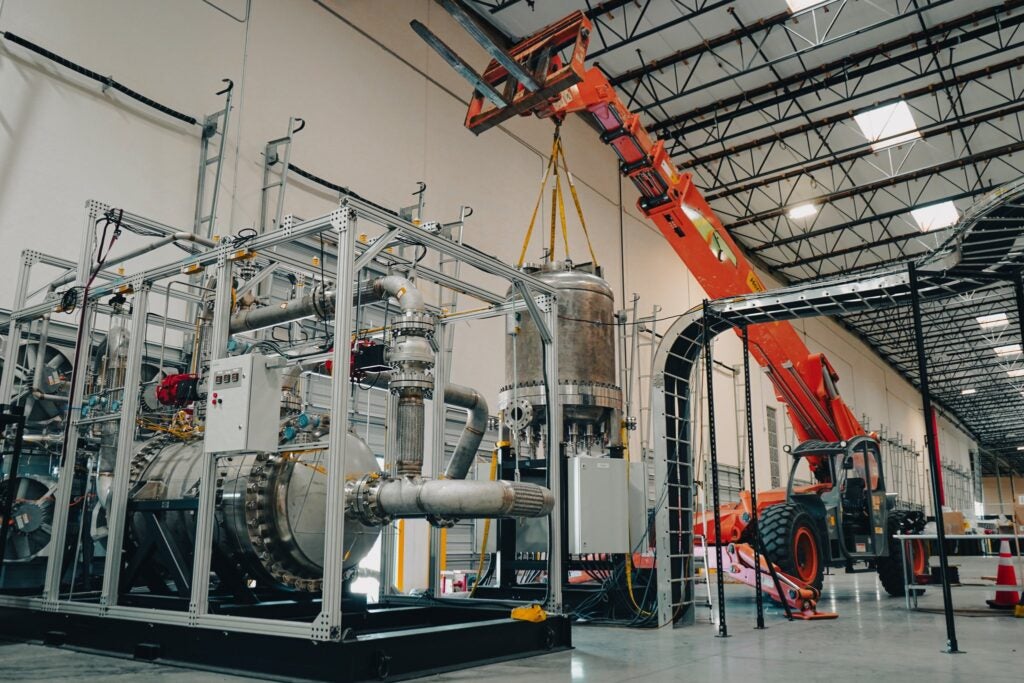
Notably, Antares has also pursued non-nuclear testing of electrically heated demonstration units at its Antares Prime facility in Torrance, including a second testing campaign in 2026 incorporating an updated heat-pipe design and control system. The parallel testing program allows the company to evaluate thermal components, inspect materials between test runs, and refine aspects of the heat-transfer and power-conversion systems independently of nuclear operations.
“Mark-0 proved we could take a reactor from a paper design to a self-sustaining chain reaction on the timeline we promised,” Bramble said in the Oct. 23 announcement. “Mark-1 isn’t a scaled-down, stand-in test rig. It’s commercially representative of the plant we’ll deploy to Fort Bragg under the Army Janus program in 2028. Mark-1 will be the first full-scale electricity-producing microreactor test in the United States. Operating at full electrical power for six months gives us comprehensive test data on every major subsystem and how they behave together. DOE’s approval of this safety agreement is the gate that lets us move not only from neutrons to electrons, but to customer plants, on schedule.”
The NSDA approval, however, does not authorize reactor operation, and Antares must complete additional safety reviews and obtain subsequent DOE approvals before Mark-1 can begin its planned operating campaign. The company followed a similar authorization sequence for Mark-0, securing NSDA approval in October 2025, Preliminary Documented Safety Analysis approval in January 2026, and Documented Safety Analysis approval in April before achieving criticality in June.
DOE’s authorization process for testing at INL is also separate from the regulatory requirements governing deployment at military installations, where Antares must address applicable site-specific safety, environmental, and operational considerations as it pursues its targeted 2028 deployments.
Separately, the Nuclear Regulatory Commission (NRC) on Oct. 22 finalized a rule allowing commercial reactor applicants to reference prior DOE- and military-authorized reactor demonstrations when demonstrating compliance with NRC safety requirements. Published in the Federal Register on Oct. 26, the rule amends 10 CFR Parts 50 and 53 to explicitly permit consideration of relevant information from federally authorized reactors that have been tested and demonstrated the ability to function safely. The provisions could eventually allow developers such as Antares to reference prior authorization and testing information in future commercial reactor licensing applications, although Antares has not announced plans to pursue NRC licensing for Mark-1. Applicants must demonstrate how the information satisfies applicable NRC requirements, including accounting for differences between previously authorized reactor designs and proposed commercial configurations, while the NRC retains responsibility for independently reviewing each application.
Testing Supports 2028 Military Deployment Plans
The planned Mark-1 demonstration is intended to support development of Antares’ R1 microreactor, a modular, transportable unit rated at 100 kWe to 1 MWe and designed to operate for six or more years between refueling. The reactor’s architecture incorporates passive heat transport, a compact power-conversion system, and an integrated transport cradle that includes shielding, reflecting the company’s focus on providing long-duration power for defense applications.
According to technical details previously reported by POWER, the R1 also includes a power management and distribution node designed to connect directly to installation microgrids, potentially allowing military facilities to maintain an independent electricity supply without continuous reliance on the commercial grid. Antares has emphasized reliability, uptime, and manufacturability in the design, rather than maximizing power density.
Antares’ most immediate deployment target is Fort Bragg in North Carolina, where the U.S. Army selected the company in August under its $2.2 billion Janus Program. That initiative seeks to deploy more than 20 commercial microreactors across military installations, beginning with five selected developers and sites. Antares plans to deploy three R1 microreactors at Fort Bragg, each rated at between 100 kWe and 1 MWe. As POWER reported in detail, the Army’s initial Janus agreements use fixed-price, milestone-based Other Transaction Authority contracts, under which participating developers must complete specified technical and deployment milestones to receive government payments. The contracting structure is intended to manage development and execution risks while advancing multiple reactor technologies toward operation at military installations.
The company is also pursuing a prototype deployment at Joint Base San Antonio, Texas, under the Department of the Air Force’s Advanced Nuclear Power for Installations initiative, which selected Antares in April 2026. That effort involves a separate regulatory pathway from the DOE-authorized test program at INL and remains subject to applicable environmental reviews and regulatory approvals.
Beyond terrestrial defense applications, Antares is developing reactor technology for space missions. In September, the company announced its selection for a $161 million Space Force Strategic Breakthrough award to advance its R1-S space reactor through a nuclear ground demonstration and spacecraft integration activities intended to support flight certification. Antares has also said its planned Mark-1 operating campaign will support an operational ground-to-space asset, extending the demonstration’s potential applications beyond military installation power.
—Sonal Patel is a senior editor at POWER magazine (@sonalcpatel, @POWERmagazine).