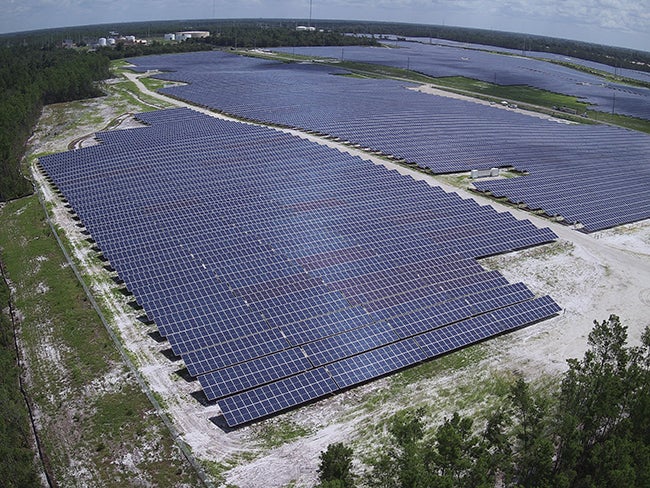

Five advanced nuclear companies will build, own, and operate more than 20 commercial nuclear microreactors across five U.S. Army installations under the Janus Program, a milestone-based effort designed to place the first project into useful service by September 2028 and establish repeatable commercial products. In exclusive interviews, the selected companies told POWER they intend to use the Army projects as anchor deployments—serving as a crucial bridge from prototype to sustained operation that could establish the operating records needed to unlock broader commercial markets and convert existing customer pipelines into follow-on orders.
In a flagship report published on Aug. 26, U.S. Army Mobilizes $2.2B Janus Program to Deploy More Than 20 Commercial Microreactors, POWER delved deeply into the Army’s rationale for the program. The Army selected BWXT Advanced Technologies for Fort Campbell in Kentucky, Radiant Industries for Fort Benning in Georgia, General Atomics Electromagnetic Systems for Fort Hood in Texas, Antares Nuclear for Fort Bragg in North Carolina, and Westinghouse Government Services for Fort Drum in New York. Combined, the five vendors will draw on up to $2.2 billion in Army investment through fiscal year 2031 under fixed-price, milestone-based Other Transaction Authority agreements negotiated through the Department of War Innovation Unit (DIU).
Selected projects will range in output from 100 kWe to 20 MWe, from single-reactor installations to multi-unit fleets, and target dates ranging from 2028 into the early 2030s and fuel strategies ranging from vertically integrated manufacturing to reliance on emerging suppliers, the advanced nuclear selectees told POWER. At the same time, each company is pursuing similar basic commercial pathways, seeking to leverage Army installations to prove sustained operation, expand manufacturing and fuel capacity, build a regulatory record, and convert an existing pipeline of utility, data center, industrial, and defense prospects into an order book.
A Growing Pentagon Microreactor Portfolio
The selections followed a competition that narrowed a larger group of bidders to 10 finalists. Experts from the Department of Energy (DOE), national laboratories, academia, the private sector, and the military services then subjected each finalist to four hours of questioning, Dr. Jeff Waksman, principal deputy assistant secretary of the Army for Installations, Energy and Environment, said during an Aug. 26 media roundtable. The Army declined to disclose an exact breakdown of the aggregate $2.2 billion, noting that the totals may change over time and that its milestone-based OTA contracts allow funds to be reallocated among vendors as the program progresses.
However, the five Janus selections also expand the Pentagon’s advanced nuclear portfolio. Three of the vendors—Radiant, Antares, and Westinghouse—hold parallel awards under the Air Force’s Advanced Nuclear Power for Installations (ANPI) initiative, announced in April 2026. ANPI narrowed an initial pool of eight prequalified developers to three active deployment tracks, pairing Radiant’s 1-MWe Kaleidos with Buckley Space Force Base in Colorado, Antares’ R1 with Joint Base San Antonio in Texas, and Westinghouse with Malmstrom Air Force Base in Montana. The program seeks to place at least one advanced reactor into operation on a service installation by 2030, although Radiant and Antares have each targeted initial deployment in 2028.
Both Janus and ANPI programs will notably utilize milestone-based Other Transaction Authority agreements negotiated through DIU, draw from an overlapping vendor pool, and target initial reactor operations as early as 2028. However, under ANPI, vendors are pursuing NRC-licensed, contractor-owned and contractor-operated projects, with the Air Force and Space Force expected to buy electricity through long-term power purchase agreements (PPAs). While Janus also assigns reactor ownership, construction, and operation to the selected companies, the Army will regulate the projects under its own nuclear authorities and make fixed-price milestone payments under agreements totaling up to $2.2 billion through fiscal 2031.
Separately, the Air Force’s microreactor pilot at Eielson Air Force Base in Alaska—the original service-installation procurement—launched under a Fiscal Year 2019 National Defense Authorization Act requirement. It paired advanced nuclear reactor developer Oklo with Eielson under a 30-year PPA structure that the Air Force has since carried into ANPI, with commercial operation targeted for 2030 pending NRC licensing. Meanwhile, the Office of the Secretary of Defense’s Strategic Capabilities Office is developing Project Pele, a transportable 1–5 MWe gas-cooled microreactor being built by BWX Technologies at Idaho National Laboratory. BWXT delivered Pele’s full TRISO fuel core in late 2025, and first power is targeted as early as 2028.
The Janus Five
| Company | Installation | Reactor | Output | Fuel | Heat Removal | First Unit |
|---|---|---|---|---|---|---|
| BWXT Advanced Technologies | Fort Campbell, Ky. | BANR | 20 MWe (75 MWth) | UCO TRISO (19.75%) | Nitrogen; passive decay-heat removal | Early 2030s |
| Radiant Industries | Fort Benning, Ga. | Kaleidos (three-unit deployment) | 1 MWe/unit; 15 Janus units total | TRISO | Helium gas | First Janus units targeted for 2028 |
| General Atomics Electromagnetic Systems | Fort Hood, Texas | GA-TES | Approx. 5 MWe baseline; architecture scalable to approx. 20 MWe | Encapsulated UZrH; TRIGA heritage | Liquid metal; natural circulation | Not disclosed |
| Antares Nuclear | Fort Bragg, N.C. | R1 (three-unit deployment) | 100 kWe–1 MWe/unit | TRISO | Sodium heat pipes | Initial military deployments targeted for 2028 |
| Westinghouse Government Services | Fort Drum, N.Y. | eVinci | Fort Drum output not disclosed | TRISO (19.75%) | Heat pipes; passive heat removal | Not disclosed |
BWXT Takes Fort Campbell With a 20-MWe BANR
BWX Technologies subsidiary BWXT Advanced Technologies will deploy the BWXT Advanced Nuclear Reactor (BANR) at Fort Campbell, Kentucky, which straddles the Kentucky-Tennessee line and is home to the 101st Airborne Division. The Janus BANR is a 20-MWe unit, scaled up from the 1.5-MWe Project Pele microreactor that BWXT has been building for the Department of War since 2020. It represents the commercialization arm of a two-track microreactor program the company has run in parallel with Pele under DOE’s Advanced Reactor Demonstration Program (ARDP), Joe Miller, president of Government Operations, told POWER.
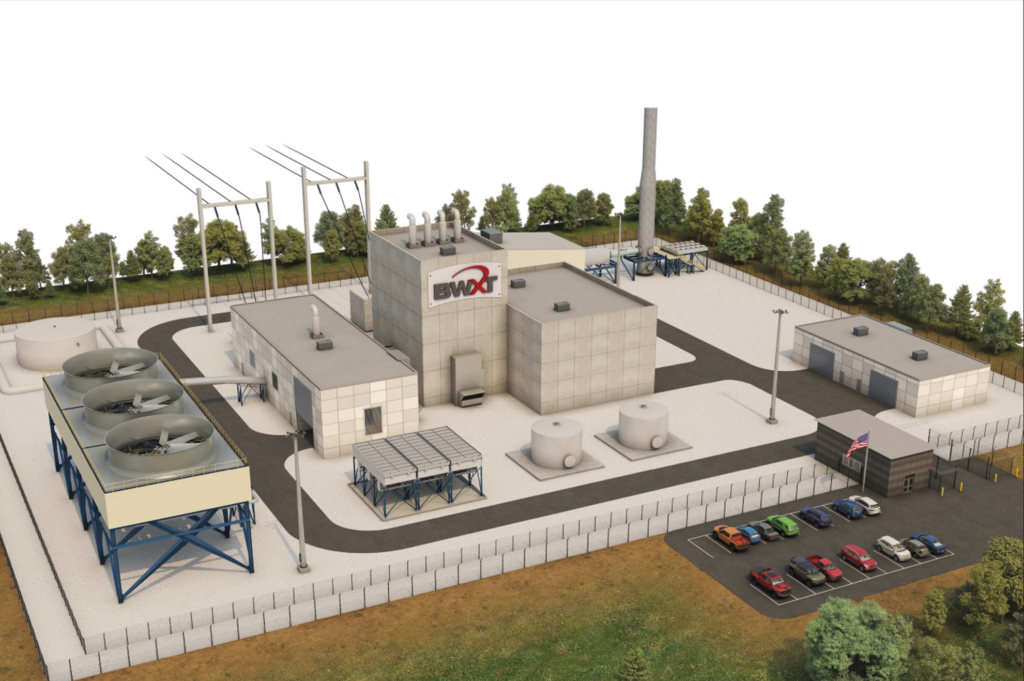
BWXT did not disclose the value of its Janus agreement, but the company confirmed a phased contracting structure. Phase 1 covers final site selection within Fort Campbell, starting Army-owned nuclear regulatory work, kicking off TRISO fuel fabrication at existing BWXT facilities, operating-company structuring, site characterization, and long-lead procurement. Groundbreaking is targeted for late 2028 and reactor operations for the early 2030s. Miller told POWER BWXT expects to deliver within roughly five years of the start.
BANR is a high-temperature gas-cooled reactor using TRISO fuel and a nitrogen primary coolant, with a thermal rating of 75 MWth and core outlet temperatures near 600C. Its fuel is uranium oxycarbide TRISO enriched to 19.75%, and it requires a roughly four-year refueling cycle. Unlike Pele, BANR is designed as a steam-cycle plant on the non-reactor side, giving it more efficient conversion and broader use cases while retaining the HTGR primary loop, Miller said. The design supports cogeneration or all-electric operation and is factory-built for road- and rail-shippable modules. At multi-unit scale, BWXT markets 100 MWe on under 15 acres, and a single reactor can be located on less than five acres. Once sited, a BANR is not transportable in the Pele sense—”you wouldn’t move it like you would a Pele reactor,” Miller noted. At Fort Campbell, BWXT is prioritizing behind-the-meter service but plans to design in the option to export power to surrounding communities, Miller said.
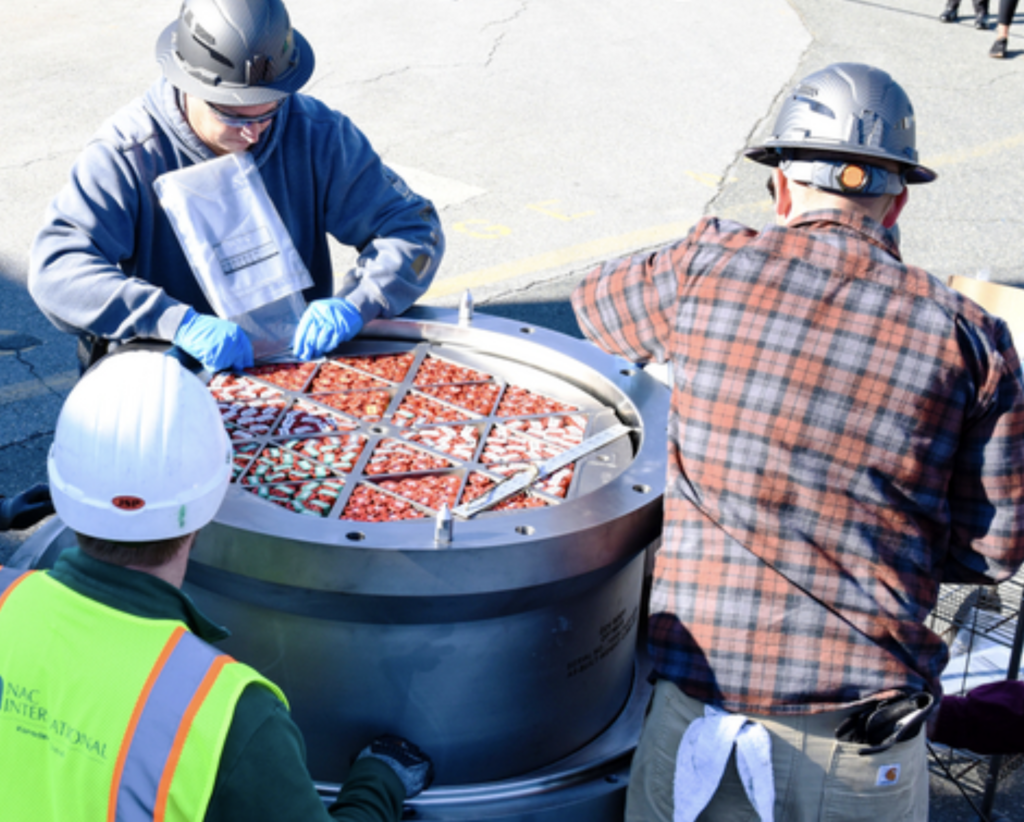
BWXT, notably, is the only Janus vendor that self-supplies its TRISO fuel. Its NRC-licensed Lynchburg, Virginia, facility fabricated the roughly 40,000 TRISO compacts delivered to INL for Project Pele in November 2025. The company has also authorized more than $25 million to more than double Lynchburg output as a near-term bridge, and it is negotiating a several-hundred-million-dollar commercial TRISO facility in Wyoming’s Trona Patch that would add roughly tenfold operational output relative to Lynchburg’s current capacity, Miller said. BWXT has also produced TRISO fuel for Antares and Radiant in the past, and Miller said BWXT expects to continue supplying Antares and Westinghouse under commercial agreements.
Northrop Grumman and Rolls-Royce are subcontractors on system delivery, which will give BWXT a prime role that extends past the reactor and fuel to the balance of plant, Miller said. Notably, the Fort Campbell team also includes a utility partner that BWXT declined to identify, though Miller described the company as “one of the aggressive type utilities out there that are taking new nuclear extremely seriously.” Burns & McDonnell has performed site and infrastructure work on BANR deployment configurations, including cost-shared studies with the state of Wyoming, he noted.
Beyond Janus, BWXT has signaled a commercial pipeline that includes a letter of intent from Tata Chemicals Soda Ash to explore up to eight BANR units in Wyoming. The company is also preparing an NRC manufacturing license (ML) application, which it says would target under 24 months of review and low-$10-million per-customer review costs by shifting more design review into the factory—a filing BWXT argues can build on Army-owned qualification work performed under Janus.
“Our long-standing strengths in reactor engineering innovation, TRISO fuel development, and advanced nuclear manufacturing are the foundation of our BANR technology,” said BWXT President and Chief Executive Officer Rex D. Geveden. “As we commence work on the Janus program, we are delivering the nation’s most credible and reliable path to deployable nuclear power. BANR is purpose-built for mission success.”
Radiant Secures Up to $750M to Deliver 15 Kaleidos Units
Radiant Industries secured a binding Janus agreement worth up to $750 million to develop and deploy 15 Kaleidos microreactors across U.S. military installations by 2030. The company described it as the largest Janus award and one of the largest contracts ever issued through the DIU. The first three-unit deployment is planned for Fort Benning, Georgia, while additional reactors will go to other military sites. Radiant told POWER that its first Janus units are expected to begin supplying resilient power in 2028.
“The U.S. Army is a savvy customer. They have the world’s top nuclear experts and know what to look for in a partner,” said Tori Shivanandan, Radiant’s president and chief operating officer. “The numbers tell the story. This award shows confidence in Radiant’s product and ability to manufacture, deploy, and safely operate nuclear microreactors for the American military.”
The 1-MWe Kaleidos is factory-built and designed to arrive as a sealed, fueled unit. It can travel by land, sea, or air, requires no cooling water, and has a 20-year operating life. Radiant says each unit can operate for up to five years before refueling, and additional reactors can be added or relocated as power requirements change.
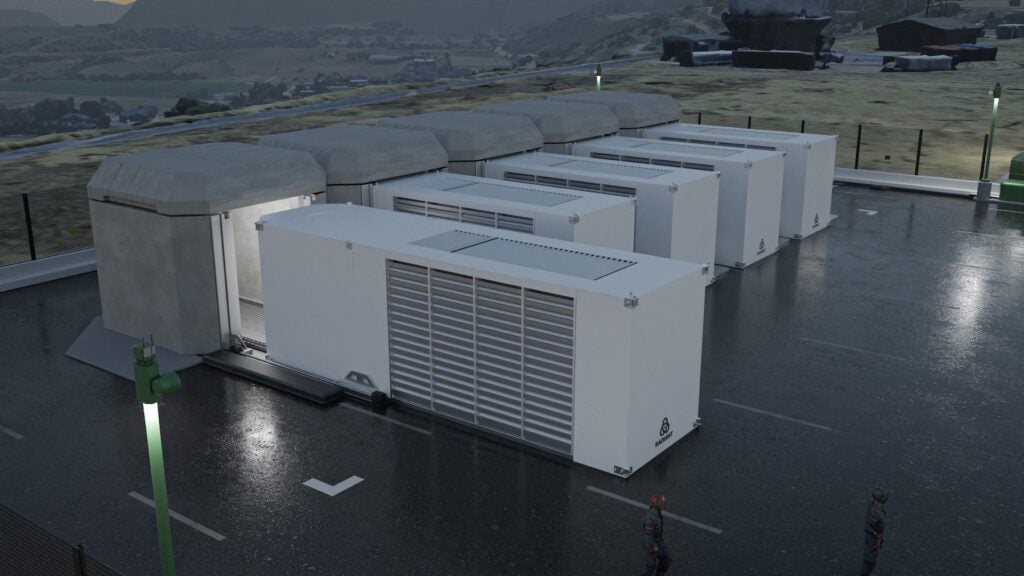
Radiant is building its 300,000-square-foot R-50 manufacturing, fueling, and storage campus in Oak Ridge, Tennessee. The company plans to manage fueling, refueling, and spent-fuel storage away from customer installations, which will not host spent fuel. Radiant says an installation can return to greenfield condition within two years after a reactor is removed.
Kaleidos has shipped to Idaho National Laboratory’s Demonstration of Microreactor Experiments (DOME) facility, where it is being prepared for testing. DOE granted Radiant exclusive access to DOME for one year to conduct a full-scale, full-power, extended-duration test using the reactor design and fuel specifications planned for customer deployments.
Radiant’s fuel pathway separates enriched uranium supply from reactor-ready fuel fabrication. DOE-allocated high-assay low-enriched uranium (HALEU) will support Kaleidos deployments under both Janus and ANPI, and Standard Nuclear will fabricate that material into TRISO particle fuel under a binding, multi-metric-ton agreement announced Aug. 20 and extending through 2031. Radiant said the Standard Nuclear agreement addresses a separate risk from access to enriched uranium. “Having access to HALEU does not by itself give you reactor-ready fuel; you also need the specialized fabrication capability to turn that material into qualified TRISO fuel at the specifications and volumes the reactor requires,” the company said. “By putting a long-term fabrication agreement in place, Radiant has secured that downstream capability for its planned deployments through the early 2030s, including for both government and commercial customers.”
The Janus agreement substantially expands Radiant’s military deployment program beyond its earlier Air Force Advanced Nuclear Power for Installations (ANPI) selection at Buckley Space Force Base in Colorado, and it feeds directly into the same product Radiant is building for commercial customers, including a signed agreement with Equinix for 20 Kaleidos units.
“What Janus changes for Radiant is the scale,” the company told POWER. “Every additional reactor in operation generates operating experience across different sites, operating environments and use cases, allowing Radiant to build an operational track record that all customers need to see to procure any product at scale. Essentially, we are able to collect one year of operational data for each reactor—when 15 are running, that means we have 15 years’ worth of operational data after one calendar year. This is not a long-term R&D program. It’s an accelerated program to deliver a capability that the military can then buy at tremendous scale.”
General Atomics Advances GA-TES at Fort Hood
General Atomics Electromagnetic Systems (GA-EMS), the San Diego-based General Atomics business unit, will advance its General Atomics Tactical Energy System (GA-TES) at Fort Hood, Texas, home of III Armored Corps, through development, testing, and site-planning milestones toward potential deployment. The agreement’s value was not disclosed.
GA-TES is the only Janus reactor identified by the five vendors that does not use TRISO particle fuel. The design uses uranium-zirconium hydride (UZrH) fuel and draws on General Atomics’ TRIGA research-reactor heritage, including the fuel’s self-regulating negative temperature coefficient of reactivity. General Atomics says 66 TRIGA facilities have been built across 24 countries during a program spanning more than 70 years. That figure is distinct from the 68 reactors of all types that GA-EMS cited in announcing its Janus selection.
GA-TES is a liquid-metal-cooled reactor that uses natural circulation, requires no large cooling-water infrastructure, and has a baseline net output of approximately 5 MWe. Its architecture is scalable to approximately 20 MWe, and the plant is designed for a 40-year operating life. The modular design supports transport by truck or rail and targets remote, austere, off-grid, and extreme environments, as well as onsite power during broader grid disruptions.
GA-EMS did not disclose a fuel supplier, utility partner, or other project participants for Fort Hood, which is located within the Electric Reliability Council of Texas (ERCOT) footprint.
“General Atomics draws on more than 70 years of nuclear innovation and reactor expertise to deliver microreactor technologies that provide safe, dependable and independent power for military installations,” said Scott Forney, president of GA-EMS. “Our experience designing and deploying 68 reactors worldwide and supporting reactor technologies throughout their lifecycles positions us to deliver assured energy solutions that enhance operational resilience and strengthen mission readiness.”
“Passive safety and operational simplicity are fundamental to our Tactical Energy System design,” said Christina Back, GA-EMS vice president for nuclear technologies and materials. “Self-protecting UZrH fuel and pump-free natural-circulation cooling reduce reliance on active systems and operator intervention.”
Antares Wins Fort Bragg for Its R1 Three-Pack
Antares Nuclear, founded in 2023 and based in Torrance, California, will own, build, and operate a three-unit R1 microreactor deployment at Fort Bragg, home of the XVIII Airborne Corps. The company declined to disclose its Janus contract value but confirmed that its combined book across the Janus Program, the Air Force Advanced Nuclear Power for Installations (ANPI) initiative at Joint Base San Antonio, and Space Force nuclear work is now “on the order of $1 billion,” according to CEO and co-founder Jordan Bramble.
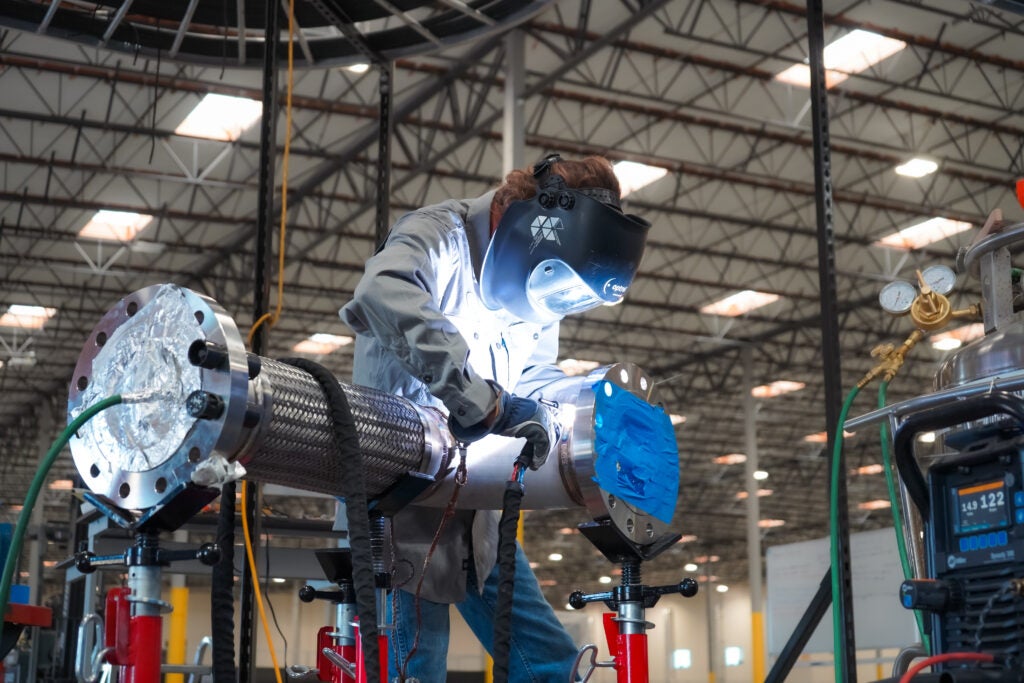
R1 is a sodium heat-pipe-cooled microreactor fueled by TRISO particle fuel, rated at 100 kWe to 1 MWe per unit, and designed for years of operation between refuelings. The company said R1 requires no connection to the commercial grid or specialized infrastructure to deploy. R1 builds on Antares’ Mark-0 test reactor at Idaho National Laboratory (INL), which achieved criticality on June 4, 2026—the first reactor to reach that milestone under the Department of Energy’s Reactor Pilot Program. Antares said it remains on track to generate electricity from a test reactor in 2027 and deploy initial production units to U.S. military installations beginning in 2028.
Under a binding agreement announced Aug. 27, notably, Standard Nuclear will supply 1 metric ton of TRISO fuel, while Antares holds an option for up to seven additional metric tons through 2035. Antares previously told POWER it expected to source TRISO from both Standard Nuclear and BWXT to meet Army requirements, but it has not disclosed a binding BWXT agreement. The company also has not said how much of the Standard Nuclear fuel will support Janus, ANPI, or its Space Force work.
“We are focused on delivering dependable, high-performance power to meet our customers’ most demanding energy needs,” Bramble said. “Standard Nuclear is an ideal partner, bringing the industrial scale and critical fuel supply security necessary to support our long-term growth.”
Antares did not name a utility partner for Fort Bragg or subcontractors on the R1 system. The company operates additional facilities in Idaho Falls, Idaho, and Aiken, South Carolina.
“We’re grateful and proud to partner with the U.S. Army and the Defense Innovation Unit on the Janus Program. Energy scarcity is constraining America’s most critical defense systems,” Bramble said. “Through Janus, Antares will deliver clean, firm, resilient power for the warfighter.”
Westinghouse Will Bring eVinci to Fort Drum
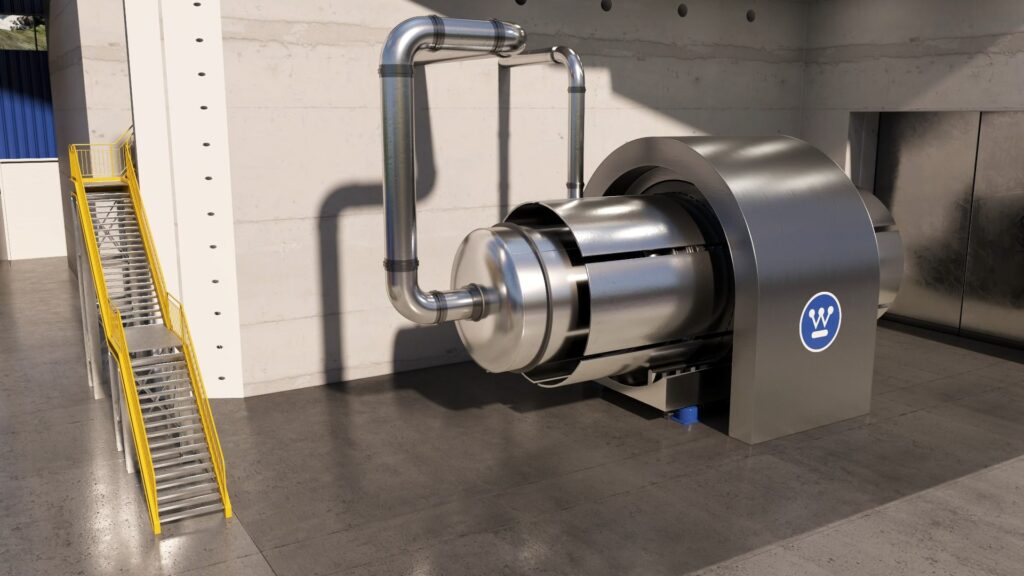
The Army selected Westinghouse Government Services to deploy the eVinci microreactor at Fort Drum, New York, home of the 10th Mountain Division. Westinghouse confirmed the selection to POWER, though it did not disclose reactor output, schedule, or contract value.
eVinci is a heat-pipe microreactor designed to deliver electricity 24 hours a day, 7 days a week for eight years without refueling, Westinghouse said. Notably, the design achieved zero-power criticality at the National Criticality Experiments Research Center, a National Nuclear Security Administration facility at the Nevada National Security Site, on Aug. 24 at 10:39 a.m. PT—two days before the Janus announcement. The company completed the test in partnership with Los Alamos National Laboratory and INL. Westinghouse is also an ANPI selectee at Malmstrom Air Force Base, Montana. The Fort Drum selection follows a mid-August letter from Sen. Chuck Schumer (D-N.Y.) to Secretary of the Army Dan Driscoll urging that the installation be prioritized.
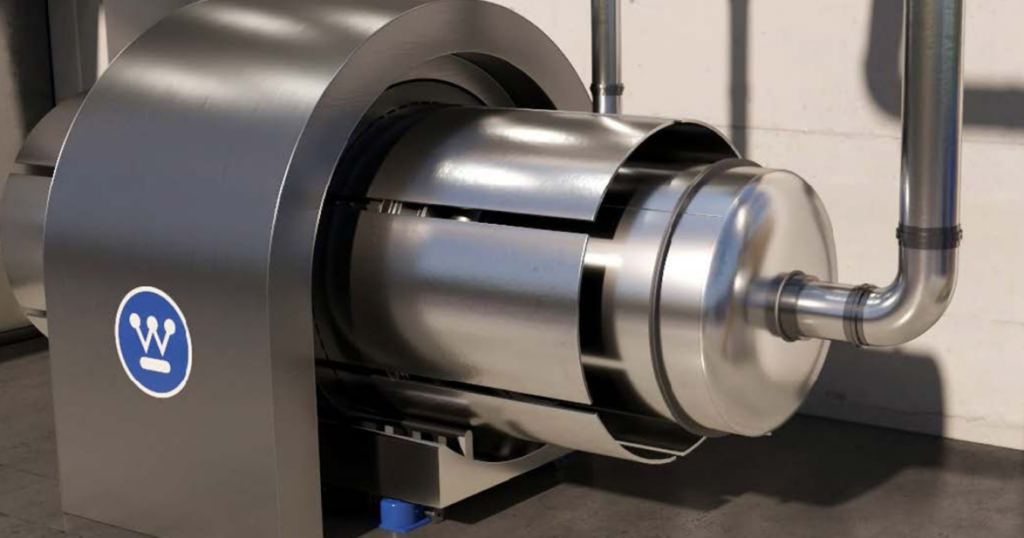
“Reliable energy is fundamental to mission assurance, operational readiness and national security,” said Rich Rademacher, president of Westinghouse Government Services. “The selection of the eVinci microreactor for the Janus Project highlights the important role advanced nuclear technology can play in providing resilient, long-duration power to the warfighter. Westinghouse is proud to support the Army’s efforts to strengthen energy security and deliver innovative capabilities.”
For the full policy, regulatory, and contracting picture, see POWER’s flagship report on the Janus Program: U.S. Army Mobilizes $2.2B Janus Program to Deploy More Than 20 Commercial Microreactors.
—Sonal Patel is a POWER senior editor (@sonalcpatel, @POWERmagazine).
Editor’s note: This is a developing story and will be updated as additional project details become available.