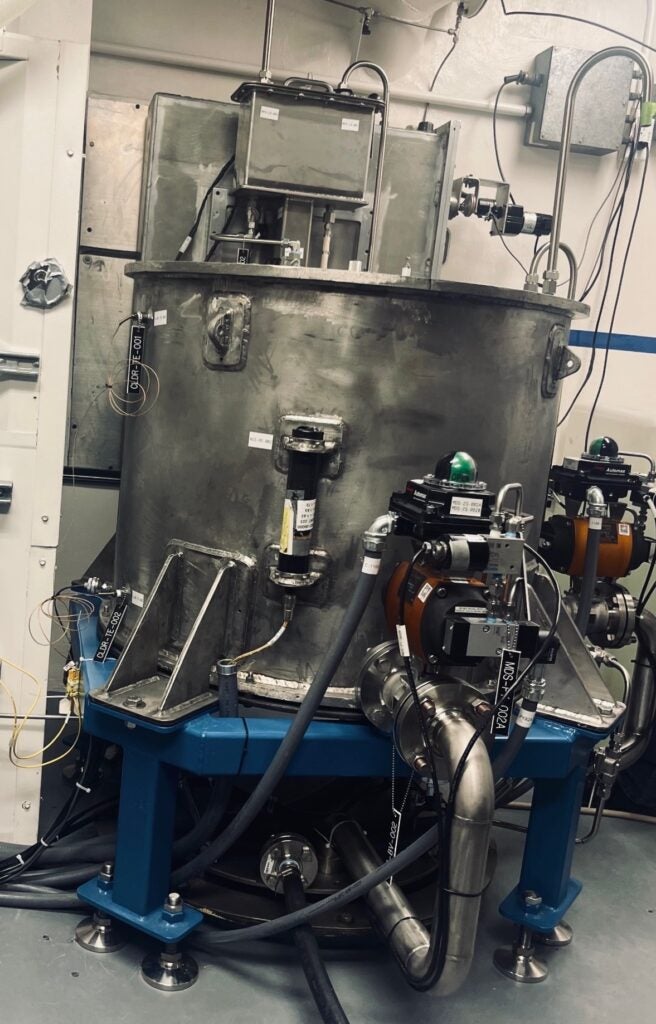

Westinghouse’s eVinci microreactor has completed zero-power criticality testing at the National Criticality Experiments Research Center (NCERC), a National Nuclear Security Administration (NNSA) facility at the Nevada National Security Site (NNSS).
The company said the milestone, achieved at 10:39 a.m. PT on Aug. 24 in partnership with Los Alamos National Laboratory (LANL) and Idaho National Laboratory (INL), validated the models and core design assumptions underpinning its heat-pipe microreactor technology.
While the test is a physics-validation experiment rather than a fueled power demonstration, it marks substantive design-basis progress for Westinghouse’s flagship microreactor offering, which the company is advancing toward first deployments in defense, space, and government applications.
“This zero-power criticality milestone reflects Westinghouse’s heritage of innovation and pushing to the next frontier of nuclear,” said Dr. Lou Martinez Sancho, Westinghouse Chief Technology Officer. “We appreciate the support and collaboration of our partners at the U.S. Department of Energy, NNSA, Los Alamos National Laboratory, Idaho National Laboratory and NNSS in achieving this important milestone.”
Zero-power criticality is a low-power physics experiment in which enough fissile material is assembled in the intended geometry to sustain a self-sustaining fission chain reaction, but at a power level so low that decay heat and radiological inventory remain negligible. In advanced-reactor development, the milestone typically confirms that neutronic models, reactivity worth of control elements, fuel-to-moderator ratios, and core configuration behave as predicted before the reactor is brought to power.
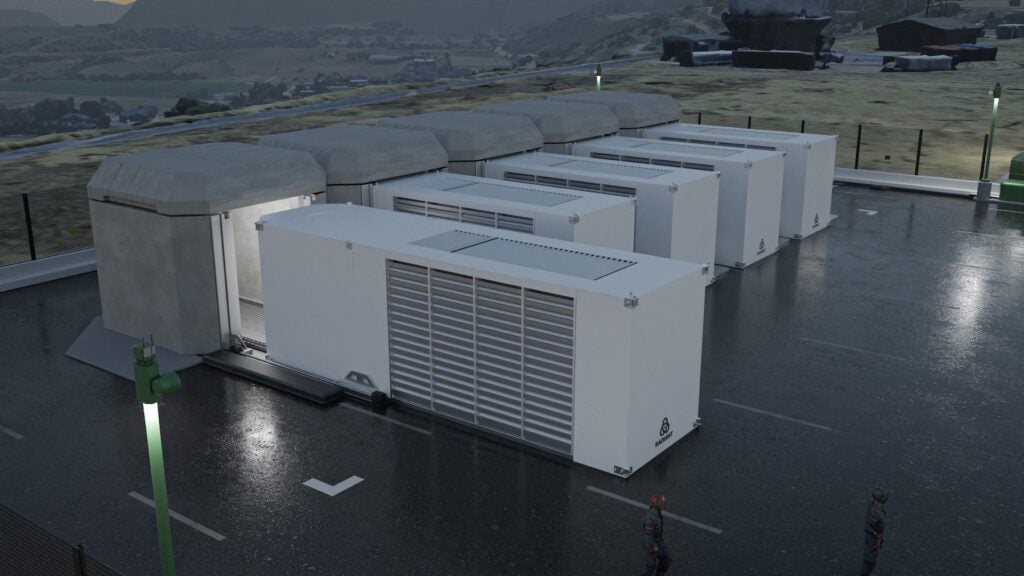
eVinci is a heat-pipe-cooled microreactor built around a solid steel-monolith core, tristructural isotropic (TRISO) fuel using high-assay low-enriched uranium (HALEU), and an open-air Brayton power-conversion cycle. In its commercial heat-and-power configuration, Westinghouse has described the unit as a 5-MWe / 13-MWth “nuclear battery” capable of delivering industrial-grade heat of up to 600 C, with a footprint roughly half the size of a hockey rink.
In Monday’s announcement, the company said eVinci is designed to provide resilient electricity for eight years without refueling and pointed to defense and space applications as target uses. Westinghouse’s current product materials also cite a 15-MWth core rating and market a distinct research-reactor variant at 5 MWe and 6 MWth at 150 C, suggesting the eVinci platform is being tailored across defense, space, research, and government use cases.
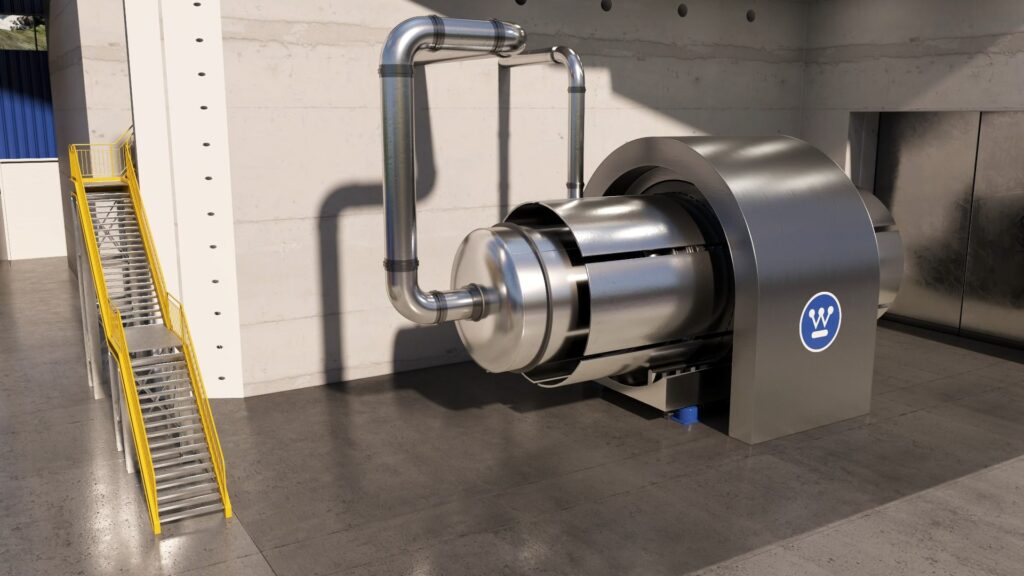
The NCERC criticality test “validated the models and core design assumptions” of the eVinci technology and is part of a “rapid product development philosophy” that combines testing, modeling, simulation, and design iteration to accelerate technology maturation while reducing technical risk, Westinghouse added on Monday. The company said learnings from the campaign will inform future eVinci design, prototype, and manufacturing improvements.
The milestone follows several high-profile criticalities affiliated with the Department of Energy’s (DOE’s) Reactor Pilot Program, which was established under Executive Order 14301 in June 2025 and directed at least three privately built test reactors to reach criticality by July 4, 2026, on non-national-laboratory sites. As POWER has reported, those DOE-authorized advanced-reactor criticalities spanned a strikingly varied set of designs and use cases. Antares Nuclear’s Mark-0, a low-power test reactor for the company’s portable, high-temperature microreactor platform, reached zero-power criticality at INL on June 4. Valar Atomics’ Ward 250, a helium-cooled, TRISO-fueled high-temperature gas reactor intended to support high-temperature industrial and power applications, reached criticality at the Utah San Rafael Energy Lab on June 18. Deployable Energy’s Unity Nuclear Battery, a 1-MWe transportable microreactor using TRISO fuel in a graphite-moderated, helium-cooled system, reached zero-power criticality at INL on June 30. Aalo Atomics’ Critical Test Reactor, a low-power test reactor supporting Aalo’s sodium-cooled, low-enriched-uranium microreactor platform, reached criticality at INL on July 4. The most recent criticality milestone was reached on Aug. 5 at Oklo’s Groves Isotope Test Reactor, a low-power, water-cooled test reactor for future isotope-production facilities, built as a first on private land.
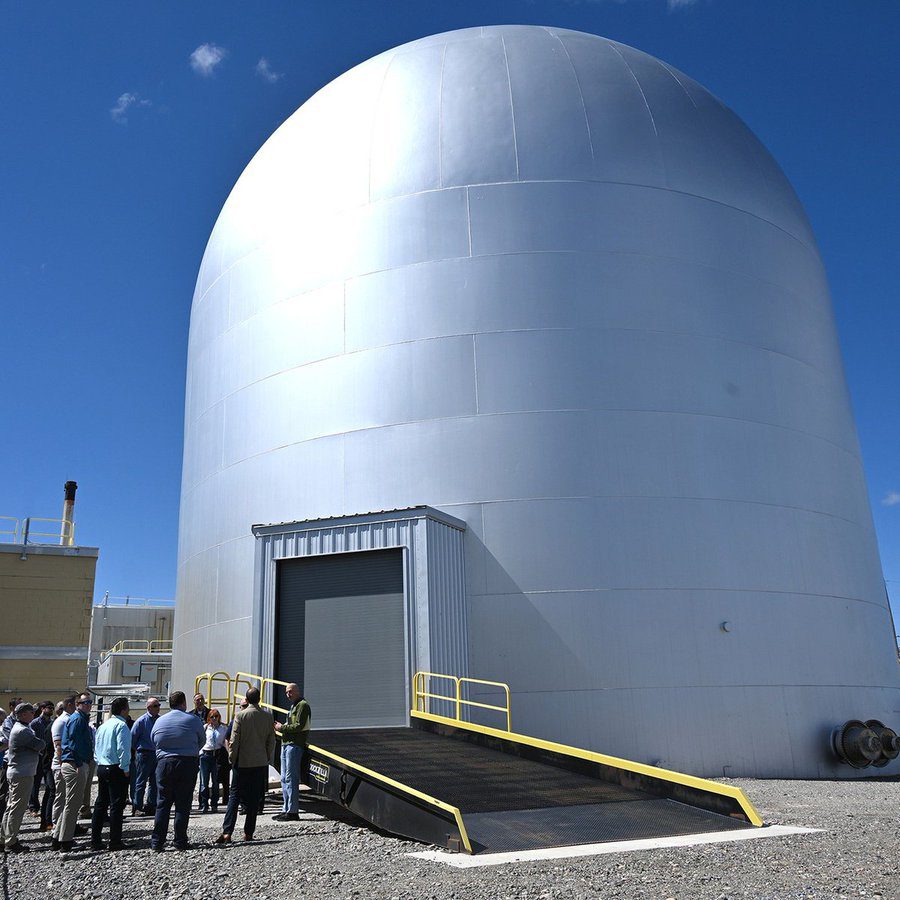
Westinghouse’s next major milestone for eVinci may be fueled operation at the Demonstration of Microreactor Experiments (DOME) test bed at INL, which DOE has retrofitted from the historic Experimental Breeder Reactor-II containment structure to host advanced microreactor experiments of up to 20 MWth. DOE conditionally selected eVinci in July 2025 as one of the first fueled experiments to be tested at DOME, alongside Radiant’s Kaleidos microreactor. The eVinci nuclear test reactor slated for DOME is a scaled 3-MWth version of the commercial design, intended to demonstrate key portions of eVinci performance and support licensing of the larger commercial unit. In late 2025, the eVinci test reactor became the first advanced reactor to receive DOE approval of its Preliminary Safety Design Report, the second of four DOE submissions required to physically site the reactor at DOME.
The NCERC milestone also aligns with eVinci’s defense and government pipeline, which continues to build. In May 2025, Westinghouse Government Services was contracted alongside the Department of the Air Force and the Defense Innovation Unit to evaluate siting and building an eVinci unit at Malmstrom Air Force Base in Montana under the Advanced Nuclear Power for Installations (ANPI) program, a contractor-owned and contractor-operated defense pathway targeting first on-base microreactor deployments by 2028.
On the licensing side, the U.S. Nuclear Regulatory Commission (NRC) accepted the eVinci Principal Design Criteria Topical Report in March 2025, establishing a baseline safety design architecture that future customers can reference to speed site-specific licensing. Westinghouse has also been building out the eVinci supply chain, signing an agreement in principle with Urenco to secure HALEU supply and a separate memorandum of understanding with Canadian firm Shawflex for specialized instrumentation and control cabling for eVinci, AP1000, and AP300 projects.
Westinghouse’s near-term deployment pipeline is now oriented around defense, space, and government applications, following the fall 2025 cancellation of its eVinci project contract with the Saskatchewan Research Council (SRC), which SRC confirmed on Aug. 26 was driven by Westinghouse’s decision to shift the program’s focus away from commercial markets.
—Sonal C. Patel is a POWER senior editor (@sonalcpatel, @POWERmagazine).
Editor’s note: This story was updated on Aug. 26 to remove references to an anticipated 2029 eVinci deployment with the Saskatchewan Research Council. SRC informed POWER that Westinghouse canceled the eVinci project contract with SRC in the fall of 2025 as part of a shift in the program’s focus toward defense, space, and government applications. This is a developing story and may be updated as more details become available.