When designed to interface directly with a utility’s medium-voltage infrastructure, battery energy storage systems (BESS) must meet stringent performance, protection, and reliability requirements that extend well beyond conventional storage applications.
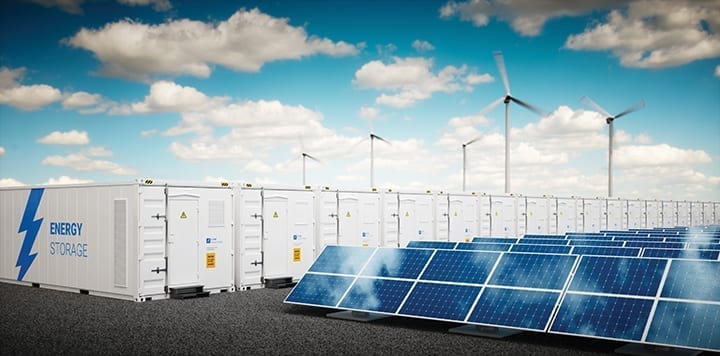
Grid-connected BESS are rapidly becoming indispensable partners with renewables to turn their non-dispatchable electricity into a reliable, schedulable, dependable slice of the nation’s power networks. By capturing and retaining the renewable energy of the sun’s shine and the wind’s wafting, battery storage supports the ebb and flow of the grid at the precise times it is scheduled, most profitable, and/or most needed.
From Peakers to Battery Storage
In some markets, the arbitrage capabilities of a BESS can significantly improve system economics. The battery system charges overnight, when demand is lower and power prices decline, and then discharges during peak daytime periods, when pricing increases. Shifting the grid’s energy curve to allow it to better match and cover the loading needs of its customers reduces costs for everyone compared to turning on a peaking generator—and without the emissions.
By supplying “injectable” backup power during dips and brownouts, BESS strengthen grid flexibility and reliability. Grid-connected battery energy storage systems reduce strains on transmission and distribution assets. Their super-fast response characteristics allow the various regional independent system operators (ISOs) to have a new tool for accurate frequency regulation and for correcting short-term imbalances between generation and load.
As BESS penetration increases as a percentage of a utility’s available power pool, understanding the technical benefits and potential unintended consequences is now a priority for grid system design engineers and ISO personnel responsible for analyzing, managing, and coordinating power flow and interconnection topology.
The electrical infrastructure that enables these larger BESS to operate safely and reliably within the grid is therefore critical. Medium-voltage switchgear, circuit breakers, and transformers form the physical and protective interface between the storage system and the utility network. The capabilities and high-power lab-proven ratings of these critical power equipment components must align with the host grid’s requirements.

In This Issue
Full issueAs leading utilities increasingly adopt network and equipment requirements that extend well beyond basic industry’s standards, these larger BESS that want to “tie into” a utility’s power pool must meet these more exacting standards. Developing a working understanding of equipment engineered to exceed the baseline performance standards commonly accepted in most BESS applications can be eye-opening, even for longtime renewable energy engineers. This is particularly true for those now designing projects in the hundreds of megawatts’ range rather than the smaller-scale installations that characterized earlier phases of the industry.
This dynamic is currently unfolding within the East River Energy Storage Project, a 100-MW/400-MWh BESS located at the former Charles P. Poletti power plant site in Astoria, Queens, New York. The Astoria battery project is one of several initiatives advanced under New York State’s Climate Leadership and Community Protection Act and New York City’s Local Law 97, aimed at retiring outdated fossil fuel–fired peaker plants and accelerating the shift toward cleaner, more sustainable energy alternatives.
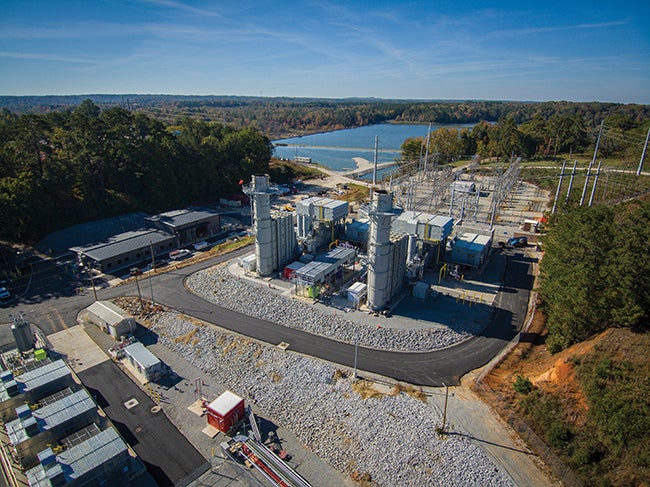
Peaker plants are typically gas turbine or reciprocating engine power generation facilities intended to operate during limited intervals of elevated electricity demand. These short-duration periods occur when standard generation capacity, together with available reserves, cannot satisfy prevailing system load requirements. In addition to major equipment outages, such supply shortfalls most commonly develop during extreme weather events, which frequently drive sudden and significant increases in electricity consumption.
In New York City, most peaker plants rely on natural gas or fuel oil and are built to start and stop quickly. When deployed as a standalone, short-duration distributed generation asset, peaking units are brought online only long enough to reduce the most acute periods of temporary system overload. Because they operate intermittently and frequently rely on smaller, older equipment with limited maintenance, these units generally perform at lower efficiency, carry higher costs per megawatt, and produce emissions at levels significantly greater than those of baseload facilities.
By comparison, some of the largest BESS can deliver equivalent or superior grid-balancing capability while operating in a fundamentally cleaner manner. Instead of burning fuel, a BESS stores electricity during off-peak periods and discharges it when demand reaches its highest levels. With near-instantaneous response to grid fluctuations, the system can be deployed immediately, providing precise and effective stabilization without producing associated emissions.
Connecting BESS to the Grid
When a utility decides to interconnect a BESS with the electric grid, the battery system’s design and function are influenced by the voltage level of the connection. At a minimum, switchgear, transformers, and circuit breakers must be specified for the applicable system voltage class, such as 15, 27, or 38 kV. This will set many criteria by way of applicable industry standards, such as the Institute of Electrical and Electronics Engineers/American National Standards Institute (IEEE/ANSI) and the National Electrical Manufacturers Association (NEMA), as well as the local utility’s standards for that system voltage class of equipment at the tie-in point of interconnection.
For the East River Energy Storage Project, the BESS components operate at 480 V and connect to a dedicated medium-voltage step-up transformer that increases the voltage to the local operating voltage of 27 kV. Con Edison’s requirements for medium-voltage switchgear on its 27 kV portion of the system are 38 kV Class or 150 kV BIL (Basic Insulation Level), ensuring excellent safety margins throughout.
In accordance with Con Edison’s ongoing study, review, and ratings practices, the system’s fault current rating is currently set at 44 kAIC (Kilo-Ampere Interrupting Capacity) symmetrical. These close-and-latch and short-circuit fault ratings are required to be verified through certified independent high-power laboratory testing.
The Citadel Switchgear Solution
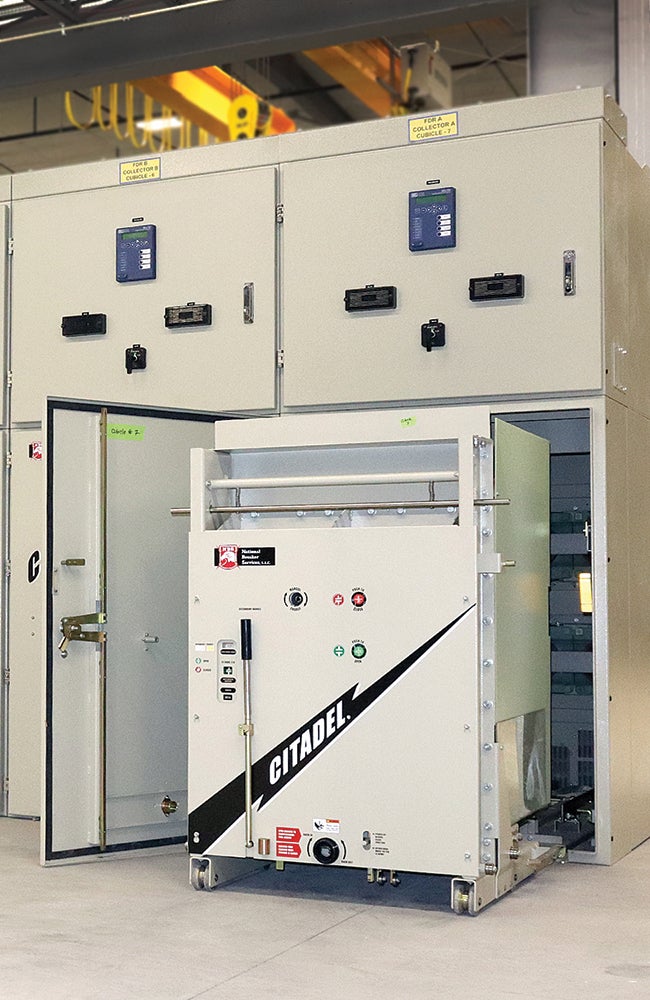
National Breaker Services was chosen for this project because of its ability to comply with Con Edison’s switchgear specifications and standards. The Connecticut-based group specializes in the engineering, design, and manufacture of medium-voltage circuit breakers (Figure 1) and switchgear used specifically in electric utility substations and generating facility applications.
 |
|
1. This is The Citadel draw-out circuit breaker. It is a medium-voltage vacuum breaker designed to rack easily into legacy switchgear. Courtesy: National Breaker Services |
The company’s product line, called The Citadel, was initially developed as fixed-mounted breaker elements to vacuum retrofit legacy switchgear systems. It was dimensionally designed to fit virtually any medium-voltage circuit breaker chassis up to 38 kV made by any domestic major manufacturer since the mid-1940s.
 |
|
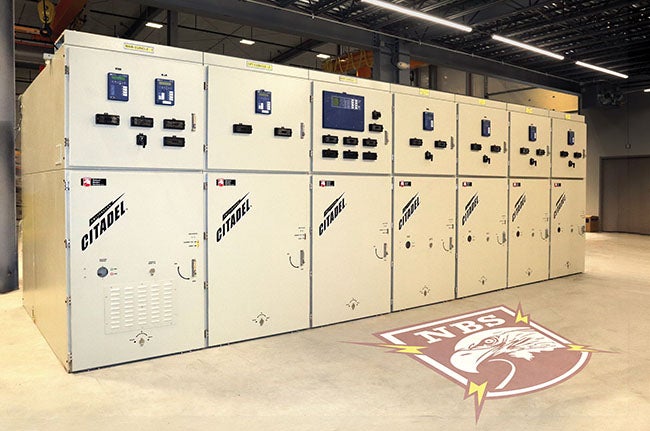
2. This is Citadel switchgear for the East River project shown prior to mounting in the outdoor walk-in enclosure at the New York site. Courtesy: National Breaker Services |
Over time, the fixed-mounted conversion element expanded its ratings to 38 kV up to 63 kA, and up to 5,000 amps (with no fans), sprouted wheels, and finger clusters, and evolved into the industry’s most rugged, safety-focused medium-voltage switchgear solution. For the East River Energy Storage Project, National Breaker Services delivered an outdoor walk-in seven-section 38-kV/44-kA draw-out medium-voltage Citadel switchgear unit (Figure 2) with roof bushings to allow the switchgear to tie into existing substation overhead lines.
To demonstrate the equipment could achieve the specified close-and-latch and short-circuit fault ratings, the Citadel platform was validated through independent testing conducted at both KEMA Labs in Arnhem, the Netherlands, an international high-power test facility, and the Korea Electrotechnology Research Institute (KERI) in Korea.
Delivery and Installation
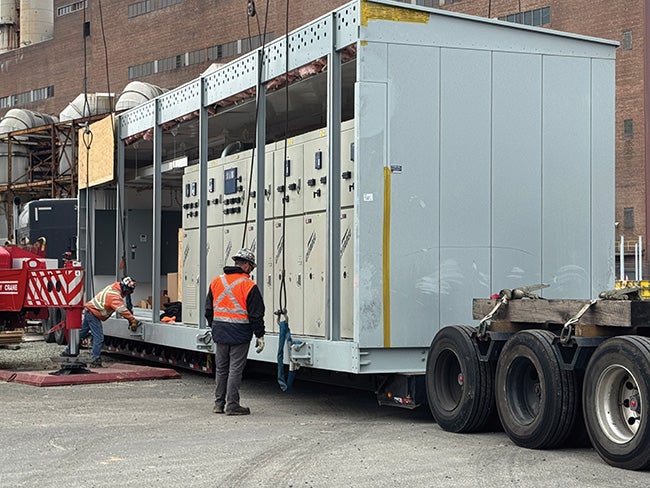
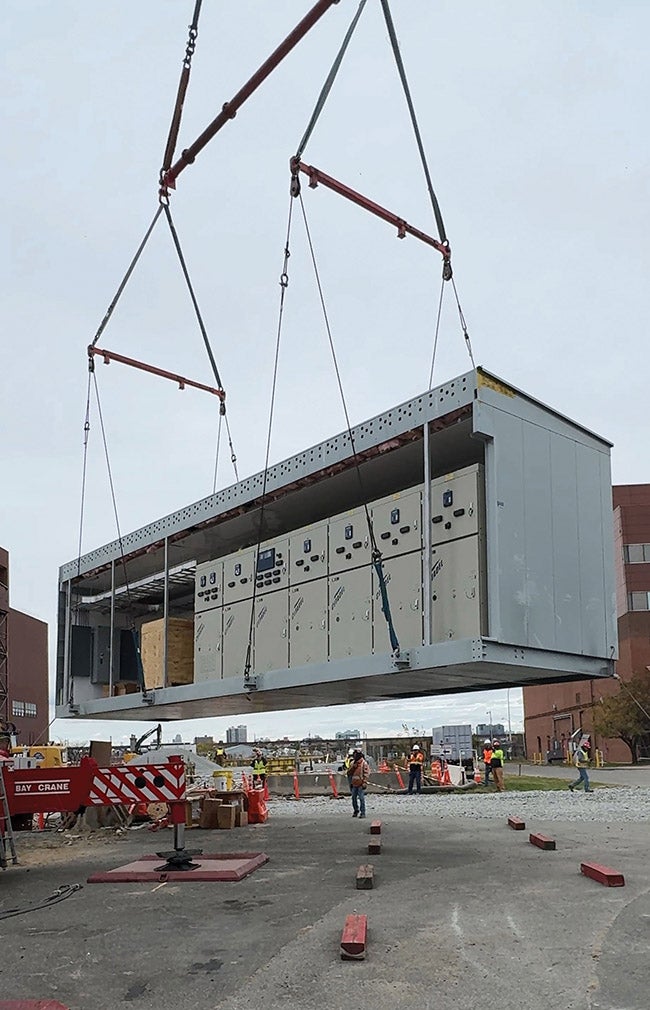
Because space at the site was constrained, the switchgear was supplied in a two-lateral section, prefabricated, weatherproof walk-in enclosure design. Each section was transported on a dedicated double-drop lowboy trailer (Figure 3) and lifted into position onto dunnage by Bay Crane (Figure 4), then assembled onsite within a single work shift, all while working within the constraints of a limited New York footprint.
 |
|
3. The 38-kV/44-kA Citadel switchgear arrives at the East River Energy Storage Project on a double-drop lowboy. Courtesy: National Breaker Services |
National Breaker Services’ walk-in, single and common-aisle substations incorporate the full switchgear assembly, including circuit breakers, bus structures, insulation systems, cabling layouts, and protective relays. By delivering a fully integrated, factory-tested solution, this approach simplifies installation, minimizes on-site construction effort, shortens project timelines, and helps ensure alignment with applicable codes and utility standards.
 |
|
4. Half of the walk-in switchgear house being “flown” onto the dunnage. Courtesy: National Breaker Services |
As BESS are deployed at greater scale, attention increasingly moves beyond the storage technology to the practical challenges of interconnecting these systems with the utility grid. Achieving a reliable interconnection requires meeting demanding medium-voltage requirements for performance, protection, and long-term reliability. At the core of this effort is the electrical infrastructure that establishes the connection to the grid, including switchgear, circuit breakers, and transformers. These critical components must be engineered and fabricated with precision to satisfy established industry standards while also meeting the changing requirements and performance expectations of leading utilities.
—Jeff Elliott is a Torrance, California–based technical writer. For more information, email Jim Duggan (jduggan@nationalbreaker.com), or call (475) 316-3471.