The average U.S. power plant wastes two-thirds of its fuel as heat, yet the technology to capture it has existed for decades—and already powers 30% or more of the grid in parts of Europe.
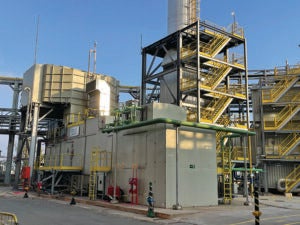
When Hurricane Sandy in 2012 knocked out power in Lower Manhattan for nearly a week, New York University’s (NYU’s) Washington Square campus stayed operational because it was not relying on the grid. A 13.4-MW cogeneration plant, commissioned in 2011, was producing the campus’ electricity and steam from a single natural gas feed when ConEd’s 14th Street substation flooded and went down. The plant was already paying for itself before the storm arrived. NYU has reported energy savings of roughly $5 million a year from the system.
Scenes like this are becoming more common, and the technology behind them is not new. Combined heat and power (CHP), or cogeneration, captures the heat that conventional power plants discard and puts it to work. The average fossil-fueled power plant in the U.S. converts only about a third of its fuel into electricity. The rest leaves as heat through cooling towers and exhaust stacks. Another 4% to 5% of what does reach the grid is lost in transmission.
A CHP system serving a single site uses that captured heat to produce steam, hot water, or process heat. The U.S. Environmental Protection Agency (EPA) reports that well-designed CHP installations reach 65% to 80% total fuel efficiency, compared with about 50% for grid electricity paired with an on-site boiler.
Across the U.S., roughly 80 GW of installed CHP capacity at more than 4,000 facilities already avoids about 240 million metric tons of carbon dioxide emissions a year. Even so, CHP supplies only about 8% of total U.S. power generation. In Denmark, Finland, and the Netherlands, the figure is 30% or higher. The U.S. Department of Energy (DOE) and the EPA estimate roughly 130 GW of untapped potential at American facilities that already have the right combination of steady thermal and electric load.
The economics are most compelling at facilities that need both electricity and heat continuously, such as a hospital, university campus, food processor, paper mill, or district energy system. For these users, a single natural gas CHP system can meet the site’s needs from one fuel stream.

In This Issue
Full issueThe case shifts further in emerging markets. The International Finance Corporation (IFC) has estimated that generator users worldwide spend $28 billion to $50 billion each year on diesel and gasoline for backup power, and that in sub-Saharan Africa roughly one in every five liters of those fuels is consumed in a backup generator. The IFC puts the fuel cost alone at about $0.30/kWh, against grid tariffs typically in the $0.10 to $0.30 range. In markets with frequent outages, industrial users leaning on diesel gensets for hours at a time are not comparing CHP against cheap grid power. They are comparing it against a machine that burns expensive fuel and produces only electricity, while their boilers burn separate fuel to meet thermal demand.
Resilience adds another dimension. For facilities where an outage carries direct human or economic cost, such as a hospital, CHP is not only an efficiency investment but a form of insurance. The DOE counts 327 of the 967 operating U.S. microgrids as CHP-anchored, representing 2.56 GW of capacity that does not depend on the bulk grid. NYU’s experience during Sandy is the kind of value that case studies rarely capture and project finance rarely prices.
CHP may not be the right answer everywhere. A facility with variable or low thermal demand will not fully use the recovered heat, which weakens the efficiency case. Where electrification of thermal processes paired with renewable electricity offers better long-term emissions performance, that path may be preferable.
Where the technical case is strong, three barriers tend to stand in the way. The first is capital. Installed costs for typical reciprocating-engine and gas-turbine systems run $1,500/kW to $3,000/kW. For industrial users in emerging markets without long-tenor financing, or for public facilities competing for limited budgets, the upfront cost is prohibitive regardless of how attractive the lifetime economics look.
The second barrier is regulatory. In many markets, interconnection requirements are unclear, inconsistently enforced, or designed for utility-scale projects rather than distributed industrial systems. A facility willing to invest may face months of negotiation simply to get permission to operate equipment it already owns. The third barrier is operations and maintenance. A CHP system is more complex than a boiler or a backup generator. It needs skilled technicians, spare parts, and reliable service contracts, and in markets where that ecosystem does not yet exist, the real cost of ownership exceeds the nameplate numbers.
Each of these barriers has a targeted response. Blended finance, including concessional loans, guarantees, and green bonds, can close the gap between projects that are sound over their lifetime and projects that can be financed today. Standardized interconnection rules with defined timelines and transparent technical criteria have generally been associated with faster CHP deployment where governments have enacted them. And performance contracting, where an energy services company finances, installs, and operates the system in exchange for a share of savings, transfers technical risk to the party best positioned to manage it.
—Justin Larson is an environmental and energy economist at RTI International.