Articles By

-
 Nuclear
Accurately measure the dynamic response of pressure instruments
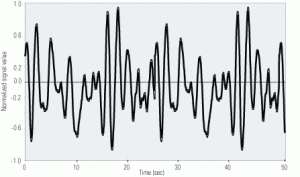
How do you know if a pressure transmitter is giving poor results? Unless the transmitter actually fails, most operators won’t notice a very slow loss in accuracy or response time. Fortunately, the noise analysis technique can identify such changes before they cause a problem. The technique has been used to effectively measure the dynamic response of nuclear power plant pressure sensors and their associated sensing lines. It also can be applied to any plant that relies on accurate instrumentation for control and monitoring plant performance.
-
Business
Milestones on the road to commercial operation
The electric power industry is capital-intensive, and it takes several years to build and commission a baseload plant for commercial operation. Owners seek contractors who are willing—given proper incentives—to build a plant for a lump-sum price with a guaranteed schedule and performance. Matching an owner’s wants with contractors’ needs is an exercise in allocating risk. Avoid the contract traps that can stall a project and cost millions to resolve.
-
 Business
This month in POWER . . .
POWER began its life in October 1882 as a tabloid-size publication originally entitled Steam. About the same time, two young Boston advertising salesmen decided to launch a new magazine about textile mill steam plants, called POWER. They bought Steam prior to publishing POWER’s first issue, so early issues of this magazine carried the flag “POWER, […]
-
 Commentary
Centralized markets are failing consumers
During my 30-year career at the American Public Power Association (APPA), I’ve had a front-row seat for most of the major events in our industry’s recent history. So it disturbs me when my view of our history is 180 degrees out of phase with how others perceive it. Such was the case with the preamble […]
-
 Nuclear
Do the math
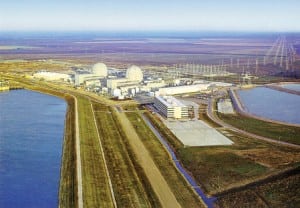
The eyes of Texas—and the rest of the world—are upon NRG Energy after its September application for licenses for two new reactors at South Texas Project (see Global Monitor). The filing was the first of its kind in nearly three decades and the first of up to 30 like it expected over the next few […]
-
 Coal
CoalGlobal Monitor (November 2007)
NRG applies for first COL / TVA green-lights Watts Bar 2 / Southern Co. and Florida muni launch IGCC project / UK approves wave energy "hub" / New Jersey-New York HV system launched / Membrane strips CO2 from methane faster / POWER digest
-
 O&M
O&MFocus on O&M (November 2007)
The NERC auditors are coming / Winning encore for on-line pH monitoring / Using baloons as temporary barriers / How data logging can cut power bills
-
 Legal & Regulatory
Can FERC deliver transmission?
This May, the Arizona Corporation Commission (ACC) rejected a proposal by Southern California Edison (SCE) to build Devers-Palo Verde No. 2 (DPV2)—a 230-mile-long, high-voltage transmission line connecting California and Arizona. The line, approved by the California Public Utilities Commission (CPUC) four months earlier, would enable SCE to import additional low-cost electricity from Arizona. The ACC’s rejection of DPV2 highlights a significant challenge for state and regional resource planners—weighing state interests against the regional benefits of interstate electricity commerce.
-
 Nuclear
Browns Ferry Nuclear Power Plant, Athens, Alabama
TVA’s 1,155-MW Browns Ferry Unit 1 returned to service on May 22 after sitting idle since 1985, when all three units were shut down to address management and operational concerns. Units 2 and 3 returned to service in 1991 and 1995, respectively, after extensive upgrades to controls, electrical systems, pumps, motors, and more. The return of Unit 1 began in 2002 with a five-year $1.8 billion restart plan to make all three units essentially identical, and that goal was accomplished in style. Welcome back, Unit 1.
-
 Nuclear
Comanche Peak Steam Electric Station, Glen Rose, Texas
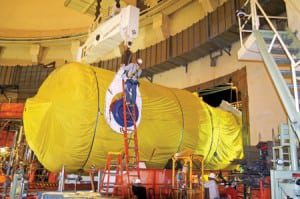
A Luminant-Bechtel team completed replacement of four steam generators and the reactor vessel head—plus almost 200 other work packages—in a short, 55-day outage at Comanche Peak Unit 1. Matching or exceeding this schedule will become the goal for those who follow.
-
 Nuclear
Fermi 2 Power Plant, Newport, Michigan
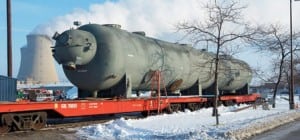
Detroit Edison teamed with Washington Group International to complete a first-of-its-kind nuclear retrofit project: replacing two moisture separator reheaters during a single 35-day outage with a perfect safety record. POWER recognizes this significant accomplishment by naming Fermi 2 Power Plant a 2007 Top Plant.
-
 Nuclear
Fort Calhoun Nuclear Generating Station, Omaha, Nebraska
Just under a year ago, Omaha Public Power District completed perhaps the most complex nuclear power plant renovation in the history of the industry in a scant 85 days—five fewer days than the original plan called for. POWER recognizes Fort Calhoun Nuclear Generating Station as a Top Plant for packing more work into one outage than was thought possible, and then executing the plan ahead of schedule and below budget.
-
 O&M
O&MThe Coal Patrol: Demand Growth — and Reliability — Are Still Supply-Limited
While noting marginal improvements since last year, America’s power reliability watchdog recently warned that the nation’s growing thirst for electricity will still far exceed planned increases in generation capacity over the next 10 years, and that reserve margins could dip below optimal levels within two or three years in California, the Rocky Mountain states, New […]
-
 Coal
CoalAdvanced Combustion: Cofiring Coal and Biomass or Non-Recyclable Waste
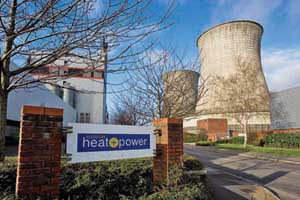
Burning biomass or nonrecyclable commercial, municipal, or industrial waste along with coal represents one of the nearest-term and lowest-cost options for reducing carbon dioxide (CO 2) emissions from existing utility power plants. At more than 150 plants worldwide, doing so has produced lower CO 2 emissions than burning coal alone. Indeed, with the number of […]
-
 Coal
CoalThe Coal Pile: Dreaming of a Green Christmas
On November 20, New York City Mayor Michael R. Bloomberg and top executives of the real estate company Tishman Speyer announced several energy conservation measures to be implemented at Rockefeller Center this holiday season. One is the outfitting of its famous Norway Spruce Christmas tree with 30,000 light-emitting diodes (LEDs) strung on five miles of […]
-
 Coal
CoalCoal Plant O&M: Retrofit Flyash-Handling System Pays Dividends
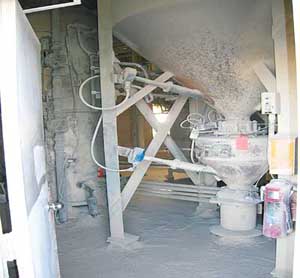
Like many older coal-fired plants, Westar Energy’s Jeffrey Energy Center (JEC) was built with traditional, pneumatic flyash-handling and removal systems. Such systems collect flyash in hoppers attached to the bottom of a unit’s electrostatic precipitator (ESP) and/or baghouse. Periodically, the hoppers are emptied into tanks and the flyash is conveyed away for disposal or beneficiation. […]
-
 Coal
CoalSafety: Detecting Fires on PRB Coal Conveyors
All conveyor systems are at risk of fire caused by the ignition of transported materials or equipment failure. But the propensity of Powder River Basin (PRB) coal to self-ignite introduces an exceptional hazard requiring special fire prevention and automatic detection and suppression efforts. To that end, this article discusses the technologies of linear heat detection […]
-
Coal
Speaking of Coal Power: Polar Bear Politics
During his June 2007 speech to the National Press Club, presidential candidate and former U.S. Senator John Edwards called America’s 37 million residents living below the poverty line "the great moral issue of our time." He proposed setting a national goal of ending poverty in 30 years. The Heritage Foundation, a conservative think tank, disputed […]
-
 O&M
O&MTech Notes: Intelligent Sootblowing Needed to Keep Uprated Units Clean
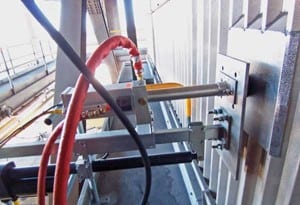
The National Coal Council estimates that 40,000 MW of additional generating capacity is available to existing U.S. coal-fired plants simply by making efficiency improvements. Because decreases in production costs go straight to a plant’s bottom line, efficiency projects usually have short payback periods, especially if implemented in concert with mandatory environmental upgrades. One often-overlooked consequence […]
-
 Coal
CoalManaging air to improve combustion efficiency
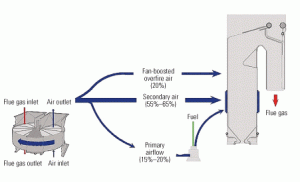
The average pulverized coal–fired coal plant is more than 30 years old and has a heat rate in the neighborhood of 10,300 Btu/kWh operating with an "off-design" coal. Add a high load factor (or increased cycling service), squeezed maintenance budgets, reduced plant staff, and increased time between overhauls to meet the plant’s pro forma, and you’ve got major stress. Fortunately, there is a way to come in under your NOx budget and lower the stress. Breathe deeply and read carefully.
-
 Coal
CoalHarness detonation waves to clean boiler tubes
Air and steam sootblowers have been the power industry’s solution to the slagging and fouling of boiler convective passes caused by flyash and combustion products. Manual cleaning systems have been superseded by computers and neural nets, but the basic cleaning apparatus remained unchanged—until now. Say hello to detonation waves. They can knock those deposits loose while markedly improving boiler heat transfer efficiency.
-
 Instrumentation & Controls
Making the grade with stainless steel tubing
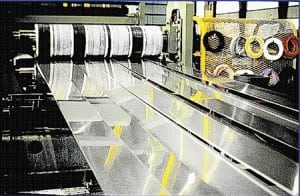
Tubing manufacturers have many alternatives for manufacturing and testing stainless steel tubing for feedwater heater and condenser applications. ASTM specifications are fairly generic in nature and only specify the minimum tube design and testing requirements—which may not be sufficient to provide the appropriate quality for a critical power plant application. To make the right material selections, it’s helpful to understand how welded stainless steel tubing is manufactured and its quality is checked.
-
 Gas
GasThis month in POWER (OCTOBER)
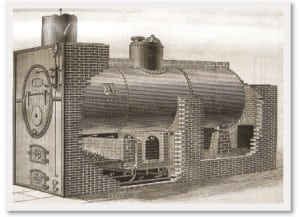
October 1886 In the late 19th century, efficient combustion of solid fuels was achieved more by trial and error than by a fundamental understanding of stoichiometry and staged combustion. Boiler manufacturers took many different approaches to the challenge. Some made sense; others didn’t. In which category does the design described below fall? In 1886 the […]
-
 Commentary
Competition policy: The best path
Winston Churchill once said, "Democracy is the worst form of government—except for all the others." The same could be said for competition policy in wholesale power markets. Competition policy has its flaws. It is not perfect, but it is better than the alternatives. One alternative is to rely completely on vertical integration and […]
-
 News
NewsEnergy industry needs a Sputnik
The 1940s and 50s are considered the golden age of science fiction literature. After my kids saw the movie, I, Robot, a few years ago, they were surprised to learn that Isaac Asimov—a giant of the genre with more than 500 books to his credit—had written a series of nine short stories with the same […]
-
 Coal
CoalGlobal Monitor (October 2007)
Siemens ships first blade from U.S. plant; GE’s frames hit 1,000; Battery problems hit hybrid EV programs; Solar thermal rebounds in California;Peabody’s Illinois coal plant gets green light;EPA could sink 278-MW CFB unit; Longest-serving NRC commissioner dies at 58; POWER digest; Readers talk back; corrections
-
 O&M
O&MFocus on O&M (October 2007)
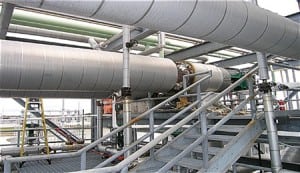
Why bypass desuperheaters fail; DSSP, CAD, and fast casting salvage nearly totaled pump; Seals of approval; Making gas turbine plants quieter
-
 Commentary
What is resource adequacy?
Under its Resource Adequacy (RA) program, the California Public Utilities Commission (CPUC) requires load-serving entities—both independently owned utilities and electric service providers—to demonstrate in both monthly and annual filings that they have purchased capacity commitments of no less than 115% of their peak loads. These purchase requirements are intended to secure sufficient commitments from […]
-
 Coal
CoalIGCC demonstration plant at Nakoso Power Station, Iwaki City, Japan
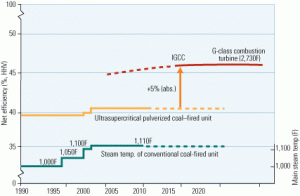
Integrated gasification combined-cycle (IGCC) power plants are not yet standard designs. Although they use mature coal gasification processes and combustion turbines, disparate technologies and equipment still require custom, laborious interfacing at each site. Every major gas turbine vendor now can point to one or more power-producing IGCC projects based on its prime mover, but none yet offers a "reference" plant that has standardized the interfacing enough to justify confidence in two key metrics: $/kW and availability. With an air-blown demonstration plant based on one of its 130-MW turbines, Mitsubishi Heavy Industries is looking to change the rules of this game.