
Articles By

-
 Coal
CoalGlobal Monitor (January 2007)
DOE walks the clean coal talk / For Swedish nuke, a case of mistaken identity / Siemens completes big CHP plant / E.ON bets big on coal / BP Solar expands Maryland plant / GE scores big turbine deals / PSNH switches from coal to wood / EPRI tests solid-state current limiter / POWER digest
-
 O&M
O&MFocus on O&M (January 2007)
Mandatory standards advance / To drain or not to drain / Practical aspects of burning landfill gas / Time management
-
 Legal & Regulatory
Barriers continue to crimp natural gas supplies
U.S. demand for natural gas is projected to increase by more than 50% by 2020. Companies are building—and the public is opposing—receiving terminals on three coasts that would increase imports of liquefied natural gas. The pros and cons of "opening up" Alaska, coastal waters, and federal lands to drilling are still being debated. These politically […]
-
 Coal
CoalInvestment in generation is heavy, but important needs remain
Forecasting the direction of the U.S. electric power industry for 2007, much less the distant future, is like defining a velocity vector; doing so requires a direction and speed to delineate progress. In this special report, POWER’s first stab at prognostication, the editors look at current industry indicators and draw conclusions based on their more than 100 years of experience. To borrow verbatim the title of basketball legend Charles Barkley’s book: I May Be Wrong but I Doubt It.
-
Coal
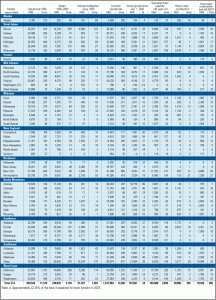
Near-term capital spending in the North American power industry
Following the money invested in projects is a viable way to compare growth trends for power projects using the four major generation types: coal, natural gas, nuclear, and renewable.
-
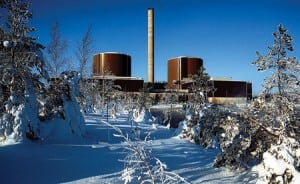 Nuclear
Tow nuclear power I&C out of the "digital ditch"
One expert has called it the "digital delta"—the seemingly endless challenges in refurbishing U.S. nuclear plants with digital instrumentation and controls. But it appears more like a deep ditch, where even those seeking to license new reactors could get stuck. Here’s the latest on the issues, experience, and results—plus recommendations for getting the industry out of the mud and back on the road.
-
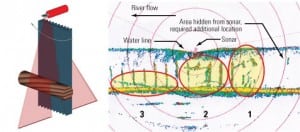 O&M
O&MAdvanced sonar revolutionizes underwater structure inspections
Ongoing maintenance is critical to the performance and longevity of underwater structures such as cooling water intake tunnels. Commercial divers or robotic vehicles can do the needed inspections, but such manual methods require a costly plant shutdown and provide only qualitative results. ASI Group Ltd. has designed and built an advanced, dual-axis sonar system that works in fast-moving water and can deliver quantitative data about the extent and location of debris buildup on submerged assets.
-
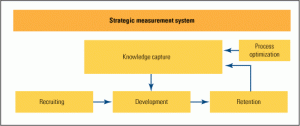 Business
Put the dynamics of the workforce supply chain to work for you
A healthy and productive workforce is one that has been thoughtfully recruited and properly trained. Understanding the role and relationships of those and other attributes in the overall workforce supply chain is an essential management function. Here’s a roadmap for your consideration.
-
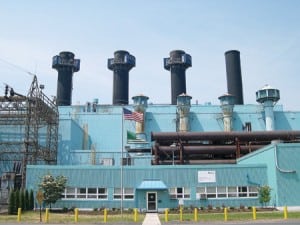 Gas
GasBurning landfill gas has environmental and economic benefits
The conflicting challenges of operating a plant beyond its prime and Exelon’s commitment to manage carbon emissions from its power system are pushing the company’s plant engineers to innovate. An example: Fairless Hills Generating Station was given a complete overhaul and now burns landfill gas that otherwise would be treated as waste.
-
 O&M
O&MVacuum-driven "hypo" chlorination is safer and cheaper
Safety issues related to the use of gaseous chlorine for disinfecting cooling water are pushing plant operators to examine other alternatives. Two units of Cardinal Generating Station recently switched to a liquid chlorination system, with pumpless vacuum injection, that was easy to install and has proven reliable. That switch has resulted in one less safety headache for the operations staff and one less invitation to regulatory scrutiny.
-
 News
NewsThis month in POWER . . .
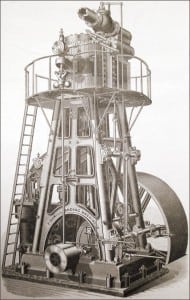
January 1885 The cover story of this issue reviewed the latest power generation technology then entering the market. "The Fishkill vertical direct acting condensing engine . . . has a heavy bed-plate of box form, with pillow-block for main journal cast on. The upright frames are A-shaped, with hollow cylindrical legs, which rest on the […]
-
 Commentary
A new day in power generation
The recently published Long-Term Reliability Assessment from the North American Electric Reliability Council (NERC) found that several areas of the U.S. and Canada risk falling below minimum capacity target levels within three years, as demand continues to outpace new supply. This risk of supply shortages requires action. In addition to the usual solutions of more […]
-
Coal
Speaking of Coal Power: Shedding More Heat Than Light
When Charles Dickens began A Tale of Two Cities with, "It was the best of times, it was the worst of times," he was referring to the French Revolution of the late 18th century. But Dickens’ words apply equally well to the American generation industry of the late 20th century. A decade of overbuilding U.S. […]
-
 O&M
O&MThe Coal Patrol: Looking Back at 2006
To borrow shamelessly from Charles Dickens, one of my favorite authors, for coal in 2006, "It was the best of times, it was the worst of times." No Escape The year began in horror. On January 2, most likely a result of a severe lightning strike, methane gas in the International Coal Group’s Sago Mine […]
-
Coal
PRB Tech Notes: Give Coal Handling the Priority It Deserves
Over the past 17 years — dating back to the 1990 Clean Air Act Amendments and including the introduction of retail competition — coal-fired power plants have become much cleaner and more efficient. Utilities have spent many billions of dollars to install pollution controls for regulatory reasons, and only slightly less to upgrade turbine-generators and […]
-
O&M
Coal Plant O&M: Elemental Analyzer Checks Quality of Delivered Coal in Real Time
When you receive a shipment, you don’t wait weeks to see whether you got what you paid for — do you? J.M. Stuart Generating Station doesn’t, but it used to. Since coming on-line in the early 1970s, the big plant, on the Ohio River near Aberdeen, Ohio, mechanically sampled coal shipments as they reached the […]
-
 Coal
CoalCoal Plant O&M: Coal Drying Reduces Pulverizer Start-up Costs
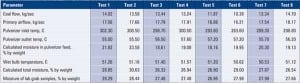
If coal leaving a pulverizer isn’t dry, it may plug up the coal pipes leading to the boiler. The coal-drying process in a pulverizer is similar to that used by flash dryers. Certain coals should be preheated to make them more combustible. Generally, preheating is done on higher rank coals — those with a low […]
-
 O&M
O&MEmissions Control: Layered NOx Reduction on a 500-MW Cyclone-Fired Boiler
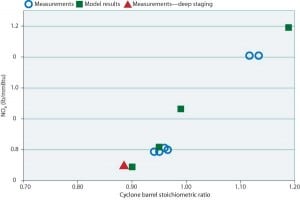
Historically, cyclone-fired boilers have been characterized as big emitters of NOx due to the very high temperatures in their primary combustion zone. Uncontrolled levels from 0.8 to 1.9 lb/mmBtu have been typical. The design of cyclone-fired units makes them impossible to retrofit with standard low-NOx burners. Prior to 1997, the conventional wisdom was that cyclone […]
-
 O&M
O&MEmissions Control: Cost-Effective Layered Technology for Ultra-Low NOx Control
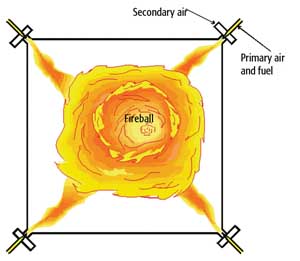
Layering NOx control technologies can reduce a coal-fired unit’s NOx emissions to levels achievable by selective catalytic reduction alone. Advanced Combustion Technology Inc. (ACT) (www.advancedcombustion.net) has demonstrated that using several in combination can cut emissions from boilers firing eastern bituminous coal or No. 6 oil to less than 0.15 lb/mmBtu. The following two case studies […]
-
 Coal
CoalEmissions Control: User-Designed Large-Particle Ash Screens Minimize SCR Fouling
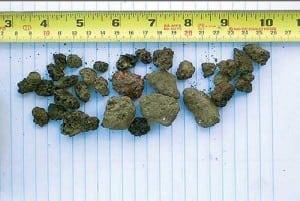
Large-particle ash (LPA), also called popcorn ash (Figure 1), is a serious concern for many coal-fired utility boiler operators who have retrofitted their unit(s) with a high-dust selective catalytic reduction (SCR) system. LPA formed in the boiler can easily carry over into the SCR reactor (Figure 2), where it often causes catalyst erosion damage and […]
-
 Coal
CoalThe Coal Pile
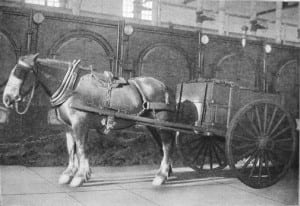
The February 1907 issue of POWER magazine reported on the construction of a new coal-fired steam engine plant on the Merrimac River outside of Lawrence, Mass. According to the plant’s owner, "the simplest and most flexible means for handling coal… to the furnace is by animal muscle… that brings the coal to the firing floor […]
-
 Wind
WindWind power: Disruptive or not?
Harvard Business School Professor Clayton Christensen coined the term "disruptive technology" in his best-selling 1997 book, The Innovator’s Dilemma. According to Christensen, a disruptive technology unseats a dominant technology by creating products that are so much cheaper or better in one or more ways that they quickly become the new mainstream standard, transforming an entire […]
-
 Gas
GasGlobal Monitor (Nov/Dec 2006)
Renewables require rethinking just about everything/Torque-splitting drive train improves wind turbine reliability/Waste gas–burning engines reach milestone/Hybrid power plant targets pipeline losses/Power from paint/Gulf Coast Power Association conference report/Pat Wood talks about the challenges facing ERCOT
-
 Commentary
A new vision for energy efficiency
The U.S. electric utility industry has long encouraged its customers to get more value from their electricity dollar. Today, the industry—facing volatile costs and mounting concerns about the environment—is coming together to create a new role for energy efficiency—one that enables technology to deliver more value to customers and electric utilities alike. For example, "smart" […]
-
Readers talk back and Correction (Nov/Dec 2006)
Fireproofing switchyards From an insurance carrier’s perspective, we fully condone the use of on-line condition monitoring for large, critical transformers ("Monitoring key gases in insulating oil keeps transformers healthy," POWER, October 2006). However, another issue that the transformer failure and subsequent fire at Arizona Public Service’s West Wing Substation in 2004 highlights is the need […]
-
-
 Legal & Regulatory
Renewable power: Environmental or political product?
What’s in a name? Plenty, if the word is "renewable." Intuitively, most people outside the energy industry consider hydroelectric power "renewable." The dictionary defines the word as follows: "capable of being replaced by natural ecological cycles." Accordingly, rainwater should indisputably qualify as renewable. Yet since the early days of renewable portfolio objectives, most hydro […]
-
 Instrumentation & Controls
The long and short of last-stage blades
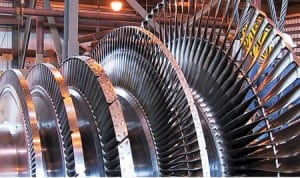
The use of longer steam turbine last-stage blades (LSBs) reduces the number of low-pressure casings and, thus, a turbine’s total installed cost. In many cases longer blades extract more energy from low-pressure steam before it enters the condenser and improve a turbine’s overall thermodynamic efficiency. But creating longer blades requires forsaking conventional design techniques for complex aerodynamic analysis of stationary vanes and rotating blades. Has the market push for longer LSBs exceeded current technology limits? Does the industry conduct proper analysis to determine when using longer blades is beneficial or not?
-
 Nuclear
DOE project converts weapons-grade uranium to fuel for Browns Ferry
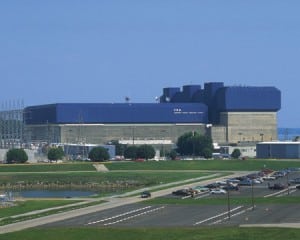
An offshoot of the 1993 Megatons to Megawatts nonproliferation program, the Blended Low-Enriched Uranium (BLEU) project has modified and developed new fabrication processes for converting surplus weapons-grade uranium materials into nuclear fuel for TVA’s Browns Ferry Nuclear Plant. This innovative public/private venture continues to deplete nuclear arsenal stockpiles while reducing storage, security, and disposal costs to U.S. taxpayers.
-
 Wind
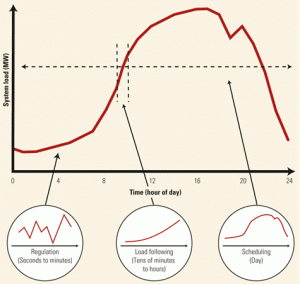
WindUnique challenges face wind power developers, buyers
Utility resource planners are used to viewing new generation in terms of firm, dispatchable capacity. Dispatching a renewable resource such as wind requires a different perspective. Wind capacity can serve as a hedge against fossil fuel price risks and perhaps future emissions restrictions, but it requires a much more structured planning horizon. Integrating wind farms into their portfolios may be the most difficult challenge utilities face today.