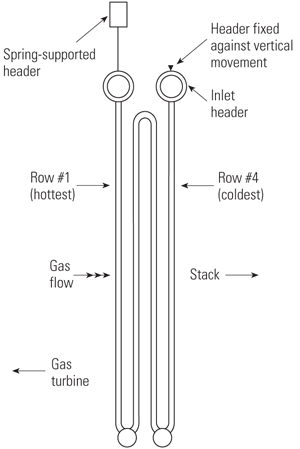
Nearly every combined-cycle operator recognizes that cycling reduces the life expectancy of hot-gas-path components in combustion turbines. Often overlooked, however, is that the same phenomenon affects the heat-recovery steam generator (HRSG). In fact, the greater physical size, elevated gas temperature, and higher steam conditions in today’s HRSGs have disproportionately increased thermal stresses and fatigue damage, particularly in the superheater section. Not surprisingly, improvements made in the design stage offer the greatest benefits in extending cyclic life.
However, existing plants also can reduce fatigue through equipment modifications, such as relatively minor changes to drain piping and drain valves, and by changing start-up and shutdown procedures. Following are some specific improvements that you can make at your plant.
Drain Piping and Valve Improvements
Carefully Size Drains. Generously size the HRSG drains to permit removal, at high temperature and pressure, of the large quantities of condensate that collect in the lower headers of superheaters during coast down and prestart purge. If condensate at saturation temperature is not removed prior to reestablishing high-pressure (HP) steam flow on a hot HRSG, a condensate quench occurs in outlet headers and steam pipes. Restarts shortly after a combustion turbine trip are a particularly nasty source of quench damage. Designers and operators often overlook the damaging fatigue effects of condensate quenching.
Superheater drains at some installations are not designed for, and cannot be used during, shutdowns and hot restarts. At other installations, the drains are available, but operators fail to use them correctly. At still other plants, the drains are inadequately sized to handle the substantial quantities of condensate. Regardless of the reason, failure to remove condensate from superheater headers obstructs steam flow during the next start-up. This produces a significant temperature differential between adjacent tubes and raises thermal stresses. Failures caused by this condensate-quench phenomenon have occurred after only 300 cycles.
Also, the substantial quantities of condensate in the superheater tubes should be drained during the combustion turbine coast down to further minimize thermal stresses. Superheater drain valves should be motorized to permit convenient, remote operation. In addition, where automated sequence controls and interlocks are available, the motorized drain valves should be automated.
Install Stack Dampers. Install dampers in the HRSG exhaust to restrict convection flow through the unit and to maintain HP steam pressure as high as possible. HRSGs without exhaust or stack dampers depressurize within a few hours after shutdown; thus almost every restart is from cold conditions. On a P91 header, a cold start will cause about 20 times more fatigue damage than a well-designed hot start; on a P22 header, cold-start fatigue damage may be 30 to 40 times that caused by a hot start.
Include Inspection Access. Provide convenient access for internal inspection. Fatigue cracks usually initiate inside tubes and headers. Some HRSGs have no facility or space to inspect header internals; thus, fatigue damage will not be evident until a crack propagates all the way through the header wall. If internal cracks are detected early, their growth rate can be monitored and replacement components procured in advance, keeping outage time to a minimum.
Change Your Shutdown Procedures. Many combined-cycle stations base operating procedures on the ideal requirements for the combustion or steam turbine. Operators of existing HRSGs may substantially lower HRSG thermal stresses simply by changing these procedures. Unfortunately, these procedures often cause severe fatigue damage in the HRSG.
Most operators believe that rapid start-ups are what damage HRSG components, but shutdowns — both routine and emergency — can be more damaging. The shutdown procedure is usually intended to keep superheater-outlet steam temperature as high as possible to permit fast reloading of the steam turbine after an overnight or weekend shutdown. In this procedure, combustion turbine exhaust-gas temperature and steam flow are both reduced rapidly during unloading, so that when combustion turbine firing stops, only moderate reduction in superheater-outlet steam temperature has occurred and the majority of the header remains near maximum steam temperature. However, as cooler air is delivered from the combustion turbine compressor during coast down and HRSG purging, condensate rapidly develops in the superheater tubes and then runs down into hotter headers, causing these sections to quench to saturation temperature. This leads to substantial thermal stresses at the inner surface of the headers.
A better procedure for normal shutdown is to ramp down the superheater outlet steam temperature during gas turbine unloading, prior to tripping the combustion turbine. One original equipment manufacturer recommends a ramp rate of 14F/min to a steam temperature of about 700F. By the time condensate begins to collect in the header, the bulk temperature of the header has been reduced further to about 60F above saturation temperature. This may extend the subsequent hot restart time after an overnight shutdown from a typical 60 minutes to 75 minutes, but it reduces fatigue damage by as much as 50%.
Rewrite Start-up Procedures, Too. A procedure sometimes used for hot starts deliberately lowers HP steam pressure prior to the restart. This practice is intended to reduce throttling at the steam turbine during start-up, and thereby shorten the start-up time. Nevertheless, by lowering HP steam pressure, the superheater is cooled to a lower saturation temperature, which results in a more damaging step increase — from saturation temperature up to combustion turbine exhaust temperature — immediately after steam flow is established.
To reduce thermal stresses in the superheater during hot starts, the step change should be minimized. This can be accomplished by maintaining pressure, thus saturation temperature, as high as possible in the superheater. In addition, combustion turbine exhaust temperature should be kept as low as possible when steam flow is first established. Note that combustion turbines equipped with inlet guide vanes (IGVs) tend to produce higher gas temperatures during start-up than those without IGVs. After steam flow is established, subsequent combustion-turbine ramp-up should be slow enough to maintain the temperature gradients induced by the initial step change.
Inject Cost Consciousness into Valve Maintenance Program
Goals of any valve program should be to reduce long-term costs of valve maintenance, improve valve operation and reliability, and improve plant operation. To achieve these goals, the program should address valve stem packing, leak detection, steam-trap diagnostics, predictive operation, matching valve class with application, individual valve problems, and standardized valves. Preferably, one valve specialist should be assigned to coordinate the program.
Packing Improvements. Tremendous changes have occurred in valve stem packing over the past decade. Opportunities for savings are numerous. Packing sets with fewer packing rows perform better than old sets with more rows because packing consolidates less over time, resulting in fewer leaks and repacks. Packing sets for high-pressure valves should be converted to five-row sets with three active sealing rows and two containment, anti-extrusion rows. These changes to existing valve packing sets should first be made to all high-pressure valves.
Torquing the packing to calculated values leads to consistently good seals on valves. Of course, torque wrenches should be checked regularly and calibrated, if necessary. Live loading — which involves installing Belvoir washers on the packing bolts to maintain the calculated preload on stem packing even when some consolidation occurs — should be considered for critical valves or valves that have exhibited problems in the past. This will allow for a considerable amount of packing consolidation before problems occur.
Valve Leak Detection. If accurate valve leakage information is available, you can rely on valve condition monitoring and eliminate most, if not all, preventive maintenance. Thermography and acoustic devices have been used for leak detection, but they are not always reliable indicators. Many valves were found to be in good condition when disassembled even though these techniques identified leakage. Fortunately, new valve leak detector technology has been developed that uses acoustic signatures captured by sensors, massaged by proprietary signal processing software, followed by computer analysis. The presence of acoustic signals in a particular frequency spectrum can be used as a predictive measure for steam leaks and for other failure mechanisms. The latest instruments can be added to the plant’s local area network if continuous monitoring of certain equipment is desired. This one improvement has allowed maintenance departments to plan their work much more effectively and has in many cases eliminated preventive maintenance.
The coordination of leak-test efforts is critical to the entire valve program. Identifying and testing whole systems — which would include the boiler vents and drains, boiler feed system, auxiliary steam system, and more — is recommended. Other valves can be tested by a thorough, organized approach to the various piping systems in a plant before planned outages. Possible annual saving at a comparable power plant is $250,000 to $350,000.
Steam-Trap Maintenance. Steam traps are not a high priority at many plants, typically because unit reliability is more important than plant efficiency. Steam traps are essentially valves that open and dose automatically. Many problems were experienced with high-energy steam traps because inverted steam traps lost their prime. The prime is a water seal in the trap that keeps steam from leaking straight through. The industry has been aware of this problem for some time and suppliers are reacting. You may have to replace existing steam traps with ones better suited to specific operating conditions. The valve leak detector mentioned above can be useful in identifying leaking traps or traps that are not performing as designed. For a comparably sized power plant, annual saving of $80,000 to $120,000 are possible by addressing steam-trap problems.
Predicting Valve Operation. Improving plant operability and reliability requires that personnel be able to predict whether valves will operate properly as needed and whether the valve will seal tightly against the expected pressure differential when closed.
Motor-operated-valve (MOV) diagnostic equipment and services have been used for some time in the nuclear industry. A diagnostic service provides information on the valve/operator/motor set condition, and setup and assists in corrections, if necessary. When the valve and operator are in good condition and set up correctly, diagnostic systems then provide the information needed to predict reliable operation and tight shutoff.
Note that the price of the diagnostic equipment and the amount of training required to reliably test MOVs and stay proficient in equipment use are high. If only a few valves on each unit are to be tested, contracting out this service is probably more cost-effective. Other noncritical MOVs should be stroked regularly so that the operations personnel are comfortable with relying on the valve to operate when needed.
Standardize Valves. At many plants, numerous types of valves are installed in similar service. Maintenance personnel are often unfamiliar with procedures that apply to each type. Parts and packing inventories increase and become more complicated. Personnel obtaining valves from stock become unfamiliar with the applicable temperatures/pressures of the different valves. Standardizing valves to be used in like services reduces inventory requirements, increases familiarity with valve maintenance, and streamlines maintenance efforts. Recent (2009) changes in ASME B16.34 code have resulted in corresponding changes in the applicable pressure/temperature combinations of many valves. Some codes no longer apply. Some common valves can no longer be purchased and installed unless they are upgraded to meet the new code.
— Dr. Robert Peltier, PE, editor-in-chief.