Join energy leaders in the Space Solar Power Symposium at Experience POWER 2026 in Washington, D.C.
A few weeks ago, while opening a panel on Space Solar Power (SSP) at SF Climate Week 2026 co-hosted by the Space Frontier Foundation and the Young Professionals in Energy, Bay Area, I asked the audience a simple question: “How many of you came here already knowing what space solar power is?” More than half the room raised their hands. That is a stark contrast to where awareness stood just a year ago.
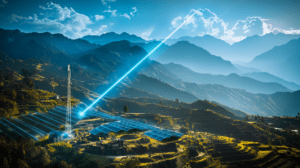
For decades, SSP occupied an awkward space between science fiction, government studies, and academic research. The concept is straightforward: place solar arrays in orbit where sunlight is near continuous, collect energy without interruptions from weather or night, and beam electricity wirelessly back to Earth. The challenge was economics; launch costs were too high, orbital infrastructure was unrealistic, and wireless power transmission was immature.
Today, nearly all of those assumptions are changing. And more importantly, the conversation around SSP is changing. This is no longer just a space conversation. It is becoming an energy conversation.
Why the Energy Industry Should Be Paying Attention
The energy industry is entering a new operating environment. Electricity demand is accelerating. Artificial intelligence (AI) infrastructure and hyperscale data centers are creating gigawatt-scale load forecasts that utilities are struggling to plan around. Transmission bottlenecks constrain renewable deployment. Interconnection queues remain clogged. Resilience concerns continue to grow.
The challenge is no longer simply generating clean energy. The challenge is generating enough clean energy that is also firm, dispatchable, and scalable. That is the gap SSP aims to address, not by replacing terrestrial renewables, but by complementing them. Solar and wind are intermittent and geographically fixed. Storage faces long-duration and scaling constraints. Nuclear remains capital-intensive and location-dependent. Space solar power introduces a different possibility: firm, dispatchable clean power delivered where and when it is needed, independent of weather, seasons, or geography.
What the Panel Revealed
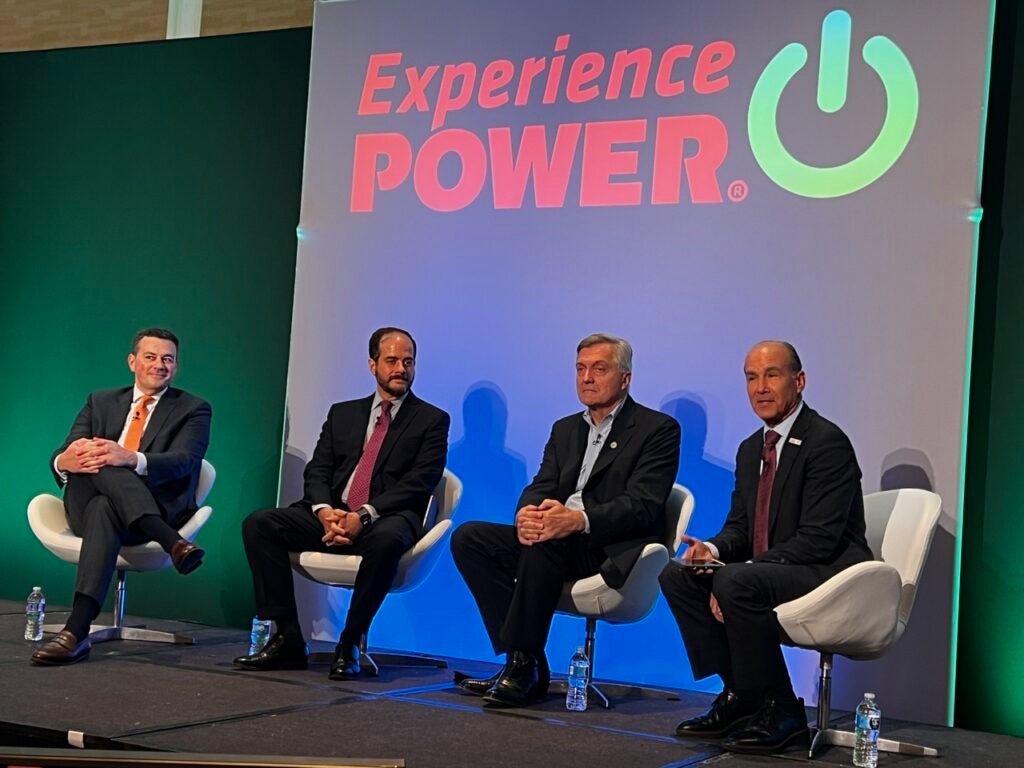
The three founders on stage were not speculating about what SSP might someday do. They were describing what they are building right now—and the announcements they made over the course of the evening reflected how quickly this industry is moving.
John Bucknell, founder and CEO of Virtus Solis Technologies, revealed the company had signed terms for its first 500-MW deployment agreement—with pilot deployments targeted within 24 months. A former SpaceX Raptor engineer with 46 patents and an active U.S. Department of Energy (DOE) Advanced Research Projects Agency-Energy (ARPA-E) contract, he is building a commercial SSP system using modular microwave-beaming satellites scalable from 100 MW to 20 GW.
Abdullah Al-Shakarchi, Chief Commercial Officer of Overview Energy, described plans to power existing utility-scale solar farms at night using near-infrared laser transmission from geosynchronous orbit—transforming daytime solar assets into near-continuous generation resources. Overview has demonstrated wireless power transmission from a moving aircraft at 15,000 feet, has a SpaceX launch booked for 2028, and a megawatt-class commercial satellite targeted for 2030. A week after the panel, Overview Energy and Meta announced a first-of-its-kind capacity reservation agreement to bring space solar energy to Meta’s data centers.
Chris Davlantes, founder and CEO of Reach Power, discussed terrestrial wireless power systems already operating today—powering robotics, defense, and remote operations—while building toward orbital integration. A NASA relay launch is planned for 2027 and the U.S. Department of Defense is an active customer. On safety, all three companies described Federal Communications Commission (FCC)–compliant approaches with triple-redundant cutoffs and power densities no more intense than a home Wi-Fi signal.
The Defining Differentiator: Geographic Dispatchability
One idea emerged repeatedly throughout the evening as SSP’s defining contribution to the energy sector.
“The true magic of space solar energy is the fact that it’s geographically dispatchable,” said Al-Shakarchi. “One satellite can see San Francisco, Santiago, Spain, Texas—and dynamically send energy wherever it’s needed.”
Today’s energy systems are geographically constrained. Power plants are fixed assets. Transmission infrastructure must physically connect generation to load. SSP changes the geometry of energy delivery itself—a satellite can redirect its beam across continents within seconds, toward the highest-value demand zone at any given moment, with no new transmission lines, interconnection queues, or permitting delays. That idea may sound radical. So did reusable rockets 15 years ago.
On economics, SSP’s target levelized cost of electricity (LCOE) of $50/MWh to $100/MWh becomes competitive when compared correctly—not against cheap daytime solar, but against firm clean power, such as nuclear ($80/MWh to $130/MWh), long-duration storage ($93/MWh), or gas peakers ($150/MWh to $200/MWh). NASA’s 2024 analysis suggests SSP could reach $30/MWh to $80/MWh by 2050.
Why Engagement Now Matters
The first partnerships, pilots, and regulatory frameworks are beginning to take shape. This is the stage where industries shape trajectories—not after the technology is fully mature, but while the standards and commercial structures are still being written.
On Sept. 30, 2026, the Space Frontier Foundation will produce a dedicated Space Solar Power Symposium in Washington, D.C., positioned between the Experience POWER and the Data Center POWER eXchange conferences. That placement is intentional. For perhaps the first time at this scale, SSP is being brought directly into the center of the power industry conversation—among utility executives, infrastructure planners, hyperscalers, regulators, and energy developers confronting explosive electricity demand growth.
The shift is already visible in who is showing up. The Energy from Space panel at SF Climate Week drew professionals from utilities, venture capital, policy, and infrastructure sectors. A subsequent USEA webinar on SSP by the Space Frontier Foundation attracted approximately 150 attendees spanning utilities, government, and industry. A decade ago, few serious commercial SSP companies existed. SSP cannot mature in isolation within aerospace—its commercial success depends on energy buyers, grid operators, and regulators determining it solves meaningful problems. Space solar power may be entering one of those moments.
The organizations that engage early will shape which applications mature first, what deployment models emerge, what standards matter, and how SSP integrates into their own future energy systems. This is no longer just a space conversation. It is an energy conversation.
—Srikanth Raviprasad (srikanth.raviprasad@spacefrontier.org) is program manager for Space Solar Power with the Space Frontier Foundation, and Abhinav Agrawal is energy specialist for Space Solar Power with the Space Frontier Foundation and a member of the Young Professionals in Energy, SF Bay Area.