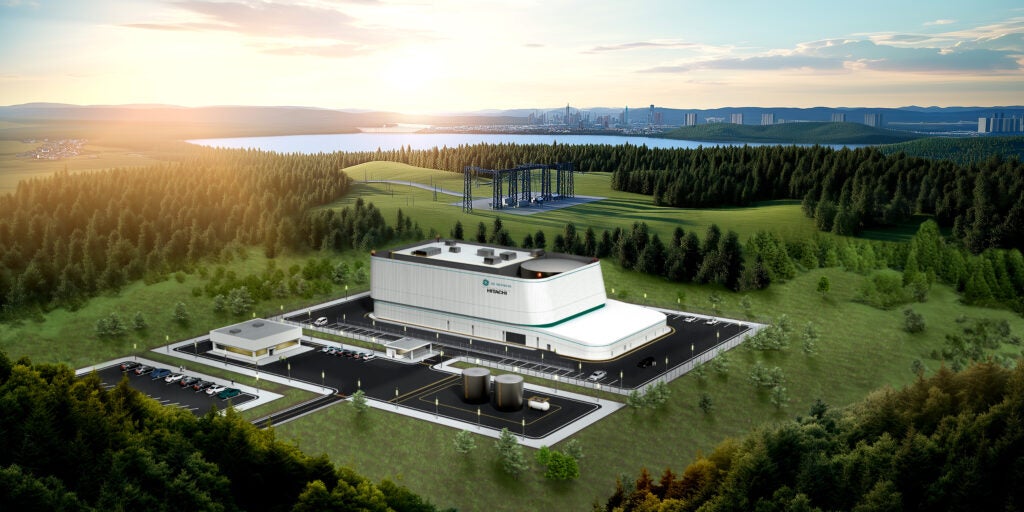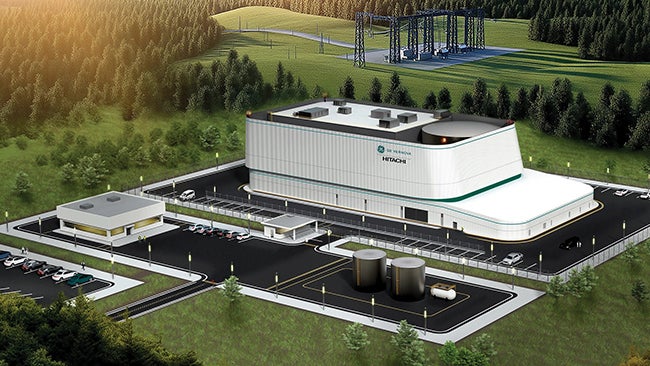

Warsaw-based small modular reactor (SMR) developer SGE has unveiled plans to deploy 14 GE Vernova Hitachi Nuclear Energy (GVH) BWRX-300 units across three U.K. sites. The company says the 4.2-GW privately financed fleet could ultimately meet roughly 11% of UK power demand.
The plan, announced by SGE on July 2, was submitted as an application under the U.K.’s newly minted Advanced Nuclear Framework (ANF) and would be executed through a dedicated project vehicle led by SGE’s UK arm, SGE SMR UK. The ANF is a U.K. government policy framework, published by the Department for Energy Security and Net Zero (DESNZ) in February 2026, that establishes the enabling policy landscape, including a project readiness assessment process, an Advanced Nuclear Pipeline, and supporting measures across finance, planning, regulation, fuel supply, and skills. The ANF is geared toward privately led SMR, advanced modular reactor (AMR), and micro modular reactor (MMR) projects in England and Wales.
“The project is targeting three multi-unit sites, the first to host six BWRX-300 units, with two further sites to follow in quick succession,” SGE said. “In total, the program represents a significant addition to the UK’s future nuclear capacity and supports the country’s long-term energy security, clean power, and industrial growth ambitions.”
SGE said it expects the project to enter the Advanced Nuclear Pipeline in November 2026, “with site selection and government support scheme negotiations completed in the first half of 2027.” Following the financing phase, “site preparation and licensing work would begin within approximately a year, with first commercial operation of the first unit targeted for 2034,” it said.

A Deep Consortium
SGE—formerly Synthos Green Energy—is a Warsaw-based European SMR development and investment platform founded in 2019 by Michał Sołowow, Poland’s second-richest industrialist and owner of the MS Galleon group (whose holdings include synthetic-rubber major Synthos and rank among Europe’s largest privately held industrial groups). In October 2019, Sołowow signed what SGE describes as GE Hitachi’s first-ever BWRX-300 agreement worldwide, establishing the company as GVH’s Polish deployment partner and, later, as a co-investor in the reactor’s standard design.
In March 2023, SGE joined Ontario Power Generation (OPG), the Tennessee Valley Authority (TVA), and GVH in a $400 million technology-collaboration agreement to develop the BWRX-300 standard design and a Design Center Working Group tasked with making the reactor deployable across jurisdictions. SGE holds exclusive BWRX-300 rights in nine Central and Eastern European countries, as well as limited exclusivity in Germany and the U.K., and it is the co-owner (with state-controlled PKN Orlen) of Polish JV ORLEN Synthos Green Energy (OSGE), which is developing up to 24 BWRX-300 units at six Polish sites, with the first unit targeted at Włocławek by 2032. Beyond Poland, SGE has signed cooperation agreements or letters of intent to advance BWRX-300 projects in Bulgaria, Hungary, and Lithuania.
SGE’s proposal for the 14 BWRX-300 fleet includes an unusually deep consortium for a pre-SMR application. Alongside SGE and GVH, it enlists Samsung C&T, the South Korean engineering-and-construction group whose nuclear track record includes delivery of the 5.6-GW Barakah nuclear power plant in the United Arab Emirates—12 GW across 10 units in total—and which has since taken on plant refurbishment work and front-end engineering design (FEED) for SMRs.
On the construction side, the team pairs Laing O’Rourke, the UK’s largest privately owned engineering and construction firm and a proponent of digital design and advanced manufacturing methods delivered through its Midlands-based component factories, with Canada’s Aecon Group, which is already a lead partner on OPG’s Darlington New Nuclear Project—the first BWRX-300 under construction anywhere—giving the U.K. consortium direct access to first-of-a-kind execution lessons on modularization, automation, and integrated project delivery.
U.K.-based Fermi Development contributes site development capability: the private-sector nuclear developer says it has already screened more than 100 U.K. sites and identified roughly 40 as potentially developable, with a workflow purpose-built for SMR fleet deployment through the Development Consent Order, permitting, and regulatory pathway. And, rounding out the group is Etara, a specialist advisory firm whose bench claims more than 200 years of combined experience advising on nuclear support-scheme design across Poland, Sweden, Belgium, Czechia, Hungary, Turkey, Finland, the Netherlands, Slovakia, Bulgaria, and Lithuania, as well as the U.K.’s Hinkley Point C, Sizewell C, and Wylfa projects.
GVH itself, GE Vernova’s alliance with Hitachi, brings the reactor technology and its fuel-cycle arm, Global Nuclear Fuel, a boiling-water-reactor fuel joint venture operating out of Wilmington, N.C., and Kurihama, Japan. SGE also said the consortium will include an “experienced nuclear operator.”
Notably, the developer says it intends to deploy under a Contract for Difference (CfD) framework “with National Wealth Fund engagement,” structured so that “there will be no charges to consumers prior to operations.” A CfD is a long-term private-law contract between a generator and a government counterparty that guarantees a fixed “strike price” for electricity so that, when wholesale prices fall below the strike, the generator is paid the difference, and when they rise above it, the generator pays back. The mechanism is designed to shield developers and financiers from market volatility while capping consumer exposure.
The National Wealth Fund, the U.K.’s statutory investment institution, notably, is separately backing Rolls-Royce SMR with up to £599 million and is positioned under the Advanced Nuclear Framework to co-invest in privately led nuclear projects.
“We are focused on delivering efficient, safe, affordable, and clean nuclear energy power at fleet scale,” said SGE Founder Michał Sołowow, whose Polish holdings underpin the company. CEO Rafał Kasprów noted the U.K. application is “a major milestone in our ambition to develop a fleet of BWRX-300 small modular reactors across the UK and the European Union,” arguing that “standardization, repetition, modularization, and a fleet deployment strategy are the most effective ways to deliver new nuclear projects successfully.”
In its ANF executive summary, DESNZ said that advanced nuclear technologies “open the door to nuclear projects owned, delivered and financed by the private sector,” a departure from a U.K. sector that has traditionally “relied on significant state underwriting or delivery by state‑owned entities.” The document points to “private‑wire power to data centers” among the target business models and commits to a “concierge‑style” Advanced Nuclear Business Engagement Unit within DESNZ to help developers navigate siting, grid, and regulatory pathways. Pipeline Membership, DESNZ notes, confers a “Statement of Limited, In‑Principle, Endorsement, signalling that government considers the project credible and potentially deliverable in the U.K.,” while the National Wealth Fund—armed with £27.8 billion and a dedicated nuclear team—”can act as a catalytic investor” alongside private capital.
Recent U.K. SMR Progress: A Crowded, Fast-Moving Field
SGE’s proposal arrives as the U.K. nuclear market enters a dramatic acceleration. In June 2025, Great British Energy–Nuclear (GBE-N)—the successor to Great British Nuclear—selected Rolls-Royce SMR as its preferred technology partner after a two-year competition in which GVH, Holtec, Rolls-Royce, and Westinghouse were shortlisted. In November 2025, the government confirmed Wylfa on Anglesey as the site for a first three-unit, ~1.5-GW Rolls-Royce SMR project, and in April 2026, GBE-N and Rolls-Royce SMR signed a landmark design-and-delivery contract, backed by up to £599 million from the National Wealth Fund and £2.6 billion allocated at the 2025 Spending Review.
To spur privately led projects, DESNZ in February 2026 published the ANF, establishing a Project Readiness Assessment process, an Advanced Nuclear Pipeline for endorsed projects, and enabling measures spanning finance, planning, regulation, high assay low-enriched uranium (HALEU) fuel supply, and skills. That included up to £300 million for a domestic HALEU supply chain and £196 million awarded to Urenco to deliver a commercial-scale enrichment facility at Capenhurst in Cheshire by 2031.
Efforts to boost the design assessment process have also ramped up. The BWRX-300 completed Step 2 of the Generic Design Assessment (GDA) in December 2025—the fastest GDA engagement to date, according to the Office for Nuclear Regulation, with no fundamental safety, security, safeguards, or environmental protection shortfalls identified. In its Step 2 summary report, ONR noted that GVH “has stated that, at this time, it has no plans to undertake Step 3 of GDA,” and that “any further assessment by the UK regulators of the BWRX-300 design will be on a site-specific basis and with a future licensee.”
For now, Rolls-Royce SMR remains the only design in Step 3 (which started in July 2024). Holtec’s SMR-300 completed a two-step GDA on March 31, 2026, formally closing that assessment pending any future site-specific work. TerraPower’s Natrium entered Step 1 in June 2026, becoming the first sodium-cooled fast reactor to enter U.K. regulatory review. Regulators on May 22, 2026, published a new position statement and an international-judgments policy targeting roughly two-year reactor design assessments, with updated guidance due in Spring 2027.
The BWRX-300 Global Deal Spectrum
SGE’s July 2 proposal marks the first identified U.K. BWRX-300 site plan since GEVH completed Step 2 of the Generic Design Assessment in December 2025, but GEVH has continued to build up its pipeline with new deals in Ohio, Texas, Bulgaria, Hungary, and Southeast Asia, construction progress in Ontario, and an expanding U.K. and Canadian supply chain.
Canada. The first commercial BWRX-300 project is well underway in Ontario. OPG received Canadian Nuclear Safety Commission construction approval in April 2025 for the first of four BWRX-300 units at the Darlington New Nuclear Project (DNNP), and full-scale construction began in May 2025. In late June 2026, crews lowered a 953-tonne basemat into a 35-meter shaft. OPG’s estimate now puts Unit 1 at CAD $6.1 billion (plus roughly CAD $1.6 billion in shared infrastructure) and the four-unit program at CAD $20.9 billion. On June 23, seven Williams Treaties First Nations committed CAD $700 million in equity financing, which Canada’s finance minister described as the largest Indigenous loan guarantee in Canadian history. Unit 1 is targeted for commercial operation by the end of 2030. Separately, in 2023, SaskPower selected the BWRX-300 for possible deployment in Saskatchewan, which would be the province’s first nuclear reactor.
U.S. TVA submitted the first U.S. BWRX-300 construction permit application to the Nuclear Regulatory Commission in May 2025 for the Clinch River site in Oak Ridge. In late June 2026, NRC staff issued the Final Safety Evaluation Report for Clinch River Unit 1 and recommended the Commission issue the construction permit under 10 CFR 50.35, which marked the first such recommendation for a BWRX-300 in the U.S. TVA is executing through an integrated project delivery partnership with Bechtel, Sargent & Lundy, and GVH, and on June 1, 2026, the Department of Energy awarded TVA $400 million in cost-shared funding to accelerate the project.
The next project may be in Ohio. On June 18, 2026, independent developer Elementl Power announced it had signed an Early Works Agreement with GVH to deploy up to five BWRX-300 units—1.5 GW total—on a 700-acre site along the Ohio River in Letart Township, Meigs County. Elementl has agreed to acquire the canceled coal plant site from American Municipal Power and has moved to file a PJM Interconnection request for an initial 600 MW. The company, which received early-stage capital from Google in 2025 to prepare three U.S. sites, is privately financing the project, with construction of the first unit targeted for 2030 and commercial operation in 2034. Elementl was already TVA’s partner on Clinch River, making Ohio its second BWRX-300 site.
On May 5, 2026, GE Vernova and Blue Energy announced a 2.5-GW gas-plus-nuclear collaboration at the Port of Victoria, which could pair two GE Vernova 7HA.02 gas turbines with up to five BWRX-300 SMRs. As POWER reported, the phased “gas-to-nuclear” model would deliver roughly 1 GW of gas-fired power as early as 2030 before ramping to 1.5 GW of nuclear generation as the SMRs come online in 2032. The site is adjacent to Crusoe’s planned 1,600-acre AI factory campus in Calhoun County.
Poland. ORLEN Synthos Green Energy (OSGE)—the 50/50 joint venture between SGE and PKN ORLEN—plans to build roughly 24 BWRX-300 units across six locations, backed by the Polish Ministry of Climate and Environment and the National Atomic Energy Agency, U.S. Department of State support, and signed letters of interest from the U.S. Export-Import Bank and the U.S. International Development Finance Corporation totaling up to $4 billion. On June 25, 2026, OSGE signed a cooperation agreement with the city of Włocławek covering up to six BWRX-300 units (1.8 GW) at Poland’s first SMR site. Days later, OSGE applied to Poland’s Minister of Energy for the EU’s first Contract for Difference on SMRs, covering 14 units across Włocławek, Stawy Monowskie (near Oświęcim), and Stalowa Wola. That effort builds on a February 2026 Polish Generic Design Agreement with GVH and a November 2025 Orano framework agreement for front-end fuel-cycle services in Central and Eastern Europe.
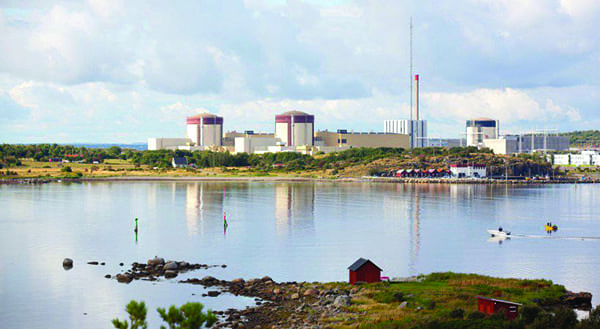
Sweden. Vattenfall down-selected the BWRX-300 in August 2025 for potential deployment at Ringhals on the Värö Peninsula, and in October 2025, GVH and Samsung C&T signed a strategic alliance covering global markets outside North America, including the potential deployment of five BWRX-300s in Sweden. GVH followed in April 2026 with a Main Services Agreement with AFRY to support Swedish Radiation Safety Authority (SSM) license preparation.
Finland. In July 2025, Fortum and GVH entered into an Early Works Agreement to advance potential BWRX-300 deployment across Finland and Sweden.
Estonia. Fermi Energia selected the BWRX-300 in February 2023 for potential deployment in Lääne-Viru County, targeting the first SMR operational by 2035.
Hungary. In July 2025, Hungarian nuclear development firm Hunatom and SGE signed a letter of intent to establish a framework for joint work on up to 10 BWRX-300 units in Hungary, extending SGE’s Central and Eastern Europe development platform into a fifth country.
Bulgaria. On December 22, 2025, Blue Bird Energy AD and SGE signed a letter of intent for a joint venture to deploy up to six BWRX-300 units in Bulgaria, complementing the two Westinghouse AP1000 units already planned for the Kozloduy site.
Lithuania. In February 2026, SGE, the Lithuanian state operator Ignalina NPP (Altra), and GVH signed an MoU to assess the feasibility of the BWRX-300 in the country.
Czech Republic. ČEZ and GVH signed a February 2020 MoU to examine BWRX-300 feasibility at Temelín. ČEZ ultimately selected Rolls-Royce SMR as its primary partner in October 2024, signing an Early Works Agreement in July 2025, but GVH continues to list the country as an active study market as ČEZ evaluates candidate SMR designs for follow-on sites at Tušimice and Dětmarovice.
Asia. GEVH’s order book expanded sharply into Asia in early 2026. On March 14, at the Indo-Pacific Energy Security Ministerial in Tokyo—attended by U.S. Interior Secretary Doug Burgum and Japan Ministry of Economy, Trade and Industry (METI) Minister Ryosei Akazawa—GE Vernova and Hitachi signed a memorandum of understanding to explore BWRX-300 deployment across Southeast Asia, working through their GVH and Hitachi-GE Vernova Nuclear Energy joint ventures and seeking to integrate Japanese suppliers. Days later, coinciding with the March 19 Trump-Takaichi White House meeting, the two governments unveiled a U.S.-Japan Strategic Investment initiative committing up to $40 billion in Japanese investment toward GVH BWRX-300 projects in Tennessee and Alabama, targeting roughly 3 GW of new SMR capacity. The $40 billion tranche is part of a larger $65 billion Japanese SMR allocation inside a $550 billion U.S. investment framework tied to trade negotiations, with a further $25 billion earmarked for NuScale.
A Building Supply Chain
GVH has also been building out its U.K. delivery capability. In September 2024, GVH signed MoUs with Aecon, AtkinsRéalis, Jacobs, and Laing O’Rourke to advance BWRX-300 technology, and in February 2025, it added MoUs with U.K. nuclear engineering firms Boccard and Cavendish Nuclear.
For its Canadian prospects, in October 2024, GVH tapped Velan to supply valves and Worley Chemetics to design a key safety system for the first Darlington unit, and in January 2025, GVH contracted BWX Technologies to manufacture the reactor pressure vessel for Darlington. Last year, GVH announced a BWRX-300 Engineering and Service Center in the Durham region near Darlington, and in June 2026, GVH and Velan expanded their collaboration to European projects to extend Reactor Integral Isolation Valve and Containment Isolation Valve supply beyond Canada.
—Sonal Patel is a POWER senior editor (@sonalcpatel, @POWERmagazine).