
Cover Stories
-
 Waste to Energy
Top Plants: Rio Bravo Rocklin Power Station, Lincoln, California
By 2008, the 19-year-old wood-fired Rio Bravo Rocklin Power Station’s operating performance had been significantly degraded by boiler erosion and corrosion caused by (among many other problems) poor fuel. After much consideration, the plant owners elected to invest in a comprehensive upgrade to restore the plant to its as-built performance. Today, the plant operates very reliably. A newly implemented predictive maintenance program should continue to drive down operating costs and further reduce the number of forced outages.
-
-
 Nuclear
Top Plants: Diablo Canyon Power Plant San Luis Obispo County, California
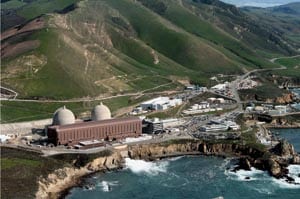
Diablo Canyon Power Plant, which is situated in a postcard-perfect location on the central California coastline, generates electricity for more than three million households in central and northern California. In 2009 the project team at the dual-unit Westinghouse pressurized water reactor facility replaced four steam generators at Unit 1 in just 58 days. Through meticulous planning and excellent project execution, performance on this Unit 1 project was an improvement on the earlier Unit 2 steam generator replacement project.
-
 Nuclear
Top Plants: Oconee Nuclear Station Oconee County, South Carolina
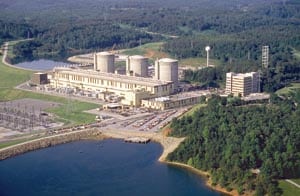
Duke Energy’s nuclear fleet provides electricity to approximately half of the utility’s customers in the Carolinas. The 2,538-MW Oconee Nuclear Station is part of that fleet and has been a pacesetter among U.S. nuclear plants since it began operation in 1973. In order to maintain the plant’s productivity and reliability, its staff implemented a comprehensive controls modernization project that spanned a decade. With its new state-of-the-art upgrades, the facility has become a leader in applying digital electronic technology in the nuclear power industry.
-
 News
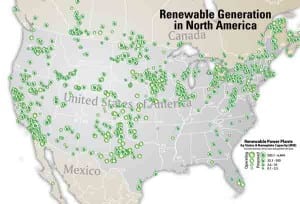
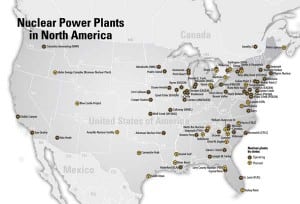
NewsMap of Nuclear Power Plants in North America
For a larger version of this or other Platts maps appearing in POWER, please contact the Platts Store.
-
 Coal
CoalTop Plants: Bull Run Fossil Plant, Clinton, Tennessee
When TVA’s Bull Run Fossil Plant was erected in the mid-1960s, it could boast of having the largest boiler in the U.S., and the plant has enjoyed a long, enviable efficiency track record. Today the public judges coal plants by their emissions. Now that it’s been outfitted with the most advanced air quality control systems, including the latest flue gas desulfurization system design, Bull Run scores a perfect "10" in both categories.
-
 Coal
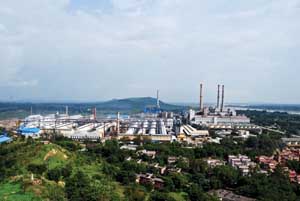
CoalTop Plants: Hirakud Power, Sambalpur, Orissa, India
Hirakud Power uses environmentally friendly circulating fluidized bed (CFB) combustion technology to produce electricity for one of the world’s oldest aluminum-smelting operations. This "captive power plant" has engineered a number of technical fixes to its original boiler designs to improve plant reliability and reduce outages and boiler repair costs. It also has made strategic investments in upgraded machinery to reduce auxiliary power consumption. In addition to an excellent environmental track record, as evidenced by being Asia’s first ISO 14001 (BS 7750) – certified power plant, Hirakud Power has solidified its position as an industry leader in CFB boiler operating experience and efficient power production.
-
 Coal
CoalTop Plants: Hutsonville Power Station, Crawford County, Illinois
This plant’s staff proves that a can-do attitude and high productivity can be compatible with a safer workplace. The proactive approaches they used at the 162-MW Hutsonville plant ranged from improving boiler efficiency to better managing risks to workers.
-
 Coal
CoalTop Plants: Nebraska City Station Unit 2, Nebraska City, Nebraska
Omaha Public Power District commissioned Unit 2 at its Nebraska City Station in May of this year. The new 682-MW unit joins Unit 1, which went commercial 30 years ago in the same month. The project is outfitted with all the requisite air quality control systems and sports a very good thermal efficiency. More importantly, the plant will provide reasonably priced power for customers of eight municipal utilities that share ownership of the plant’s electrical output. Those utilities paid for their portion of the construction cost and now receive a like portion of the electrical output from Unit 2 under a unique participation power agreement.
-
 Coal
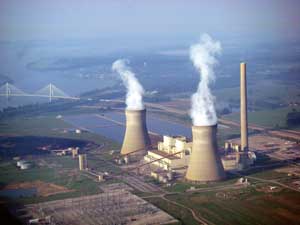
CoalTop Plants: Rockport Power Plant, Rockport, Indiana
Hard work was required at the 2,600-MW Rockport Plant to make improvements to equipment, materials, and processes. But that hard work has paid off: The plant’s units operate much better, employee safety has improved, the facility is setting generation records with both of its 1,300-MW units, and it earned the PRB Coal Users’ Group Large Plant of the Year honors.
-
 Coal
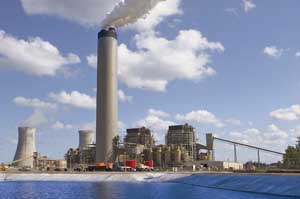
CoalTop Plants: Seminole Generating Station, Palatka, Florida
Complying with a corporate environmental policy requires much more than just writing a check for equipment upgrades. It takes a dedicated and knowledgeable staff that’s willing to invest years of work to permanently reduce a plant’s environmental footprint. The staff of Seminole Generating Station have completed multiple, incremental plant improvements over the past decade that have significantly reduced air emissions and minimized solid waste disposal.
-
 Gas
GasTop Plants: Edward W. Clark Generating Station, Clark County, Nevada
The Edward W. Clark Generating Station, which has supplied electricity to the Las Vegas Strip for more than half a century, has learned the secret of life in the desert: adaptability. The plant’s early years featured conventional steam plants operated around the clock. By mid-life, Clark had been upgraded with two combustion turbine combined-cycle power blocks operated as intermediate-load resource. Today, the old steam plants have been replaced with fast-start peaking gas turbines.
-
 Gas
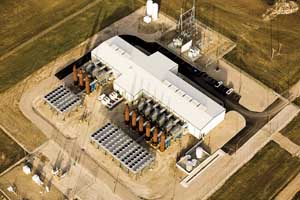
GasTop Plants: Goodman Energy Center, Hays, Kansas
Midwest Energy has a history of thinking and acting independently, especially since breaking away from the Rural Utilities Service almost 15 years ago. Two years ago, when its board of directors grappled with finding a balance between purchasing and generating electricity, it decided to construct its first power plant in 37 years. A matched set of nine 8.4-MW gas engines at Goodman Energy Center now provides efficient peaking electricity, improved overall system reliability, and backstop capacity for a 325-MW electrical system that features 16% wind power generation.
-
 Gas
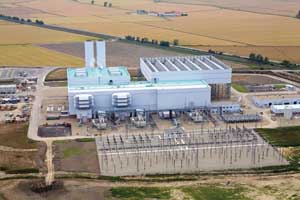
GasTop Plants: Livorno Ferraris Power Plant, Vercelli Province, Italy
Northern Italians are enjoying la dolce vita (the sweet life) even more today than they have historically, thanks to the additional electrical capacity provided by the new Livorno Ferraris power plant. Well-received by locals due to its environmentally progressive operations and low-profile appearance, the 800-MW plant is powered by combined-cycle units that burn natural gas. The plant, which generates more than 5 million kWh per year, is part of a comprehensive renewal of the Italian energy sector and will make an important contribution toward ensuring that the country’s power supply is more secure.
-
 O&M
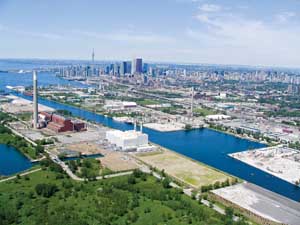
O&MTop Plants: Portlands Energy Centre, Ontario, Canada
Construction of the Portlands Energy Centre was a logistical dream: A mothballed power plant next door had an active switchyard, natural gas pipeline, and cooling water structure. The new facility put peak power into the Ontario Power Authority’s grid from its two combustion turbines only two years after collecting the necessary permits. The entire plant entered commercial service on April 23, 2009 — six weeks early.
-
 Coal
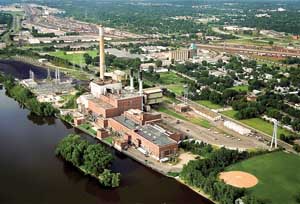
CoalTop Plants: Riverside Repowering Project, Minneapolis, Minnesota
Xcel Energy has completed the third and final project required by its 2003 Metropolitan Emissions Reduction Project agreement: repowering the Riverside Plant with a gas-fired 2 x 1 combined-cycle plant and tearing down the old coal-fired plant. Saved from demolition was the Unit 7 steam turbine system that now serves the new plant. Xcel staff expertly managed the project to an on-time start-up and accepted many important construction tasks, harkening back to the days when utilities took a more active role in the design and construction of projects.
-
 O&M
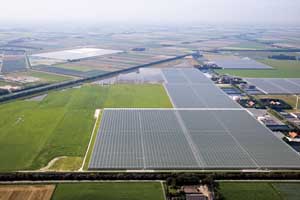
O&MTop Plants: Royal Pride Holland Commercial Greenhouse Cogeneration Plant, Middenmeer, North Holland Province, Netherlands
At Royal Pride Holland’s commercial tomato greenhouse, green thumbs and green energy go hand in hand. With a total energy utilization of 95% in this application, GE’s new Jenbacher J624 natural gas – fired engines offer the innovative greenhouse an economical supply of on-site electrical and thermal power, as well as CO2 fertilization, to support its operations.
-
 Coal
CoalCity of Springfield’s CWLP Dallman 4 Earns POWER’s Highest Honor
City Water, Light & Power (CWLP), the municipal utilities agency of the City of Springfield, Ill., determined that coal-fired generation was its best alternative for providing long-term reliable and economic electricity to the city’s residents. For negotiating an unprecedented agreement with the Sierra Club that allowed the project to move forward, for choosing the latest in coal-fired technology and air quality control systems as the foundation for the city’s comprehensive energy policy, and for assembling a tightly integrated team that completed the project well before the contractual deadline and under budget, CWLP’s Dallman 4 is awarded POWER magazine’s 2009 Plant of the Year award.
-
 Instrumentation & Controls
Digital Networks Prove Reliable, Reduce Costs
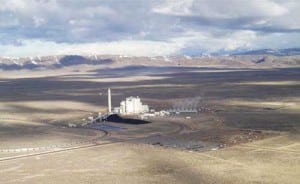
The debate over the benefits of using digital bus networks as the communications backbone of new power plants is all but settled. The technology is maturing, and the reliability of digital hardware is superior to that of hardwired systems. Newmont Gold Mining’s 200-MW TS Power Plant is perhaps the power industry’s best example of how a plantwide digital controls architecture can provide exceptional reliability and be significantly less costly to install.
-
 O&M
O&MAdvanced Modeling Tools Slash Combustor Analysis Chores
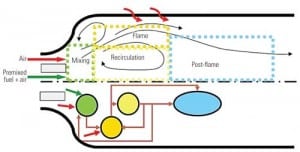
Combustor design simulation requires the resolution of complex geometry, turbulent flow patterns, heat transfer, and detailed chemistry. Although computational fluid dynamics (CFD) can simulate the reacting flow in realistic geometries, it requires the use of severely restricted chemistry models that are too simple to accurately simulate emissions and operational stability. A new simulation tool is now available that eliminates this CFD shortcoming while significantly reducing computing time.
-
 Water
WaterReconsider Start-up Controls to Avoid Boiler Deposits and Underdeposit Corrosion
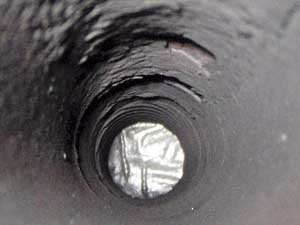
Water treatment programs for boilers and heat-recovery steam generator (HRSG) units appropriately focus on chemistry controls during normal operation. However, rates of corrosion product transport and deposition can be much greater in boilers and HRSG units during start-up than during routine operation. For that reason, in addition to standard programs for monitoring and control of corrosion product transport, deposition, and underdeposit corrosion, consider adding contingency plans for boiler water chemistry holds in the start-up process.
-
 Water
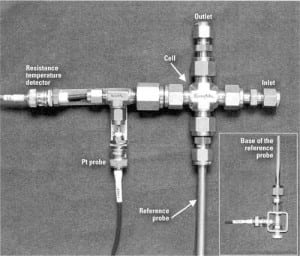
WaterHow to Measure Corrosion Processes Faster and More Accurately
Maintaining reliable and efficient plant operations requires good control of corrosion and corrosion product transport in power plant water systems. The Electric Power Research Institute recommends oxidation-reduction potential for passivator control in feedwater systems, as do many industry experts. Here’s how to turn that recommendation into a robust feedwater monitoring program.
-
 Distributed Energy
In Search of Perfect Power
What do you do when your research institution is losing roughly half a million dollars annually as a result of multiple electricity outages — and electricity demand keeps rising? If you’re the Illinois Institute of Technology, you turn the challenge into a campuswide learning experience by teaming with the Galvin Electricity Initiative and other experts to design and construct a prototype Perfect Power System (PPS). Even during its implementation, the PPS promises to provide more reliable and sustainable electricity to the university at a lower cost than it had been paying.
-
 Coal
CoalPolish Plant Beats the Odds to Become Model EU Generator
Once a Soviet satellite, Poland is now transforming into a thoroughly modern nation. To support its growing economy, this recent European Union member country is modernizing its power industry. Exemplifying the advances in the Polish electricity generation market is the 460-MW Patnów II Power Plant — the largest, most efficient (supercritical cycle), and environmentally cleanest lignite-fired unit in the country.
-
 Instrumentation & Controls
ISA POWID: Where Power Computing Professionals Meet
Which new and emerging technologies will be essential to your power plant’s success? Our special cover story series gives you a glimpse into the future of advanced distributed controls, wireless applications, and automation technologies.
-
 Instrumentation & Controls
Distributed Control Technology: From Progress to Possibilities
The past decade has seen an explosion of technology that has significantly altered the process control industry. The adoption of commercially available technology driven by desktop computing has allowed suppliers to focus on applications to enhance the process and deliver ever-greater value to the user.
-
 Instrumentation & Controls
Optimize Your Plant Using the Latest Distributed Control System Technology
Distributed control systems are powerful assets for new and modernized power plants. Thanks to three product generations of technology innovations, these systems now provide new benefits — including improved O&M efficiency, greater plant design flexibility, and improved process control and asset reliability — that help competitive plants advance in the game.
-
 Instrumentation & Controls
Power Plant Automation: Where We Are and Where We’re Headed
Over the past decade, power plant control systems have evolved from DCS-centered platforms with proprietary software, to open systems using industry standard hardware and software, and then to totally integrated plant automation systems with almost unlimited connectivity and the ability to interrogate field instruments from many different manufacturers. What’s next?
-
 Instrumentation & Controls
Enhancing Plant Asset Management with Wireless Retrofits
Wireless technology is a mostly untapped resource in the power generation industry that can have a significant impact on the way business is done. It enables a greater degree of connectivity among devices for enhanced monitoring and asset utilization and has led to the development of new applications that improve productivity, uptime, and overall business performance.
-
 Instrumentation & Controls
Wireless Technology Unlocks Possibilities
Modern wireless systems improve productivity, monitoring activities, and safety at power plants by enabling the right people to be at the right place at the right time. Wireless technology can put hard-to-access process and asset information at your fingertips, wherever you are, to enable more accurate and timely decisions.