Power generation operators are navigating a major workforce transition at the same time operations and maintenance (O&M) work is becoming more complex. Deloitte’s 2025 Power and Utilities Industry Outlook notes that demand for U.S. electricity surpassed expectations in 2025, driven by artificial intelligence (AI) training workloads and electrification initiatives, naturally creating a corresponding surge in workforce demand.
That creates a difficult balance for power generators. They need to bring new workers up to speed, preserve institutional knowledge and maintain consistent execution across plants, field assets, crews and contractors. At the same time, rising electricity demand, grid modernization, renewable integration, distributed energy resources, data center growth and renewed interest in nuclear power are adding more complexity to the work.
Hiring and training more workers is part of the answer. Maintaining consistency across the work itself also needs to stay top of mind. As operators bring in newer workers, rely on third-party service providers and manage more diverse generation portfolios, standard work can begin to vary in ways that are hard to see.
That is operational drift. It occurs when day-to-day work gradually moves away from approved procedures, safety practices or maintenance standards. In power generation, drift may begin with an inspection performed slightly differently from site to site, a recurring alarm handled based on local habit, a work order closed without enough detail or a field workaround passed informally from one technician to another.
Power generation O&M is highly procedural, safety-sensitive and often performed in demanding environments. A technician may be responding to an equipment fault, coordinating with a remote operations center, preparing for an outage, following lockout/tagout procedures or documenting a critical inspection before a unit returns to service. Their job demands technical skill, safety discipline, and judgment in the field.
And while training prepares a worker for the job, “know-how” alone does not prevent drift. Execution determines whether the job is performed safely and consistently every time.
Training vs. Execution
The power generation industry has seen massive progress in standardizing safety and technical training, with modern frameworks helping establish baseline knowledge and making it easier for technicians to move across employers, projects and geographies. That foundation is important, especially as the industry works to scale the workforce.

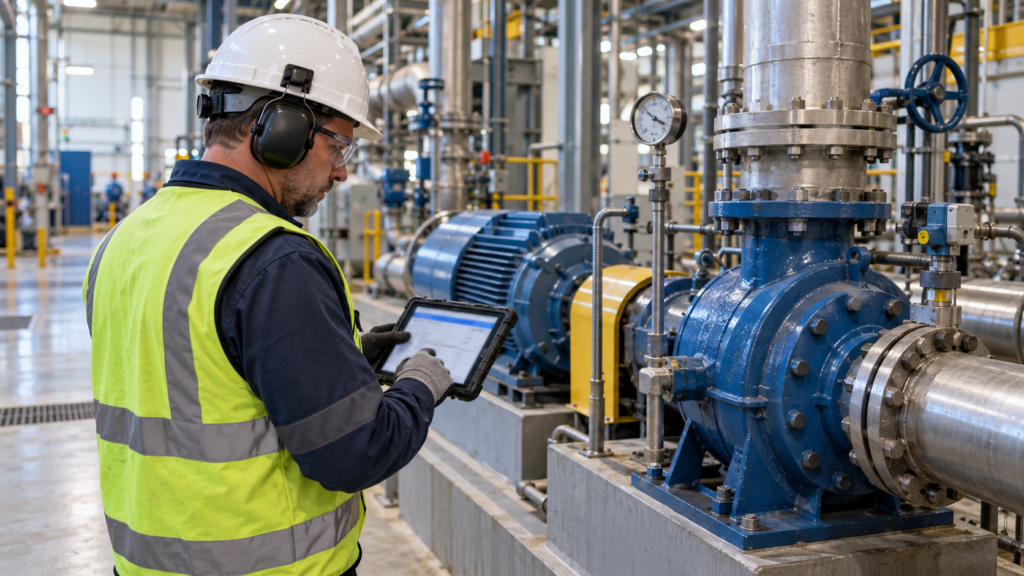
Credit: iStock / Getty Images, courtesy of Atheer
However, once technicians are in the field, they face real-world conditions that training cannot replicate. Workers may have to decide, on the spot, when an exception requires supervisor input. Most of the time, deviations from standard practice are not the result of carelessness. A technician may have a valid reason for handling a task differently, but there’s risk in limited visibility, since that deviation may never be reviewed or incorporated back into the standard process.
If a field adjustment becomes habitual, the habit becomes local practice. Local practice becomes invisible to leaders who only see that a work order was completed.
The Next Workforce Challenge: Consistency
As power generation operations span a broader mix of assets, sites and teams, clearing the next workforce hurdle depends on consistency. The following are a set of practical questions operators need to be able to answer:
- Can technicians access the standard procedure instructions at the point of work?
- Do supervisors have a clear method of verifying that procedures are completed correctly?
- Is there a protocol in place for recording exceptions in real time?
- Will field observations feed back into engineering, reliability and procedure departments?
- Is there a strategy to leverage AI to the frontline teams in a governed, compliant way?
The ability to answer “yes” to these questions is critical because the cost of inconsistency rises with scale. A small documentation misstep at a generating unit may be manageable, but when repeated across a fleet, it becomes a larger operational problem.
Eliminating operational drift doesn’t mean removing worker judgment. Field teams will always need to adapt to real conditions. The ultimate goal is to make those adaptations visible, reviewable and useful. When a technician encounters something unexpected, the organization can capture what happened, determine whether the procedure needs to change, and share that learning across the fleet.
This need will become more urgent as the workforce changes. Deloitte notes that utilities are already cultivating a new generation of talent and embracing new skills, while also facing retention challenges and competition for workers from other sectors. Nuclear power shows another version of the same issue. The U.S. Department of Energy projects the nuclear sector will need 375,000 additional workers over the next 20 years.
Across generation types, the pattern is similar. More complex work is being handed to a changing workforce, and organizations need better ways to preserve expertise, guide execution and capture what happens in the field.
The Work Order Does Not Tell the Whole Story
In practice, capture happens (or doesn’t) in one place: the work order.
Power generation operations leaders rely on work orders, inspection records and maintenance logs to understand asset health and workforce performance. These records document preventive and corrective maintenance, downtime, parts usage and recurring failures, and they support reliability analysis and long-term performance improvement.
But a completed work order is a record that a task happened, not proof of how well it was performed. A technician may close a task with minimal notes or a recurring issue may be described differently by different crews. Field observations may remain trapped in free-text notes or informal conversations, disconnected from the systems built to catch patterns.
This challenge grows as assets age, fleets diversify, and experienced workers retire. Older assets often require more informed field decision-making, while newer technicians may not yet recognize subtle signs of failure or know when a condition warrants escalation. If experienced workers are the only ones who understand site-specific risks or recurring equipment behaviors, that knowledge is tied to individuals rather than built into the process.
Power generators cannot rely on tribal knowledge alone. They need a way to put expert guidance in the flow of work and capture what technicians learn in the field.
When Detection Outpaces Response
Power generation operators are already focused on improving reliability and reducing downtime. Predictive maintenance, condition monitoring, SCADA data, vibration analysis, thermal monitoring and remote operations tools have all become important parts of modern O&M.
Technology that detects a problem is only half the equation. The organization still needs the field team to respond consistently. A recurring fault, inspection finding or abnormal operating condition may be handled well by one crew and inconsistently by another. One team may escalate quickly and document the issue in detail. Another may treat it as routine or close the work order with limited context. If each crew answers those moments differently, a real reliability problem can look like a set of isolated incidents.
A documentation issue can make root-cause analysis harder. A procedural inconsistency can lead to rework, downtime or safety exposure. The risk may stay hidden until it creates a measurable consequence, such as lost production, repeat failures, audit concerns or delayed return to service.
Consistency Across a Mixed Workforce
Power generation operations depend on a vast network of internal teams, OEM support, contractors and specialty service providers. That model gives operators flexibility, but it also makes consistency harder to hold onto. Different teams bring different habits, documentation standards and interpretations of the same procedure. One contractor may capture detailed inspection photos and notes; another may provide only basic completion data. One crew may escalate a recurring condition quickly; another may treat it as routine.
This isn’t a reason to avoid contractor support. Contractors are essential to operations, especially during major maintenance, component replacement and work across dispersed sites. It’s a reason contractor-heavy environments need stronger execution standards, clearer guidance and better proof of work.
Operators need to know that safety-critical and reliability-critical tasks are performed consistently regardless of who completes them, and that means confirming the task was performed to standard.
Moving from Completed Work to Verified Execution
Preventing operational drift requires a shift from completed work to verified execution. Beyond confirmation that a task moved through the system, operators need confidence that the operation was performed safely, consistently and in alignment with the approved procedure.
That starts with bringing guidance into the flow of work, so technicians aren’t relying on memory, disconnected documents or informal notes for critical tasks. Digital workflows, contextual instructions, remote support and proof-of-work capture can reinforce standard execution while still letting workers document exceptions when field conditions require judgment.
It also requires better feedback loops. When technicians repeatedly encounter the same unclear instruction, recurring fault or site-specific condition, that information shouldn’t stay buried in maintenance logs—it should inform procedure updates, training, reliability analysis and operational planning.
Here is where operators can turn workforce pressure into an opportunity. As the industry scales, reducing operational drift will make it easier for every technician, crew and contractor to perform critical work the right way, and that makes field knowledge visible across the enterprise.
Power generation depends on reliable assets, but reliable assets depend on reliable execution.
Operational drift threatens that reliability because it grows in the space between the procedure and the work actually performed. For power producers navigating workforce growth, distributed assets and increasingly complex O&M demands, the path forward is clear: train the workforce, but don’t stop there. Reinforce the standard at the point of work; capture the exceptions and, with the advent of intelligent work execution platforms, verify execution. Use field reality to improve the process. That is how operators reduce drift before small deviations become larger risks.
—Swaroop Kolli is president and CPO at Atheer.