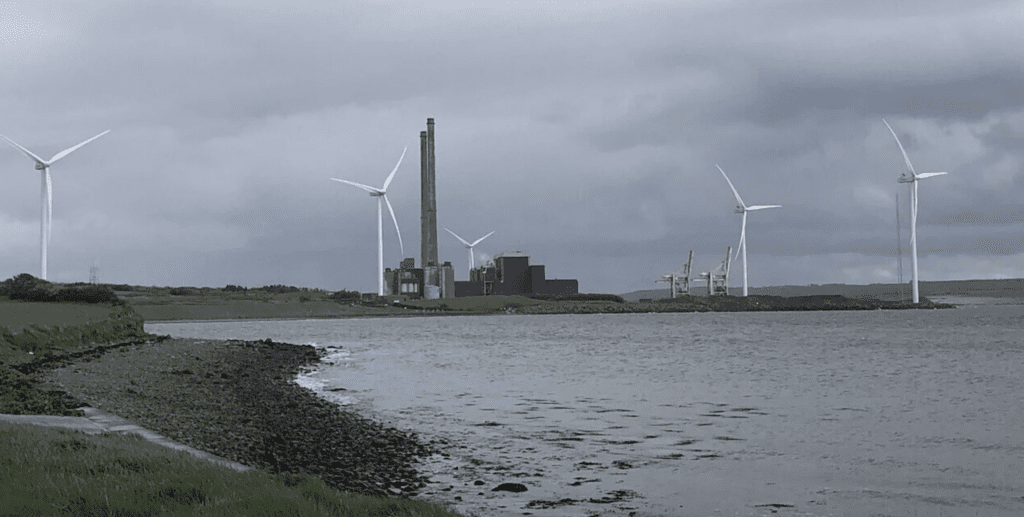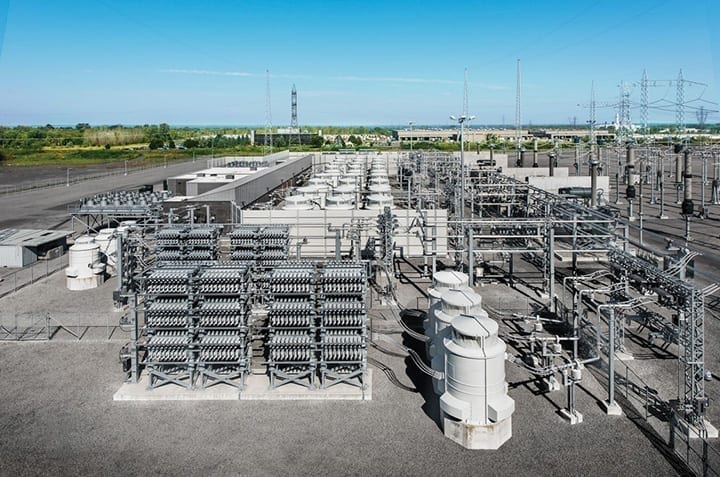
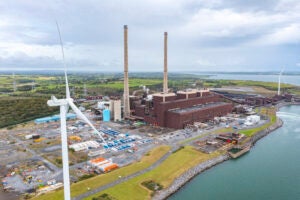
The integration of intermittent renewable energy to power grids worldwide has meant there’s a need for technologies designed to support grid stability. Siemens Energy, working with Electricity Supply Board (ESB), Ireland’s leading energy company, developed a stabilizing system using a synchronous condenser at the former coal-fired Moneypoint power station in southwest Ireland near Kilrush, County Clare.
As part of the project, ESB announced the launch of Green Atlantic @ Moneypoint, an ambitious plan to transform the County Clare site into a green energy hub, where a range of renewable technologies will be deployed over the next decade to support the regional power supply. The synchronous condenser, a key component of the Green Atlantic project, is the first in Ireland, and it incorporates what the companies call the world’s largest flywheel (Figure 1) used for grid stability. Moneypoint now enables an increased integration of wind power into the Irish power grid by providing sufficient inertia (4,000 MW) for frequency support, short-circuit power for system strength, and reactive power (245 Mvar) for voltage control.
The coal-fired Moneypoint Generating Station was commissioned by ESB in the 1980s. Its total generating capacity of about 900 MW across three generating units made it Ireland’s largest power station. ESB noted how for more than four decades, the station played a vital role in supporting Ireland’s electricity system and economic development.
Coal-fired generation at Moneypoint ended in 2025. It marked the end of an important chapter in the site’s history, and was a significant milestone in Ireland’s energy transition, reflecting both ESB’s net-zero ambitions and the wider transformation taking place across the energy sector. The facility’s transition led to its selection as a finalist for POWER’s Reinvention Award.
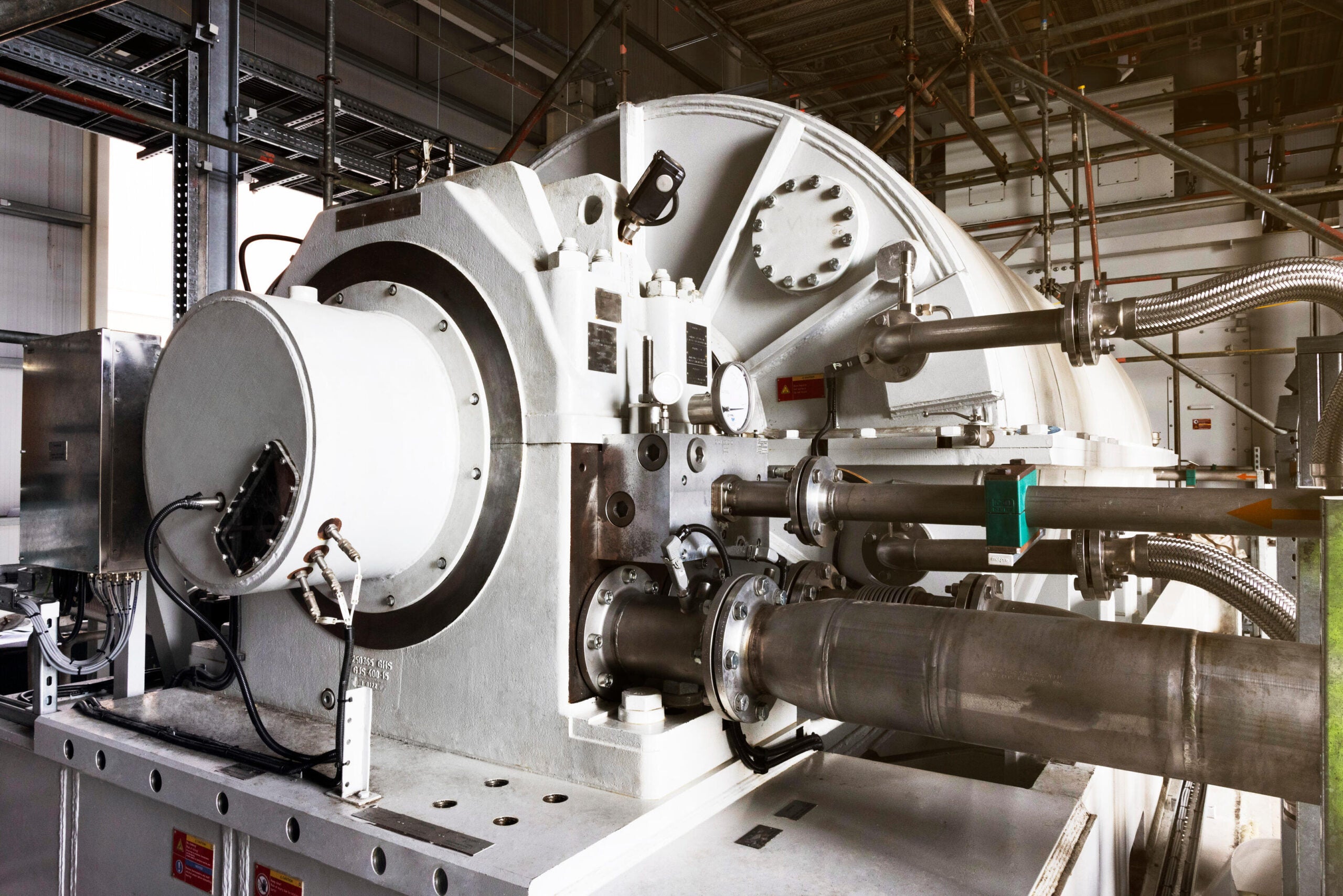
the Irish grid. Source: Siemens Energy / Jonathan Browning
Moneypoint continues to support the electricity system; Unit 1 at the site can burn heavy oil to produce power when needed. Through Green Atlantic @ Moneypoint, the site is entering a new phase of development—transforming from a traditional fossil-fuel generation site into a major green energy hub supporting renewable integration, energy storage, low- and zero-carbon generation and Ireland’s long-term energy security.
Ralph Morgenstern, a grid stabilization expert with Siemens Energy, talked with POWER about the importance of the Moneypoint project. “Previously, power generation was mainly done with fossil power plants, using large synchronous generators, which continuously spin and have a weight of tens of tons,” said Morgenstern. “As the integration of renewable energy is rapidly increasing, reduction of CO2 emissions is possible by shutting down fossil fuel power plants. Consequently, the large spinning mass from the synchronous generators is missing. Synchronous condensers can provide the missing rotating mass, and to increase the inertia, a fixed coupled flywheel can be added.”
Nick O’Mahony, managing director of Siemens Energy Ireland, in a statement provided to POWER said, “The synchronous condenser and the flywheel in Moneypoint are providing 4,000 megawatt-seconds of inertia to the grid, which helps a lot to stabilise the voltage and the frequency in the entire region. The flywheel weighs over 130 tons and the rotor almost 70 tons. If this is spinning at 3,000 rpm it is acting as a stabilizer and is the enabler for more wind power and further CO2 emission reduction in the future.”
ESB, the owner of Moneypoint, noted the overall strategy for Green Atlantic @ Moneypoint, which is the plan to transform the site into a green energy hub. The group wrote: “Green Atlantic @ Moneypoint is ESB’s transformational programme, which is reimagining the Moneypoint site as a leading green energy hub at the heart of Ireland’s clean energy transition. Building on decades of service to Ireland’s electricity system, the programme sets out a long-term vision for the redevelopment of this strategically important site to support renewable energy, energy security and the transition to a net-zero energy system.
“The programme brings together a range of complementary projects designed to support the evolving needs of Ireland’s electricity system,” wrote ESB. “These include offshore wind-enabling infrastructure through the proposed Moneypoint Hub project, which would create a large-scale port and marine facility to support the construction, assembly, deployment and maintenance of offshore wind projects. The programme also includes long-duration energy storage, low- and zero-carbon dispatchable generation, sustainable redevelopment of existing infrastructure and the exploration of future hydrogen-derived fuels. Together, these projects will help create a flexible and resilient energy hub capable of supporting Ireland’s energy needs for decades to come.
ESB continued: “The Moneypoint Synchronous Compensator project, delivered in partnership with Siemens Energy, was an important early milestone in this transformation and demonstrates how existing infrastructure can be repurposed to enable greater integration of renewable energy onto the Irish electricity system.”
ESB wrote that the Green Atlantic project “has been conceived with Ireland’s long-term renewable energy future in mind and recognizes the significant offshore wind opportunity along Ireland’s Atlantic coast. Moneypoint’s location on Ireland’s Atlantic coast, combined with its deep-water access, extensive industrial footprint and existing transmission infrastructure, positions it uniquely to support the next phase of Ireland’s renewable energy transition.”
—Darrell Proctor is a senior editor for POWER.